 When Ainsley Channon finds that his son is not unexpectedly making a hash of running the Paris branch of his piano manufacturing and sales company, he sends his protégé, young Scottish piano-tuner Brodie Moncur to use his initiative to improve business. In the process, Brodie becomes infatuated with Lika, a beautiful Russian aspiring opera singer. Their relationship has to be conducted in secret, since she is the mistress of the once celebrated but now physically declining and alcoholic pianist John Kilbarron. From the outset it seems doomed to fail, owing not only to Kilbarron’s jealous and unstable character but also the menacing presence of his “minder” brother Malachi, who may have designs on, even some hold over Lika as well.
It was never quite clear to me why Brodie loves Lika so much, in what seems like a purely physical relationship. She seems dull and devious, dragging Brodie down the same path, changing him from a purposeful, outgoing individual into a passive, moping drifter with his life on hold – but of course, as the title states, “Love is Blind”. Admittedly, Brodie has occasional insights, such as the fact that being in love does not guarantee happiness, while we can never truly know another person, even when there is supposedly mutual love.
I was disappointed by some aspects of the early chapters. The book opens with a detailed description of how to tune a piano, which made little sense to me in the absence of a labelled diagram or two, clearly out of place in a novel. It read like a piece of research conducted to give the story authenticity, but dumped rather clunkily into the text. Then there are the potentially interesting situations which do not lead anywhere, such as Brodie’s visit to the family home, where his widowed father “Malky” dominates eight of his children into adulthood, reserving particular venom for Brodie, the only one to have escaped so far. A charismatic preacher in public, Malcolm Moncur degenerates somewhat implausibly into a gross, drunken bully behind the scenes. Like too many of the characters, he comes across as a caricature. It is never clear why he detests Brodie so much. Is there any significance in the fact that he is so dark compared to his siblings?
The pace is slow as if an essentially thin plot is being padded out, until the novel reaches a dramatic climax at the end of Part 3, two-thirds of the way through. After this, the tension is more sustained, and some past threads are pulled together more, to reach a passably satisfactory ending.
With its varied locations, from Scotland to Russia and the remote Andaman Islands, and the extensive cast of characters, this is an original if rambling take on a well-worn romantic theme but it did not really move or engage me, although many critics and general readers have clearly found it entertaining and engrossing.
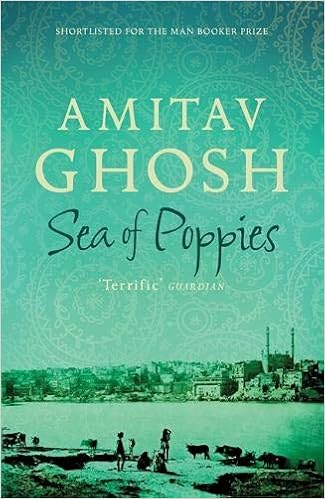 The first book in the “Ibis” trilogy, named after the sailing ship which is the setting for some of the action, “Sea of Poppies” focuses on the C19 opium trade operated by the ruthless East India Company. It begins in rural India, where Deeti struggles to make a living from the poppy harvest which has replaced the crops which at least guaranteed a level of self-suffciency. She is resigned to marriage with a man who has become addicted to opium to ease the pain of his wounds, gained in fighting for the British colonialists. The fact he is employed in an opium factory does not help.
 As Chinese American Billi wanders the New York streets chatting by phone to her Nai Nai or grandmother, still living on the other side of the world, she casually supplies the white lies to keep the old lady happy. Yes, she is wearing a hat to keep warm but no earrings which might be grabbed by thieves, tearing her lobes. Meanwhile, Nai Nai tells a lie in turn, pretending to be at her sister’s house when she is actually in hospital for tests.
![Pain and Glory DVD [2019]](https://images-na.ssl-images-amazon.com/images/I/81IE5w1kb1L._AC_SY445_.jpg) Superbly acted by Antonio Banderas, Salvador Mallo is a celebrated sixty-something film director whose sense that his career has come to an end is aggravated by poor health, particularly an aching back and tendency to choke. Desperate for pain relief, he is prompted to begin a drastic course of action which may prove self-destructive during his reunion with the charismatic but heroin-addicted former star of the film which fed his fame thirty years previously. At the same time, the meeting sets in motion a chain of events which may set him back on the path of creativity.
Superbly acted by Antonio Banderas, Salvador Mallo is a celebrated sixty-something film director whose sense that his career has come to an end is aggravated by poor health, particularly an aching back and tendency to choke. Desperate for pain relief, he is prompted to begin a drastic course of action which may prove self-destructive during his reunion with the charismatic but heroin-addicted former star of the film which fed his fame thirty years previously. At the same time, the meeting sets in motion a chain of events which may set him back on the path of creativity.![BAIT [Dual Format] [Blu-ray]](https://images-na.ssl-images-amazon.com/images/I/51uJRnbTDeL._AC_SY445_.jpg) This is the tale of a fateful chain of events in a coastal Cornish community where there are tensions between locals no longer able to make a decent living from the traditional activity of fishing, and wealthy outsiders who can afford to buy picturesque cottages as second homes, but contribute nothing to the local community on their summer visits apart from their spoilt, bored kids patronising the local pub. The focus is on Martin who persists in trying to work as a fisherman, despite his lack of a boat – his laborious stretching of nets along the beach and planting of a single lobster pot yield meagre results . He has fallen out with his pragmatic brother, who has decided to use his boat to provide trips for tourists, and is full of brooding resentment against the couple to whom he has been forced to sell the family home. It is not just a question of fish bait, but of people baiting each other.
This is the tale of a fateful chain of events in a coastal Cornish community where there are tensions between locals no longer able to make a decent living from the traditional activity of fishing, and wealthy outsiders who can afford to buy picturesque cottages as second homes, but contribute nothing to the local community on their summer visits apart from their spoilt, bored kids patronising the local pub. The focus is on Martin who persists in trying to work as a fisherman, despite his lack of a boat – his laborious stretching of nets along the beach and planting of a single lobster pot yield meagre results . He has fallen out with his pragmatic brother, who has decided to use his boat to provide trips for tourists, and is full of brooding resentment against the couple to whom he has been forced to sell the family home. It is not just a question of fish bait, but of people baiting each other. In the 1960s, Leonard Cohen joined the colony of aspiring writers on the exquisite Greek island of Hydra, with the lures of casual sex, cheap alcohol and easy access to drugs. He soon began to receive practical and emotional support from Marianne Ihlen, the beautiful young Norwegian who was for several years his lover and “muse”. Apart from not seeming in awe of him, she was a good listener with a gift for drawing out the talent in others. Abandoned by her husband and the mother of an appealing child, “Little Alex”, Marianne was open to ideas of “free love”, but as Leonard developed his megastar status as a singer/songwriter, she could not cope with hectic lifestyle involving long visits to the States, and having to share him with the hoards of fans who also wanted a piece of him.
![The Body Lies by [Baker, Jo]](https://images-eu.ssl-images-amazon.com/images/I/41149oLTzwL.jpg) In this slow-building psychological thriller, a young creative writing lecturer discovers to her cost that she has become the obsessive focus of her most talented student Nicholas Palmer’s work, with the risk that he may move from “merely” recording his close observation of her, intrusive as that is, to actively manipulating her to fit his story, in his belief that, to be authentic, writing must be based on real experience.
In this slow-building psychological thriller, a young creative writing lecturer discovers to her cost that she has become the obsessive focus of her most talented student Nicholas Palmer’s work, with the risk that he may move from “merely” recording his close observation of her, intrusive as that is, to actively manipulating her to fit his story, in his belief that, to be authentic, writing must be based on real experience.![Galileo: Watcher of the Skies by [Wootton, David]](https://images-eu.ssl-images-amazon.com/images/I/41tr5pv0zmL.jpg) My fascination with Galileo, the brilliant thinker who was eventually gagged by a bigoted Inquisition, was fed by Michael White’s absorbing biography, “Galileo Antichrist”. Although very strong on childhood influences, personality, dealings with friends and family, his inventions and the tortuous path by which he fell foul of the priests pulling the strings behind an insecure and neurotic Pope, the biography seemed a little thin on the all-important scientific theories to do with motion and astronomy, and to have gone too far into trying to make ideas accessible by “dumbing down” the details.
My fascination with Galileo, the brilliant thinker who was eventually gagged by a bigoted Inquisition, was fed by Michael White’s absorbing biography, “Galileo Antichrist”. Although very strong on childhood influences, personality, dealings with friends and family, his inventions and the tortuous path by which he fell foul of the priests pulling the strings behind an insecure and neurotic Pope, the biography seemed a little thin on the all-important scientific theories to do with motion and astronomy, and to have gone too far into trying to make ideas accessible by “dumbing down” the details.
 Antenna Reviews