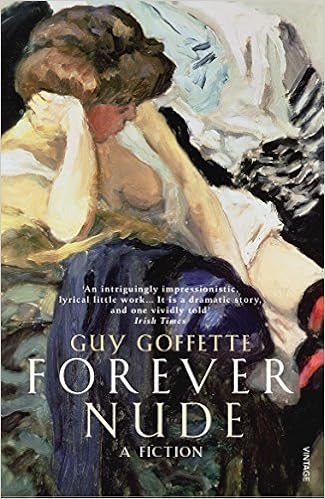
 I read this in French, but presumably my comments still apply, although it is hard to imagine how the distinctive French “stream of consciousness” style could have been translated without something being lost.
With a quirky title perhaps including a pun on “bonheur” and “Bonnard”, these linked short stories form a poetical, fragmented fictionalised biography of the post-Impressionist painter who made a lifelong companion of Marthe, the young woman who captivated him in a chance encounter on a Pairs street, and provided the model for hundreds of paintings and sketches of her, often in the bath, dressing or relaxing on the bed, but “toujours nue” (“Forever Nude” in the English translation).
We learn that Marthe was really Marie, a poor farmer’s daughter who adopted a false name including an aristocratic “de” when she escaped to Paris to make her fortune. Bonnard did not discover this until he came to marry her more than thirty years later. He had his own share of secrets, in particular his liaison with a vivacious young blonde, Renée Monchaty, a marked contrast to the apparently more passive Marthe, increasingly shrewish and sickly as she aged. Renée’s suicide, perhaps sparked by his marriage, shocked Bonnard to the core. All this could have been worked into a dramatic novel, together with Bonnard’s legal problems after Marthe’s death, which led eventually to a change in the law guaranteeing an artist’s rights of full ownership to his or her entire body of work. However, Goffette is much more interested in writing about Bonnard’s art as a form of visual poetry, using colour in place of words, and in portraying the artist as a man who shunned “la gloire imbécile”, wishing only to paint what he pleased, when and how he wanted.
At first, I found the style overblown as in the opening chapter, where Goffette describes entering a gallery hot and flustered, only to be refreshed by encountering a painting of the toujours nue Marthe spraying herself with eau de Cologne. Written from a male viewpoint, the lengthy sensual, even erotic description of Marthe made me uneasy. It seemed voyeuristic and sexist, akin to a man assuming the right to impose himself on a pretty stranger who has caught his eye in the street.
However, gradually, the writer won me over, mainly in helping me to view Bonnard’s paintings with new eyes. This was only possible since I had access to a computer and was able to find images of most of the paintings he describes. It would actually be a better book with photographs of these works included.
Goffette showed me how the use of a black blind, cutting off my view “comme une guillotine”, made it fall “brutalement” to a sleeping Marthe and cat: in fact, it drew my attention to the view outside the window, another theme Bonnard loved to explore. I was also struck by the vivid colours in his last painting, an almond tree in blossom. On his death bed, with his nephew’s help, he still felt the urge to change a patch of ground from green to bright yellow.
Although the flowery style is not to my taste, there are a number of telling insights, and I have also discovered a large number of paintings by Bonnard which I like, and am now able to appreciate why he was and is so highly regarded as a painter, if not by Picasso.
 If you have not read Tomes 1 and 2 of “Les Sauvages”, the following review contains spoilers. Also, Tomes 3 and 4 will make little sense if you have not yet read the first half of the series. This review refers to both Tomes 3 and 4, which I bought combined in one volume.
 “I do not feel obliged to believe that the same God who has endowed us with sense, reason, and intellect has intended us to forgo their use.”
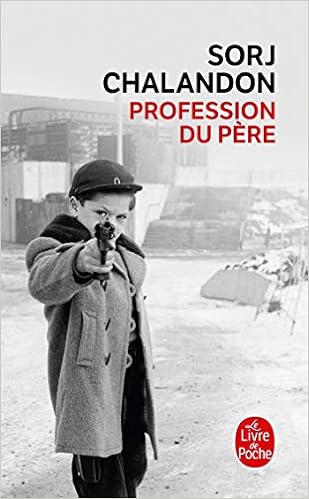 At the funeral of André Choulans there are only two mourners: his long-suffering wife and son Émile, an artist who sketches the crematorium with an odd lack of emotion as they await the coffin. Narrator Émile then proceeds gradually to account for this tragic situation, going back to his childhood, the France of De Gaulle and the stirrings of rebellion in Algeria in 1961. As an impressionable youngster, Émile craved his father’s approval, believing his web of lies and fantasies, but fearing the violence which he might at any moment unleash on his child and wife. Émile suffers the embarrassment each year of being asked to write his father’s profession on a school form. How can he say that he is a secret agent? This is the latest in a string of professions he is too young to question: pastor, pilot, parachutist, judo expert and singer to name a few.
 This book made me reflect for the first time how in the early C20 when long-established stable empires were beginning to crumble, “Each country, old or new, was free to treat those who lived within its borders as it wished. International law offered few constraints on the majority’s treatment of minorities, and no rights for individuals”. The European Convention on Human Rights was not signed until 1950.
 Harriet Tyce draws on her experience of working as a barrister in this gripping but unsavoury debut psychological crime thriller.
 To get the most impact from this book, I would advise readers to leave the potentially slightly distracting “Foreword” to the end. Advertised as a sequel to “The Disappearance of Adèle Bédeau”, also featuring Inspector Georges Gorski, this can be read as a stand-alone novel. Reading the two books “in order” may help to clarify Gorski’s personal situation, but I think “The Accident on the A35” has a better pace and more interesting characters and wry humour.
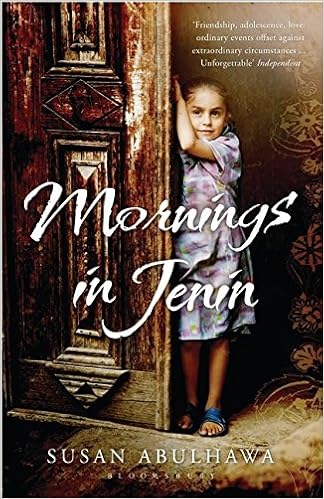 The opening chapters give a somewhat romanticised view of life in the ancient village of Ein Hod, said to be granted to Palestinian ancestors by Saladin, with flute playing in the olive groves after a day’s harvesting, yet perhaps this serves to heighten the brutal shock of “El Nakba”, the catastrophic expulsion of the Arabs from the land they had occupied for centuries, by soldiers in support of Israeli settlers.
 At first, I was put off by the twee sentimentality and the continual interjections of the coy narrator, who suggested that he might be one of the inhabitants of “la rue triste”. Yet although this short novel is not a page turner, it sucks the reader into the evocative atmosphere of a 1940s Parisian street where life goes on despite the Occupation. The last novel of the prolific French author Robert Sabatier, written in his eighties, this seems to draw on his own memories of growing up in Paris, orphaned young, apprenticed to the printing trade, drawn to literature and poetry, largely self-taught and ending up a writer.
 Antenna Reviews