When her dividends dry up in the 1930a depression, Barbara Buncle sets about writing a book for publication to make ends meet, using the male pen-name of “John Smith” to cut more ice with the publisher. Since, to use her own words, she has “no imagination” this is inevitably about the doings of the inhabitants of her village of Silverstream, whom she has known for years. Mr. Abbott of Abbot and Spicer agrees to publish the book because the characters seem so real, and is also intrigued by the puzzle as to whether the author is writing subtly “tongue in cheek” or “a very simple person writing in all good faith” based on acute observation. The bestselling “Disturber of the Peace” provokes outrage among those who discover that they have been blatantly parodied in the clearly recognisable village which has been renamed “Copperfield”. They are determined to track down and punish “John Smith”, but even when some suggest that the author may be female, it does not occur to them that she might be the dowdy and insignificant Barbara Buncle. Under pressure from Mr. Abbot to write a second book, what will she reveal next, will she be exposed and, if so, with what outcome?
I was initially reluctant to read this for a book group, expecting it to be dated, trivial and at best provide a bit of escapism from the modern world. On one level, it is all these things, but is also an insight into a past way of life, and written with the same kind of clarity and humour as apparently employed by Miss Buncle, it carries the reader along.
Dorothy (D E) Stevenson wrote stories compulsively from her childhood onwards and became a prolific and successful novelist of mainly romantic fiction, since then fallen out of print for decades. It is interesting to speculate how she would have used her talent in different circumstances: if born a man like her father’s cousin Robert Louis Stevenson, she might have written adventure stories; if born now, she might have applied her fertile imagination to TV drama series. As it was, she followed the conventions of her time in which a widow living beyond her means could not think of finding a job but had to scheme to trap a wealthy husband; a vicar’s wife who found it extravagant to hire a taxi still had three servants and a nanny; men dominated their wives who had to resort to subtly manipulating them without appearing to; the two women who lived together were never explicitly referred to as lesbians, but the intelligent one who had never been allowed to get educated and develop her brain is shown playing the “male” role to support her weak and indecisive partner, and so on.
So, in writing about a world in which “the good ended happily and the bad unhappily – that is what fiction means”, Dorothy Stevenson is worth reading mainly for her humorous observation of human nature.


![Laetitia Rodd and the Case of the Wandering Scholar (A Laetitia Rodd Mystery Book 2) by [Saunders, Kate]](https://images-eu.ssl-images-amazon.com/images/I/41soCKapS9L.jpg)
 In a rundown Irish coast town, former County boxing champion, the aptly named Douglas Armstrong (played by actor Cosmo Jarvis, strongly reminiscent of a youthful Marlon Brando) has to deal with the stigma and probable guilt of having accidentally killed a man in the ring. Although he probably lacks the drive to make the effort to move away, he is kept in the locality by the presence of his ex-girlfriend Ursula and small son Jack, who is autistic. This is despite Ursula’s efforts to keep him at bay to protect Jack from the malign influence of the local drug dealers, the Devers, who employ Douglas as an enforcer to punish or keep in line anyone rash enough to cross them. Ironically, Jack is most disturbed by any hint of force or violence, so that the horses in the stable where Ursula works provide one of the few calm settings where father and son can connect with each other.
 Having exposed the injustice of the benefits system in “I, Daniel Blake”, Ken Loach has turned his forensic lens on the iniquities of the gig economy.
 Despite its dry title, this short, unusual novel is a riveting masterpiece.
![Official Secrets (DVD) [2019]](https://images-na.ssl-images-amazon.com/images/I/81eJzA2bxDL._AC_SX342_.jpg) I remember well the 2003 one million-plus people’s London march in the vain attempt to prevent the Iraq War, likewise President Bush’s refusal to wait for the completion of UN weapons inspector Hans Blick’s investigations in Iraq before launching an attack, together with the UK Parliament’s decision to support the US militarily on the basis of what proved to be the “dodgy dossier”, falsely confirming the Iraqi capacity to launch weapons of mass destruction on Britain in 45 minutes.
I remember well the 2003 one million-plus people’s London march in the vain attempt to prevent the Iraq War, likewise President Bush’s refusal to wait for the completion of UN weapons inspector Hans Blick’s investigations in Iraq before launching an attack, together with the UK Parliament’s decision to support the US militarily on the basis of what proved to be the “dodgy dossier”, falsely confirming the Iraqi capacity to launch weapons of mass destruction on Britain in 45 minutes. This is an autobiography which aims to avoid “sentiment”: “The point is not to speak of the personal”. Instead, referring to herself in the third person, or writing collectively as “we”, Annie Ernaux adopts a fragmented approach which tends to distance the reader from her.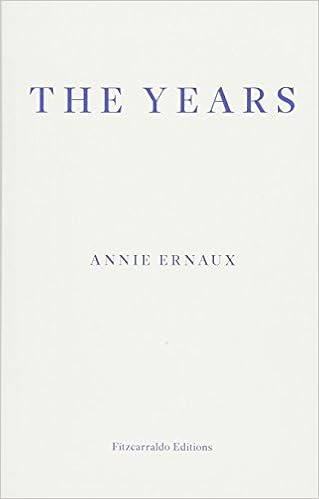
 Antenna Reviews