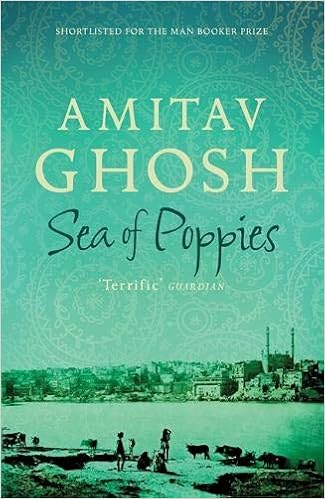
 The first book in the “Ibis” trilogy, named after the sailing ship which is the setting for some of the action, “Sea of Poppies” focuses on the C19 opium trade operated by the ruthless East India Company. It begins in rural India, where Deeti struggles to make a living from the poppy harvest which has replaced the crops which at least guaranteed a level of self-suffciency. She is resigned to marriage with a man who has become addicted to opium to ease the pain of his wounds, gained in fighting for the British colonialists. The fact he is employed in an opium factory does not help.
At the other end of the social scale is Neel, the unimaginably privileged native landowner, so complacent in his sense of entitlement that he has allowed himself to be trapped into debt by the hard-nosed employee of the East India Company, Mr Burnham. Aided by his eccentric Indian agent Baboo, Burnham is prepared to do whatever is necessary to gain full control of Neel’s lands.
Flitting between an at times confusing horde of characters, some larger than life and stereotyped, reminiscent of a Dickensian novel, the storylines gradually merge to bring the main players together on the Ibis, a converted former slave ship, which is scheduled to transport a group of criminals and unlucky migrants rejected by their families to provide cheap labour for the East India Company.
One of the most likeable and straightforward characters is Zackary Reid, the American carpenter-turned-sailor who, being the son of a slave girl and the master who freed them both, has a natural sympathy for some of the disadvantaged Indians he encounters. Another is Paulette, the spirited and frankly quite devious daughter of a deceased European botanist.
There is a good deal of humour, often somewhat heavy-handed, along with considerable violence and degradation. Despite the frequently implausible, exaggerated to the point of ludicrous events, with people on the brink of death miraculously saved, the novel provides vivid descriptions and creates a strong awareness of the nature and implications of the opium trade, and the attitudes and values of the various parties concerned. For instance, with the risk of an imminent war between Britain and China, Burnham, despite claiming to be a devout Christian, has no understanding of why Chinese rulers might wish to end an exploitative trade which is wreaking havoc on their population, and is over-confident that the conflict will be short-lived.
His Indian roots may make it easier for the author to identify with and portray a period perhaps understandably neglected by western writers. He has certainly undertaken an impressive amount of research on every aspect of the story, including opium manufacture and the operation of sailing ships. A downside of all this is that the presumably authentic language used by, for instance the Lascar and British sailors or even Burnham’s wife is so peppered with native language, jargon or slang as to be virtually incomprehensible at times. I found this very distracting, and would have liked a glossary, together with a map and list of characters for quick reference.
I do not mind the abrupt ending of the story, clearly akin to a cliff-hanger to encourage us to read on, although the novel could be regarded as free-standing, leaving one to imagine “what happens next”. However, for the time being, I do not feel sufficiently engaged to read the rest of the trilogy, I think mainly because I find some of the drama needlessly overdone.
 As Chinese American Billi wanders the New York streets chatting by phone to her Nai Nai or grandmother, still living on the other side of the world, she casually supplies the white lies to keep the old lady happy. Yes, she is wearing a hat to keep warm but no earrings which might be grabbed by thieves, tearing her lobes. Meanwhile, Nai Nai tells a lie in turn, pretending to be at her sister’s house when she is actually in hospital for tests.
![Pain and Glory DVD [2019]](https://images-na.ssl-images-amazon.com/images/I/81IE5w1kb1L._AC_SY445_.jpg) Superbly acted by Antonio Banderas, Salvador Mallo is a celebrated sixty-something film director whose sense that his career has come to an end is aggravated by poor health, particularly an aching back and tendency to choke. Desperate for pain relief, he is prompted to begin a drastic course of action which may prove self-destructive during his reunion with the charismatic but heroin-addicted former star of the film which fed his fame thirty years previously. At the same time, the meeting sets in motion a chain of events which may set him back on the path of creativity.
Superbly acted by Antonio Banderas, Salvador Mallo is a celebrated sixty-something film director whose sense that his career has come to an end is aggravated by poor health, particularly an aching back and tendency to choke. Desperate for pain relief, he is prompted to begin a drastic course of action which may prove self-destructive during his reunion with the charismatic but heroin-addicted former star of the film which fed his fame thirty years previously. At the same time, the meeting sets in motion a chain of events which may set him back on the path of creativity.![BAIT [Dual Format] [Blu-ray]](https://images-na.ssl-images-amazon.com/images/I/51uJRnbTDeL._AC_SY445_.jpg) This is the tale of a fateful chain of events in a coastal Cornish community where there are tensions between locals no longer able to make a decent living from the traditional activity of fishing, and wealthy outsiders who can afford to buy picturesque cottages as second homes, but contribute nothing to the local community on their summer visits apart from their spoilt, bored kids patronising the local pub. The focus is on Martin who persists in trying to work as a fisherman, despite his lack of a boat – his laborious stretching of nets along the beach and planting of a single lobster pot yield meagre results . He has fallen out with his pragmatic brother, who has decided to use his boat to provide trips for tourists, and is full of brooding resentment against the couple to whom he has been forced to sell the family home. It is not just a question of fish bait, but of people baiting each other.
This is the tale of a fateful chain of events in a coastal Cornish community where there are tensions between locals no longer able to make a decent living from the traditional activity of fishing, and wealthy outsiders who can afford to buy picturesque cottages as second homes, but contribute nothing to the local community on their summer visits apart from their spoilt, bored kids patronising the local pub. The focus is on Martin who persists in trying to work as a fisherman, despite his lack of a boat – his laborious stretching of nets along the beach and planting of a single lobster pot yield meagre results . He has fallen out with his pragmatic brother, who has decided to use his boat to provide trips for tourists, and is full of brooding resentment against the couple to whom he has been forced to sell the family home. It is not just a question of fish bait, but of people baiting each other.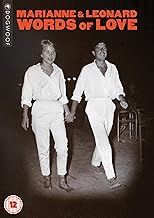 In the 1960s, Leonard Cohen joined the colony of aspiring writers on the exquisite Greek island of Hydra, with the lures of casual sex, cheap alcohol and easy access to drugs. He soon began to receive practical and emotional support from Marianne Ihlen, the beautiful young Norwegian who was for several years his lover and “muse”. Apart from not seeming in awe of him, she was a good listener with a gift for drawing out the talent in others. Abandoned by her husband and the mother of an appealing child, “Little Alex”, Marianne was open to ideas of “free love”, but as Leonard developed his megastar status as a singer/songwriter, she could not cope with hectic lifestyle involving long visits to the States, and having to share him with the hoards of fans who also wanted a piece of him.
![The Body Lies by [Baker, Jo]](https://images-eu.ssl-images-amazon.com/images/I/41149oLTzwL.jpg) In this slow-building psychological thriller, a young creative writing lecturer discovers to her cost that she has become the obsessive focus of her most talented student Nicholas Palmer’s work, with the risk that he may move from “merely” recording his close observation of her, intrusive as that is, to actively manipulating her to fit his story, in his belief that, to be authentic, writing must be based on real experience.
In this slow-building psychological thriller, a young creative writing lecturer discovers to her cost that she has become the obsessive focus of her most talented student Nicholas Palmer’s work, with the risk that he may move from “merely” recording his close observation of her, intrusive as that is, to actively manipulating her to fit his story, in his belief that, to be authentic, writing must be based on real experience.![Galileo: Watcher of the Skies by [Wootton, David]](https://images-eu.ssl-images-amazon.com/images/I/41tr5pv0zmL.jpg) My fascination with Galileo, the brilliant thinker who was eventually gagged by a bigoted Inquisition, was fed by Michael White’s absorbing biography, “Galileo Antichrist”. Although very strong on childhood influences, personality, dealings with friends and family, his inventions and the tortuous path by which he fell foul of the priests pulling the strings behind an insecure and neurotic Pope, the biography seemed a little thin on the all-important scientific theories to do with motion and astronomy, and to have gone too far into trying to make ideas accessible by “dumbing down” the details.
My fascination with Galileo, the brilliant thinker who was eventually gagged by a bigoted Inquisition, was fed by Michael White’s absorbing biography, “Galileo Antichrist”. Although very strong on childhood influences, personality, dealings with friends and family, his inventions and the tortuous path by which he fell foul of the priests pulling the strings behind an insecure and neurotic Pope, the biography seemed a little thin on the all-important scientific theories to do with motion and astronomy, and to have gone too far into trying to make ideas accessible by “dumbing down” the details.
 I read this in French, but presumably my comments still apply, although it is hard to imagine how the distinctive French “stream of consciousness” style could have been translated without something being lost.
 Antenna Reviews