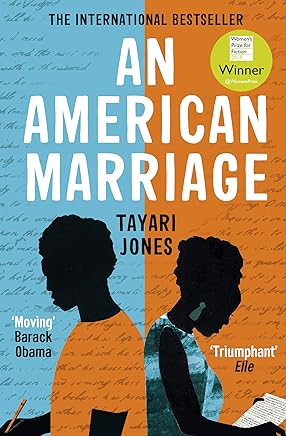
“An American Marriage” by Tayari Jones – perceptive and poignant

An American Marriage: WINNER OF THE WOMEN'S PRIZE FOR FICTION, 2019


Review of “An American Marriage by Tayari Jones.

A bright working-class boy from a small town in Louisiana, Roy has managed to escape the usual snares for black teenage youths: drugs and jail sentences. Pragmatic about accepting “leg-up programs” he is a graduate set on a promising career as a salesman and entrepreneur. Clever and beautiful, but also indulged, perhaps a bit neurotic and self-centred, Celestial comes from a more middle class background. Although the son of a sharecropper, her chemist father has managed to make himself a millionaire through the invention of a popular soft drink. Despite being unusually close since childhood to doggedly devoted “boy next door” André, Celestial is strongly attracted to his college friend Roy. Clearly in love, the two may have got married “too young”, particularly in the case of Celestial who is much less keen than him to “start a family”, being mainly driven to make her mark as an artist. A foolish tiff sets in train a series of fateful events ending in Roy receiving a long prison sentence for a crime that Celestial knows he did not commit. How will this disaster affect their marriage?

I was disappointed by and critical of the author’s glossing over the dramatic potential of the period between the arrest and the sentencing, but concluded that it was her intention to focus on the relationships between the “triangle” of Roy, Celestial and André, and the parents’ reactions in the aftermath of the tragedy.

The story is told from three different viewpoints: Roy, Celeste and to a lesser extent André, which often portray the same situation from opposing angles. Whilst agreeing with readers who found the style of the letters exchanged when Roy is in jail somewhat unrealistic and too contrived, overall the novel is very readable and compelling.

Roy aroused the most sympathy in me: a basically decent man who suffers unjust blows from various quarters. He may be an unreliable witness in playing down the philandering during his short marriage, but he has essential integrity and an endearing sense of dry humour which expresses itself even in his darkest periods. Although I was untroubled, as other reviewers have been, by not much liking Celestial and André, towards the end I found myself not caring enough about the outcome of their drama: whatever happened, Roy had the resilience to survive, André was accustomed to disappointment, and Celestial seemed emotionally immature and too self-absorbed to worry for long about hurting someone else. Although somewhat ludicrous, the dramatic climax of this book is very effective in dissecting people’s behaviour and emotions under pressure. I was satisfied that the author reached a conclusion which I had broadly predicted, suggesting that I had understood what she wanted to convey, although others may interpret it differently.

Tayari Jones clearly wishes to explore the theme of racial inequality in America, but this is also a very perceptive, moving and often wryly funny study of marital relationships, and a commentary on American society from a black perspective, which is enlightening for a white British reader. I could not understand all the American idioms and cultural references, but this did not matter unduly.

I cannot decide to what extent this winner of the “Women’s Prize for Fiction” will appeal to male readers. For me, it is occasionally overly sentimental, but this is countered by unflinching descriptions of raw, bleaker events when needed.

Highly recommended overall.
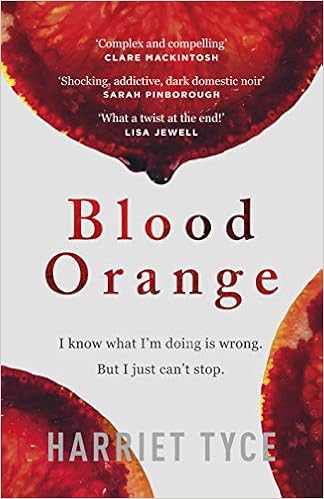
“Blood Orange” by Harriet Tyce: the consequences of actions

Harriet Tyce draws on her experience of working as a barrister in this gripping but unsavoury debut psychological crime thriller.
Remotivated by the chance to lead her first murder case, Alison intends to have only one drink with work colleagues before returning home to Carl, convenient house-husband and part-time therapist since being made redundant, and six-year old daughter Matilda. It soon becomes clear that, not for the first time, Alison will get horribly drunk and have rough sex with handsome but unpredictable and manipulative lawyer Patrick with whom she has drifted into an adulterous “secret” affair. At first, it is hard to believe how such a dysfunctional, often cringe-making and weak-willed individual in her personal life could possibly be an effective and respective barrister. How has kept his patience with her for so long?

However, as the tale progresses, one begins to develop another perspective. Apart from the fact Alison is paying the bills, Carl often seems something of a control freak, unduly quick to criticise her efforts to be a good mother, even in front of Matilda, or denigrate her efforts at cooking – can it really be as bad as he implies? He seems over-protective of his daughter, keen to monopolise her affections. Is he really trying to undermine Alison’s relationship with her child, even demoralise her to the point of doubting her sanity?

The novel also touches on deeper themes concerning the problems for women seeking to succeed “in a man’s world”, or to hold down a complex job with irregular hours without neglecting their children. Has Alison become a “high-functioning” alcoholic, apparently on the brink of total collapse, because of the training which meant spending time in the pub after work getting on good terms with the senior colleague who could put vital work her way? If she were a drunken, adulterous man, would she “get away” with it more easily?

Reminiscent of “Appletree Yard”, I imagine this being made into a television mini-series. Yet although I understand the critical acclaim and popularity gained with the public, it would have been a better book for me if it had been more subtle, rather than laying on the drama with a trowel in ludicrously exaggerated dollops. When Alison picks her daughter up from school very late, an officious teacher, “a solid barrier of dun-coloured knitwear”, blocks her exit, demanding an instant fine of £20 cash which will increase to £30 if not paid until the next day. Tell me if I am wrong, but I cannot imagine any modern-day school imposing such a penalty. Also, is it likely that Alison would interview her client suspected of murder, not in her office but at a busy restaurant, where the waiter almost pours red wine over her confidential paperwork and the medium steak ordered proves so bloody that it seems the one thing that is apt, if ghoulishly?

Creative writing classes seem to plug the use of a dramatically violent or sinister prologue as a “hook”, but apart from making modern novels seem “formulaic”, in this case it amounts to a spoiler for readers with memories of a past scandal and would have been more effective if presented as one of the twists in the somewhat contrived conclusion. To be more than a smutty romp in the wake of “Fifty Shades of Grey”, this novel needed to have less emphasis on, I quote, “booze”, “shit”, “vomit” and sex, and more character development. It amounts to a simplistic theme in which essentially well-intentioned women rise above their flaws to win out over dominant but irredeemably vile men who deserve to pay with their lives. But what made them so bad, and are there no extenuating factors, as in real life? Also, it may well be that some barristers are drunken and unethical in real life, but this book seems to condone some very ambiguous moral values, quite casually suggesting that “wrong actions” are readily acceptable if taken for the “right” reasons.

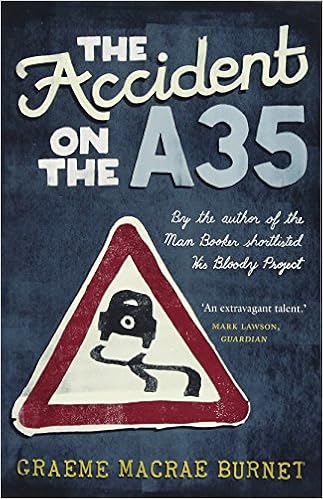
“The Accident on the A35” by Graeme Macrae Burnet: “in world that is neither true nor false, what is real?”

To get the most impact from this book, I would advise readers to leave the potentially slightly distracting “Foreword” to the end. Advertised as a sequel to “The Disappearance of Adèle Bédeau”, also featuring Inspector Georges Gorski, this can be read as a stand-alone novel. Reading the two books “in order” may help to clarify Gorski’s personal situation, but I think “The Accident on the A35” has a better pace and more interesting characters and wry humour.
When local lawyer Bertrand Barthelme, an influential figure in the provincial French backwater of St. Louis in Alsace, is killed in a road accident one Tuesday night, foul play is not suspected. Unable to resist pleasing Bertrand’s pretty and surprisingly young widow Lucette, Gorski goes beyond standard procedure in an attempt to check on Bertrand’s final movements, discovering in the process that he has been lying to his wife for years for some unknown reason. Meanwhile, Bertrand’s seventeen-year-old son Raymond embarks on his own sleuthing exercise, intrigued by the discovery in his father’s desk of a scrap of paper bearing an address for the nearby centre of Mulhouse, in what looks like a woman’s flamboyant handwriting, quite out of keeping with his father’s stern image.

The detective story proves incidental to the essence of the book, which is the in-depth psychological study of the two main characters, Georges and Raymond, together with convincing little portraits of the supporting cast, bringing them alive as authentic characters with recognisable foibles. Added to this is the strong sense of place: the claustrophobic, inward-looking conservatism of a small town where mediocrity is expected and dullness is the comfortable norm. Yet this being set in , I think, the early 1970s, there is a flicker of dangerous revolt in the reference to Sartre, whom Raymond is absorbed in reading: a novel is “neither true nor false” but is must seem “real”.

Reminiscent of Simenon, the strong sense of being in France is heightened by the author’s skill in producing what purports to be a painstakingly precise translation of a French novel, clear, concise and vivid in style but also constrained, rather like the main characters themselves. Although very different in theme from the author’s prize-winning “His Bloody Project”, both the “Gorski” books continue the common factor of a sensitive, troubled adolescent boy denied affection and empathy by a harsh or uncommunicative male figure. Raymond cuts (sometimes literally) an often amusing but poignant figure, secretive and observant, easily embarrassed, desperately worried about what people think of him, unable to prevent himself from antagonising those whom he likes or loves, with occasional bursts of short-lived euphoria when, no longer controlled by his father, he manages to kick over the traces with some “real”, however bizarre, action in a dull “unreal” world.

Gorski seems similarly emotionally stunted, the son of a deceased pawnbroker who “plays the part” of a detective, potentially very successful with his perceptive, persistent approach, but oddly passive in his personal life, and like Raymond, finding it hard to engage with others, estranged from his wife, and frequently the butt of mockery, dismissed as a plodder.

I found this book a page turner, ramping up a high degree of tension towards what seemed likely to be a fateful but unpredictable end. Both very abrupt, and leaving a great deal to my imagination, the ending disappointed me initially, despite some ingenious twists. On reflection, I decided it is actually quite subtle and effective.

I was also irritated at first by the repeat of the quirky device used in “The Disappearance of Adèle Bédeau”, namely the claim that both books are the work of the author Raymond Brunet – not a spoiler since we are told this in the Prologue. There is speculation as to the extent to which “The Accident on the A35” is autobiographical, accounting for Brunet’s own trouble personality. Since the two novels would stand quite well without this extra twist, I am not sure it is beneficial, particularly since it serves to distance the reader somewhat from the drama.

Having said this, Graeme Macrae Burnet manages to engage us with the characters by the sheer quality of his writing, saved from bleakness by moments of humour, and the promise that there may be a third book in the trilogy – another manuscript also having come to light in 2014.

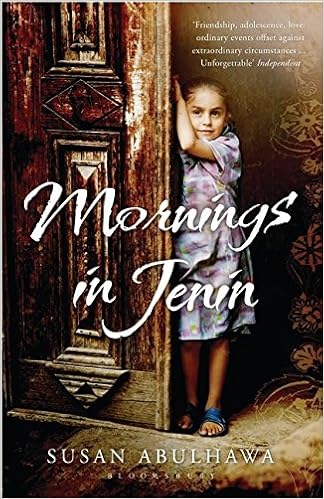
Mornings in Jenin by Susan Abulhawa – “Where should the birds fly after the last sky?”

The opening chapters give a somewhat romanticised view of life in the ancient village of Ein Hod, said to be granted to Palestinian ancestors by Saladin, with flute playing in the olive groves after a day’s harvesting, yet perhaps this serves to heighten the brutal shock of “El Nakba”, the catastrophic expulsion of the Arabs from the land they had occupied for centuries, by soldiers in support of Israeli settlers.
Based on both respected written sources and her own experience of the refugee camp in which she was born, and of taking the chance as a teenager to study in the US, ending up living with her daughter in Pennsylvania, author Susan Abulwhawa has written a searing tale of Amal, a spirited Palestinian girl whose family members suffer terribly in various ways as they are forced out of Ein Hod to a UN-financed adobe box in the camp at Jenin. An infant brother is kidnapped by an Israeli soldier to comfort his young wife who has been left infertile after ill-treatment at the hands of the Nazis – in such ways the author shows sympathy with the sufferings of the Jews and an understanding of how it has so tragically fed their own determination to create a state of their own, whatever the cost.

Amal’s mother, a once lively Bedouin girl, is traumatised by events, only able to deal with her emotions by internalising them, thus seeming cold and distant to her daughter, who in turn treats her own child in the same way, through a fear of loving what one is doomed to lose. Amal’s cultivated, innately gentle father is radicalised to take up arms in the attempt to regain his property and freedom. Her brother Youssef is consumed by the desire for revenge, and so on.

Although leavened with humour and the strong sense of community, the bleakness of real events, and the unrelenting destruction of innocent families, seem at times too much to take, but anger and outrage kept me reading, together with the sense that to give up implies a lack of respect for those suffering a grave injustice which is still ongoing.

Another aspect is the style of writing, about which I have mixed feelings. I appreciate that there has been an attempt to emulate the flowery, convoluted style of Arab writing, but for a British reader it can become exhausting in its overblown repetition. Since I assume English is the author’s second language, I am not sure to what extent the often unusual use of words is deliberate. Certainly, at times it creates a vivid, poetic quality to convey fear, violence, internal reflections on one’s state. I particularly liked the sensitive translations of Arab poetry. By contrast, the author’s style is frequently jarring, and in moments of intimacy may appear cloying and cringe-making.

The most authentic and engaging sections of the novel are those set in Palestine. In the safety and opportunity of the United States, Amal succeeds in her studies and work, but always seems like a transient observer, detached from her surroundings and characters who seem somewhat two-dimensional. There are some interesting if arguable insights, such as her sister-in-law’s belief that Americans do not love like Palestinians because “they live in the safe, shallow parts that rarely push human emotions into the depths where we dwell…the terror we have known is something few Westerners ever will. Israeli occupation exposes us very young to the extremes of own own emotions, until we cannot feel except in the extreme.” These sound like the author’s own personal reflections.

Bearing in mind that it seems even UN reports have counted some massacres of civilians as justifiable actions by Israel against militants, and in view of an apparent general lack of awareness of the details of the Palestine-Israeli problem, this unflinching and moving novel is an effective way of spreading the word about a major injustice.

To quote from Khalil Gibran’s “The Prophet”:

“Your children are not your children.
They are the sons and daughters of Life’s longing for itself….
You may give them your love, but not your thoughts,
For they have their own thoughts.
You may house their bodies but not their souls,
For their souls dwell in the house of tomorrow which you
cannot visit, not even in your dreams.
You may strive to be like them but seek not to make them like you.
For life goes not backward nor tarries with yesterday.”

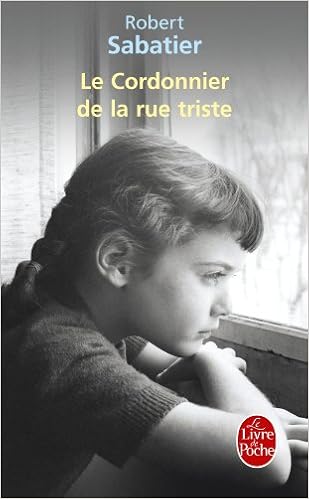
“Le cordonnier de la rue triste” by Robert Sabatier – looking on the bright side

At first, I was put off by the twee sentimentality and the continual interjections of the coy narrator, who suggested that he might be one of the inhabitants of “la rue triste”. Yet although this short novel is not a page turner, it sucks the reader into the evocative atmosphere of a 1940s Parisian street where life goes on despite the Occupation. The last novel of the prolific French author Robert Sabatier, written in his eighties, this seems to draw on his own memories of growing up in Paris, orphaned young, apprenticed to the printing trade, drawn to literature and poetry, largely self-taught and ending up a writer.
Perhaps there is something of himself in the central character Marc, an unusually handsome boy who becomes a skilful cobbler, but loses the use of his legs as a result of an accident when pursuing his passion for running. This tragic event is somehow lightened not only by Marc’s spirit, but also the help given by an assortment of local characters: Jack-of-all- trades Paulo, resembling a comic strip character but with a talent for inventions, not least a workable wheel chair for Marc; Madame Gustave, the kindly manageress of a local bistro who keeps Marc supplied with food, or Rosa la Rose, the tart with a heart.

Every now and again, events begin to take a dramatic turn, but tend to subside like small waves on a beach. What makes this book worth reading is the poetic style, with occasional insights, such as how attempts to reconstruct the past often lack something “impalpable”, like “un reflet dans un miroir déformant”, whereas the strongest witness comes from the first-hand experience of writers like “Erich Maria Remarque”, author of “All quiet on the Western Front”. More than sixty years later, with an old man’s perspective, Marc observes with irony the individuals walking along “la rue triste” like automatons, a mobile phone to one ear, as preoccupied as if their lives depended on the call”. The gift of a TV from a grateful customer introduces him to the ludicrous world of shows in which the audience laugh at the presenter’s inane comments, and applaud not only the rights answers to simple questions but even seem to applaud themselves, like so many “performing seals”.

The novel is like an adult fairy tale, just about saved from mawkishness by some sharp dialogues and ironic humour. It also reminds me of the highly regarded “Stoner”, in its ability to capture the thoughts of “ordinary” people, and what it means to be alive.

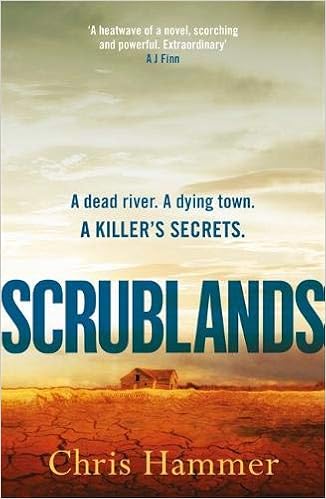
Scrublands by Chris Hammer: angel of death

In this debut novel, Chris Hammer makes good use of both his first-hand knowledge of journalistic procedures, and his travels through the Murray-Darling Basin of Eastern Australia to research the impact of the 2008-9 drought.

Like Jane Harper’s “The Dry”, with which it is often compared, although with a distinctly different plot, this is another novel on the crimes triggered by the unrelenting heat and hardship caused by lack of predictable rain in rural Australia.

Traumatised by an ordeal suffered in Gaza, with questions over his ability to hold down his post, once successful foreign correspondent Martin Scarsden is given the supposedly straightforward task of covering how the run-down, drought-ridden town of Riversend is coping a year after its charismatic priest has inexplicably gunned down five local residents, before being shot dead himself by the local copper. Despite his grim motel room at “The Black Dog”, Martin finds himself reluctant to leave, caught up in the desire to find out exactly what motivated the priest Byron Swift to commit such an ungodly crime, but his quest is complicated by the apparent tendency of virtually all the local inhabitants to lie and have something to hide. Using the present tense throughout to heighten the tension, Chris Hammer keeps the suspense going by gradually revealing information, but keeps us guessing until the end as to the precise reason for the atrocity. Also, with the local population so divided against Swift, some of those with most reason to hate him being most surprisingly keen to describe him as a kind of saint, the priest’s true character remains an enigma almost to the end.

Initially slow-paced, but punctuated with dramatic events like the “hook” of the shooting outside the church in the prologue, the plot twists start to come so thick and fast that I began to feel bombarded. Martin’s frequent repeated summaries of events, either in his own mind or to update another character, prove very useful, making me wonder whether some editor advised this. If the book is made into a film, as I think is planned, some of this clarification may be lost.

Although the style at times seems formulaic and clichéd and some characters stereotyped, together with the, for female readers at least, common male fantasy of a romance with an impossibly beautiful much younger woman, the novel is saved partly by the vivid, closely observed descriptions of the landscape. “The sun slams down like a hammer on the anvil of the car park”; “where the river should be…there is a mosaic of cracked clay, baked and going to dust….There is nothing to hear; the heat has sucked the life from the world: no cicadas, no cockatoos, not even crows, just the bridge creaking and complaining as it expands and contracts in thrall to the sun”. Perhaps a surfeit of alliteration, but vivid and evocative writing. Crossing the barren stretch which separates Riversend from the greener civilisation of Bellington, with the temperature over 40 degrees, Martin hallucinates that his car is stationary, with world moving beneath him at the speed of 110 kilometres.

The author is also strong on the moral dilemmas and contradiction of being a journalist. Martin gets a buzz from being the first to submit a scoop, but his hubris over a run of good luck is shattered by the realisation that he has inadvertently published errors which may harm a third party, but cannot expect any support from bosses concerned only to save their own skins. Martin inhabits a “dog eat dog” world of wheedling, lying and moral blackmail to extract information, with the use of subterfuge to prevent others from getting hold of a story before there has been time to file it. He begins to see his past self in others, from the time when he was able to observe and therefore report brutal events so dispassionately, whereas post-Gaza he finds himself discarding details likely to cause pain to others, even though, at the risk of breaking a relationship, he can’t resist the drive to expose the truth as a whole – “It’s what I do”.

This succeeds well as a page-turning yarn but needs to be more concise, with the conclusion a little less neatly sewn up, shorn of corny romance, and devoting more care to the development of Bryon Swift’s puzzling character to be on a par with, say, a Graham Greene classic.

“The disappearance of Adèle Bedeau” by Raymond Brunet – brilliant “translation” by Graeme Macrae Burnet

The sudden disappearance of Adèle Bedeau, the surly waitress at the real-life Restaurant de la Cloche in the “unremarkable” town of Saint-Louis on the French-Swiss border triggers the chain of events in what proves to be a psychological drama involving the two main protagonists in opposite camps, yet oddly similar in some ways.

The Disappearance of Adele Bedeau by [Burnet, Graeme Macrae]

Manfred Baumann, an outsider by reason of his Swiss father’s surname and his own awkward personality, manages a bank in the town. Bound by routine, obsessively tidy, unable to form social relationships despite living in Saint-Louis for years and doomed to rub people up the wrong way without meaning to do so, Manfred would also make a good detective in his close observation of his surroundings, his eye for detail and speculation on people’s behaviour – as often as not misconstruing their motives (perhaps not so useful for a sleuth!). What past events make him so secretive and prone to persist in a needless lie, which may in fact make him the subject of suspicion? Why are his emotions so repressed, and do they have a tendency to burst out in acts of violence?

The detective deployed to investigate Adèle’s disappearance is Gorski, a man of unusual persistence, who works on the basis of evidence, scorning the reliance on “hunches” of work colleagues, also haunted by his failure to solve the murder of a girl some twenty years earlier, for which a man he believes to be innocent was found guilty, later dying in prison. Found wanting by his snobbish middle-class wife, Gorski might have felt more at home if he had followed his father’s wishes and taken over the family pawn shop.

It would seem better known in France where it was apparently made into a film by Chabrol, Brunet’s novel has been brought to English readers in a superb translation (in that in never seems like one) by Graeme Macrae Burnet who made his name with the unusual murder story “His Bloody Project”, and could well have written this novel himself. I was fascinated by his “afterword” which reveals the intriguing similarities between the original author Raymond Brunet and his creation Manfred Baumann. An only child like him, attached to his mother but losing his father at an early age, Brunet too was “chronically shy”, never known to have a girlfriend nor to be gay, regarded as “aloof and superior” at work, and was a frequent patron of the Restaurant de la Cloche, until the discovery of his negative portrayal of the place together with its regular customers made it uncomfortable for him to go there. In fact, Brunet identified so closely with Baumann that he was devastated by Chabrol’s portrayal of him as “somewhat comic and pathetic”.

In short, an unexpectedly good read.

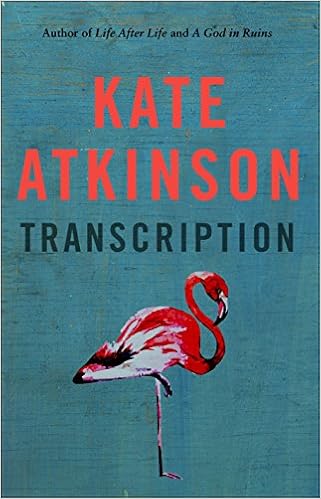
“Transcription” by Kate Atkinson – No need for a bodyguard of lies when truth has vanished.

There are plenty of stories of naïve young women caught up in World War Two who prove plucky and shrewd when parachuted into occupied France to work in espionage or join the Resistance. This novel focuses on a more mundane form of spying, and at times almost seems like a parody of the genre.

Obliged by her widowed mother’s terminal illness and death to give up her school scholarship and prospect of trying for Oxford, Juliet Armstrong finds life taking an unexpected turn when she is recruited by MI5 in 1940, initially as a typist transcribing bugged conversations between Fifth Column Nazi sympathisers and “Gordon Toby”, the work colleague masquerading as a Gestapo agent.

Pehaps intentionally, the recorded conversations are monumentally boring and trivial – little threat to national security – but when Juliet is recruited to spy on one of the female members of an ultra-right wing club, matters take an unexpected sinister turn. As the plot switches continually between 1940 and 1950, when Juliet is working on childrens’ programmes at the BBC, the tale becomes less of a spy thriller, and more a case of paying the price for past actions.

At times the story is quite funny, even a page-turner creating the sense that the plot is going somewhere interesting and unpredictable. Therefore I tried to suppress my irritation (over the excessive use of asides in brackets!), together with a sense of unease over the underlying jokey, flippant attitude to war, which seems an aspect of Juliet’s personality. She is actually quite an unappealing character: instinctive lying without blinking, often for no apparent reason; getting a “buzz” from taking the occasional fool-hardy risk; proving ruthless and calculating under pressure; perhaps the ideal spy in her lack of emotion or commitment to anyone or anything. She is kind to dogs, or people who have suffered inadvertently through her actions, but does not seem deeply moved by anything.

This impression may be the unintended consequence of shortcomings in the writing. I agree with other reviewers who have found the characters wooden and underdeveloped, the few really dramatic incidents implausibly contrived, and the long-anticipated climax so disconnected from what has gone before that it seems as if pages have been left out in a printing error. It is presumably intended to be a clever and surprising twist, but it seems like lazy writing, even insulting, to foist it on the reader in this way.

Whereas most writers apologise for any factual mistakes in a novel, Kate Atkinson defiantly admits “I got a lot of it wrong on purpose” – permissible in the case of MI5’s refusal to “spill the beans” on the transcription process. The portrayal of BBC School Broadcasting in the early 1950s seems accurate as I recall, and it does not bother me if the rest is not. What I find harder to accept is an established writer taking the soft option of a plot with gaping holes.

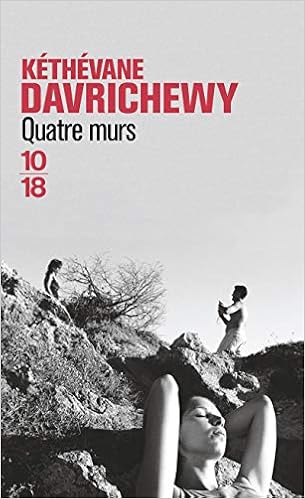
“Quatre Murs” by Kéthévane Dvarichewy – They mess you up your family….

As is often the case, although very close as children, four siblings have drifted apart into adult life. All they seem to have in common is a tendency to be troubled, even neurotic, perhaps owing to past repressed events which are gradually revealed.

In the prologue, they are brought together physically by the final visit to the childhood home which their widowed mother has decided to sell. This inevitably triggers nostalgic memories, but tension is aroused by the mother’s wish to give some of their inheritance in advance to her two younger and less successful children, the twins Elias and Rena.
The “four walls” of the title seem like a metaphor for the four adult siblings who need to decide whether they want to rebuild their relationships to prevent their family group from crumbling, once it has lost the “anchor” of the family home. To do this, they have to understand their relationships in the first place, which is hard in view of all the unspoken resentments, real or imagined guilt of the past.

A reunion with their mother two years later at the Greek holiday home purchased by elder son Saul creates a situation in which the four can reflect on the past, perhaps make a few confessions and ultimately begin to rebond. The author uses the device of taking a different view point in each chapter: that of Saul, the “intellectual”, successful but troubled former journalist; then Hélène, the internationally known creator of perfumes who has perhaps erected a false screen of not wanting either children or a man in her life; Elias, who has not achieved his potential as a pianist and is separated from his wife, and Rena who has suffered a crippling accident, leaving her dependent on a crutch, perhaps another metaphor for emotional clinging to others.

Is perception of the past changed by the passage of time, or does each individual see it in his or her own way? Memories take root differently, with hate linking us as much as love. Do only children, like their parents, make a fantasy out of having a large family, thus creating a heavy burden for their own brood of children? People worry how their children will turn out, what they can do to avoid mistakes in their upbringing, all the while finding it hard to see themselves as parents. Such are the observations produced by the characters’ continual navel-gazing.

There are some strong dialogues (sometimes hard to keep track of who is speaking), leading me to wonder if this might have worked better as a film which could also have captured visually the ambience of the childhood house, or Saul’s Greek retreat. Critics have noted the subtlety and “non-dits”, unspoken words, of this novella, so perhaps I missed some of the revelations. For me, these proved too fragmented, the details sometimes hard to follow, except when delivered in a melodramatic outburst. One could argue that the real drama lies in the reader’s freedom to speculate over what may really lie behind all the obscure hints and allusions. For instance, do incestuous feelings lie at the root of a character’s malaise? Can it be hard for the siblings in general really to love anyone outside the charmed circle of their childhood bonds, now broken without being fully satisfied by anyone else?

The French author may have been inspired by her Georgian heritage to create a family with parents who were originally Greek immigrants, one of Jewish extraction, but it was unclear to me how being immigrants influenced the essential exploration of family ties, except that feeling a little rootless may have encouraged the mother to foster excessively tight bonds between her children.

A potentially promising novella left me rather bored and disappointed with its underdeveloped characters, thin plot, and somewhat tame conclusion.

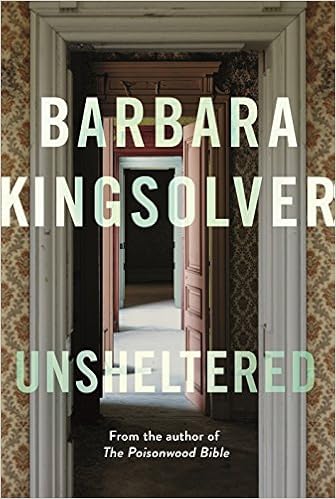
“Unsheltered” by Barbara Kingsolver

Willa, whose name may have been inspired by the celebrated American writer Willa Cather, has inherited a suburban house in New Jersey which is unfortunately falling down through lack of foundations. This is perhaps a metaphor for a middle class family fallen on hard times, so “unsheltered” from both personal problems plus those of a world threatened by climatic change and the collapse of capitalism, to name a couple of issues. Willa has to cope with a handsome, charming but unreliable husband who seems unable to keep his academic posts, even when it is not his fault, in addition to disabled father-in-law “Old Nick”, free-spirit, prickly daughter “Tig”, and son Zeke, traumatised by his wife’s post-natal suicide leaving him with an infant son he will inevitably dump on his mother.

This storyline interweaves in alternate chapters with that of a family from 1871, a century and a half previously, who occupied the same house in Vineland, one of the “Nineteenth-Century Utopias Gone to Hell”. Willa’s unlikely counterpart is Thatcher Greenwood, the earnest new science teacher whose passion for Darwin’s theories and other fresh discoveries such as the existence of molecules, are ahead of the times, even judged “heretical” in the conservative, pious small town community. With his pretty but shallow wife Rose, who cannot come to terms with the need to economise, nor give her husband the support he needs, the situation is reminiscent of Doctor Lydgate and his wife Rosamond in “Middlemarch”. Thatcher finds a kindred spirit in his neighbour, the eccentric investigator of spiders and carnivorous plants, botanist and thinker Mrs Mary Treat.

Such is the standing of the bestseller, “The Poisonwood Bible”, with its brilliant first part on the inflexible American missionary who drags his family off to the Congo to cultivate the land and convert the local people without understanding either, that it feels presumptuous to find fault with this book. I was also sufficiently fascinated by the idea of climate change causing Monarch butterflies to migrate to the Appalachians to forgive the tedious passages in “Flight Behaviour”. Yet much as I wanted to enjoy “Unsheltered”, written by a scientist with a sincere desire to explore environmental and social issues, and based on thorough research of the real-life Vineland and Mary Treat, who corresponded with Darwin, I found it intolerably heavy going, bogged down in the flaws increasingly evident in earlier novels, without enough redeeming features despite the potentially interesting themes.

The style is too convoluted, digressive and crammed with indigestible detail. The mostly undeveloped, two-dimensional characters indulge in contrived, stilted conversations which are an all too obvious device for information dumps and debates on what we should think about important issues, with “incorrect” ideas given a put-down, if only in thought, by right-thinking people like Willa. There’s also a tad too much of the saccharine tone: when Mrs Treat unexpectedly “twinkled” over Thatcher’s admiration for her tarantula house, my heart sank.

In the midst of all her domestic ties, former journalist Willa is intrigued to find out more about Mary Treat, but there is not enough to tie together the two strands which might have been more eengaging if divided into two separate novels, or as some have suggested a straightforward piece of non-fiction on the state of our society.