“A Long Long Way by Sebastian Barry: “A passing drama of the earth”.

In the way that “All Quiet on the Western Front” stands out by portraying the First World War from a German perspective, “A Long Long Way” is distinctive in portraying an Irish viewpoint.

The young hero Willy Dunne is eager to join up as a  means of compensating for the short stature which has made it impossible for him to join the Dublin police force, to his father’s all too evident regret. In the trenches, Willy soon experiences the squalor and tedium alternating with the terror of being the continual target of snipers and deadly gas attacks which gradually bring him to a realisation of the futility of war.

The details of the Irish political crisis which was coming to a head at the same time  are a little hard to follow without prior knowledge, but the fragmented details probably give a very accurate impression of Willy’s own limited understanding of the situation. About to board a ship at the end of a brief period of leave, Willy is caught up in the Easter Rising of 1916, the civil war which pitted rebel Irishmen against their pro-British compatriots. The sight of a young man, very like himself, dying at his feet on a Dublin street  makes a deep impression, but when he tries to express his feelings in a letter  home to his fiercely loyalist father,  the latter disowns him, unable to empathise with the evolution in attitudes that life at the front has brought about.

By turns lyrical and poetic, or filled with “a touch of the blarney” when the soldiers are joshing in the trenches to keep their spirits up,  this is probably the most explicit and visceral, “blow by blow” imagining of a young soldier’s  experiences  of World War 1 that I have read. It captures Willy’s numbed acceptance of fate: on one hand his vulnerability to being struck down at any moment, on the other his apparent indestructibility as comrades die, often before he has a chance to get to know them properly,  to be replaced by others in a seemingly endless cycle.

There is the surreal contrast of the occasional visits home where those closest to him have no inkling of the horror of the trenches. For the most part his girlfriend Gretta serves as a symbol of love and normality for him to cling to in the surreal world of war.  Even when his ordeals in the trenches are  compounded by unexpected and somewhat unjust rejection on a personal level during his final visit home,   all this is offset by one of the most moving and subtle scenes in the book, when Willy bravely makes a point of visiting the family home of Captain Pasley, his first officer in command  who sacrificed his life so pointlessly.

There were times when all seemed so bleak and graphic that I questioned whether to read on, but although the end  was something of a contrived anticlimax , “A Long, Long Way” is worth reading, particularly if one’s first encounter with a novel of the First World War.
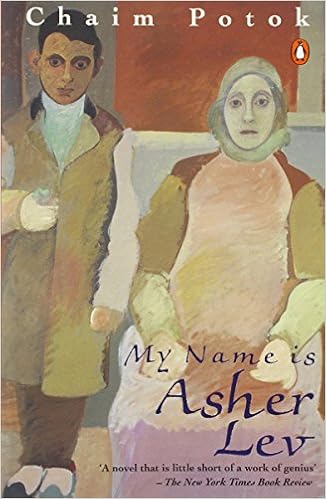
My Name is Asher Lev by Chaim Potok: an outstanding novel which must not be forgotten

Growing up in the New York of the nineteen fifties and sixties, Asher Lev belongs to a strict, tight-knit Jewish Hasidic community presided over by the benevolent dictatorship of the Rebbe, whose interpretation of the Master of the Universe’s wishes is not to be questioned. From an early age, Asher is obsessed with drawing every detail observed in his small world. While his gentle mother urges him to draw “pretty pictures”, and is in due course sufficiently sympathetic to buy him paints and accompany him to art galleries, until driven away by the shock of seeing “forbidden” Christian art, his serious-minded father impatiently dismisses a fad he hopes will soon pass. Frequently absent on trips to Europe where he sets up Jewish schools and helps Jews escape from Russia, he is angered by Asher’s poor grades at school and bemused by the Rebbe’s pragmatic decision to allow Asher to be taught by an eminent artist, completely secular despite being Jewish. The parents’ dawning admiration when some of Asher’s art is acquired by a major museum is outweighed by their refusal to attend any exhibition displaying his portraits of nudes.

As the novel builds to a tense climax bewildering and shocking or sadly comprehensible according to one’s viewpoint, some may find it too slow-paced. Yet the repetition reflects the narrow world in which Asher feels trapped and the often minute detail gives a profound understanding of his development as an artist and a fascinating psychological study of the main characters. It also conveys a strong sense of place, convincing dialogue, and many moments of wry humour amidst the angst.

I am not sure how a deeply orthodox Jewish reader would respond to this novel, and the author himself was intriguingly both a rabbi, inspired to become a writer by reading “Brideshead Revisited” as a teenager, and an artist. However, for an atheist reader like me, it portrays very vividly the tension between religion, ritual and duty on one hand contrasted with and tending to stifle or drive to extremes creativity and personal freedom on the other. In its perceptiveness, it shows how achievement as an artist may require a single-minded dedication which at times appears utter selfishness and self-absorption. There is also the ironic contradiction that art is often exploited for financial gain, the value of an artwork may be artificially inflated and it may be purchased as an investment or trophy by someone who cares nothing for art.

The novel draws on Potok’s own experience in that he was also a painter, like Asher producing Chagall-like portraits of dreamlike Jewish ritual scenes and animals. So Potok’s painting career somewhat paralleled the journey of Asher Lev: a young man, very creative and very religious, who does not fit with his community. “I began to paint when I was about nine or ten years old,” Potok once said in an interview. “It really became a problem in my family, especially with my father, who detested it.” Potok even painted a Brooklyn Crucifixion of his own, resembling the painting in his novel.

This reminded me of “A Tale of Love and Darkness”, the autobiography of the early life of Amos Oz, yet despite being a portrayal of fictional characters, Potok’s novel feels more authentic and and in some ways more insightful, perhaps because it is in fact an exploration and development of his own situation, than a simple account of it.

“Under the Greenwood Tree” by Thomas Hardy: tuning his merry note

Under The Greenwood Tree by [Thomas Hardy]

On a cold and starry Christmas Eve in 1850s Wessex, or a thinly disguised rural Dorset, the Mellstock Church “Quire” of fiddlers and singers keep up the time-honoured tradition of carolling their way round the scattered hamlets of the parish, to a mixed reception. Farmer Shiner bawls at them to shut up, which only incites them to play even louder, the young vicar murmurs his thanks without getting out of bed, and pretty new schoolmistress Fancy Day poses in her window with a candle, captivating the tranter’s (carrier’s) son Dick Dewey. The course of their love affair forms the main theme, but the secondary one of the vicar’s desire to replace the quire with a modern cabinet organ to be played by none other than Fancy Day, is no less important since it reflects the changes in society which are gathering pace as old habits wither away, and strong communities are ruptured as people begin to drift to the towns for work.

There is in fact relatively little about this trend in the novel, despite Hardy’s interest in social and political matters. Having had his first novel rejected as likely to alienate readers with its radical ideas, Hardy played safe with “Under the Greenwood Tree”, intended as a “study of rural life”, the motley local characters, with their pithy, quirky observations in the local dialect, forming a humorous background to the romance. So, it forms a sharp contrast to Hardy’s subsequent gripping but progressively more bleakly tragic novels:“The Mayor of Casterbridge”; “Tess of the D’Urbervilles” and “Jude the Obscure.”

Years later, Hardy seemed to regret having written “so lightly, so farcically and flippantly at times” rather than develop a deeper study of the group of musicians, who are portrayed as somewhat two-dimensional comical characters, as indicated by the description of their silhouettes against the sky as they gather to sing at Christmas Eve. The novel is strongest in its vivid description of rural life: the closeknit community with the tranter throwing his cottage open for an uproarious Christmas party with dancing; the tolerant inclusion of the “simple-minded” Thomas Leaf, although he serves a useful purpose in being the only one able to sing a “top G”, the smoking out of the bees to gather their honey, at which Head Keeper’s daughter Fanny is still adept despite having been educated “to be a lady”. With echoes of Hardy’s poems, there are many striking images of the countryside such as the distinctive sounds made by different trees in the opening paragraph: the fir trees rock, the holly whistles and the “ash hisses amid its quiverings”.

The possibility of tragedy in the book’s climax and the final sentence with its twist of ambiguity give hints of Hardy’s darker later masterpieces.

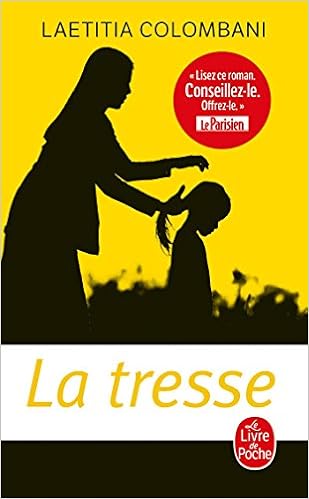
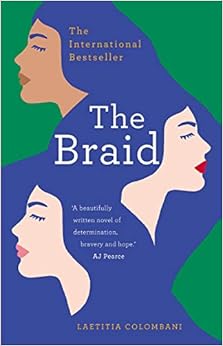
“La Tresse ” or “The Braid” by Laetitia Colombiani: “saved by a hair’s breadth”

Like the three stands of a plait (ou tresse) the chapters focus in turn on three women who seem at first to have little in common apart from their sheer determination. A villager in Uttar Pradesh (India), Smita is a Dalit, member of the “Untouchable” cast which means that, like her mother before her, she must empty the toilets of higher caste neighbours, using the same wicker basket impregnated with the curse of its pungent odour. All that keeps her going is the dream of her small daughter Lalita breaking the vicious circle and escaping her fate by getting an education. The Brahmin teacher accepts the expected bribe to take her on, only to humiliate the little girl on the very first day. Incensed and defiant, disappointed by her husband’s refusal to leave his rut of rat-catching in the village, Smita chooses the dangerous course of travelling with Lalita to a relative in a distant city where the pair can start a new life.

The daughter of a Sicilian wig-maker in Palermo, Guilia is the only one of three sisters to take an active interest and work in the family business which she seems destined to take over in due course. Her carefree life is shattered when her robust, seemingly indestructible father is badly injured in a road accident which leaves him in a coma. Obliged to sort out some paperwork, she makes a shocking discovery. At the same time, perhaps susceptible in her grief, she embarks on an unlikely love affair.

Meanwhile in Canada, high-flying lawyer Sarah, twice married with three children largely absent from the scene because they are cared for by male nanny and factotum “Magic Ron”, takes pride in her success and is utterly confident in her sense of being in control. When confronted by a threat to her career which perhaps she should have foreseen, which cannot be managed and contained through sheer willpower, how will she cope?
This is easy to read and plot-driven, but the continual switching between apparently unconnected storylines is somewhat jarring, at the same time serving to increase suspense over how, if at all, they will converge at the end and masking a thinness in Guilia’s and Sarah’s tales. I would have found it a more satisfying read if presented as three separate short novellas, although I accept this would have weakened the “Eureka” moment of realising what links the three women. Smita’s tale seems to me the most fully developed and engaging, perhaps because there is a stronger sense of place and portrayal of a (to me) unfamiliar, distinctive culture as she travels towards her goal.

Since the author is a scriptwriter and film-maker, I assumed this novel was written from the outset with adaption to the screen in mind*. At a recent interview, the author was adamant this was not the case. This was partly because she wanted the freedom of not needing to think about the cost of, for instance, choosing specific widely distant locations. She acknowledged that her books are regarded as cinematographic, which she explained as meaning based on situations one can visualise, like Smita and her daughter travelling on an overcrowded train for the first time, rather than relying heavily on description of people or dialogues. On the other hand, perhaps because of the author’s scriptwriting background, the style is for me the weakest factor – by turns heavy on exposition, or unduly sentimental in tone. The strength of the stories lies in the dramatic incidents and changing emotions of the characters.

*At the time of writing this, both of her first two novels have been or are in the process of being filmed.

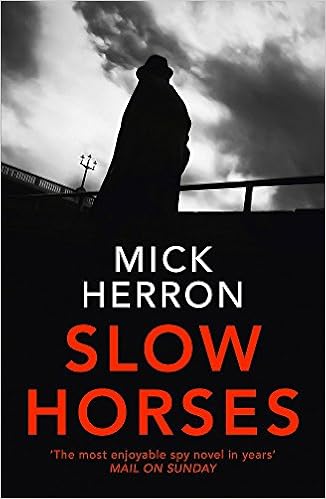
“Slow horses” by Mick Herron: “practise to deceive”

“Come, friendly bombs, and fall on Slough
It isn’t fit for humans now,
There isn’t grass to graze a cow
Swarm over, Death!”

This well-known attack on Slough by John Betjeman is the source of the name Slough House, in turn easily corrupted into “Slow horses”, the derogatory nickname of disgraced MI5 intelligence officers sent to work there on pointless tasks, until they are driven to leave the service at no further cost to the organisation. The particular failure of their slovenly, foul-mouthed boss Jackson Lamb has not been disclosed, but for his hapless underlings it ranges from leaving a highly confidential computer disc on the Tube, handed in at the BBC, to making a careless error when tailing a suicide bomber at Kings Cross, resulting in massive and costly damage. This was bad enough for River Cartwright to be sacked, but for the string-pulling of his grandfather, retired spook the “OB” which turns out to mean the “Old Boy”.

The narrative starts slowly, setting the scene and filling in the backgrounds of the main characters, but it is always vital to pay close attention, particularly in view of the author’s penchant for making an incident clear only after the event. Matters hot up when a young man is kidnapped by extremists who threaten on camera to behead him but nothing is as it first seems in this increasingly tangled plot. Mick Herron does not baulk at killing characters off, both good and bad, which serves to raise the suspense. As the slow horses get embroiled in some unintended consequences and real action, will then end up as scapegoats or heroes?

With shades of John le Carré and Raymond Chandler, I found this book a page turner by reason of the plot twists, wry humour and cynical comments on our society. Some readers may disagree if they are put off by a tendency to repetition, long-windedness, implausible moments and points which remain frustratingly unclear (perhaps a few loose ends are to be picked up in a sequel). The ambitious politician Peter Judd is an obvious parody of Boris Johnson, but is it wise to bring in current named celebrities whose names may not mean much in a few years? For instance, Jackson Lamb is described as “Timothy Spall gone to seed (which left open the question of what Timothy Spall not gone to seed might look like)”.

I found some aspects of the final denouement confusing, too rushed and something of an anticlimax. Perhaps it is a pitfall for elaborate plotters to run out of steam for a mind-blowing revelation at the end.

“Slow Horses” is the first of seven full-length novels in a series as at 2021. I believe it is best to read these chronologically, not least in order to understand the allusions in the successive books. I may read one or two more in a while, but fear they might prove “too much of the same”.

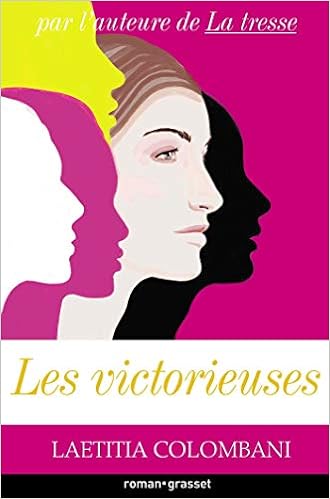
Les Victorieuses by Laetitia Colombani: “Making a difference”

When a businessman on trial for fraud is found guilty, he hurls himself over the guardrail to his death six floors below on the marble floor of the foyer at the Paris Palais de Justice . This dramatic opening hook proves to be no more than the trigger for high-flying lawyer Solène’s mental breakdown. Having pursued a legal career at the cost of personal relationships, Solène is left apathetic and reliant on antidepressants. As a form of therapy, she agrees to spend every Thursday as a “scribe” for the women with a wide range of social problems, refugees and former rough sleepers living at the Salvation Army’s Paris hostel in the historical “Palais de la Femme”. Gradually, she builds a rapport with a variety of women, but her growing sense of “making a difference” proves fragile in the face of the inevitable setbacks in such a vulnerable group. Yet there is always humour and mutual support mixed with the pain and deprivation.

The storyline alternates with a fictionalised account of the real-life Blanche Peyron, wife of Commissioner Albin Peyron, who is presented as the driving force in acquiring the substantial building originally intended to house Parisian workers, constructed on the site of a former convent. The plight of a woman with a small baby, for whom Blanche could not find a suitable lodging in 1925 despite four decades of striving to eliminate the widespread problem of homelessness in the capital, was what motivated her to create the haven for women which exists to this day.

“Les Victorieuses” is very easy to read, contains flashes of insight, as in the description of how we find it hard to look homeless people in the eye as we pass them by, and raised my awareness of a piece of social history as regards the struggles of the Protestant Salvation Army to make headway in Catholic France. Sadly for my taste, the style is too coated with sentimentality– even a tweeness that seems incongruous. In this, it resembles the sugary sweets on which Solène gorges when she is feeling low.

Social problems and acts of violence tend to be glossed over or sanitised. Apart from Solène, whose personality is explored in some detail, although I am not sure she is intended to be as flawed as she actually appears, most of the other characters are somewhat two-dimensional, often stereotyped or romanticised. “Les Peyron” in particular seem too good to be true. There is a tendency to provide potted histories of past lives, rather than to undertake the harder task of revealing characters through their dialogues, behaviour and thoughts.

I read this in French, “good practice” for an English reader and likely to stimulate discussion in a book group.

Laetitia Colombani has won plaudits for “La Tresse” which some critics seem to regard as a superior novel.

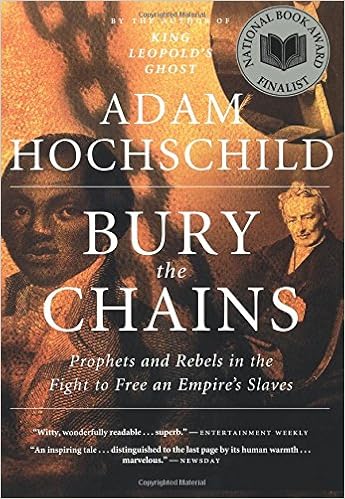
“Bury the Chains” by Alan Hochschild: Understanding the Past

Called Saint Wilberforce, even King Wilberforce by slaves in the West Indies, the man often credited with leading the British movement for the abolition of slavery is portrayed here as deeply conservative: he was against giving more British people the vote, expected women to be submissive, and argued against a cruel slave trade rather than for “too rapid” an emancipation, even at one point voting against the liberation of children born to slaves. He was mainly useful to the abolitionist cause as an MP, close friend to the Prime Minister William Pitt, and a compelling speaker.

This highly readable yet deeply researched “narrative history” focuses on the lesser known characters who in fact played a more fundamental part in the long battle to end the inhumane trade on which many people in the late C18 believed the British economy depended. Author Adam Hochsfield apparently set out with the aim of writing about John Newton who evolved from the callous captain of a slave ship to an Anglican clergyman, rueful abolitionist and writer of “Amazing Grace”. Through his research, the author came to realise that the real force behind the movement was Thomas Clarkson whose prize-winning essay in Latin on the slave trade brought him to the Damascene conversion “that if the contents of the Essay were true it was time that some person should see these calamities to their end”. This led him to travel thousands of miles on horseback to seek out and gain testimonies from those who had witnessed the horrors of the slave trade, and in many cases perpetrated or suffered them directly.

I was surprised by the amount and intensity of interest in slavery amongst workers in the industrial cities like Birmingham, prepared to attend meetings and sign petitions against slavery. Even children brought up in liberal households often gave up eating sugar. It was a different matter in the ports grown rich on the trade: on a tour to promote his autobiography, the remarkable Equiano, the former slave kidnapped from Nigeria who had bought his freedom and became a respected campaigner, asked the influential Josiah Wedgwood to come to his aid if he was seized by a press gang in the slave ship port of Bristol. White Britons were also at risk of being kidnapped and forced to join the Navy, and sailors on slave ships suffered brutal discipline and physical hardship, factors which further fed opposition to the slave trade.

Despite the mountain of evidence collected, including the infamous diagram of the slave ship in which slaves were packed with no room to move, which so shocked even the Tsar of Russia, apparently seeing no parallel between the plight of slaves and his own serfs, it proved impossible to end slavery in British territories until the reform of Parliament in 1832 created enough broadminded MPs to outweigh those whose family wealth depended on the income from plantations.

The case for change was also strengthened by the “crisis in the sugar colonies” caused by the increase in violent rebellions by the slaves in West Indian plantations, which meant they could no longer be relied upon as a source of wealth: St Domingue, now Haiti, “the jewel of the European colonies”, with its rich soil at one time producing a third of the world’s sugar and more than half its coffee, set the trend with its ultimately successful struggle for its independence from France.

Although freedom was clearly a necessity on moral and humane grounds, too often former slaves found themselves no better off in material terms. Those who fought for the British in the American War of Independence in exchange for freedom, had to take such drastic measures as escaping to a grim life in Nova Scotia to escape recapture by slave masters when the fighting was over. Others found that the Utopia of a free state in Sierra Leone was a myth, with the settlement of “Freetown” within sight of Bance Island, the notorious slave trading post for those captured inland and brought to the coast for transport to the West Indies and America.

Although apparently belittled by some academics for being too anecdotal, my sole criticism is that it does not explain with sufficient clarity the crucial 1807 Slave Trade Act which brought the slave trade to an end. Otherwise, this impressive book brings the key players alive, sets the fight for abolition in the context of the times, and encourages reflection on the issues raised.

Of the great campaigners, only Clarkson lived to see the “real victory” in 1838, when some 800,000 slaves in the British Empire became officially free, having first served for a further six years as “apprentices” for their former masters, who were also compensated with £20 million in government bonds, under a scheme including a Church of England plantation. Obliged to pay for rent and food, ex-slaves often remained impoverished but they were free, one of the first steps in changing the status quo and achieving greater social justice.

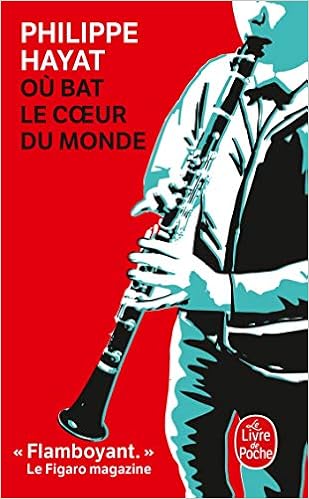
Où bat le cœur du monde by Philippe Hayat – Where the world’s heart beats or escaping through music

In 1930s Tunisia, still a French colony, Darius Zaken’s pious father plans to leave the Tunis ghetto to set up his bookshop in the modern French quarter where his son can attend the lycée. An appalling incident shatters his dreams, leaving Darius lame and too traumatised to speak. Against the odds, his mother Stella dedicates her life to his getting a good education which will lead to a professional job in mainland France, but a chance meeting with a spoilt rich girl called Lou gives him other ideas. Taking him under her wing, she introduces him to the louche world of jazz, and he develops a passion for the jazz clarinet, for which he has a remarkable talent. To his bewildered mother, jazz is a meaningless cacophony.

With the onset of World War Two, the arrival in Tunis of black American jazz musicians attached to the US Army gives Darius the change to slip away to the United States. Here he can realise his talent eventually, but in a harsh world of prejudice and segregation, where jazz is regarded as the preserve of the black population, and many of the most talented musicians addicted to drink, heroin and cocaine. A sensitive soul, Darius attracts the sympathy of a succession of women: his mother, Lou and ultimately Dinah, an astute black American.

Focusing on the first part of Darius’s life, when he is striving to succeed, this novel is episodic, leaving the reader’s imagination to fill in the gaps. Philippe Hayat succeeds in conveying a sense of the appeal of jazz, even to someone like me who does not care much for it, but his descriptions tend to be too long, repetitious and overtechnical. I was prompted to look up the parts of a clarinet, the nature of a ride cymbal, the meanings of various musical terms like “anatole”, chabada or Lydian scale, together with researching the lives of celebrities who inspired Darius and in time actually played with him: Dizzy Gillespie, Lester Young, Charlie Parker and Billie Holiday who proved as tragically troubled in their often too short lives as Hayat describes.

This novel has a strong sense of place, be it interwar Tunis, Sicily under the WW2 Allied invasion, or postwar New York. The complex mother-son bond between Stella and Darius is well-described and moving. There are some striking, powerful dramatic scenes.

On the downside, the narrative drive is undermined by too many passages which are overlong and frankly dull. There are a few digressions too ludicrous to ring true, like the brothel where Darius is employed to play his clarinet to clients through holes in the wall through which he can view them, or Stella’s employment at a bank where she somehow becomes a financial expert in record time. Is a loss of speech through shock likely to be permanent? It is of course symbolic in that Darius expresses his emotions through the international language of music instead.

The plot structure seems weak. The opening chapter showing Darius as an old man giving his last performance, aided by the faithful Dinah, is not an engaging start, not least because we have yet to learn their backstories, and also destroys any dramatic tension since one knows from the outset that Darius will succeed.

In short, parts of this book are excellent but one has to wade through some dull passages to find them.

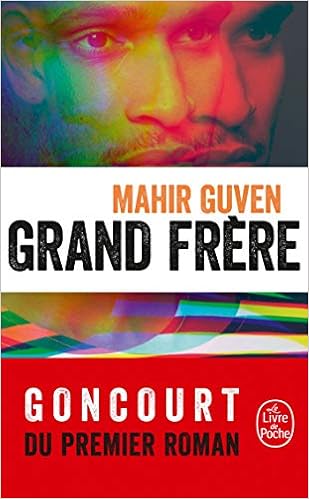
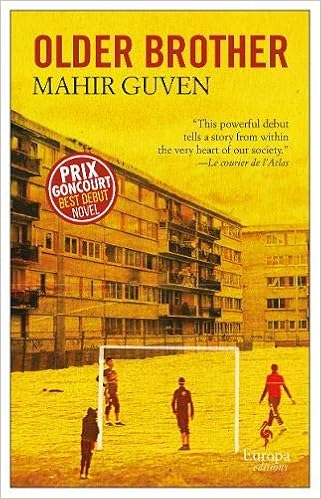
Grand Frère or Older Brother: staging a comeback

Two brothers, unnamed until the final twist of the almost all-revealing epilogue, grow up in Paris caught between two very different cultures: their volatile left-wing father fled from Syria to France where, having abandoned his studies, he married their Breton mother who died tragically young when they still needed her stable influence.

The narrative swings between the two men, helpfully printed in different fonts although their written styles are very different. Older Brother (Grand Frère) slogs for a “VTC” app-based Uber-like chauffeur-driven car hire company, much to the fury of his father who drives a conventional taxi under threat from the hi-tech competition.

Younger Brother, probably more intelligent and reflective, is an operating theatre nurse who disappears without warning to Syria, where, if he is to be believed, he simply hopes to gain more job satisfaction, with a better prospect of progressing to work as a doctor than in the prejudiced environment of a Parisian hospital. This move shocks his brother and father, not least because they come under suspicion as supporters of a possible terrorist.

After a slow-paced scene-setting start, the novel “takes off” when younger brother suddenly reappears after an absence of three years, presenting his sibling, already under pressure as an involuntary police informer, with a problem: should he shop his brother, or make himself accessory to an assumed terrorist by helping him?

Reading this in the original French, I found the first part hard going, partly owing to the large amount of French slang and Arab colloquialisms helpfully often translated in the glossary at the end – there may even be some of the words the author enjoys inventing! There is also Older Brother’s tendency to express himself in a stream of marijuana-befuddled consciousness. His is a very macho, chauvinist cochon culture: still in her mid-twenties, his “woman” has breasts hanging to her navel, to give a flavour of this. Yet his flow provides a vivid picture of the immigrant communities with the older men grafting to make a living in Paris, while their children channel their talents into rap, or fall under the spell of silver-tongued religious fanatics. The author’s fascination with people-watching feeds the sharp observations of the passengers whom Older Brother transports round the capital, and fragments of his homespun philosophy on life show surprising flashes of insight.

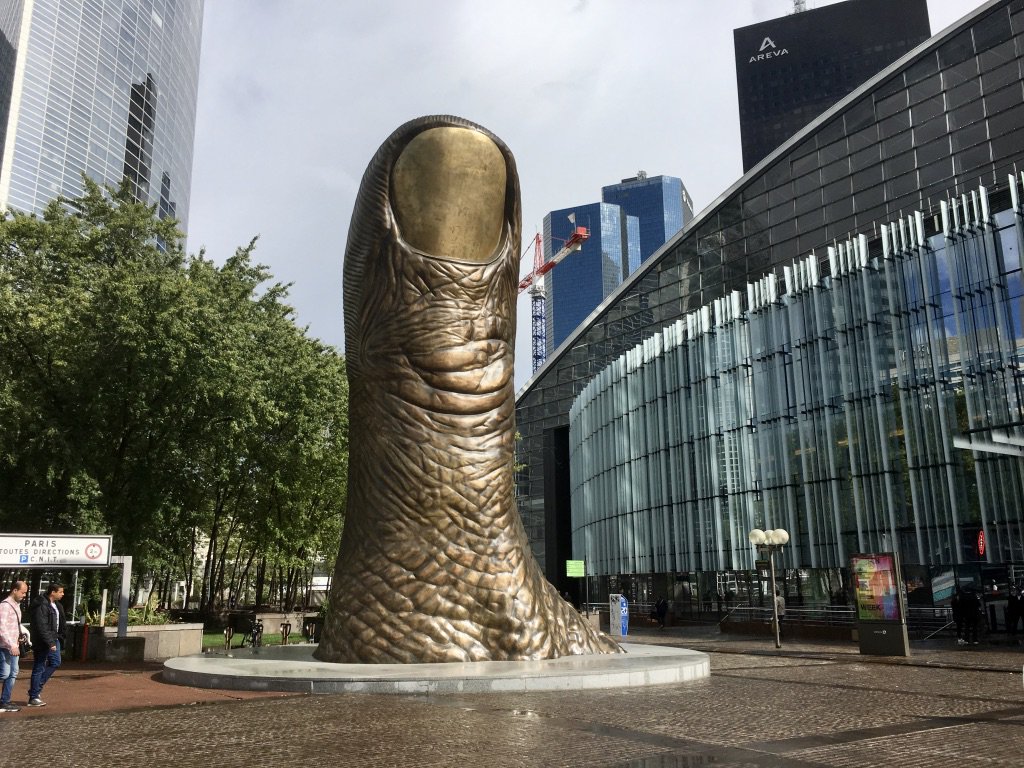
It’s worth looking up any reference one does not understand: I was intrigued by the detailed description of a thumb-shaped sculpture in the La Défense area which actually exists in Google images.

soundlandscapes on Twitter: "'Le Pouce': César Baldaccini's iconic 40-foot  thumb in La Défense this afternoon.… "

An interesting talk by the author, himself the children of immigrants from Kurdish Turkey, which seems to have made him more open to challenging conventions of all kinds, helped me to appreciate this award-winning first novel more. The French which I often found so hard to grasp is apparently the language of many young people in France, with immigrants too often feeling alienated or undervalued. Of course, much of this authentic flavour would be lost in translation, but the novel would be easier to read!

The accelerating pace to a dramatic climax encourages one to keep going, but it is the epilogue which, even if not an entirely original ploy, provides what seems on reflection to be the only satisfactory ending, also a resolution of some implausible aspects of the plot which troubled me. Its open-endedness gives scope for the author to write a sequel.

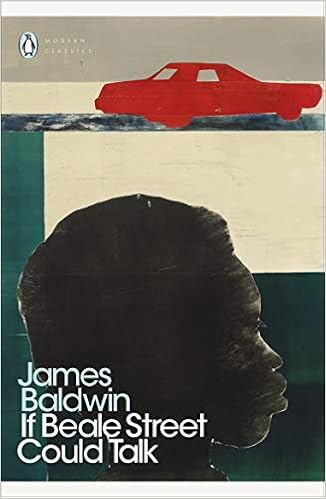
If Beale Street Could Talk by James Baldwin: when love is growing up

Written half a century ago and read against the backdrop of “Black Lives Matter” this modern classic is a reminder of the persistence of racial injustice, given added authenticity by the black American author’s personal experience. Nineteen-year-old Tish has a steady job and close-knit family, who accept with almost unbelievable equanimity her unplanned pregnancy, just when her fiancé and childhood sweetheart Fonny, who has ambitions to be a sculptor, has been arrested for a serious crime on a charge trumped up by a vicious racist white police officer. Made all the more poignant by the depth of the couple’s love, this novel is an unflinching portrayal of how the cards may be stacked to destroy the lives of an innocent couple simply because of their colour.

The approach is unusual in that the male author sets himself the challenge of getting inside the mind of a young woman, even to the extent of describing her orgasm. James Baldwin is also experimental in the flexible structure of the book. Tish narrates the novel in the first person, presumably to involve the reader in a more vivid experience of the drama, but when it suits him he replaces her voice with his own observations in his own style, as when he launches into an analysis of the mental differences between women and men. To portray events in which, say, Fonny’s friend Daniel is previously framed by the police and put in prison, or Tish’s mother Sharon visits Puerto Rico to make contact with the woman who has been manipulated into picking Fonny out of an identity parade, the author simply takes “writer’s licence” and has Tish describe scenes as if she has witnessed them in person.

With strong opening scenes, dialogues and sense of place, as the facts are revealed, I found myself engrossed in how they would play out. Although it seems inevitable that Fonny would be found guilty, would some twist expose a fatal flaw in the prosecution? The sympathetic white lawyer might be prepared to work virtually “pro bono”, but how would Tish’s family and Fonny’s loving but weak father Frank manage to scrape together the money for his bail, without themselves taking to illegal activities which might cause them to fall foul of the law?

The “bad” characters are too often caricatures with no redeeming features, like Fonny’s religiously fanatical mother who seems inexplicably hostile towards him – most mothers love their sons. His thinly sketched sisters are also pointlessly disagreeable. Although I am often intrigued by ambiguous or inconclusive situations leaving one free to form one’s own conclusion, in this case I was surprised and disappointed by an ending so abrupt as to seem incomplete. Yet perhaps for Baldwin, the development of specific scenes was more important than the arc of a plot.