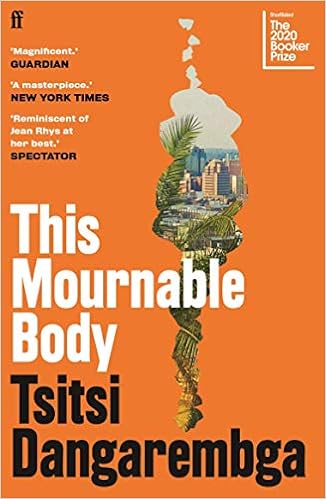
“This mournable body” by Tsitsi Dangarembga: more ebbing than flowing

Thirty-something Zimbabwean Tambudzai is desperate to obtain a job in Harare which will enable her to leave the hostel where she is technically too old to stay. The reader gradually gleans details of her backstory: born in an impoverished village, gaining a good education with the help of an uncle has given her high aspirations, but these have been dashed by a combination of bad luck, a tendency to mental illness (involving a recurring hyena and ants), negative self-talk and low self esteem.

Unlike some reviewers, I was not put off by the author’s decision to write the entire novel in the second person “you”, justified on the grounds, “that was the only way I could access the subject matter in a way that I felt made sense……I needed distance and I imagined the reader would to”. Neither was I deterred unduly by Tambudzai’s frankly unlikeable and irritating personality, as she shamelessly sponges off others while criticising them, lies without blinking to impress or manipulate them, and continually observes them with often acute accuracy but an empathy bypass.

So why did I almost give up on page 25 and only plough on to give the benefit of the doubt to a book I began out of curiosity because it was on the Man Booker shortlist?

I found some scenes exaggerated to the point of absurdity, alternating with tedious descriptions dwelling too long on mundane detail. Was the tendency to render some points unclear deliberate, or due to a lack of editing? It appears I would have understood more of the allusions if I had read the previous novels about Tambudzai, “Nervous Conditions” and “The Book of Not” but there is no explanation in the edition I read that this is the third part of a trilogy, which ends so abruptly that a fourth book seems on the cards.

I wondered whether the author had deliberately used a laboured, wooden style to create a distinctive voice for Tambudzai, as one who is desperately trying to conform and succeed in a second language and culture to which she does not feel a true sense of belonging. More positively, the Zimbabwean turn of phrase adds authenticity to the dialogue, as in the wry menaces of the menfolk idling outside when Tambudzai turns up intending to apologise for her most appalling outburst.

This is a very uneven novel, essentially a framework for a chain of incidents which provide a fragmented but wide-ranging and sadly bleak view of Zimbabwe: the enduring rural poverty and ethical dilemmas of exploiting it to encourage “eco-tourism”; the superstition, crude sexism and corruption persisting in Harare beneath a thin veneer of the worst aspects of Western “civilisation”; the tough women freedom fighters despised as whores for returning from Mozambique with fatherless children; the menacing presence of war veterans; simmering resentment against white farmers still retaining land, and suspicion of mixing – “White people are a problem”, Tambudzai’s mother warns,”You can only work with them if you know them”.

There are a few very well observed scenes, such as the relationship between Tambudzai’s cousin Nyasha and her white German husband, their relative poverty turning Tambudzai’s envy into contempt (while living off them) – in her eyes it is inexcusable to be poor and white. Other examples are when the security guard Silence attempts to assert what little authority he possesses to prevent his wife, Nyasha’s maid-of-all-work, from accompanying the family to the cinema on her afternoon off, or when Tambudzai negotiates with her mother and the village chairwoman to persuade them to assist in turning their village into a tourist attraction. The author is also good at capturing children’s behaviour. Tambudzai’s exultant drive in the hard-won status symbol of a company car back to her village is a triumph of comic parody. Perhaps this book needs a second reading, if one has the patience, to appreciate it fully: towards the end, in a fit of nostalgia, Tambudzai comes across a poem called “Mantra”, written as an adolescent which she now dismisses, “impatient with the cryptic phrases” but it is perhaps a subtle way of showing how adversity has shrivelled her creativity.

There is just one point, where Tambudzai notes the natural beauty of the landscape on a northern farm, at which one glimpses what Zimbabwe might be.
“Good Economics for Hard Times” by Abhijit V. Bannerjee & Esther Duflo: rambling too widely?

I had high expectations of what promised to be an accessible book on post-financial crisis economics by a couple of Nobel Prize winning academics.

Themed by a range of interesting topics like migration, trade, growth rates, climatic change, or artificial intelligence, although it is often hard to work out from the chapter headings what they are likely to be about, I was soon disappointed by what seems an overly superficial, disjointed, anecdotal approach, by turn tending to labour over stating the obvious, or failing to develop important ideas sufficiently. I understand an attempt to avoid putting general readers off with too many diagrams and tables, but used in moderation these can be more effective than wordy paragraphs.

Ideas too often seem presented in a rather one-sided way. For instance, the benefits of migration are cited, but not the complex problems it can create. I was surprised that the situation in Europe was not used as a major example of this.

At times, the tone appears a little patronising. The “better answers” in the title prove in short supply and in the main quite woolly.

A shorter, more carefully considered book expanding on any one chapter would have been more useful. But perhaps this book is not meant for mature readers already armed with a basic knowledge of economics who have also developed a good understanding of social and political issues. Ancillary to a rather dry basic economics course for students, this might be useful in stimulating questioning debate.

“History of Wolves” by Emily Fridlund: “The false belief that anything could ever end”.

Narrator Madeline, called Linda at school, recalls her childhood in the backwoods of northern Minnesota, where her lapsed hippie parents scrape a living after the failure of their commune. A teenage loner with no real friends, she lives in a kind of emotional vacuum between her strong, silent father “who always made it seem a great kindness… not to ask too many questions” and self-absorbed, insensitive mother with her half-finished projects, of which Linda is one. Expected to undertake adult tasks from an early age – chopping wood, feeding and exercising the dogs, walking miles in the dark after school to fetch drain unblocker – yet also given total freedom to roam, Linda observes people with the same forensic eye she applies to the natural world, but is often unable to interact “normally”, to the point of seeming autistic. She tends to become obsessed with other “outsiders”, like teacher with a shady past, Mr Grierson, who may have seduced pliant Lily, mocked for being part-Indian, which she never denies.

When the Gardners occupy a lakeside house in the area, Linda is paid to childmind their precocious four-year-old son Paul, and is surprised by the unfamiliar sensation of bonding with the little boy, also perhaps developing a crush on his mother Patra, who seems at times like an older sister. Linda notices Patra’s moments of “breathtaking tenderness” for her son, only to neglect him in her abject need to please dominant husband Leo. He turns out to be a third generation Christian Scientist which sits oddly with his profession as an academic astronomer. Members of this religion will not be pleased with the portrayal of their beliefs in this book, as troubling signs of something amiss in the Gardner family gradually builds up to a tragedy in which Linda is implicated.

This highly original, quirky novel is marked by a string of striking descriptions which enable one to visualise or sense situations even if entirely outside one’s experience: the changing colours in the sky above a lake as the night draws in; the behaviour of dogs; the pleasure of watching a child’s absorption in doing a jigsaw; a mother’s fruitless efforts to induce her teenage daughter to talk to her.

There are sharp insights, and bitter ironies as in the case of Mr Grierson who may have been punished for actions he only thought of committing – a twist of the Christian Scientist belief that “it’s not what you do but what you think that matters”.

Yet the critical incident, which arguably haunts and defines the rest of Linda’s life, remains unclear in some key respects and insufficiently explored. This may be deliberate since the author is more interested in capturing an individual’s thought processes together with the fragmented, even inaccurate impressions she may draw from a situation.

What may seem like a weakness in what I found to be the artificial, unconvincing conversations involving Leo and later Linda’s lover Rom may also be intentional, in that Linda either does not understand what the former is saying or resents the latter’s attempt to pin her down.

Perhaps a novel such as this can only have an ambiguous ending, but I was somewhat disappointed by what seemed a creative writer’s damp squib of a final twist which provides a somewhat weak conclusion. It left me with a sense of sadness over a life which seems needlessly blighted, since Linda is portrayed for much of the book as a bright, resilient person with a wry take on the world.

Overall, deservedly shortlisted for the Man Booker Prize, this novel probably needs to be read more than once to appreciate it fully.

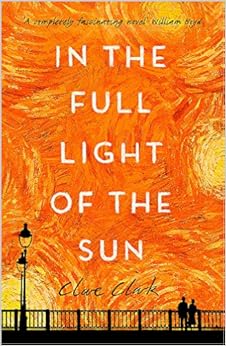
“In the Full Light of the Sun” by Clare Clark – fascinating theme but confused plot

Against a backdrop of rampant inflation and corruption, “madness spreading like gas”, in 1920s Berlin, famous art critic Julius Köhler-Schultz is in the throes of a bitter divorce from his much younger wife, who has decamped with their small son and “the only painting in the world” Julius “could not bear to live without”, a self-portrait of Van Gogh. In this vulnerable state he falls under the spell of a charismatic young art dealer, Matthias Rachman, but is he quite what he seems? Julius also supports the artistic ambitions of talented but troubled teenager Emmeline Eberhardt.
This novel was inspired by the long-forgotten but once famous case of Otto Wacker, the German dancer who was eventually tried for knowingly selling fake Van Gogh paintings, always after compromising the reputation of some expert by gaining his authentication. Initially I was impressed by the novel’s very strong sense of time and place, and the slow-burning build-up of suspense. It was therefore a shock to be plummeted into Part 2 with an abrupt switch to the viewpoint of Emmeline whose drunken agonising over unrequited lesbian love becomes somewhat tedious, although no doubt a true reflection of one aspect of inter-war Berlin. By the time I reached Part 3 in the form of the diary of lawyer Frank Berzacki, forced to face up to the Nazi regime’s inexorable crushing of Jewish rights, I realised that the author has deliberately inverted what one expects of a plot. Instead of setting an art crime at the forefront, this is obliquely referred to throughout the book, generally secondary to the inner thoughts and concerns of the three main characters in turn.

Can one ever be sure a painting is not a fake? Are the eye-watering sums paid for some art justified? Such questions woven into a historical thriller about possible fraud should make an absorbing read, so why did I find it frustrating, the middle section in particular such heavy going? I could forgive the frequently overblown or mawkish style whenever the author touches on passionate feelings, because this is offset by the many striking, poetical images, particularly in Emmeline’s section which I suppose is a way of portraying her artistic eye. She describes a flock of starlings: “ a vast rippling cape…surging and wheeling, stretching into swooping curves, twisting in helixes, rising in streamers on the wind, the whisper-roar of their wings like the sea or the thrumming of a thousand fingers on a thousand paper drums”.

The three sections are welded together in an unwieldy structure. Too many mostly thinly sketched and often unnecessary characters, and minor incidents which pad the novel up to over four hundred pages, tend to overwhelm or drive out the plot, in which key events take place “off stage” and so remain confused or unclear and left for the reader to surmise. I would have preferred the author’s painstaking research applied to a factual portrayal of art in interwar Germany.

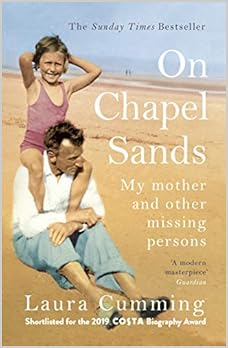
“On Chapel Sands” by Laura Cumming: How everything turns away quite leisurely from disaster”

In 1929, on the long golden Lincolnshire beach of Chapel Sands, three-year-old Betty Elston was abducted when her mother wasn’t looking, but found safe and well in a house nearby a few days later. Why did Betty so readily accept being kidnapped and why were no demands for money involved? Perhaps understandably, her parents did not reveal that she had been adopted until an incident ten years later but why was she kept so isolated from local people? Why did the kind-hearted Betty come to reject her adoptive father to the extent of not going to his funeral? And why did the baker’s boy deliver bread to the neighbouring households, but not hers?

Although this reads at times like fiction, it is art critic Laura Cumming’s biographical “homage” to her mother in which “all the characters and events are real” with “only one name… changed, in the final chapter”. Skilled in interpreting what lies behind a painting, the author deftly drip-feeds the intriguing details of her mother’s life, some not discovered until years after the event.

Betty’s adoptive mother Veda seems sweet and submissive, perhaps worn down by two decades of infertility in a community where being a wife and mother was the main point of one’s existence, not to mention dealing with George, allegedly an “extremely intelligent but domineering and somewhat like a character from Dickens.”. Adoptive father George seemed cast as villain of the piece but I felt that the author was rather too hard on him, only softening in the revelation saved for the final chapter. In the kind of life where much of the excitement comes early on, in his case with a valiant role in the Boer War, ending up as a travelling salesmen during the years of Depression and World War Two must have been an anti-climax. Yet his skill in making elaborate models and using a simple Box Brownie character to produce some evocative photos suggests he may have been a frustrated artist, whereas Betty and Laura, born later, had the chance to develop their artistic talents.

Perhaps a little too thin at times, leading to repetition and reliance on speculation, the facts are fleshed out with descriptions of local celebrities like Tennyson who wrote of Chapel Sands as “a sand-built ridge….the spine-bone of the world”, together with vivid accounts of social life in rural Lincolnshire in the last century. Here were tightknit, inward-looking local communities where everyone knew each other’s business, but no one said a word to Betty about her origins. We are reminded of a lost world of self-sufficiency: in the 1920s the village of Hogsthorpe “numbered not quite five hundred people” with “a surprising range of shops – a butcher, a baker, not one but two shoemakers, a pair of blacksmiths….– a confectioner, three separate grocers, a bricklayer, plumber and wheelwright.… you could have your hair cut, have bicycles and baskets custom-made…the elementary school had room for more than a hundred pupils” – all this long gone.

Linking her mother’s life to the pictures she collected, Laura Cumming provides a detailed analysis of Breughel’s “Landscape with the Fall of Icarus”: the sturdy farmer ploughing improbably close to the cliff edge seems oblivious to Icarus drowning in the sea, just as the locals ignored the Elston family drama, while George is likened to Icarus in his hubris. It is a pity my Kindle could do justice neither to George’s photographs nor the paintings cited , so I advise reading a paper copy of the book if possible.

This book follows the same forensic technique as Laura Cumming’s “The Vanishing Man”, interpreting and speculating on the works of the great painter Velasquez. I was more impressed by the latter, but it may be a matter of taste whether one prefers the smaller-scale, more domestic canvas of the life of an ordinary girl who escaped a narrow world to find fulfilment as a painter and weaver, against the odds.

“Second-hand time” by Nobel Prize winner Svetlana Alexievich: “Cracking the mystery wrapped in an enigma”

Second-hand Time by [Alexievich, Svetlana]

This is an amalgam of largely unedited and at times remarkably frank, no-holds-barred interviews with individuals and fragments of conversations with groups living in the former Soviet Union after the collapse of communism in the early 1990s. The author’s personal experience of life in Belarus, and her obvious listening skills no doubt helped to draw people out.

Patterns emerge from the diverse accounts. Despite the violence, physical hardship and social oppression, those who lived under Stalin’s regime retain a nostalgia for the past which may at first seem surprising. It must be partly due to conditioning from an early age with the propaganda of patriotic songs:
“World capital, our capital/Like the Kremlin’s stars you glow/You’re the pride of the whole cosmos/Granite beauty our Moscow”.

Yet it also seems related to the past pride in being part of an empire, the sense of purpose in helping to build it through fighting on the winning side against Germany, working with one’s hands to develop it, sending Gargarin as the first man into space. There is also the lost “dream of equality and brotherhood”, and drive to “create Heaven on Earth” – the pining for community spirit and mutual support, overlooking the practice of informing on friends and neighbours. The “sovok” (Soviet man) remains appalled by the current lack of idealism, the preoccupation with obtaining consumer goods (“A Mercedes is no kind of dream”) and rewards for the crooks who control the new market system.

Then there are those born after Stalin’s death in 1953, who grew up reading forbidden books, and conducting endless debates in the kitchen about how life might be changed for the better, half-joking over the risk of a bugged light fitting. They were initially seduced by Gorbachev’s “Perestroika”, even daring on his behalf to brave the tanks on the streets in the abortive coup against him. This made their disillusion all the deeper when the unchained capitalism of the 1990s made them the victims of crooks and violent gangsters, creating large-scale unemployment for the first time, forcing even the skilled and educated to sell their possessions and work as cleaners or flog goods smuggled in from Europe, and reducing to destitution pensioners whose savings had become worthless.

I think the title “second-hand time” refers to the irony of how events have come round full circle in some ways: Russia is ruled in 2020 by an ex-KGB man who has made himself into a modern equivalent of an autocratic Tsar. There is even a “new cult of Stalin” with “everything Soviet back in style, but in the commercialised form of Soviet cafes, Soviet salami, Soviet-themed TV shows, even tourist trips to Stalin’s camps. Young people are reading Marx by choice.

The book also covers the horrors of civil war in areas like Armenia and Chechnya, where different ethnic groups who had previously intermingled came to blows once the iron hand of communist control was removed. The second-class treatment, racial and religious discrimination against migrants like the Tajik street cleaners of Moscow is another troubling aspect of recent change.

Does the lack of editing not only create a book of nearly 700 pages, too long for many people to find the time to read it, but also make for excessive repetition, or does the latter serve to reinforce important impressions? I am not sure what a reader with no prior knowledge would make of all this. Even with the useful chronology of political events from 1953, it is sometimes hard to keep track of exactly what people are referring to. Yet I kept coming across sharp observations and vivid insights which encouraged me to read on. I regret that the author did not do more to sift these out for the reader, although you may feel that the rambling, contradictory nature of the text adds to its power.

It sometimes seems as if the typical Russian man is addicted to vodka, continually beating his wife and children. Women are portrayed as neurotic, hysterical and superstitious, with a self-destructive urge to nurture inadequate men, particularly prisoners, down on their luck, who will inevitably repay their kindness with brutality in due course. Westerners, it seems, can never really understand the tortured, sentimental Russian soul…..But despite the frequent oppressive bleakness, this book encourages readers to form their own understanding of a complex situation of mingled brutal tragedy and poignant humanity. It proves a very powerful and informative aid to grasping the current nature of Russian society and how it has come about.