“The Transit of Venus” by Shirley Hazzard

I was curious to discover why “The Transit of Venus” has been regarded by some critics as a modern classic, one of the most outstanding novels of the C20.

Growing up in Australia in the years leading up to World War II, Caro and Grace are orphaned when a ferry, the Benbow, capsizes in Sydney harbour, leaving them to be raised by their difficult, manipulative cousin Dora, apparently based on the author’s own mother: “a destroyer who sees herself as a perpetual victim”.

The Transit of Venus across the Sun in 2012

An Australian herself, born in 1931, Shirley Hazzard was well-placed to describe life in a distant Dominion where children are taught British history and culture as being somehow more important and interesting than their own. For the sisters, “going to Europe” is “about as final as going to heaven. A mystical passage”.

Once in England, pretty, passive Grace is quickly married off to the stuffy, pompous bureaucrat Christian. Less conventional and more of a risk-taker, Caro is caught in a triangle of “doomed love” between on one hand, the charismatic, egotistical playwright Paul Ivory, to whom she is physically attracted, and on the other, scientist Ted Tice with whom she has a strong rapport, in a meeting of minds. The narrative takes us through several decades into their late middle age, focusing on certain key events. So in its disjointed, wide-ranging scenes, it is a kind of literary soap opera.

I was initially puzzled by the style of a book which, first published in 1995, seemed to date from an earlier age, until I read that Hazzard had greatly admired Henry James. By coincidence, I read it immediately after Virgina Woolf’s “Mrs Dalloway”, a ground-breaking “stream of consciousness” novel. There are parallels with this style in “The Transit of Venus”, which although generally written in carefully crafted sentences, often breaks off to leave them hanging, unfinished. They drift in and out of direct speech, and wander as thoughts do. The reader has to concentrate continuously to pick up allusions to past events, not to mention the clues required to understand the novel’s ending. Although I have only read it once, this is one of those novels which needs to be reread slowly, to grasp its meaning and appreciate it more fully.

Hazzard was clearly a talented writer, but perhaps because every chapter went through many (it has been suggested twenty-seven) drafts, the result often seems contrived. Although some of the dialogue is very realistic, at other times it appears artificial and pretentious, like the opening comment in a hotel bedroom scene: “I like this eclecticness. Most eclecticness is too dark”. I did not find the characters particularly convincing or engaging. Yet perhaps they were inspired by people met in Shirley Hazzard’s unusual life: she travelled a good deal as the daughter of a diplomat, through her employment in offices of the United Nations, and her marriage to a respected “Flaubert scholar”. In other words, how many “ordinary” people did she meet?

At times the novel is a page-turner, with interesting anecdotes, thought-provoking observations, striking and original descriptions, and beautiful prose. At others, sentences become incomprehensible, passages seem overwrought, and attempts to introduce a sense of the societal changes or politics of the time appear clunky. Chapter 31, located in a New York television studio where Caro overhears a conversation which has something to do with the Vietnam War and the Bay of Pigs, is probably based on an incident which the author experienced, but makes little sense and jars in being so misplaced and overlong.

What will Gen Z and those who come afterwards make of all this?

Howards End by EM Forster: accepting our differences

In what was to prove the end of an idyllic period for the leisured English middle classes just before the outbreak of World War One, E. M. Forster captures the tensions and lack of “meeting of minds” between two middle class families with very different roots and attitudes: the Schlegels and the Wilcoxes. The intellectual Schlegels get away with appearing a bit unorthodox since they are half-German, that is “foreigners”. They are idealistic within their cocoon of privilege, living comfortably on inherited money. The much wealthier, pragmatic, materialistic Wilcoxes have built a fortune “in trade” and have no compunction about “keeping the workers in their place”. As Henry Wilcox observes,
“You do admit that, if wealth was divided up equally, in a few years…the hard-working man would come to the top, the wastrel sink to the bottom”.

Through a fateful meeting of the Schlegel siblings with the bookish, music-loving clerk Leonard Bast, Forster portrays the rigid class divide of the early 1900s. Too poor even to afford a decent umbrella, too decent to abandon the ageing, former prostitute lover who has latched on to him, unable to regain a foothold on the ladder of respectability when he loses his job through no fault of his own, it proves too hard for him to win acceptance and pursue his interests.

Howards End seems an unlikely place for the Wilcoxes to live, being a somewhat unfashionable place in the depths of the countryside, based on Forster’s own childhood home, “Rooks Nest House”. It turns out that this belongs to Mrs Wilcox, a rather unsatisfactorily vague, two-dimensional character, dismissed as “uninteresting” by Margaret Schlegel’s chatterati friends. She exerts a calming influence on her family, but is not the woman one would expect Mr. Wilcox to have chosen for a wife. It seems that she is the “guardian” of a house which is the almost mystical symbol of an idealised way of English life that is fast disappearing at the turn of the C19 century. Knowing that she is terminally ill, she appears to hold, but never clearly expresses, the belief that Margaret Schlegel is more suited to own the house than the soulless, capitalist family into which Mrs Wilcox has married. The implications of her decision form an important part of the plot.

It may be surprising that, when widowed, the patriarch Mr. Wilcox falls for Margaret, the plain, serious-minded elder sister who has devoted herself to her orphaned siblings to the point of risking becoming an old maid. It is understandable that she seeks “a real man” in the form of Mr Wilcox, even though the two are clearly fundamentally different in their attitude to life.

The main characters, at least on the “middle class” side, are well developed. Margaret’s younger sister Helen, impetuous with a hint of instability, plays the role of the character prepared to challenge the system, but ill-equipped to cope unaided when “it comes to the crunch”. Brother Tibby provides a further contrast as the hypochondriac, wimpish bookworm cosseted by his sisters, who do not seem to resent the fact that, being the male child, he is the one to go Oxford.

Written at the end of a prolonged period of social stability and convention, but foreshadowing some dramatic changes, this stands out as one of the first “modern” novels, quite radical and original in certain respects. The story proceeds with some unexpectedly humorous moments and a sense of real connection between the characters in the form of conversations to which one can relate. Forster focuses on the relevant scenes, confidently omitting any superfluous “linking” chapters. Perhaps he can be forgiven for drifting occasionally into overblown Victorian-style philosophising.

This is an engaging family drama, with some profound insights which repay rereading. It can be read at two levels: either an Edwardian soap opera, or a quite complex amalgam of Forster’s deep reflections on the nature and future of English society, the differences between people and the ultimate need for tolerance. Although the characters may be a little wiser at the end, the wry truth remains that in any crisis the poor and the underdogs will tend to be the ones who lose out, but hints of the approaching war suggest that the escapist paradise of Howard’s End may not last.

“The Silver Bone”, (The Kiev Mysteries 1) by Andrey Kurkov –

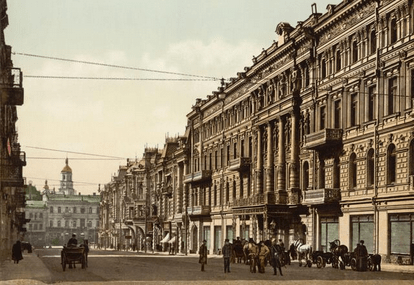
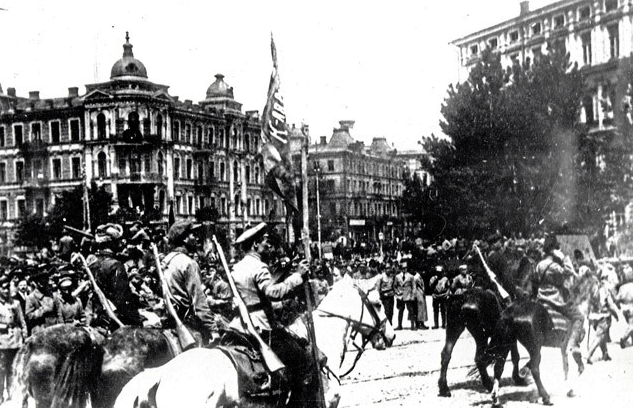
Set in the Kiev of 1919, this historical crime fiction provides a striking portrayal of life in the Ukrainian People’s Republic, newly formed in the wake of the Great War and the Russian Revolution, its independence undermined by a confusing succession of competing Bolsheviks, White Russians, and Hetman-led Cossacks. Perhaps this enables us to identify even more with the perpetual state of uncertainty and disarray which the citizens of Kiev have to endure now.

In the dramatic opening pages, former student Samson Kolechko’s right ear is severed by a passing Cossack’s sabre, which also leaves his father lying dead in the street.  On returning to the scene, Samson finds that his father’s shoes have been stolen, but his wallet remains, stuffed with banknotes, although some are useless, having been replaced recently by yet another new regime’s currency .

When his flat is requisitioned by a couple of corrupt Soviet soldiers, who use it to store stolen goods, Kolechno fears for this life. By a rare stroke of luck, his ability to write coherent reports gains him employment as a detective at the local police station. Intrigued by a curious silver bone among the stolen items, he embarks on a dangerous investigation.

The first in what promises to be a series of “The Kiev Mysteries”, this novel was longlisted for the International Booker Prize, and has been widely praised. Andrey Kurkov was already well-known for his writing, including “Death of a Penguin”, a satire on the political situation in the Ukraine of the 1990s.

Translated from the Russian, the style is sometimes stilted, but this may enhance the sense of a past age. Based on a good deal of research of the period, including a street map of the main locations, “The Silver Bone” relies on black humour and a touch of surrealism, which some may find unnecessary and irritating, to keep us engaged in a world of arbitrary decisions. People survive by keeping their heads down in a world of sudden violence and niggling deprivation. They’re are beaten if they resist attempts to commandeer all but their most basic items of furniture; they are ordered to remove snow drifts in the streets, without being given the necessary equipment. Power cuts are frequent, goods and services are best paid for using some item in short supply, even as basic as salt, if one can get hold of it.

Unfortunately, apart from a few dramatic moments, and an ironic twist at the end which paves the way for a sequel, the solving “mystery” proves a disappointment- convoluted and unconvincing, weighed down with some unduly long or tedious descriptions. Left with a sense that the denouement doesn’t quite “add up”, one cannot muster the energy to trawl back through the text to work out why.

Apart from Samson, the characters are mainly two-dimensional, with a few exceptions like Kholodny who has abandoned the priesthood to become a policeman. When asked by Samson what people will believe in when they forget god, he meditates, “In themselves, in the future, in the power of nature”, sadly a case of overoptimism.

There are parallels between this and the earlier “Death and the Penguin” but the latter is more subtle and original in its quirkiness, contriving to escape censorship in corrupt regime.

“Gros-Câlin (Big Hug) by Romain Gary as Émile Ajar: Crushing defeat

Not content to have been France’s most popular author in the past, Romain Gary resolved to restore his flagging reputation, regain critical acclaim and win for a second time the Prix Goncourt which is only supposed to be awarded once to the same person, by resorting to the ruse of writing under a pseudonym, as Émile Ajar. The publisher Gallimard was prepared to go along with this, and no one else seemed to notice that “Gary” sounds like “burn” and “Ajar” like “embers” in Russian.

Ajar’s first novel, published in 1974” was “Gros Câlin”, or “Big Hug”, the quirky tale of “M. Cousin”, a lonely, Parisian statistician, who purchases a pet python, which will give him the physical contact he craves, and bring him into contact with people drawn by curiosity. Feeding Gros Câlin soon becomes a problem, since his diet of living mice distresses Cousin, particularly as regards a pretty white mouse which he names “Blondine” and resorts to keeping in a box on a shelf out of the python’s reach. When he confides in a priest, he receives the cynical advice to buy a lot of mice to make them seem anonymous and easier to kill, rather like fighter pilots in the war, who found it less disturbing to bomb from a great height people they didn’t know.

This satirical humour may not prove enough of a distraction from the essential poignancy of Cousin’s chronic inability to relate to others, and to read social situations correctly. In the Metro, he chooses to sit right next to the only other occupant of the carriage, with no concept of behaving oddly and invading a stranger’s personal space. At work, he is convinced that Mlle Dreyfus, a work colleague, is in love with him simply because she greets him regularly in the lift, and imagines that they will soon get married.

This novel proved so successful that Gary had to persuade his cousin Paul Pavlowitch to impersonate him in interviews. However, perhaps because I read this in French, I could not fully appreciate all the literary allusions, puns and misuse of words which French readers apparently find so clever and entertaining.

Lacking much of a plot, the narrative soon began to feel repetitive and tedious, particularly as regards Cousin’s visits to prostitutes, which are described in sordid detail, suggesting Gary’s bias toward defending this way of life. The descriptions of Mlle Dreyfus, who comes from Guyana, struck me as being, if unintentionally, somewhat racist.

Towards the end, the novel becomes somewhat surreal, with Cousin appearing to have been driven mad, which like “But it was all a dream” may seem like a cop-out. There are a few interesting observations, like the fact that it might be useful if, like a python, a human being could simply shed his skin periodically to achieve a kind of “rebirth” – also a metaphor for Gary achieving renewed success by writing under an assumed name.

Describing Cousin’s sense of isolation may have been an outlet for Gary’s own state of mind, for only a few years later in 1980, the author shot himself – having left a note for his lawyer to reveal the true identity of Ajar.

“Nickel Boys” by Colston Whitehead: disturbing for good reason.

After his parents’ departure to make a better living in California, Elwood is left to grow up in the Florida of the 1960s in the segregated black neighbourhood of Frenchtown, Tallahassee. He is kept on the straight and narrow by his stern but loving grandmother. A bright, thoughtful boy, he is fatefully influenced by a record of Martin Luther King’s speeches, which he plays obsessively.  His potential is spotted by a teacher, who eases his path to a technical college, the route to a better life.

Through an unlucky chain of events, he is obliged to hitch a ride to his first day at college, and just happens to be picked up by the driver of a stolen car.  With a prejudiced court, the penalty is disproportionate This leads to his incarceration in the grim institution of the Nickel Academy, based  on a  former real reform school, Dozier School in Florida, which operated for more than a century.  It was exposed recently as the scene of much appalling violence against pupils, including unrecorded deaths and burials. Not only this, but the inequity between the treatment of the  black and white students, and the cynical exploitation on the part of local people, including influential members of the local “clan”, Ku Klux implied, in siphoning off food and equipment intended for the boys, added to the injustice which Colson Whitehead clearly felt impelled to make more widely known.

Thinking I had read enough fiction about boys being abused at school for one lifetime, I avoided reading this at first. However, having walked out of the highly praised film version of it, because I could not engage with the technique being used, I decide to read the book in order to grasp exactly what it was about. This would be an unbearably bleak read were it not for the vivid descriptions of a society which kept flagrant inequality alive with a casual, unthinking acceptance, and the author’s flashes of dry, ironic humour, against the odds.  The novel resembles his debut novel, “The Underground Railway” in tending to digress into the lives of various minor characters, but is different in the authentic ring of its sense of place, rather than any hint of magic realism.

He also lightens the plot by shifting forward in time for much of the final Part 3, to show us the life of an adult Elwood who has survived the Nickel Academy to make a living, but we see the permanent scars in apparent difficulties in sustaining emotional relationships, and no evidence that he has managed to fulfil his intellectual promise.  Sometimes, the narrative drive seems to lose momentum, but the plot comes into sharp focus with a dramatic and unexpected twist at the end.

I was interested to read Colston Whitehead’s description of the two central characters as the  “two different parts of my personality”, with Elwood Curtis being “the optimistic or hopeful part of me that believes we can make the world a better place if we keep working at it”, and his friend Jack Turner, “the cynical side that says no—this country is founded on genocide murder, and slavery and it will always be that way.”

“The Nickel Boys” is a book that all young white people would benefit from reading, to gain an understanding of the wrongs suffered by black Americans over time. Whitehead is a talented writer who merits being one of the few to win the Pullitzer Prize twice.

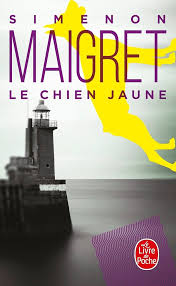
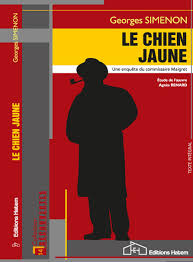
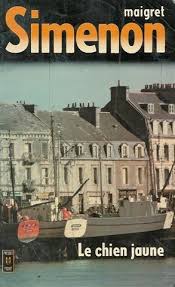
“Le Chien jaune” (The Yellow Dog) by Georges Simenon – promising but Simenon not at his best

Maigret needs no introduction, and the choice of “Le Chien jaune”, popular enough to be made into a film only a year after its publication in 1931, seemed a promising choice for a French book group.
It began well, with a customs officer observing the murder by an invisible assassin of a well-liked wine merchant shortly after he leaves a hotel bar. Summoned to investigate, as Maigret sits in the bar, he witnesses an attempt to poison the dead man’s colleagues. Meanwhile, a yellow dog, origin and owner unknown, has begun to lie by the till.

There was general agreement that Simenon shows once again his gift for capturing the ambience of a place, in this case the Brittany fishing port of Concarneau, which in the early 1930s may well have been the kind of provincial, inward-looking community where fear and prejudice could easily be aroused and manipulated. The impact of the journalists, descending en masse from national newspapers and bent on sensationalising events, is well portrayed.

However, there is something lacking. Most of the characters seem quite wooden, stereotypes or caricatures, while the plot plods through a disjointed series of events, with some of the most dramatic scenes described by third parties.

There is too much reliance on implausible scenes, as when Maigret and Leroy just happen to be sitting on the hotel roof when an intriguing meeting between two characters is visible through a nearby window. Maigret’s public admission of a criminal act for which he is never charged, and turns out to have made to protect a suspect for whom he feels sympathy, is also ludicrous.

Maybe this is unfair, in that Simenon, arguably the French (he was actually Belgian) equivalent of Agatha Christie, was a pioneer in making detective fiction highly popular. By creating Maigret as such a flawed character, needlessly brusque, uncommunicative and high-handed, perhaps he set the trend for dysfunctional but talented detectives. In this case, Maigret’s talent seems hard to justify: while informing his hapless sidekick Leroy that he is acting on intuition rather than following procedures, the fact that he could in no way have deduced so accurately and then explained the details of the complex crime so clearly in the usual “denouement” scene leaves the reader feeling a bit cheated.

If detective novels have become so much more sophisticated and dramatic in recent decades, do we still want to read about Maigret? Credited with having written more than 400 novels, Simenon’s many “romans durs” (hard novels) like “Le Train” or “Le Chat” seem to have more merit: psychological novels with tight structures and clear, spare prose, a wide range of themes and contexts and “real” characters.

Simenon’s extraordinary life is also more gripping than this encounter with Maigret.

“The Quiet American” by Graham Greene: mixed motives

Fed by fear of the draft which deterred young Brits from going to America, and a spate of excellent but harrowing films, my memories of the Vietnam War are limited to the doomed efforts of the American government to drive the Communists out of the north in the 1960s. In fact, this war lasted from 1955-75, and was preceded by the shorter first Indo-China about which my knowledge is very shaky. This is the period in which Graham Greene sets his classic, “The Quiet American”, to which I turned with a huge sense of relief after struggling through a few superficial, over-hyped modern novels.

The narrator is Fowler, a cynical British journalist, although we never quite learn what disappointments have driven him so far from his native land. He finds solace in opium and his beautiful young mistress Phuong – a relationship which may seem exploitative to readers seventy years on. He reports objectively on the attempts by the French to prevent the insurgency of the Communist Việt Minh into their Far Eastern colony, showing great foresight in observing that the increasing American involvement will come to nothing, and “in five hundred years there may be no New York or London, but they’ll be growing paddy in these fields, they’ll be carrying their produce to market on long poles wearing their pointed hats”.

Fowler is therefore irritated by what he sees as the naivety of Pyle, an idealistic young American, newly arrived in Vietnam to work for the Economic Aid Mission. It becomes apparent that he may even be a menace, through his desire to meddle in the situation via direct action, by promoting a “Third Force”, as advocated by a writer he much admires.

As Fowler tries to warn him, “We are the old colonial peoples, Pyle, but we’ve learned a bit of reality, we’ve learned not to play with matches. This Third Force – it comes out of a book, that’s all. General Thé’s only a bandit with a few thousand men, he’s not a national democracy”.

Fowler’s growing animosity is fuelled by Pyle’s infatuation with Phuong, whom he wishes to marry and save from what seems to him a sad fate if she stays with Fowler – too old and separated from a wife who refuses to divorce him.

It is not a spoiler to reveal Pyle’s murder, which is reported at the outset. The intrigue lies in the revelation of how this comes about, and the question of the extent of Fowler’s involvement in it, and of the degree to which an action can be justified if the motives are suspect. This psychological drama plays out against vivid images of life in Vietnam of the 1950s, from the cities to the tense encounters with the enemy in the countryside. As a reader, one can simply be absorbed in Fowler’s personal crisis, without always being entirely clear about the various power groups involved. On the other hand, the novel is an opportunity to understand a past conflict more clearly, and consider parallels with the present.

In around 180 pages of tight prose peppered with wry observation and convincing dialogue (except perhaps when Fowler is telling Pyle about love while the two men take refuge in a watch tower), Greene transports us into a different world. To absorb all this, the book needs to be read slowly, more than once. It is a masterpiece, perhaps in danger of being forgotten beneath piles of more recent mediocre undemanding fiction.

Les Possibles by Virginie Grimaldi: French hen lit

When a carelessly discarded cigarette end sets fire to his home, Jean takes it for granted that his daughter Juliane will take him in indefinitely. Her stolid husband Gaëtan tolerates the situation, five-year-old Charlie is delighted by his grandfather’s childlike antics, but Juliane is exasperated by the often implausibly eccentric and inconsiderate behaviour which in the past drove her mother to divorce Jean.

It is only when he begins to show signs of dementia, likely to advance rapidly, that Juliane begins to appreciate Jean’s zest for life, and freedom from the constraints of caring what other people think. With her own lack of self esteem, she could benefit by learning from this. So she can laugh nostalgically with her sister of the time when, to slay a child’s nightmares, he vanquished an imaginary dragon in the downstairs loo with the aid of the garden hose.

Largely “rave reviews” from readers extol this novel’s humour and “feel good” factor, while the darker aspects are airbrushed. So the last chapter (in the original French), «Stairway to Heaven» – Led Zeppelin, is a clear reference to the inevitable outcome, but Jean’s last days are completely glossed over. This milking of a potentially moving situation, with its focus on sentimentality and denial of painful reality seems superficial, even dishonest.

Published in 2015, French author Virginie Grimaldi’s first novel was an instant bestseller and by 2022 she had produced eight more, heading up the list of “the most read” novelists in France. Reading “Les Possibles” for a French book group, I gained some useful vocabulary, but the novel seems quite formulaic: eighty-two short chapters, often barely three pages in length; a string of incidents padded out with “tick box” modern issues to which readers can relate – narrator’s eating disorder, dysphasic son (who displays little evidence of this) lesbian sister and so on. The final chapters which focus on a US road trip along Route 66 are each titled with the gimmick of the name of a pop song in English, linked to the story line, such as «Little Girl Blue» – Janis Joplin, a cue for the sisters’ shared recollections of Jean from their childhood.

The Dictionary of Lost Words by Pip Williams: “Understanding why some words are more important than others!”

Motherless Esme spends a good deal of time at her father’s workplace – the Scriptorium, a somewhat misleadingly named shed in the garden of Dr. Murray, who in 1884 embarked on the mammoth project of creating the Oxford English Dictionary (OED) with the aim of filling the gaps in Samuel Johnson’s famous work.

An inquisitive child, Esme collects the postcard-sized slips of paper which fall into her hiding place beneath a work table. Each slip contains a word submitted for consideration with a definition or quotation containing it. She forms the habit of keeping for herself words which she has been told will not appear in the dictionary, since there is no written record of them to provide the necessary “evidence”.

As an adult, Esme chooses not to become actively involved in the “votes for women” campaign, and she seems to accept fairly meekly the fact that, simply through being female, she is unable to gain qualifications and advance as a lexicographer or editor, despite her obvious knowledge and capability. Yet her unusual childhood makes her unconventional in surprising ways, so that, to keep a measure of personal freedom, she makes a radical and painful decision of the kind she may regret for the rest of her life.

Increasingly aware that the OED reflects and is limited by the vocabulary of educated men brought up in the Victorian era, Esme finds an outlet for her suppressed frustration and her curiosity through acts of quiet defiance: collecting and creating a written record of the words which ordinary, often illiterate people use in daily conversation, unlikely to be heard by lexicographers in the strongly class-divided society of the time. She realises that words used by and about women in particular are missing from the OED, including those considered obscene, but in common use. So “knackered” is noted as an overworked servant’s graphic description of feeling exhausted. “Dollymop” is a pejorative term for a prostitute, or an actress who is presumed to be one.

One might criticise the author for applying “modern” attitudes to the situation in the early C20, yet through Esme she is making a thought-provoking point.

Not until reading the Author’s Note at the end did I appreciate the extent of her impressively detailed research. Imaginary characters like Esme, and the loyal servant and friend Lizzie who does her best to be a mother to her, are interwoven quite skilfully with the real Doctor Murray and his family, together with Esme’s godmother Ditte and her novelist sister Beth, both volunteers who contributed words to the cause.

One of the most interesting aspects is the continual definition of words. I’ve learned that “cushy” comes from the Hindu word “khush” for pleasure, while “bumf” was apparently used in the First World War for scraps of paper needed for the trench latrines.

As an Australian writer, Pip Williams manages to weave in that the descendants of the Karuna people did not lose their natives language as a result of colonisation, because German missionaries made the effort to consult with the Aboriginal men, and write it down for the record.

Although I was drawn by the originality of the theme, the narrative frequently drags under the weight of repetition and detailed banal descriptions. It could be argued that this conveys the nature of Esme’s life in what is on one level a deeply realised fictional autobiography. There is excessive sentimentality for my taste, and some unconvincing plot developments with too many coincidences, or a tendency to “come to nothing”, except to pad out a book which often seems overlong.

It is worth making the effort to finish this novel, which should provoke a lively, wide-ranging discussion, making it a good choice for a book group.

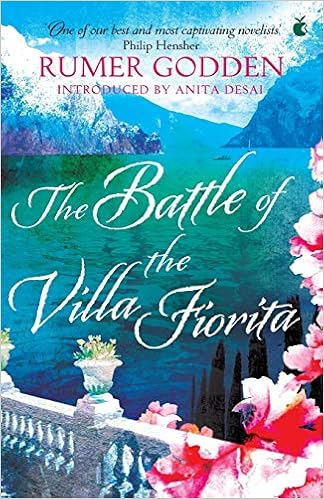
“The Battle of the Villa Fiorita” by Rumer Godden – unintended consequences

Cocooned in a middle-class country house world of around 1960, conventional, dutiful and considered dull by her “friends”, Fanny’s life revolves round her three children or her garden when they are at boarding school, while her reliable if also somewhat dull husband Darrell is often working abroad. When, by chance, she catches the eye of a charismatic film director called Rob, she cannot resist the realisation of what a totally different life with him could be. Divorced by Darrell, who also gains custody of their children, Fanny is suppressing her guilt during her stay with Rob in an idyllic villa on the shores of Lake Garda, when her two younger offspring, eleven-year-old Caddie and Hugh, who is fourteen, show surprising initiative and guile in arriving unexpectedly to persuade her to return “home”. Delighted by the fact that they still “want” her, the upsurge in her maternal instincts inevitably creates tensions in her relations with the pragmatic and somewhat cynical Rob, who also turns out to have a daughter Pia who proves as opposed to his planned marriage as are the other children. Unintended consequences of their actions and the unpredictability of Lake Garda itself, build up to a dramatic climax. How can the children possibly succeed in splitting Fanny and Rob who clearly love each other. If they do, will they live to regret it?

What may sound “Mills-and-Boon”, and I would be interested to know if this novel appeals to male readers, is saved by the fact that the prolific author Rumer Godden was an expert storyteller, who mixes wry humour and poignancy, giving all her characters distinct personalities, and entering into the minds of the main ones, so that one understands their motivations, and feels some sympathy even when disliking them, or vice versa. She also creates a strong sense of place, in this case mostly of Lake Garda, which tallies with my memories of, say, the lakeside lemon groves at Limone, Malcesine with it steep streets and castle below the grassy slopes at Monte Baldo, the sudden dramatic storms which descend on the lake, plus it is interesting to read descriptions of an area before it was inundated with modern tourism.

This novel will probably seem dated, although it brought back a vivid memory of the late 1950s when my tight-lipped mother would not allow mention at the dinner table of the divorce of a school-friend’s parents. It seems that Rumer Godden’s own divorce of her first husband and realisation of the “turmoil” this created for her daughters was the genesis of this highly fictionalised account, also making the writing more authentic. On reflection, I was satisfied by the ending which leaves the future open and uncertain, as is the case in real life.

My only criticisms are over some aspects of the portrayal of Pia and Hugh, which it would be a spoiler to explain. Also, in the latter part of the novel, perhaps the author’s own conversion to the Catholic faith may have created a sense of guilt and retribution for sin which undermined her insights as a writer.