Rose by Tatiana de Rosnay: Warped Vision

Rose (French Edition) by [Tatiana de Rosnay, Raymond Clarinard]

It is well-known how the ambitious “beaver” Baron Haussmann implemented Emperor Napoleon III’s vision of a modernised Paris. Elegant C19 classical boulevards replaced insanitary slums and overcrowded alleys dating from medieval times. On reflection, the wide new avenues must also have required the demolition of sound buildings, some of historic interest, destroying close-knit, thriving communities in the process. Not all the 350,000 people displaced needed to be rehoused, or benefited from the upheaval.

Rose Bazelet, the heroine of this novel, is one such person. Living her entire life in central Paris, mostly in the family home of her husband in the Rue Childebert, of which photographs can still be found on the internet, she fondly imagines that her house will be protected by its proximity to the ancient Church of St Germain-des-Prés. It is a shock to the whole community when the letters arrive, bluntly announcing the planned demolition of their properties. All resign themselves to accepting the compensation offered to go and start a new life, as Rose’s own brother has already done in another district already razed for redevelopment. Unable to leave a house suffused with memories of her husband and son, Rose has other plans, so we find her hiding in the basement, reading treasured letters, revisiting her past life, and writing a few unexpected confessions to the husband to whom she still feels exceptionally close a decade after this premature death.

This novel is at its best in powerful descriptions of the vast building sites which resemble war zones, where all the old landmarks have be obliterated, leaving only gigantic holes bordered by unstable ruins with hanging strips of wallpaper, doors swinging on hinges and steps spiralling into a void – hallucinatory images. The author weaves the main points in Rose’s essentially narrow bourgeois life with actual historical events: the painful birth of the daughter Violette with whom she never manages to bond takes place against the backdrop of street riots, part of the July 1830 uprising to oust the Bourbon king Charles X. The bookseller who rents a premise on her ground floor introduces the widowed Rose to the best-selling book at first considered such an outrage to public morals and religions that its publication was blocked: Flaubert’s “Madame Bovary”, no less. The pervading sense of nostalgia, both for a lost community and way of life, mingled with longing for those one has loved, is very strong. We also see how Rose’s personality develops in later life, as her experiences make her both more open minded and self aware.

This may be too saccharine and mawkish at times for some tastes, although it could be argued that the tone is authentic for a C19 woman who has led an essentially sheltered, conventional, comfortable life with limited experience and education. However, a sudden switch to the shocking or macabre, perhaps when least expected, adds some depth and bite to the tale.

I was for the most past irritated by Rose’s inability to accept reality like everyone else, and move on. However, apart from the fact that the plot obviously depends on this, I have to admit that Tatiana de Rosnay succeeds in evoking empathy with Rose rather than simply regarding her as self-absorbed, even selfish. A final twist also adds to the aspects for discussion which make this a fruitful choice for a book group. I read it in French translated from English (the author is Anglo-French), which gave it a more authentic feel.

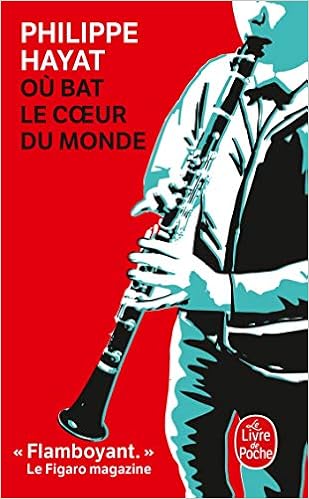
Où bat le cœur du monde by Philippe Hayat – Where the world’s heart beats or escaping through music

In 1930s Tunisia, still a French colony, Darius Zaken’s pious father plans to leave the Tunis ghetto to set up his bookshop in the modern French quarter where his son can attend the lycée. An appalling incident shatters his dreams, leaving Darius lame and too traumatised to speak. Against the odds, his mother Stella dedicates her life to his getting a good education which will lead to a professional job in mainland France, but a chance meeting with a spoilt rich girl called Lou gives him other ideas. Taking him under her wing, she introduces him to the louche world of jazz, and he develops a passion for the jazz clarinet, for which he has a remarkable talent. To his bewildered mother, jazz is a meaningless cacophony.

With the onset of World War Two, the arrival in Tunis of black American jazz musicians attached to the US Army gives Darius the change to slip away to the United States. Here he can realise his talent eventually, but in a harsh world of prejudice and segregation, where jazz is regarded as the preserve of the black population, and many of the most talented musicians addicted to drink, heroin and cocaine. A sensitive soul, Darius attracts the sympathy of a succession of women: his mother, Lou and ultimately Dinah, an astute black American.

Focusing on the first part of Darius’s life, when he is striving to succeed, this novel is episodic, leaving the reader’s imagination to fill in the gaps. Philippe Hayat succeeds in conveying a sense of the appeal of jazz, even to someone like me who does not care much for it, but his descriptions tend to be too long, repetitious and overtechnical. I was prompted to look up the parts of a clarinet, the nature of a ride cymbal, the meanings of various musical terms like “anatole”, chabada or Lydian scale, together with researching the lives of celebrities who inspired Darius and in time actually played with him: Dizzy Gillespie, Lester Young, Charlie Parker and Billie Holiday who proved as tragically troubled in their often too short lives as Hayat describes.

This novel has a strong sense of place, be it interwar Tunis, Sicily under the WW2 Allied invasion, or postwar New York. The complex mother-son bond between Stella and Darius is well-described and moving. There are some striking, powerful dramatic scenes.

On the downside, the narrative drive is undermined by too many passages which are overlong and frankly dull. There are a few digressions too ludicrous to ring true, like the brothel where Darius is employed to play his clarinet to clients through holes in the wall through which he can view them, or Stella’s employment at a bank where she somehow becomes a financial expert in record time. Is a loss of speech through shock likely to be permanent? It is of course symbolic in that Darius expresses his emotions through the international language of music instead.

The plot structure seems weak. The opening chapter showing Darius as an old man giving his last performance, aided by the faithful Dinah, is not an engaging start, not least because we have yet to learn their backstories, and also destroys any dramatic tension since one knows from the outset that Darius will succeed.

In short, parts of this book are excellent but one has to wade through some dull passages to find them.

Six Fourmis Blanches by Sandrine Collette – Tempting Fate

Six fourmis blanches (Sueurs froides) (French Edition) by [Sandrine Collette]

In an isolated Albanian mountain valley steeped in superstition and reputed to be cursed, Matthias is believed to have inherited the gift of keeping bad luck at bay before a wedding or suchlike, by choosing a suitable goat to hurl as a sacrifice from a high point to appease evil spirits – this is not a book for animal lovers. Despite the respect, even wary awe in which he is held, when Matthias inadvertently falls foul of the local mafia-style boss Carche, his only option is to abandon everything and go on the run.

The parallel storyline which will eventually converge with it, starts out in a much lighter vein. Lou and her partner Elias, a pair of young urban French professionals, follow an impulse to spend a long weekend trekking in the Albanian mountains in early spring in the company of four other compatriots whom they barely know, led by Vigan, a hardy-looking local guide who inspires confidence and is even fancied a bit by the two women in the group. After a day of idyllic wandering, the walkers wake to a world transformed by a freezing blizzard. The novel becomes a psychological thriller in which they are challenged beyond their capacities both physically and mentally by the forces of nature and an unrelenting sequence of mishaps. The group members prove all too human in their flaws, apart from the almost saintly Elias.

The author is skilful in creating a powerful sense of the intense cold, the mood swings between giving up and fighting on against the odds, the changed perceptions in which malign spirits and devils suddenly do not seem so preposterous, the dilemma between instinctively saving oneself and cooperating in risky efforts to save others. In a thriller which does not flinch from the macabre, it is not at all clear until the last page, and possibly even then, who will survive and how.

This novel works on two levels: both as a well-plotted page-turner thriller with a strong sense of place (admittedly frequently far-fetched, particularly the dénouement, but that is par for the course in this genre) and also a perceptive in-depth study of character in the case of the alternating narrators, Matthias and Lou.

I read this in the original French and imagine it would need a good translator to pack the same punch in English.

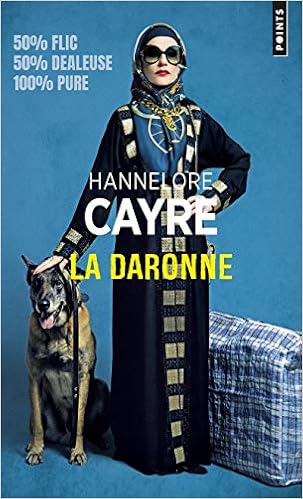
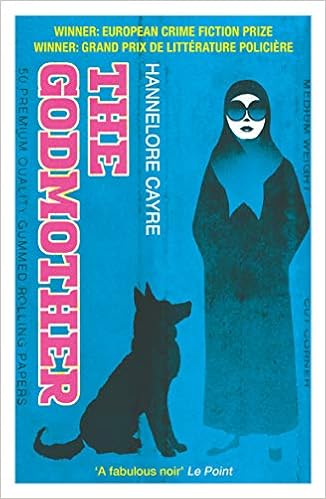
La Daronne or The Godmother by Hannelore Cayre: “The sins of the fathers”

Widowed young, now in her fifties, the misnamed narrator Patience finds that her work as an Arab interpreter/translator for the Paris judiciary does not pay enough to cover the care home costs for her demanding aged mother. Listening to the recorded conversations of suspected Arab drug dealers under police surveillance, her imagination is caught by a close-knit Moroccan family who have switched from legal farming to growing high grade khardala, or hashish, and when she knows that a stash of this has been hidden to evade near Paris to evade a police search, temptation proves too great.

Can she find the precise location of the drug, aided by DNA (ADN in the original French), a retired police sniffer dog she has saved from the standard fate of euthanasia when no longer useful? Will she succeed in selling the drug on and laundering the proceeds without being either detected by the police, including the senior office Philippe who happens to be her lover, or exposing herself to the vengeance of thwarted dealers?

Apart from being a crime thriller which depends too heavily on coincidences and glosses over plot flaws, this is also a psychological study of a somewhat cold, calculating woman, lacking in empathy, who on her own admission has no friends, only acquaintances, since she makes no effort to hide her impatience with people she finds slow or boring. Apparently only capable of feeling love for her dead husband or dumb animals – the first luxury she buys with her illgotten games is an expensive collar for DNA – she is secretly repelled by Philippe’s lovemaking and displays a troubling lack of compassion for her mother. Has her personality been moulded by an amoral, emotionally deprived upbringing with her criminal wheeler-dealer Tunisian father and Jewish mother traumatised by time spent in a concentration camp? Apart from holidays in luxury hotels abroad, Patience grew up on a property next to a motorway, where unwelcome intruders were shot down by her father, to be buried in a corner plot where the grass grew abnormally green, fed by a phosphate-filled soil – a typical macabre allusion.

Patience’s cynicism can be amusing, as when she cites Philippe’s great fault: he believes in God. “If he’d told me he believed in a human destiny governed by a plate of celestial noodles, I couldn’t have found it more ridiculous”. She is acutely aware of the irony of situation: criminalisation of cannabis stimulates “the web-of drug-taking which drowns France” on one hand, and costly legal action on the other, as the police and lawyers pursue the dealers who are selling drugs for inflated prices to their children. Still, at least it creates employment.

The pace seems quite uneven, with abrupt digressions into Patience’s past life interrupting the narrative flow. Tedious detail at some points contrasts with overly rapid treatment of the occasional highly dramatic incidents at others. Most of the characters seem too highly exaggerated to be either convincing or engaging. The result is a patchy black farce which sits oddly with potentially moving explorations of human nature.

“La Daronne”, meaning “mother” or “boss lady” in French was presumably translated as “The Godmother” in the mafia sense of the word. Seemingly written with a film in mind, it has been dramatised with the title “Mama Weed” and Isabelle Huppert in the lead. Is this the kind of book which “works better” in the visual images of a film, perhaps losing some complexity in the process?

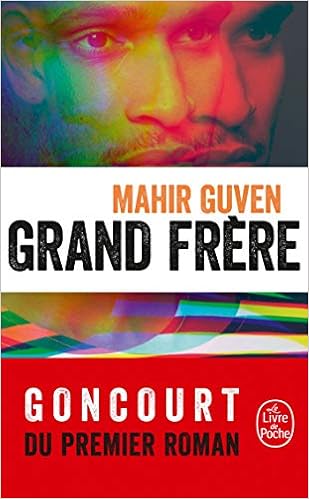
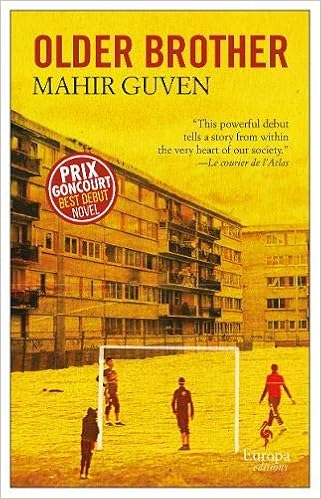
Grand Frère or Older Brother: staging a comeback

Two brothers, unnamed until the final twist of the almost all-revealing epilogue, grow up in Paris caught between two very different cultures: their volatile left-wing father fled from Syria to France where, having abandoned his studies, he married their Breton mother who died tragically young when they still needed her stable influence.

The narrative swings between the two men, helpfully printed in different fonts although their written styles are very different. Older Brother (Grand Frère) slogs for a “VTC” app-based Uber-like chauffeur-driven car hire company, much to the fury of his father who drives a conventional taxi under threat from the hi-tech competition.

Younger Brother, probably more intelligent and reflective, is an operating theatre nurse who disappears without warning to Syria, where, if he is to be believed, he simply hopes to gain more job satisfaction, with a better prospect of progressing to work as a doctor than in the prejudiced environment of a Parisian hospital. This move shocks his brother and father, not least because they come under suspicion as supporters of a possible terrorist.

After a slow-paced scene-setting start, the novel “takes off” when younger brother suddenly reappears after an absence of three years, presenting his sibling, already under pressure as an involuntary police informer, with a problem: should he shop his brother, or make himself accessory to an assumed terrorist by helping him?

Reading this in the original French, I found the first part hard going, partly owing to the large amount of French slang and Arab colloquialisms helpfully often translated in the glossary at the end – there may even be some of the words the author enjoys inventing! There is also Older Brother’s tendency to express himself in a stream of marijuana-befuddled consciousness. His is a very macho, chauvinist cochon culture: still in her mid-twenties, his “woman” has breasts hanging to her navel, to give a flavour of this. Yet his flow provides a vivid picture of the immigrant communities with the older men grafting to make a living in Paris, while their children channel their talents into rap, or fall under the spell of silver-tongued religious fanatics. The author’s fascination with people-watching feeds the sharp observations of the passengers whom Older Brother transports round the capital, and fragments of his homespun philosophy on life show surprising flashes of insight.

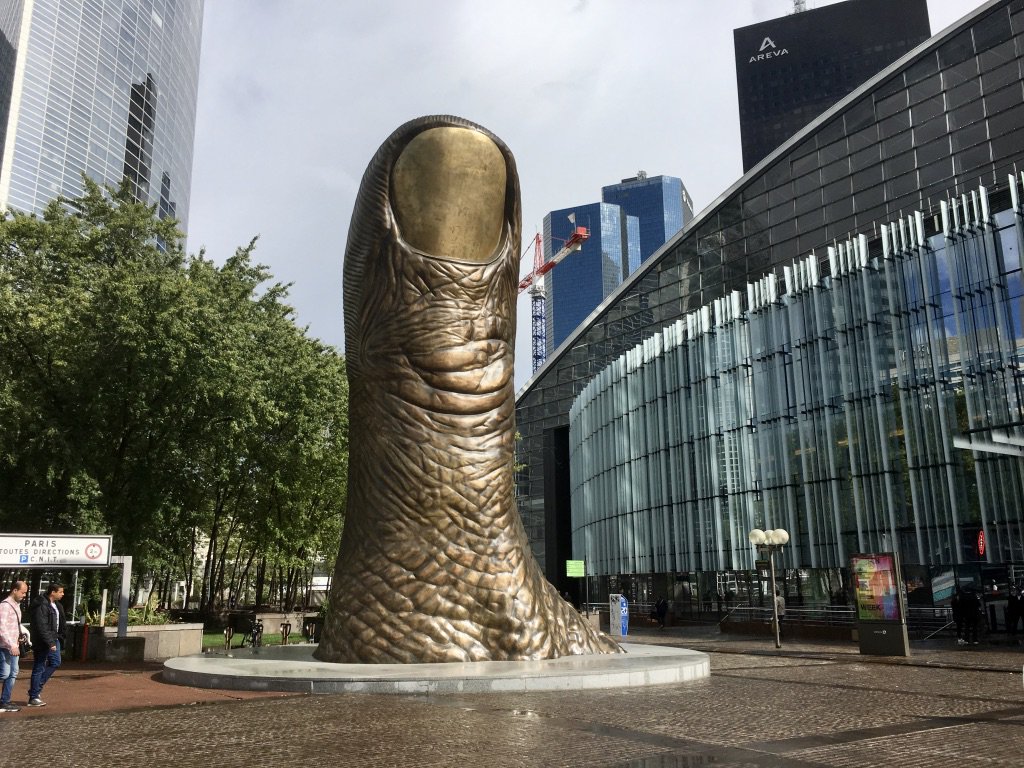
It’s worth looking up any reference one does not understand: I was intrigued by the detailed description of a thumb-shaped sculpture in the La Défense area which actually exists in Google images.

soundlandscapes on Twitter: "'Le Pouce': César Baldaccini's iconic 40-foot  thumb in La Défense this afternoon.… "

An interesting talk by the author, himself the children of immigrants from Kurdish Turkey, which seems to have made him more open to challenging conventions of all kinds, helped me to appreciate this award-winning first novel more. The French which I often found so hard to grasp is apparently the language of many young people in France, with immigrants too often feeling alienated or undervalued. Of course, much of this authentic flavour would be lost in translation, but the novel would be easier to read!

The accelerating pace to a dramatic climax encourages one to keep going, but it is the epilogue which, even if not an entirely original ploy, provides what seems on reflection to be the only satisfactory ending, also a resolution of some implausible aspects of the plot which troubled me. Its open-endedness gives scope for the author to write a sequel.

“L’Été Circulaire” or “Summer of Reckoning” by Marion Brunet

In the picturesque setting in  and around Cavaillon, the “capital of the cantaloupe melon” and gateway to the Luberon in Provence, sixteen-year-old schoolgirl Céline, too pretty and promiscuous for her own good, has got pregnant, but refuses to divulge by whom, not even to her more savvy sister Jo, let alone to her father Manuel when he tries to beat the truth out of her.

Described on the cover as a “policier” or crime novel,  but really more of a psychological drama, one  could dismiss this as a light potboiler,  when in fact it conveys a vivid sense of place, a telling portrayal of what it feels like to be an adolescent, and the convincing development of a wide range of different characters, arousing sympathy for all of them despite their all to evident flaws.

There is the hard-working, hard-drinking builder Manuel who finds it easier to express frustration and rage through his fists.  Despite his own family having migrated from Spain, he feels no empathy with the Arab migrants a few pegs down the pecking order, which feeds his resentment of the youth Said who drives a hard bargain fencing the antiques Manuel steals to supplement his income.

Then we have his wife Séverine, steered too young into a shotgun marriage,  claiming to be content with her lot but destabilised by a single friend’s apparently more glamorous lifestyle together with the shock of becoming a grandmother at thirty-four.

The undercurrents are gradually exposed and clues dropped.  As Céline’s pregnancy becomes more obvious, relationships with her school-friends change. Accustomed to admiration, she becomes an object of curiosity and mockery. “Making herself useful” on her grandparents’ farm, it seems that her grandmother, surprisingly tolerant of her pregnancy, is mostly disappointed to learn that the child will not be  boy. Her childhood innocence is fractured further by the knowledge that her grandfather has employed migrants without papers so that he can avoid paying them by turning them over to the police when their seasonal work is done.

Jo, who surprises her teachers with her academic ability, “given her background”, puzzles her father by her desire to watch plays at the nearby Avignon Festival, but  is soon disillusioned by the privileged, casually  friendly  group of middle-class young people she encounters.

Summer of Reckoning by [Marion Brunet, Katherine Gregor]

Gradually building to a dramatic  climax, the novel ends as it began at the annual summer fair, at which, beneath an apparently rather similar surface, much has changed in what the English translation of the title aptly calls  “A Summer of Reckoning”.

“Ça Raconte Sarah” or “All about Sarah” by Pauline Delaboy-Allard: Crazed Love

Ca raconte Sarah (Double t. 121) (French Edition) by [Pauline Delabroy-Allard]

The narrator  whose name we never learn, so I shall call her “N”,  is a Parisian teacher with a young daughter, abandoned recently by her husband,  who gets embroiled in an intense love affair with Sarah, a talented violinist who plays in a string quartet at international concerts. Extrovert, capricious, out to shock, Sarah cuts a striking figure with her distinctive, mysterious beauty,  nose hooked like a bird’s beak,  green eyes the colour of malachite, or absinthe, hooded like a serpent’s – this gives a flavour of the book’s extravagant flow of words to describe her in minute detail. Quite what Sarah sees in the comparatively ordinary N, whether she genuinely reciprocates the passion, is never made clear, but it seems neither woman has been involved in a lesbian relationship before.

All About Sarah by [Pauline Delabroy-Allard, Adriana Hunter]

The novel succeeds in depicting an obsessive love, at times mixed with hate in the first part, followed in the second half by the intense grief of an irretrievably lost love, evoking a bizarre sense of relief  mingled with guilt. This is achieved by continual repetition of incidents and phrases with a hypnotic effect, often like the variations on a musical theme.

The prose switches between a poetic flow and dry definitions incongruously inserted in the text to create some contrived, heavy-handed,  metaphors as when Sarah, having stated, “I think I’m in love with you”, strikes a match, which gives off the odour of sulphur, followed by a definition of sulphur, “symbol S”, followed by a description of Sarah, “symbol S”. Another occurs in Trieste where N, who has taken  refuge alone, is troubled by an intense moaning which turns out to be the local wind, the bora, “which drives people mad”, but in her increasingly demented state, N observes, “I know it isn’t the wind, but its you, Sarah who is howling…you’ve found me and your will not leave me in peace”.  At this point the novel takes on hints of a gothic horror tale.

The relationship takes its course in a kind of vacuum in which N’s daughter, the ex-husband who wants partial custody, the interim Bulgarian boyfriend, colleagues at work  who might be wondering what is afoot remain ciphers, blank slates. Rather than become irritated by the implausibility of all this,  one has to assume that the focus on the love affair to the virtual exclusion of everyone else is intentional to heighten its  claustrophobic intensity. However, it becomes so extreme and long drawn out that I never really felt myself engaged in it. Perhaps a more tightly written novella would have made more impact.

It seems that, herself obsessed by Margaret Duras, author of “Hiroshima mon Amour”, the author tried to portray a passionate affair in imitation, perhaps appearing a little pretentious and “pseudo-literary” in the process.

We know from the prologue that the love is doomed, since the N  is lying in bed with her love as she  dies – but at the end of the novel we are left wondering whether Sarah really did die, and if so how, while N’s fate is also ambiguous. Sarah  certainly seems to be mentally unstable,  and the love affair seems to drive N into a state of madness, so that at the end she in a sense becomes Sarah, in  what seems a circular narrative. It seems that the author wishes to leave the interpretation of the novel open to each individual reader.

Le Mystère Henri Pick (The Mystery of Henri Pick) by David Foenkinos: picking over the traces

Ambitious young Parisian book editor Delphine Despero falls for moody young writer Frédéric Koskas, but despite her efforts in getting his first novel published quickly amid much hype, it proves a flop. On a visit to her parents in Brittany, the couple are intrigued by the local bookstore to which writers bring novels rejected for publication, where they discover a literary masterpiece written by one “Henri Pick”, who turns out improbably to be the recently deceased manager of the local pizza restaurant, recalled by his wife and daughter as neither a great reader nor known to write more than an occasional shopping list. The publicity storm created by this threatens to blow off course if not capsize the lives of all concerned.

At first, I found this book lightweight and contrived, and was motivated to read on only by the fact it was my book group choice, which at least served to improve my French. I was mildly irritated by the unnecessary footnotes which interrupted the flow, but more so by the pretentious tendency to write knowingly about the world of publishing, the pain of the writing process, and to name-drop shamelessly writers and books which a reader needs to be excessively “well-read” to appreciate. I suppose some of the Wikipedia-swallowing digressions are interesting, as in the poignant description of the real-life photographer Vivian Maier who worked for a year as a New York nanny, producing and storing thousands of Cartier-Bresson type photographs, sometimes without even developing the film, which remained undiscovered and unrecognised in her lifetime.

I am also uneasy about authors who, far from denying that characters bear any resemblance to living persons, actually include very much alive celebrities in their books – including in this case Jean-Paul Enthoven who by chance ironically figured in the press over his rejection of his Raphael’s overly autobiographical novel the day before I encountered him in this quirky novel.

Although my initial reaction has not fundamentally changed, at some point the whimsical humour did strike a chord with me – I think at the point when a character is dumped by his lover for scraping her Volvo car not once but twice, and thereafter is obsessed with Volvo cars, which he discovers are all without exception scratched. Foenkinos also succeeded in arousing my curiosity as to who really wrote the masterpiece.

I realised eventually that it is unimportant that “The Last Hours of a Love Story” somehow linked to the death of Pushkin sounds pretty unlikely to become a bestseller, and is probably intended to parody the publishing world’s hyping of often mediocre books. “The Mystery of Henry Pick” is really a series of psychological studies: the vitriolic book critic who finds himself friendless when he loses his job and comes to realise that he has been venting his own frustration over his inability get published; the woman whose impulsive affair with a stranger helps her to see how she has allowed her life to go awry. It is all about how and why people manipulate situations, fail to communicate with each other, or at some point come to take stock of how they have lived, all this conveyed through often humorous insights.

With talk at one point of “making a Biopick”, this novel lends itself to be made into an entertaining film, as has been the case. The setting in Crozon on the west coast of Brittany must also have boosted its tourist trade.

“Désorientale” (Desoriental) by Négar Djavadi – Culture shock

Disoriental by [Négar Djavadi, Tina Kover]Born into an Iranian family of intellectuals who opposed the regimes of both the Shah and Khomeini, author Négar Djavidi arrived in France aged 11 after crossing the mountains of Kurdistan on horseback with her mother and sister. This gives an authentic ring  and some autobiographical elements to her acclaimed first novel.

It is a family saga covering four generations of an Iranian family  over more than a century of dramatic political and cultural change from exotically named feudal lord  Montazemolmolk living in the northern region of Mazandaran, with his harem of more than fifty bickering wives to grandson Darius, a dissident intellectual whose writing against first the Shah and then Ayatollah Khomeini forces him into exile in Paris with his family, including daughter Kimiâ, the narrator.

Much of the story is related in the form of flashbacks or imagined reconstructions of anecdotes Kimiâ has heard about her relatives, recalled as she sits, clutching a tube of sperm, in the waiting room of a Paris fertility clinic. This rather clunky plot device adds to the reader’s frequent confusion over the large number of often thinly sketched characters, like the brothers of Darius who are referred to by numbers 1 to 6 (there is a list of key family members at the back which you could miss until too late) and continual lengthy digressions.  The approach is deliberate in that the author has explained when interviewed her aim to portray the fragmented, kaleidoscopic nature of memory. Although this has received critical praise, I found the abrupt switches in her thoughts, usually expressed in dense exposition, quite hard to take. A stream of consciousness  can be very powerful, but in this case the continual change of subject is further disrupted when Kimiâ becomes an intrusive narrator,  justifying or apologising for an abrupt switch of topic:  “Allow me before it’s too late, before the storm of the Revolution rises and invades my story, to return to my resemblance to Grandmother”.  Dramatic events are undermined by a lack of subtlety,  even giving them an incongruous pantomime quality, as in the continual foreshadowing of  “L’ÉVÉNEMENT” (“THE EVENT”).

Continually being told what to think, trying to keep track of the characters as they flit in and out, mentioned in passing, I rarely engaged with any of them. The author is  by profession a script writer, so I am surprised that she did not make more use of scenes with dialogues which would have enabled the characters to reveal themselves, open to interpretation as we do in real life. The details of the occasional footnotes to provide a condensed history of events could have been woven into the story, or included as an introduction at the outset.

Kimiâ is “disoriented” in more than one sense: not only the abrupt cultural change from Teheran to Paris via an arduous trek led by people smugglers, but also confusion over her sexuality. Predicted by her tealeaf reading grandmother to be a boy, she acts and feels like one, imagining herself growing up to be a man. Her period of extreme teenage rebellion in Paris, dressing as a punk, drinking and smoking joints in shared squats after her perplexed mother has thrown her out is therefore a way of taking refuge in a world where her background is of no interest and she is not judged. She ends up in a relationship with a woman, but desperate to have children fathered by a man who will take an interest in his children, and able to provide the kind of cultural context she has lost in exile.

Although I think a heavily pruned version of the story with fewer characters would have been much more effective and allowed more space to develop some interesting ideas, perhaps the style is in the tradition of Iranian storytelling, so that an oppressively large cast of relatives bound in a love-hate relationship, and strong ties of mutual support and obligation, somehow co-existing with harsh judgement and rejection e.g. of homosexuality (to the extent of denying its existence), serve to provide the necessary insight into Iranian life.  By contrast, Kimiâ’s  adult world of punk and pop groups and artificial insemination for lesbians using sperm from an HIV positive man,  is not really typical of the West, and is a rather extreme example of the contrast between the freedom of the West and the conservatism of Iran.

There are some interesting comparisons e.g. whereas the Paris clinic is tense and silent, in Iran people would be so engaged in chatting that they would not notice when their turn to be seen arrived!  When the mother of Kimiâ’s partner  confuses Iran with Saddam Hussein’s Iraq, Kimiâ sees this as the result of living in Belgium, a reassuring, peaceful place where everyone’s the same, after living for generations free of problems without any immigration or mixing: “no need to concern oneself with other people,  nor to be afraid of them, nor question their presence”.  This of course shows a lack of knowledge and understanding on both sides!

Although I read this in the original French, I believe the English translation is very faithful to it.

Hiver à Sokcho or Winter in Sokcho by Elsa Shua Dusapin – “When the rain-hammered sea rises like spikes on the spine of a sea urchin”

I did not expect to be so gripped by this choice for a French book group, which has also been highly praised in its English translation.

A twenty-five-year-old narrator whose name we never learn, so I shall call her “N”, returns from studies in Seoul to her home town of Sokcho, a seaside resort more dead than alive in the winter snows near the grimly surreal border zone with North Korea. N seems to feel a perpetual “outsider”, through being only half Korean, her father a French engineer “passing through” of whom she has no memories. Since the author is also half-Korean and half-French, one has to hope that this is not too autobiographical.

Into the rundown hotel where she skivvies for the grumpy Park, there appears Kerrand, a successful creator of graphic novels, with the added attraction of being French, who immediately uses N to help him buy art materials and guide him around. From the outset they are drawn to each other: both introverted, troubled and unfulfilled, which drives Kerrand to drift round the world seeking a purpose for the cartoon hero who may be his “alter ego”, while N tries to avoid facing up to her feelings by burying herself in routine tasks and clinging to the mantra that “her mother needs her”. Although on the same wavelength when discussing Kerrand’s art, they find it impossible to express, perhaps even acknowledge their emotions, as they keep making tentative advances and then withdrawing, always out of phase.

I admire the deceptive simplicity with which the author subtly conveys so much in such a short novel, with chapters rarely more than two pages, written in a clear style, switching between minute description and a kind of poetry to create vivid pictures. It is necessary to read every word to avoid missing some vital point.
Unable to predict the ending, I was not surprised that it proved ambiguous and in some respects sad, yet still somehow the right outcome of this skilfully crafted novel.

READ ON FOR MORE COMMENT

Reading between the lines, N’s incongruous engagement to the self-absorbed male model Jun-Oh, seems most likely to be a failed attempt to ward off her mother’s continual badgering for her to get married. Repressing her frustration, N’s at times almost bulimic stuffing of food to please her mother indicates her mental distress. Portrayed as a robust character less in need of help than her daughter, her mother runs a fish stall and takes pride in her cuisine, including her licence to remove the poison-filled liver from the puffer-fish, a Korean delicacy. Food, particularly of a fishy nature, plays an important role in this book as it does in Korean life.

We are given an intriguing insight into Korean life outside the westernised bubble of Seoul: the celebration of Seollal, the Korean New Year; the social life round the jjjmjilbang, or segregated Korean bathhouse; the “haenyeo”, hardy female divers with the unfamiliar (to us) range of edible creatures they cull from the sea.

Since Kerrand is keen to be driven to the border with North Korea, N visits it for the first time, because “only the tourists come here”. “Forbidden to leave the marked track, forbidden to raise one’s voice, forbidden to laugh” they pass through no man’s land “beige and grey as far as the eye can see”, where N can only tell that the grey-uniformed figure behind the souvenir counter is alive from the blink of her eyelids. The threat from the North even extends to the beach where a summer tourist who strays over the border risks being shot by an enemy machine gun.

N guides Kerrand round the Buddhist temple at Naksan, prompted by the stone statues to relate the folktale of the serpent which the dragon, guardian of the spring, must find to make the tortoise, guardian of the winter, cede his place.

Many phrases stick in the mind: “Pavane of dead leaves in the wind” or a striking description of fishermen preparing to catch squid: the slow rhythm of their boats on the swell, the switching on of bulbs attached to cables stretched from poop to prow to attract the molluscs, the pagoda at the end of the jetty from which N can watch their “light traps part towards the open waters, a slow and proud procession, the Milky Way of the sea” – all much more beautiful in the original French.