Riding the V Train to Zengeance

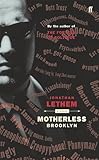
This is my review of Motherless Brooklyn by Jonathan Lethem.

In this Chandler-inspired tale, small-time crook Frank Minna selects a group of teenage orphans, "Motherless Brooklyn" to be his "men". When he is murdered some years later, one of these, Lionel Essrog, takes it upon himself to find the killer of the man who has become a father figure, and who empathised with his little understood Tourette's Syndrome which he nicknamed "Terminal Tugboating" – not knowing when some "verbal gambit was right at its limit" – even giving Lionel a book on Tourette's to help him to manage his condition.

What sets this book apart is the author's ability to enter into the mind of a person with Tourette's, and sustain this through more than three hundred pages of narration. I have no idea how accurate this is, but we come to accept Lionel's need to shout and play aloud with words continually to relieve his inner tension, his obsessive need to count things, to have everything in fives if that is his number of the moment, to touch people even if strangers, all of which makes him appear crazy, odd, an object of disgust, often insulted and underestimated even by those who should know him well, although we can see the tragedy of the intelligence and sensitivity trapped beneath all this.

This book is likely to divide opinion sharply. After I had adapted to Lionel's conversations peppered with gibberish wordplay – often with a rational thread to it – I found the writing original and often very funny with its wry New York humour, at times moving, insightful and poetical, creating a vivid picture of the character of Brooklyn and its residents – Italian makers of mouth-watering sandwiches; sinister old mobsters called Matricardi and Rockaforte, which Lionel transforms into wordplay as "Bricco and Stuckface"; beat cops who "dislodge clumps of teenagers" with a terse "Tell your story walking!" Yet at times, the prose seems too contrived, and Lionel unbearably irritating with his endless references to "ticcing" (having a nervous tic), although it is no doubt part of the author's intention to create understanding and sympathy for an apparently unappealing character.

About two-thirds in, I began to have concerns about the plot. Tension gives way to farce in scenes such as when Lionel is bundled into a car, only to note that his kidnappers all wear dark glasses with the price tags still attached, giving, him, of course, a desperate desire to touch them. I do not find Frank's brother Gerard a believable character. The arrival at the final denouement seems to me rather clunky and underwhelming, as if all the author's efforts have gone into writing brilliant and unusual prose, rather than plotting a satisfying detective thriller. After having worked so hard to keep up with Lionel's flights of verbal fancy, it is disappointing to have the plot explained with such pedestrian clarity at the end.

⭐⭐⭐⭐ 4 Stars

Because it’s there

This is my review of Into The Silence: The Great War, Mallory and the Conquest of Everest by Wade Davis.

There is no need to be a mountaineer to appreciate this account of the early attempts to scale Mount Everest. Wearing a Tweed jacket, making reluctant use of heavy oxygen canisters because he had seen their benefit in action, but lacking the nylon ropes, hi-tech crampons and other paraphernalia now available to reach the summit, George Mallory and his companion Andrew Irvine disappeared in 1924, leaving the tantalising question as to whether they had managed to reach the top.

This is less a biography of Mallory, more a study of the exploration in the context of the 1920s, in particular the grim legacy of the First World War, its horror and folly described here with particular harsh clarity: the British Establishment saw the conquest of Everest as an antidote to what Churchill called "a dissolution..weakening of bonds…decay of faith" plus climbers like Mallory diced with death quite casually having seen it close at hand so often but somehow survived the trenches.

The British Empire seemed to dominate the world, although the cracks were starting to show, so it was still possible for Curzon, Viceroy of India, to assert an Englishman's natural right to be first to the top of Everest! A skilful climber was forced out of one team because he had been a conscientious objector.

Since what is now known to be the easier route through Nepal was barred, the expeditions of 1921-24 approach through Tibet, encountering all the wild beauty and mystery of this unfamiliar culture, from the fields of wild clematis to the barren valley trails marked with stone shrines and inhabited by hermits whose self-denial seemed a waste of time to the mountaineers, although they appreciated in turn that the local people thought the same of their activities. Respectful of mountain deities and demons, the Tibetans even lacked a word for "summit".

With blow-by-blow day-to-day accounts, Wade Davis supplies often fascinating detail of the planning of the expeditions, problems over porters and pack animals, difficulties of surveying the mountains accurately to find a suitable route to the top, the relationships between the climbers – great camaraderie versus frequent friction-, the hardship and often foolhardy bravery of the ascents, the unappetising sound of the meagre rations of fried sardines and cocoa, agonies of frostbite, thirst, and having to turn back close to the summit rather than risk getting benighted on an exposed precipice and above all, the astonishing first sight of the high peaks when the unpredictable clouds and mists disappeared.

The author conveys a strong sense of what it must have felt like to climb: the grind, the exhilaration, the sudden unexpected accidents, the shock after surviving a fall, the exhaustion, the awareness of self-imposed folly, the total physical and mental collapse of some, for others the compulsion to press on.

I found it quite hard to follow the precise details of the routes with the various camps set up on the way, which is a pity as it destroys one's enjoyment of some key sections. I overcame this difficulty by looking up maps and cross-sections on Google Images, but it is a pity Wade Davis and his publisher did not agree to include these in the text, with appropriate photographs, or they could have developed a website to provide this useful information.

This book really brings home how much the early ascents were based on trial and error, and how commercial and political pressures added to a tendency to be over-ambitious, as climbers persisted in aiming for the summit with inadequate resources and preparation.

⭐⭐⭐⭐ 4 Stars

Telling not Showing Satire

This is my review of Other People’s Money by Justin Cartwright.

This is a recent addition to the current crop of novels on life after the banking crisis. When Sir Harry Trevelyan-Tubal is felled by a stroke, chairmanship of the traditional, upmarket, family-run private bank, Tubal & Co, passes to a new broom, his son Julian. Seduced by hedge fund managers and the lure of gambling on derivatives, Julian finds himself saddled with "chunks of mortgages on an alligator farm in a swamp, two thousand worthless homes in Mississippi … a shopping mall in a town flattened by a hurricane…" to give you a flavour of Cartwright's barbed wit. The only solution is to poach money from his family trust fund, to tide the bank over whilst a sensitive sale goes through to a stinking rich, status-conscious Coney-Islander-made-good American banker. Clearly, this is the basis for a sufficient disaster to whet your interest, although things may not turn out quite as expected. Certainly, it was enough to hook me after an initially slow start with a good deal of "telling" rather than "showing" the reader what to think.

Having read several of Cartwright's books, I would say that he is on form as regards some sharp, lively dialogues (with the drawback that sometimes you cannot work out who is speaking – see page 200 of the first hardback edition – where was the editor?), striking descriptions and thought-provoking observations. Although stereotypes without exception, his characters are well-developed. I liked little touches like the visionary producer Artair Macleod being reduced to putting on "The Wind in the Willows".

My main reservation about the book is its focus on the super-rich who will be comfortably off even in the worst case scenario. There is no hint of the real hardship that millions of innocent people have suffered as a result of the banks' irresponsibility.

So, the book cannot be more than the enjoyable, fairly lightweight satire, into which it settles after the climax of a potential crisis has been defused. Yes, Cartwright is making the sardonic point that "the rich are always with us" and the establishment will always look after its own, but liitle more than that – apart from the observation on our general lack of idealism: "Now, nobody thinks about reaping the benefits of freedom; instead they hope to win the lottery or become celebrities".

Cartwright likes to weave in references to another writer, in this case Flann O'Brien's "At Swim-Two-Birds" which plays on the idea of a story having many beginnings and ends, and many ways of telling it, or that "events take place one way, and we recount them the opposite way". Apart from the fact that these insights are fairly self-evident, I do not think "Other People's Money" illustrates these points in a particularly striking way.

⭐⭐⭐⭐ 4 Stars

Thicker than Water

This is my review of The Sisters Brothers by Patrick deWitt.

For months I avoided reading this tale of two contract-killer brothers since I imagined it would be gratuitously violent and suspected its Man Booker shortlisting was a gimmicky attempt to popularise the award. I was wrong to the extent that this is a well-written novel, an entertaining page-turner with an original and intriguing approach, a black comedy in its mix of wry humour and grim brutality.

Charlie and Eli, inappropriately surnamed "Sisters", a name which strikes fear in all those familiar with their reputation, are hired by the vicious "Commodore" to murder a gold prospector called Hermann Warm. Their journey from Oregon to San Francisco proves to be an 1850s Wild West Odyssey, in that they encounter a succession of strange characters and situations. In the course of this, the brothers' personalities and some explanations for their violent behaviour are gradually revealed.

Whereas Charlie is a psychopath, although his habit of losing himself in brandy suggests an uneasy conscience, the narrator Eli comes across as a more sympathetic character, often thoughtful and kind to others, except when a black mist of anger descends upon him, a condition often cynically manipulated by his more dominant brother. Despite their continual bickering, a strong bond binds these two.

The moral ambiguity in the novel made me uneasy, in that you may find yourself wanting the brothers to escape justice, despite the terrible crimes they have committed for money, and even liking Eli, although he is arguably guiltier than his brother because he has a clearer sense of right and wrong.

I was never quite clear how the brothers came to be so educated. Charlie comments on "the fortuitous energy" of California, to which Eli adds, "It was the thought that something as scenic as running water might offer you not only aesthetic solace but also golden riches". And this, from an otherwise boorish thug?

After the striking early chapters my interest waned in the second half, I think because the "climax" of the meeting with Warm proved a damp squib. I found some of the final scenes in California too implausible, and Warm's life history unengaging. I wondered at the end if the author had been uncertain how to finish the tale.

Overall, I understand why this book has been so successful, and it has more than a touch of the Coen brothers' work. It is not a "stunning" novel, say in the Cormac McCarthy league, but probably was never intended be so.

⭐⭐⭐⭐ 4 Stars

Age cannot wither

This is my review of The Best Exotic Marigold Hotel (DVD + Digital Copy).

I would be interested to know whether you need to be over (or close to) retirement age to relate to this film, or even to opt to see it in the first place.

The plot revolves round seven rather different characters who have in common the facts that they are (with one exception) middle class, retired, mostly lonely and/or hard up. An inexpensive hotel located in the exotic Indian city of Jaipur and designed for long-term stay by the elderly attracts them as a possible solution to their problems.

The hotel, run by a charming dreamer (played by Dev Patel of Slumdog Millionaire fame) is predictably shambolic, a partially ruined former palace of stunning beauty, with picturesque neglected gardens from which it is moving to watch a pure white stork as it flaps improbably, as if on the point of sinking, up into the blue.

Some members of the group adapt readily to the colourful bustle and intriguing history of India – others cannot wait to return to England. Graham, the high court judge who lived in India in his youth, harbours a secret which is gradually revealed.

Although I feared from trailers that the film would merely be a chance for seven famous actors – including Judi Dench, Maggie Smith, Bill Nighy and Tom Wilkinson, to ham it up in a visually striking location in north India, thereby boosting its tourist trade, I was relieved to find that they were given quite subtly developed roles which give scope for their skills.

There are some implausible aspects to the plot e.g. how could Bill Nighy and his self-absorbed wife be reduced to poverty by the loss of his civil service pension from unwise investment when it is likely to be paid regularly on a final salary basis? Yet overall, the story has a bittersweet quality which leaves you guessing to the very end as to whether it will end happily in general. In addition to continually amusing scenes, we see not only the vibrancy of India (perhaps the poverty is underplayed) but also hints of the new development in the slick call centre employing Indian graduates, and the concrete and glass blocks emerging on the sites of former slums and dusty makeshift cricket pitches.

This is a lightweight film, but well-made without being too cloying and sentimental.

⭐⭐⭐⭐ 4 Stars

A Convert to Coriolanus

This is my review of Coriolanus [DVD] [2011].

Although based on a dark, grim and bloodthirsty Shakespearean tragedy, I was very impressed by this film which I went to see with some trepidation.

Well-paced and not excessively violent (compared to what it could have been) the acting is excellent, the words spoken with such expression and clarity that the sense comes through very strongly, even to someone like me unfamiliar with the text. It does not bother me that some passages and plot details may have been omitted in the interests of making the plot easier to digest. Likewise, a dialogue which sounds at time surprisingly modern compensates for the lack of any memorable "To be or not to be"-style soliloquies which may not come across well in a film.

The modern setting is not irritating and gratuitous as is too often the case, but also enabled me to see the film's relevance to our divided and violent world. Rome is represented as a typical concrete western city, ruled by the cynical "haves" ("patricians") while the mass of "have-nots" are beginning to riot over lack of bread, although they are easily swayed by cunning politicians.

Rome is under threat from a Balkan-type community called the Volscians, against whom the professional soldier Caius Martius (Ralph Fiennes) gains a celebrated victory over the city of Corioles, thus being rewarded with the surname "Coriolanus". This leads naturally to his appointment as a consul, but "honest to a fault", he refuses to conceal his contempt for the people. His political enemies play on this to get him banished, which of course turns him from a loyal supporter of Rome to a man bent on revenge.

On a personal level, this is an interesting psychological study of pride, fanaticism and jealousy. The complex relationship between Coriolanus and his mother Volumnia, played brilliantly by Vanessa Redgrave, shows how a strong man may be controlled as a tool of his physically weaker but mentally stronger mother's ambition.

If I had studied this play at school, I think I might have hated it – although a good teacher enabled me to appreciate the drama of Julius Caesar. Hopefully, this intelligent modern rendition may enable many students – and general viewers as well – to understand and value this very interesting play.

⭐⭐⭐⭐⭐ 5 Stars

Pure Marble

This is my review of Life And Fate (Orange Inheritance) by Vasily Grossman.

This is one of the few "mind shifting" books I have read in that it may alter your perception of the meaning and value of life, and the nature of freedom – the right to live with one's own individual quirks. Inspired by Tolstoy's "War and Peace" and informed by Grossman's firsthand experiences on the Soviet front attempting to drive the Nazis back from Stalingrad, this modern masterpiece by the Jewish Ukrainian journalist deserves to be more widely known.

Initially banned despite the political "thaw" under Khrushchev, I believe because Grossman's parallels between the totalitarian nature of Nazism and Stalinism were too hard to take, we must be thankful that copies were smuggled out to be published in the west.

My praise stands despite my difficulty in "getting into" the work. This is partly due to the cast of more than 150 characters with either difficult to grasp or overly similar names (Krymov v. Krylov, etc.), which require frequent reference to the glossary at the back. Then, there is the continual shift from a German labour camp, to Stalingrad, to a family evacuated from Moscow to Kazan and so on, to encounter yet another group of people, but never being quite sure whether this is a "one-off experience" or whether they are minor or major players who will reappear a couple of hundred pages later. All that connects the various scenes is that the characters are in some way related or acquainted.

There is no single strong plot, just many descriptions in the "social realist" style. This is sometimes wooden, and the structure ramshackle, but all this is offset by some brilliant writing.

I suspect that each reader will be hooked eventually by a different event. In my case it was the account of the Russian officer casually risking German sniper fire to visit his men holed up in various bunkers. For others, it may be the Russian mother's grief to learn that her soldier son has died from his wounds, and her inability, despite remaining sane in every other respect, to accept that he is really dead.

The gifted but prickly physicist Viktor Shtrum, modelled on Grossman himself, comes nearest to being the central character. His agonised thoughts are subtly captured as he oscillates between criticism of the Stalinist regime, fear over being condemned for this, an irresistible desire for praise and recognition of his work, a sense of release when he dares to stand up to the political stooges or minders who run the show at his institute in exchange for material benefits, despite their own mediocrity as scientists, or his need to justify to himself his occasional human weakness under the pressure to conform.

There are powerful scenes of battle, although mostly it is a question of waiting to advance or surveying the aftermath. Grossman does not shrink from the most shocking and moving scenes, such as a woman and boy entering a death camp even to the point of perishing in the gas chamber. Yet this is written with such sensitivity that it reads like a memorial to those who suffered.

Despite all the grimness, there is a good deal of wry humour, with some witty dialogues and moments or high tension. Landscapes are often vividly described, such as the wild tulips on the steppes of the Kalmyck, near the Caspian Sea, which I found on "Google" with some other scenes which exactly illustrate Grossman's descriptions.

I plan to keep a copy of this book to read again later and cannot recommend "Life and Fate" too highly.

⭐⭐⭐⭐⭐ 5 Stars

Latin Morse

This is my review of Inspector Montalbano: Collection One (2 Disc) [DVD].

In our insatiable thirst for detective thrillers, foreign language productions have the benefit of introducing us to a different way of life in a setting which might well suggest the location of our next holiday.

In this case, the drama is set in the fictional Vigata, a quaint old stone-built town spreading over a hilly Sicilian coastline bathed in perpetual sunshine. Detective Montalbano occupies an elegant flat overlooking the Mediterranean where he can relax swimming at the end of each stressful episode.

We are introduced to a slow-paced (apart from the crimes, that is) way of life revolving round food – a man will put the enjoyment of a good meal before rushing to greet his lover – and the extended family, where relatives and workers gather on a sunny terrace to consume plentiful meals together.

Smartly turned out and astute, Montalbano somehow commands the respect of his staff despite the kind of volcanic outbursts which would have him sent on an anger management course in Britain. Like most detectives, he is on shaky terms with more senior officials, perhaps in part owing to his tendency to break the rules, but survives in his post, probably because he always seems to solve the crime in hand, usually through his ability to make deductions from very slim evidence.

The denouement is often unpredictable, partly because the very complicated plot tends to have a few twists which are hard to follow – and to be honest at times implausible. It's quite fast-moving, so with the sub-titles as an added constraint you have to concentrate.

Overall, it's worth watching as the characters are well-developed, the dialogue is amusing, the cases have intriguing aspects, and all does not end happily in every respect – there is a gritty undercurrent, say in the suffering of Tunisian immigrants in "The Snack Thief" or the continual hints at bribery and corruption amongst higher ranking officials, making the "honest" Montalbano a rarity.

⭐⭐⭐⭐ 4 Stars

Don’t count on it

This is my review of Inside Men [DVD].

Manager of a counting house, through which huge quantities of cash are shipped, John cuts a sad figure as a man frightened of life. Uptight and tense, bullied by his boss and mocked by his staff, perhaps impotent, he maintains an unlikely position as best performing manager through obsessive hard work, assisted by being prepared to make up from his own pocket any small shortfall in the accounts. For the most part he is almost robotically lacking in emotion, but under pressure the underlying rage on occasion bursts out.

Then John's discovery of a petty theft by two of his employees triggers the idea for the heist with which the drama opens.

As much a psychological drama as a thriller, the intricate and intriguing plot switches back and forth in time over a period of months, in order to explore the motivations of the "inside men" and reveal both the complex details of the planned theft, and how it works out in practice. The three main characters and the women in their lives are all strongly developed with distinct personalities.

In a reverse of the norm, the earlier parts of the drama are in many ways more suspenseful and gripping than the denouement. I can understand why some viewers have reported feeling let down by the ending. My sense of disappointment was short-lived when I realised that, in leaving some morally ambiguous outcomes, the plot leaves us with a good deal of food for thought.

⭐⭐⭐⭐⭐ 5 Stars

A Perverted Goldfish Bowl

This is my review of The Aquariums of Pyongyang: Ten Years in the North Korean Gulag by Kang Chol-Hwan,Pierre Rigoulot.

This is the gripping memoir, despite a somewhat clunky translation at times, of one the first North Koreans to claim asylum in the South, after escaping via China in 1992. He is untypical in belonging to a wealthy family: his grandfather made money after emigrating to Japan, but allowed himself to be persuaded to return to North Korea by his fanatically pro-Communist wife. They soon learned their error, with the grandfather being forced to hand over his millions to the Government, and ultimately losing his life in prison for the crime of criticising the inefficiency of the North Korean distribution system. His close family were also punished with a decade spent in Yodok, a harsh concentration camp designed to re-educate the relatives of traitors.

I was already familiar with the grim facts about life in North Korea through Barbara Demitz's "Nothing to Envy", which is based on the American journalist's interviews with a number of refugees who also made it to the South, again via China. I thought "The Aquariums of Pyongyang" might be more authentic in that it would be less "fictionalised" with the device of imagined dialogues and recreation of people's thoughts. Although this is the case, Kang Chol-Hwan focuses mainly on the exhausting and soul-destroying routine of life in the camp: the use of "team targets" and "snitches" to keep people in line, the sadistic teachers, the shocking public executions which adults were forced to watch and even participate in at times, by stoning the "criminals", the farcical "self-criticism" sessions, enforced adulation of the "Dear Leader" Kim Il-sung and over all else the obsession with obtaining food, even resorting to eating rats.

There is less exploration of how ordinary people in general survive in the warped dictatorship of North Korea. Kang Chol-Hwan mentions the famines of later years, but does not discuss exactly how they arose. Also, once released, he managed to have access to a relatively good material standard of living, partly through the use of family money and goods imported from Japan to provide the endless bribes needed, also through his own black market business activities.

Kang Chol-Hwan does not portray himself as a particular likeable person, but perhaps this is understandable in view of the brutalising experience of the camp. His final adult years in North Korea and ultimate escape are covered rather hastily, maybe to protect others; he acknowledges with some guilt that relatives and acquaintances must have been sent to the camps because of his defection. It is also interesting to learn of his initial shock over the sexual freedom of life in the west (although he claims to have lived off a Korean brothel-keeper resident in China, and benefited from her contacts to board a ship to South Korea) and over the wasteful consumption of his newfound home country. As an observer from an alien culture, he provides a useful yardstick by which to judge capitalist society and its values.

Overall, this is informative and thought-provoking, but gives a rather limited picture, perhaps because the author spent so much of his time in one camp.

⭐⭐⭐⭐ 4 Stars