Avoir le cafard et pas la ratatouille

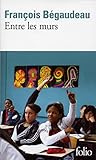
This is my review of Entre les murs (Collection Folio (Gallimard)) by Francois Begaudeau.

François Bégaudeau’s portrayal of a young teacher’s struggle to teach French to a multi-ethnic class of fourteen-year-olds in a tough Parisian suburb was made into a Palme d’Or-winning film. I found the film more effective, in that the teenage pupils who improvised their role for weeks to get into their parts are very convincing, while the inspired director Laurent Cantet manages to select characters and scenes from the book to create a much stronger narrative than the original.

In a succession of short scenes over the course of a school year, Bégaudeau’s book uses continual repetition to create a surreal, groundhog day sense of the claustrophobic world of teaching: in the staffroom, Bastien forever eats dry cake, and the rest spend their time cadging change for the defective coffee machine, asking how to produce double-sided sheets on the erratic photocopier, and despairing over their classes in Pinteresque conversations. As for the class, Souleymane persists in coming to each lesson with his hood over his hat, the disaffected Dico keeps pestering for a transfer to another class, and Bégaudeau’s attempt to teach his pupils arcane points of grammar, as prescribed by the state, or the rather more useful ability to reason, are scuppered by their ignorance of basic vocabulary. Yet, they can be remarkably perceptive at times, and their constant complaint to Bégaudeau, “Vous charriez trop” seems justified in some ways. Although he clearly wants to teach them to think, and has a soft spot for the more cooperative students and the bright, extrovert dynamo Sandra, the system is against him. “I slept badly” is a cue for an outburst of sarcasm or worse on his part, as when he calls students “imbeciles” or accuses girls of “having the attitude of a slut”. At times, he loses all dignity in a slanging match verging on violence with the insolent Dico who get under his skin, for whom he regularly abandons his class to drag the youth before the Principal – a well-intentioned but ineffectual man who reminds me of President Hollande.

In this tragi-comedy, the teachers resemble the pupils too closely: with the three rings in one ear and tee-shirts with motifs of fire-breathing dragons and unicorns, is Leopold clearly distinguishable from a student? Also, the staff express themselves in such a slangy, colloquial way that one wonders how the students can ever learn good practice.

The book is hard for a non-French reader because of all the “argot” and unfamiliar practices but made me curious as to the contrasts with British secondary education. The French system seems much more complicated, yet alarmingly democratic in, for instance, having student representatives at certain review meetings such as “le conseil de classe”. Since many of the scenes are very funny, one can read this purely as a tragi-comic farce, but underlying it all is the dilemma of how to teach a diverse group effectively, as implied by the twenty-two probing questions on best practice which form one chapter.

⭐⭐⭐⭐ 4 Stars

Rising to many challenges

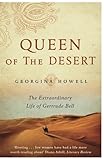
This is my review of Queen of the Desert: The Extraordinary Life of Gertrude Bell by Georgina Howell.

The great wealth of the steel-making Bell family gave Gertrude the means, confidence and connections to pursue a succession of interests. After becoming the first woman to be awarded a First in Modern History at Oxford, Gertrude found the conventions of upper class life in late Victorian England far too constraining. She became a linguist, translator of Persian poetry, mountaineer who achieved a number of “first” ascents of challenging peaks, archaeologist, desert traveller, writer, intelligence officer, confidante of King Faisal in the newly formed Iraq of the 1920s and Director of Antiquities who established a museum in Baghdad.

She was clearly enthralled by the romance of Arab desert culture, not least the handsome sheikhs in their striking robes, who may have accepted her because she was so unlike any other woman they had ever met: when she came to their tents bearing gifts and wearing evening dress, they called her “the Khatun” or “Desert Queen” but when she appeared in breeches riding astride she probably seemed to them more like a man.

Georgina Howell’s heavy use of lengthy extracts from letters and reports is as effective as she intended in conveying a sense of Gertrude’s ability to communicate, great energy, enthusiasm and wry wit. We gain a strong sense of a determined, opinionated woman who was often unconsciously snobbish – anticipating the need to correct the governess likely to call napkins "serviettes" – and contemptuous of “quite pleasant little wives” who meekly conformed.

At times, I was aware of repetition, or longwinded description that is hard to digest, but in the main the author’s marshalling of a mass of information is quite impressive. I find her a little too uncritical of Gertrude’s active campaigning as founding secretary of the Women’s National Anti-Suffrage League in 1908: the idea that do-gooding visits with her mother to the homes of the working poor had convinced her that women “at the end of their tether” managing families on a tight budget simply did not have time to gain the education to vote seems patronising, even hypocritical in someone so resolved on fulfilment in her own life.

Yet, Gertrude was in some ways quite conventional: in her early twenties, she accepted her parents’ rejection of a fiancé considered to lack the means to support her, although his death in ambiguous circumstances shortly afterwards must have haunted her. Love was the one area in which success eluded her – a prolonged affair was doomed since it was with a married man who clearly had no intention of leaving his wife, while despite her physical bravery it seems Gertrude could not find the courage to consummate their relationship.

Perhaps owing to lack of evidence, Georgina Howell glosses over Gertrude’s probable suicide on finding herself in her late fifties having run out of fresh challenges with only the bleak prospect of a painful death from decades of chain-smoking. I often had a sense of a life frenetically packed with activity which masked an inner unsatisfied longing.

I suspect that Gertrude’s role in the formation of an independent, “democratic” Iraq is slightly exaggerated, but it is a fascinating tale which inspires me to read more about Arab history. The parallels with today are very striking: the unstable union of tribes over which Faisal attempted to hold sway, the reluctance to accept British support in keeping control, the difficulty of defining a border with Turkey and accommodating the Kurds, the divisive Shia-Sunni conflicts prompting Gertrude’s “blackest hatred” for Ibn Saud’s Akhwan (now Wahabis) “with their horrible fanatical appeal to a medieval faith…. the worst example of an omnipotent religious sanction”.

⭐⭐⭐⭐ 4 Stars

Gaudy Night by Dorothy L Sayers: From false statement of fact to mops and buckets

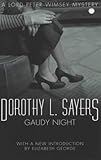
This is my review of Gaudy Night (A Lord Peter Wimsey Mysteries) by Dorothy L Sayers.

Her celebrity as a writer of detective fiction gives Harriet Vane the confidence to visit 1930s Oxford for a “Gaudy Night” celebration for the first time since graduating from Shrewsbury College where she was so happy before the trauma of being falsely accused of poisoning her lover and saved from the gallows by the intervention of amateur sleuth Lord Peter Wimsey. When the activities of a poison pen poltergeist begin to threaten the peace and the reputation of the College, Harriet is called back to investigate.

I found this novel entertaining although it proved as dated as I had feared, including in ways I had not expected. In terms of style, it often feels like a novel written a century earlier than it was.The frequent Latin quotations and Greek tags with no translations provided are particularly irritating, but perhaps an educated reader of the time would have had no trouble knowing what they meant. Alternatively, having been taught Latin since the age of six by her father, perhaps Dorothy Sayers overestimated the capacity of her readers, or with the dismissive arrogance often shown by Harriet maybe considered that if they could not understand it they could lump it. There is a similar kind of academic elitism in the often abstruse quotations from sixteenth century writers included at the start of most chapters. Yet the irony is that the female dons of Shrewsbury College frequently behave with the emotional immaturity of the pupils of Enid Blyton’s “Mallory Towers”.

As a detective mystery, the plot is rather thin. This is much more a psychological study of a group of women pursuing careers in a privileged cocoon, yet continually troubled by the sense that they are regarded as inferior to their male counterparts (in separate cocoons) and by doubts as to whether they have made the right choice. Should they have satisfied the desire for a man instead, even at the cost of having to further his career rather than their own, or of sacrificing self-fulfilment to putting their children first? Harriet naturally arouses resentment since she appears to “have it all”: a career in the big wide world, the option to become an academic, and a very wealthy suitor offering her future security for the taking.

For the most part Harriet and Lord Peter (Why does he have to be an aristocrat except to feed some fantasy of the author’s?) communicate for the most part through the exchange of literary quotations and witty ripostes. One of Harriet’s reasons for refusing his regular proposals of marriage seems to be that he makes her feel inferior. With justice, it would seem, in that she has to call him in to solve the crime, and even rewrites her novel to take account of his criticisms of her leading character Wilfred. There is also a double standard in the indulgent attitude to the idleness of Lord Peter’s student nephew, whereas Harriet rages against the “waste” of the place offered to an “ordinary” girl who has only come to Oxford to please her parents.

Many scenes make me uneasy in their elitism: Lord Peter calling a waiter continually to pick up the napkin which has slipped off Harriet’s silk skirt, or Harriet betting in a College sweepstake, not on a horse, but on the student most likely to win a prize.

Despite Dorothy Sayers apparently unconscious snobbery – a product of her times – she sometimes mocks the conventions: the male dons’ ludicrous popping formal shirt-fronts; the pleasure of “snuffing the faint, musty odour of slowly perishing leather” in the Bodleian Library; the possible futility of the complex mechanistic analysis of poetry.

⭐⭐⭐⭐ 4 Stars

Revenge served cold

This is my review of The Frozen Dead (Commandant Servaz) by Bernard Minier.

An extraordinary and gruesome sight awaits the unsuspecting team of Swiss hydro-electric power workers as they exit from their cable car onto an exposed mountainside platform. As further murders occur, suspicion falls on the nearby Wargnier Psychiatric Institute which incarcerates some of the most notorious criminally insane prisoners in Europe, not least the cunning psychopath Julian Hirtmann. Yet, when Commandant Servaz visits the grim Institute with his colleagues the security seems too tight for anyone to escape, let alone return between crimes. Meanwhile, the emotionally vulnerable young psychologist Diane Berg, who seems quite unsuited to her temporary post at the Institute, begins to collect disturbing evidence which places her in danger but which she has a tantalising reluctance to share with the police.

In this debut thriller which made his name in France, Bernard Minier is good at conveying a sense of the oppressive, sinister beauty of remote Swiss valleys under the pressure of unrelenting snow blizzards with at least one unknown killer on the loose. In a page-turning plot, well-controlled despite its many twists, he is good at creating a sense of suspense and tension, although too often a dramatic scene comes to nothing. One could argue this is realistic, except that many aspects of the intrigue are very far-fetched.

Some of the characters are quite well-developed, but they are in the main clichéd, with Servaz a likeable but somewhat formulaic sleuth. He has the usual dysfunctional family life, a wife driven away by his over-dedication to work, apparent appeal to beautiful women without having to make any effort, and an incongruous erudite streak in his penchant for voicing Latin quotations with the Classics as light reading. His apparent past success in solving crimes is belied by an apparent lack of the necessary attributes to make an effective cop: he is frightened of heights and fast speeds, hopeless at target practice, and makes elementary errors under pressure like forgetting his firearm when vital, at least for self-protection. For one in some ways so lacking in physical courage, it is odd that he is so often prepared to embark on dangerous situations without back-up.

Perhaps because of his own past career as a customs official, Minier displays a love of detail which can prove quite tedious, even boring, making the novel perhaps a couple of hundred pages too long. I enjoyed reading this in French as a good source of vocabulary-building, but would have found it hard to sustain my interest in the English version. I agree with reviewers who found it in need of pruning.

Although Minier has left at least two strands to follow up in a sequel, these are unlikely to draw me to read more by an author who seems to favour the clichéd macabre, and quantity over quality. I have removed a star for the English version, since, stripped of the original French, the book's shortcomings are likely to be more apparent.

⭐⭐⭐ 3 Stars

“Footsteps” by Richard Holmes: Leading a lobster on a blue silk ribbon

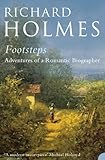
This is my review of Footsteps by Richard Holmes.

“Age of Wonder”, the brilliant biography of the lives of enlightenment scientists who inspired Romantic poets like Coleridge and Shelley prompted me to read “Footsteps” published by Richard Holmes thirty years earlier. This short book is a series of four essays describing his forensic retracing of the journeys and temporary resting places at key stages in the lives four famous writers.

In 1964, a precocious eighteen-year-old Holmes, at times somewhat pretentious in his desire to develop a written style, wanders through the beautiful wilderness of the French Cevennes in the wake of Robert Louis Stephenson and his long-suffering and frankly abused donkey Modestine. Four years later, as a Cambridge graduate rejecting the security and status of a well-paid conventional career, Holmes sets off for Paris to draw some parallels between the idealistic youthful hippy revolution of 1968 and the cataclysm of the French Revolution, with a focus on Mary Wollstonecraft, the feminist icon who in fact was unable to prevent her life being controlled to some degree by dominant men, but who experienced some of the most terrifying aspects of the “Reign of Terror” under Robespierre, unlike Wordsworth who had scuttled back to the safety of the Lake District. In 1972, Holmes loses himself in Italy in order to explore the self-imposed exile of Shelley. Finally in 1976, a fascination for what C19 photography can reveal to a biographer leads Holmes to immerse himself at the risk of his own sanity, in the life of the gifted but troubled Gérard de Nerval: “one is tempted to say that, had Nerval been born earlier he would have been saved by religions; had he been born later he would have been saved by psychoanalysis”.

What makes Holmes’ biographies so remarkable is his capacity to “get under the skin” and seem to inhabit the minds of his subjects. In “Footsteps” he includes interesting reflections on the at times all-absorbing to the point of obsession process of biography, as he begin to understand it. He perceives himself as “a sort of tramp permanently knocking at the kitchen window and secretly hoping he will be invited in for supper” or even as a ghost of past writers.

More than simply the collection of factual material, there is the “creation of a fictional or imaginary relationship between the biographer and his subject… a degree of more or less conscious identification with the subject”. He identifies the “moment of personal disillusion” when the biographer is “excluded from or thown out of the fictional rapport he has established” by a lack of reliable evidence. So, in the absence of “proof”, I was surprised by his theory that Shelley had an affair with his wife’s friend Claire Clairemont which led to a miscarriage, after which the poet adopted a foundling child born on the same day only to have it fostered elsewhere and die soon afterwards.

Perhaps inevitably, the essay format makes for a somewhat fragmented work, and the autobiographical passages can appear contrived and an almost irritating distraction from his subjects. “Footsteps” is a seedbed for the later flowering of a masterpiece like “Age of Wonder”, and it has made me want to read more of Mary Wollstonecraft’s clear, perceptive and remarkably “modern” work, and brought me to appreciate more the tragedy of Shelley’s circle and the genius of his poetry, realising that I have been too quick to reject Romantic poetry for its flowery sentimentality.

⭐⭐⭐⭐ 4 Stars

Having the last laugh

This is my review of The Lady in the Van [DVD] [2015].

Already produced as a memoir and well-received play, the tale of the eccentric “Miss Shepherd” who squatted in a dilapidated van on the forecourt of Alan Bennett’s London home for fifteen years, has now become a film. It is marked out by Maggie Smith’s superb and flawless performance which captures a sense of the maddening, manipulative woman who is tolerated, and even helped in an ineffectual way, by a possibly somewhat caricatured group of comfortably off, self-styled liberal-minded middle class neighbours too polite to behave otherwise.

Commencing in the 1970s, the drama has the nostalgic air of past, somehow more innocent and less fraught times, predating the tight parking restrictions, health and safety concerns and care plans for the elderly (however inadequately implemented) of today. When the council comes round with a yellow-line painting machine, Alan Bennett caves in and allows the new van donated by a local titled Catholic do-gooder to be driven onto his driveway. It is not long before Miss Shepherd conducts her ritual of plastering the vehicle with yellow paint thickened with lumps of Madeira cake.

Alan Bennett uses the interesting device of cloning himself as the put upon resident and more cynical writer (given to talking to each other) who recognises Miss Shepherd’s potential to be milked for future publication. To some extent, the two main characters use each other, with the comic touch of Alan conducting a conversation with the old lady while his alter ego interjects “but this was never said – I made it up”. Such is the old lady's reticence that Bennett does not discover the full facts of her life until after her death, which lead him to reflect that, despite her years of confined existence, she has perhaps in some ways had more firsthand experience than he has, being forced to rely on observing others for his material.

The story is full of humour as when Alan’s assumption that Miss Shepherd’s claim to having been “followed home by a boa constrictor” is a sign of her madness is undermined by the discovery of a snake in a neighbour’s garden following a mass escape from a local pet shop. Yet beneath the laughter is the deep sadness of the wasted life of a talented pianist who was forced to give up playing following her insistence on becoming a nun, a calling to which she was clearly completed unsuited. There is also the tragedy of as society which cannot cope with an individual who is highly talented yet difficult to the point of being labelled mad – also the irony of the social services coming too little too late to the scene, and failing to understand Alan’s pragmatic, literally “hands off” support. Bennett pulls no punches over the squalor involved in van-life, and the acting captures all too accurately the indignities of old age, the incontinence, increasing unsteadiness, aggravated by poverty. So, one comes away laughing but also sad for a tale of lost promise and over intimations of one’s own fate in old age, and guilt over not helping elderly people more.

⭐⭐⭐⭐⭐ 5 Stars

A spy going back to the cold

This is my review of Bridge of Spies [DVD] [2015].

“Bridge of Spies” is a reminder or insight, depending on your age, into the early 1960s when the Cold War was at its peak together with fear of nuclear war and the tensions in a divided Berlin which led to the construction of the infamous wall imprisoning the communist sector in a time warp free from western influence.

When successful American insurance lawyer James Donovan is virtually ordered to represent captured soviet spy Rudolf Abel, it soon becomes apparent that he is merely expected to co-operate in the rubber-stamping exercise of going through the motions of justice seen to be done. A stubborn man, as Abel shrewdly observes, Donovan tries to get Abel’s conviction overturned on appeal, then suggests that he should be spared the electric chair in order to provide a useful bargaining counter in a possible future exchange with a captured American spy. Donovan’s idea is put into practice sooner than he could have bargained when US pilot Francis Powers is shot down over Russian territory whilst photographing sensitive terrain from a height of 70,000 feet.

This is the kind of film we have come to expect from Spielberg: fleshing out in an entertaining if sometimes sentimental way an interesting real-life drama which perhaps went under-reported at the time. We see the ludicrous US government guidance to the public on how to behave in the event of a nuclear strike, the wave of uncomprehending public rage against Donovan’s attempts to apply the rule of law to a spy, the mistrust and jockeying for power between the Russian and East Germans, and the sense of culture shock when Donovan is transported into an East Berlin of bombed wastelands, poverty-stricken youths driven to crime and the gunning down of those seeking to scale the newly constructed wall to freedom.

Not a great film perhaps, but worth seeing for its period detail and intelligent, often wrily amusing, script worked up by the Coen brothers, and a compelling performance from Tom Hanks, with Mark Rylance playing the part of a chastened Thomas Cromwell caught spying. It is also an incentive to discover more about this recent history.

⭐⭐⭐⭐ 4 Stars

Smart, attractive shoulder bag worth a look

This is my review of Womens Real Leather Hand Made Shoulder or BackPack Handbag – Made in Italy Real Leather Smooth Finish.

This bag comes in such a wide range of colours that it is hard to make a choice. The straps are just the right length for a shoulder bag, and they can be easily adjusted to create a smart back pack. The flat bottom enables the bag to be placed in a vertical position without tipping over. The leather is smooth and quite stiff, although it has quickly formed bulges to reflect the shape of articles inside and this detracts a little from the smart design. I would have preferred a softer leather which would have given a more casual appearance from the outset.

A slight drawback is that adjustable straps are crossed over in "shoulder bag" mode which makes it harder to open the bag fully but which may keep it in place on the shoulder better. There are two main compartments separated by a soft zipped pocket, so that items tend to slip down to the roomy bottom, but it is hard to open the bag wide enough to rummage for them, particularly when the bag is on one's shoulder. It's a "medium" capacity bag, unsuitable for those who like to tote around elephant's graveyards, but at least it won't give you shoulder-ache.

Since the detailed online description stated that purple bags (my choice) had a synthetic exterior, whereas some other colours and the overall description state "leather" I was a bit anxious, but can confirm that the product seems to be leather on the outside with a soft off-white lining which will probably get stained or dirty before it wears out.

The price seems very reasonable, the design is attractive. I like the bag but it is a little too narrow at the top to use the space fully. N.B. Five months on, and the purple colour is rubbing badly off the thin purple shoulder straps, so won't buy again, which is a pity since the design is stylish.

⭐⭐⭐⭐ 4 Stars

Useful answers but you need to have the questions already!

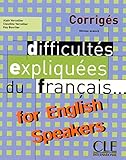
This is my review of Difficultes expliquees du francais…for English speakers: Corriges by Olivier Ravanello.

It is very useful to have these model answers, but they should have been included in the main text giving explanations of French grammar points likely to give English students difficulties with questions to test one's learning.

The only point in favour is that it is easier to refer to the answers in a separate booklet alongside the questions. I suppose that teachers may prefer this separation since it is harder for students to cheat, but perhaps the need for two books could be reflected in the price – which seems rather high for 64 pages of answers to questions in another book.

⭐⭐⭐⭐ 4 Stars

Brooklyn [DVD] [2015] – Half-wishing things could have been different

This is my review of Brooklyn [DVD] [2015].

When Eilis is unable to obtain suitable full-time employment in the tight-knit, isolated Irish town of Enniscorthy, her elder sister Rose pulls strings with fixer, Irish American priest Father Flood to get her a visa and job in New York, with accommodation in a Brooklyn boarding house. Like millions of other Irish immigrants, she begins to make a life for herself after the initial appalling homesickness, but is likely to be cast into a kind of limbo, in which, when in Brooklyn, her past in Ireland seems unreal and dreamlike, and vice versa.

At first I was reluctant to see the film version of “Brooklyn” since I thought it was unlikely to capture the book’s main achievement which is to convey the shifting inner thoughts and emotions of the heroine Eilis. Yet author Colm Toibin seems happy with the film , and actress Saiorse Ronan is skilful in showing a bright yet unassuming girl who is a mix of naïve and shrewd, sensitive yet resilient, dutiful in her Catholic faith but spirited.

The film gives a vivid and convincing portrayal of life in conservative small town Ireland of the early 1950s, as opposed to the bustle of a New York street in the rush hour or Coney Island on a summer weekend.

Scriptwriter Nick Hornby keeps fairly faithfully to the original plot and dialogue, including the final ironic twist, and I can understand why a few scenes have been added, for instance at the end, to suit the visual medium of film. Yet, I felt that some minor scenes have been omitted unnecessarily, creating an overly abrupt plot development in the process. To give a a spoiler-free example, the film would have gained from more leisurely initial “scene-setting” to portray Rose as more striking and successful in her social and work life than she seems in the film, while we could have seen more of Eilis reluctantly accepting a part-time job with the ghastly Miss Kelly, reporting her days in humorous anecdotes over the tea table in an attempt to make them more bearable. Also, her initial humiliating encounter with “eligible young Irish bachelor” Jim Farrell before she leaves for Brooklyn is inexplicably left out altogether. Perhaps more could have been made of the stifling web of Enniscorthy gossip stretching its threads even into Mrs Kehoe’s Brooklyn boarding house.

Overall, the film is likely to please those who have never read the book, and have the power to move those who have, despite any reservations.

⭐⭐⭐⭐ 4 Stars