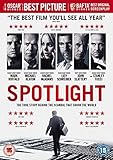
“Spotlight” [DVD] [2016] – Don’t rock the boat for a few bad apples

This is my review of Spotlight [DVD] [2016].

In 2002, the Boston Globe’s long-term investigative unit, a team of four journalists named “Spotlight”, uncovered a major scandal of child abuse by Catholic priests who were protected from public humiliation and criminal charges by the power and influence of the Catholic Church. This has been made into a gripping film, apart from the fact that some of the legal procedure and newspaper practice is a little hard to follow, which is frustrating, although I was able to “get the gist” of it.

It is interesting that even the Spotlight team were able to overlook the seriousness of the abuse, because respect for the Church had become so deeply ingrained. It takes the arrival of a “new broom” editor Marty Baron, Jewish and an outsider, to see the ethical imperative, not to mention simple newsworthiness of the allegations against John Geoghan, an unfrocked priest accused of molesting more than 80 boys.

The film’s focus is on the painstaking process of assembling evidence, spiced up with the questionable reliability of some witnesses, the predictable opposition from influential Catholics, the occasional impact of external events, notably the 9/11 destruction of the Twin Towers which delays progress for a few weeks, but most of all the succession of shocking realisations: according to an expert, 6 per cent of Boston’s priests were statistically likely to be paedophiles, giving a total or 90 to pursue; it had become standard practice for the Church to make settlements, not publicly recorded between the erring priests and the families of their victims, the lawyers taking a one third cut of the proceedings in what one “Spotlight” member calls “a cottage industry.”

Well-acted with the momentum of a strong plot to carry it a long way, some of the more “technical” scenes could have been made clearer, but overall this is highly recommended. I wonder what Catholics will make of this hard-hitting film.

⭐⭐⭐⭐ 4 Stars

“The Girl on the Train” by Paula Hawkins – Formulaic, manipulative but good portrayal of alcoholic narrator and undeniable page turner

This is my review of The Girl on the Train by Paula Hawkins.

Rachel’s morning commuter train often stops at a red signal near Euston, enabling her to fantasise over an attractive couple who live in a house backing onto the railway line. Its layout is familiar to Rachel, since she recently lived a few doors away from it in the house still occupied by ex-husband Tom, now with his new wife Anna and baby daughter. Her grief over this is driving Rachel into the downward spiral of an erratic, embarrassing alcoholic but when exactly did she begin to drink too much and why?

This is the starting point of a twisty psychological thriller which relies heavily on the way vital details are revealed. The viewpoint switches between Rachel and the object of her fantasy, Megan, at times also including Anna, to make a somewhat clunky dramatic triangle, as each recalls recent events in a kind of mental diary. It is often interesting to see how these different characters see the same events. Rachel’s personality is the most fully developed: probably an unreliable narrator, perhaps guilty of some dreadful act committed in a drunken haze, arousing contempt or frustrated pity mixed with despair in those who have to deal with her, she also evokes sympathy in the reader with her flashes of wry humour and self-knowledge. In contrast, Megan and Anna seem to speak with the same voice, shallow and unstable cyphers, in fact all the characters apart from Rachel tend to be portrayed as two-dimensional stereotypes. None of them is very likeable, although that does not bother me.

This book is not particularly well-written, it has clearly been over-hyped, a conscious attempt to recreate the success of “Gone Girl”. It is easy to guess the key to the mystery, and final chapters leading up to the climax seem more rushed and formulaic than the intriguing slow build of the first half. Although the highly visual descriptions pave the way for a film of the book, I shall not feel driven to watch it.

Despite this, the novel is definitely a page turner with a plot which is imaginative in detail if somewhat hackneyed in its main thrust. The ending was better than the let down I had expected. It fascinates me how brilliant, insightful wordsmiths are often hopeless at plots, or underestimate their importance, whereas those with a gift for constructing an intrigue cannot prevent themselves from slipping into banal, clichéd prose. The recent novels “I saw a man” and “Disclaimer” seem to me to achieve a stronger combination of good writing and intriguing plot.

⭐⭐⭐ 3 Stars

Excellent design

This is my review of SPIRIT LIGHTWEIGHT TRAVEL CROSSBODY BAG FAB COLOURS. ITEM NUMBER 1651 (Deep Purple).

This is my replacement for a good value, well-designed organiser bag, compact but remarkably capacious by virtue of its many gusseted compartments, with adjustable strap to be crossbody if preferred, ideal for travel as it has secure sections for passports, tickets and money, leaving space for a kindle, purse, phone and small essential personal items, and is casual enough for a country walk but smart enough to take into a hotel dining room. The range of colours available online is excellent, although prices vary slightly, but all are very reasonable.

I bought a dark pink bag in this colour a few years ago and have found it very useful – still in good condition but getting a little worn on the leather sections and a bit grubby on the outside, so I decided to save it for wet and muddy outings and buy one in a darker colour for my next holiday.

⭐⭐⭐⭐⭐ 5 Stars

Concise, informative and easy to use

This is my review of Lonely Planet Pocket Madeira (Travel Guide) by Lonely Planet,Marc Di Duca.

Madeira feels safe and friendly, with many people in Funchal speaking English, but the very reliable bus services can be quite infrequent and I imagine driving a hire car on the switchback roads is a nightmare, whilst signboards are often lacking, so as an independent traveller one really needs a reliable and accessible guide book as a framework for the various bus timetables and tour leaflets you will acquire en route.

On a week's visit to Madeira for the first time, I found this pocket guide very useful not merely for advance planning but to carry round each day to check details. Marc Di Luca, the named author (unlike many guides which I suspect are produced by a band of researchers who may not have actually visited the places they describe) clearly has genuine local knowledge and a grasp of what a complete stranger needs to be told.

I like the frequent use of maps at various scales, from the pull-out one to provide an overview of the island and the key centre of Funchal to those showing a number of driving and walking routes e.g. the very interesting walk along the western Funchal sea front from the Lido to Praia Formosa (it could in fact be extended from the ochre fortress Fortaleza de Santiago near the picturesque old district, the Zona Velha, on the eatern edge of Funchal sea front all the way along to the fishing village of Camara de Lobos to the west. I like the way Di Luca even provides bus numbers and terminus names for, say trips to the Funchal Botanical Gardens or gives specific advice to take a morning bus to the Eira do Serrado viewpoint to make it possible to admire the amazing view of Curral da Freiras (the Valley of the Nuns) before taking the hairpin-bend path down to the village.

Key attractions are highlighted in the index, information is clearly organised under headings, and important points repeated at different points to make them hard to miss. Since the book is quite concise and informative, its worth reading every word before you travel. Then you won't miss such useful advice as the benefit of bargaining with taxi drivers – as we waited for the airport bus, we bargained a persistent taxi driver down to the same price as the bus – 5 euros for a single trip, which proved useful since it was probably full, and we met disgruntled tourists who had to pay 45 euros to reach the airport in time.

The guide glosses over Santana on the north coast, reflecting the fact that not only is there not much to see there, but the climate is much colder – the day we visited, the seashore was obscured in a cotton-wool blanket, although the bus drive across the island is fascinating to see how houses perch on sloping terraces above breathtaking precipices.

A minor criticism is that the levada walks featured (along Madeira's famous irrigation channels) tend to be rather long for many tourists e.g. 11-16 km. Perhaps a few shorter, easier stretches could also have been specified.

With this guide highly recommended overall, make sure to visit Monte Palace Tropical Gardens on the cable car, the Eira do Serrado viewpoint above the Valley of the Nuns on a clear day and take a boat trip out to view Funchal from the sea.

A more expr

⭐⭐⭐⭐⭐ 5 Stars

Well-described walks for longer stays and stout boots.

This is my review of Madeira Walks: Leisure Trails Volume 1 by Shirley Whitehead,Mike Whitehead.

These 41 walks all begin with a useful chart to show length, approximate time needed (possibly somewhat underestimated for those who want to take their time), variation in height, whether circular or one way, vertigo risk and refreshments en route. They are clearly described with details of method of access and return, key features on the way, illustrated with photographs of the scenery and a small map, which often looks hard to follow so the Discovery Walking Guides Ltd Madeira Tour & Trail 1:40,000 super-durable waterproof map is also recommended. All routes require sturdy footwear with a good grip, since paths are often uneven and slippery from springs and moss. I noticed many walkers using poles for stability or confidence. Walks with a low vertigo risk unsurprisingly tend to offer less dramatic views.

Since, although reliable, Madeira buses tend to be infrequent, a taxi is likely to be necessary at least one way for many of the walks making it tempting to opt for an organised levada walk tour instead. For those with limited time on the island or not very hardy walkers, I would recommend the walks which link in with bus services to major points of interest e.g. Walk 1 from Praia Formosa in West Funchal to the fishing village of Camara de Lobos – this walk can be commenced earlier, say at the Funchal Lido or even the Fortaleza do Santiago near the Funchal teleréfico to Monte. Walk 7 from the viewpoint of Eira Serrado, accessible on the No. 81 morning bus, gives striking views on the hairpin track down to Curral das Freiras (the Nun's Valley), although it can be slippery on the mossy rounded steps. The No. 8 walk in the Ecological Park is interesting, although despite the evidence of recovery from a largescale fire, I was depressed by the sight of blackened, leafless trunks. Walk No. 19 from Ribeiro Frio (Bus 56 or 103) is a short, easy walk to viewing balconies giving dramatic views of the peaks.

⭐⭐⭐⭐ 4 Stars

Useful and fascinating

This is my review of Madeira Tour & Trail Super-Durable Map by David Brawn.

This very clear and durable map is excellent for planning and keeping to a route, or simply understanding in retrospect some of the extraordinary terrain encountered e.g. on the drive from Funchal to Santana. I gather that some of the leisure routes shown are out-of-date, but with the continual risk of landslides this is perhaps inevitable. I would be reluctant to drive a hire car on the narrow switchback roads, so regard this largely as an aid to planning itineraries and walking.

⭐⭐⭐⭐⭐ 5 Stars

More than first meets the eye

This is my review of MADEIRA A SHORT ILLUSTRATED HISTORY by joana de Freitas.

A readable, wide-ranging and very informative social, economic and political history of Madeira with some fascinating old photographs, from the navvies risking their lives on precipices to construct the famous irrigation channels to an early titled tourist leaping in a flamboyant high dive at Reid's Hotel.

⭐⭐⭐⭐⭐ 5 Stars

Life encroaching on art

This is my review of Le Quatrieme Mur (Prix Goncourt Des LycEens 2013) by Sorj Chalandon.

The “fourth wall” of the title is the invisible barrier between the imagined world of the cast on stage and the reality of the audience and the outside world. It is 1982, and French historian Georges whose true love is the theatre promises his dying friend the enigmatic pacifist, Greek Jew Samuel Akounis that he will stage Anouilh’s “Antigone” during a negotiated cease-fire in a bombed Beirut cinema using actors drawn from opposing Lebanese groups: Antigone will be played by a Palestinian refugee, her lover by a Muslim Druze, her autocratic father by a Christian phalangist, his guards by Shiites and so on. Georges’ wife Aurora, understandably dismisses this as a dangerous folly, and the explosive flash-forward of the opening chapter indicates from the outset that the project will not end well.

Its achievement or otherwise does not really seem to be the point: just as Anouilh used the Greek tragedy to honour the French resistance to Nazi domination, Chalandon seeks to reinterpret it through the drama of the futile, self-perpetuating Lebanese conflict. It is not merely a simple case of individuals who have been conditioned to hate each other laying aside their grievances. Ironically, each player is persuaded or permitted to take part by a different cultural interpretation of the Greek tragedy. Yet when a resurgence of violence breaks through the fourth wall, roles are reversed and distorted as real life becomes the drama.

This novel is often theatrical and soaked in symbolism, as when Samuel gives Georges sand from Jaffa for the Palestinian actors who have been forced to leave their land – this has an obvious parallel with the earth Antigone insists on scattering over her brother’s corpse in defiance of her father Creon.

Some of the most powerful passages are descriptions of the Palestinian camps and the tension created by snipers, reflecting Chalandon’s background as a journalist. There are some strong play-like dialogues, although I agree with the reviewer who found a lack of development in the characters who tend to be stereotypes of the groups they represent. After somewhat rambling and disjointed opening chapters, this novel turns out to be both original and to have a carefully constructed plot which falls into place at the end like pieces of a puzzle. Yet it is undermined for me by the “stagey” approach permeating many scenes, rendering them artificial and contrived with a reduced potential to move the reader. I often found the sentimentality mixed with extreme violence quite distasteful, as when a sniper insists that Georges grasps his leg to feel the vibrations when he fires his weapon, only to start quoting Victor Hugo. Is this intended to redeem him by suggesting that he is a man with a soul despite his brutality?

I am not usually put off a book by my dislike of the main character, but in this case was often repelled by the self-absorbed, naïve, misguided, unstable narrator, clearly “turned on” by violence, who casually abandons the wife and child he professes to adore, who falls for his leading lady and lets everyone know it, who lies to people because he is too cowardly to admit the truth, not to mention his casual exposure to great risk of the driver Marwan who loyally assists a project about which he is profoundly sceptical.

The novel irritated me as I read it, but left me with a sense of ambiguity both as to what the author intended and what I actually drew from it.

⭐⭐⭐⭐ 4 Stars

Nice photos but short on practical detail

This is my review of Berlitz: Madeira Pocket Guide (Berlitz Pocket Guides) by Berlitz.

This attractively produced little guide provides a useful summary of the main points of interest when planning a short visit, but I found it quite hard to use during my holiday because it proved short on precise details of public transport and the geography of places bearing in mind that Madeira is lacking in clear signposts and information boards for tourists. It does not consider sufficiently how places appear from the viewpoint of a total stranger.

For instance, it would be useful to know which buses useful for excursions start near the "Teleféricos" cable car to Monte, or that on leaving the bus from Funchal at Ribeiro Frio you need to walk on up the hill round to the left to find the start of the levada walk to the viewing platforms, and so on.

The guide would have benefited from more maps and walking routes (say from the Funchal Lido to Formosa Praia and on to the fishing village of Camara de Lobos, rather than chatty descriptions of say "leviathan" sperm whales (which actually resemble black logs in the water except when they dive). The index is also unclear since it does not highlight the main reference to each place e.g. for the highlight of Monte it's page 41.

I found the Lonely Planet Pocket Guide less "pretty" but of much more practical use.

⭐⭐⭐ 3 Stars

The Revenant – I ain’t afraid to die any more, I’d done it already

This is my review of The Revenant [DVD] [2016].

Based on a true story, this is an epic tale of survival in the bleakly beautiful lawless wilderness of 1820s America’s western frontier. When a hunting expedition is brutally torn apart by marauding Indians bent on stealing the valuable “pelts” to sell to the French settlers, the Americans rely on Glass to use his skills as a guide to get them back to the fort before the snows set in, but after he is horrifically wounded in what will no doubt become a famous “bear scene”, they have to decide whether to put him out of his misery, or leave him in the care of two group members.

The unrelenting pain and misfortune suffered by Glass, in an Oscar-deserving performance from Leonardo di Caprio, would be intolerable to watch but for the skill of the photography and direction – how on earth were some of the scenes produced? – and the stunning scenery, in particular the mountainous panoramas on a vast scale. Although, as is often the case, Glass is made both to suffer too much and yet to keep overcoming each setback against the most overwhelming odds, there is a fascination in seeing how he uses a mixture of ingenuity and what he has learned from the underestimated Indians in order to survive. Despite his toughness, he has a rapport with the Indians amongst whom he has lived, even fathering a half-Indian son by a woman he clearly loved. He seems genuinely to appreciate nature: at one point when he may be on the point of being murdered he appears to stop in his tracks to observe a dramatic avalanche in the distance. We gain an insight into the fragility of frontier life, where men are forced to compete for scarce resources and some like Fitzgerald are driven half-mad by past traumas.

The Director ends the drama in perhaps the only way possible to avoid corny sentimentality. My sole reservation is that it was not only the Indians and the French who needed subtitles. It was impossible at times to grasp what most of the Americans were drawling, in particular the villainous Fitzgerald. Although I could usually work out what had happened, it was frustrating to be unable to grasp it straight away.

⭐⭐⭐⭐ 4 Stars