A Certain Smile by Françoise Sagan

Bored with her law degree course in Paris, drifting through a comfortable but passionless relationship with somewhat possessive fellow-student Bertrand, Dominque is intelligent and introspective, with a sharp wit, yet at around twenty still quite inexperienced and immature. So she is ripe for seduction by Bertrand’s attractive, worldly-wise uncle Luc, who claims to see in her a kindred detached, cynical spirit and suggests they embark on a short affair. She cannot resist the temptation, despite not wishing to hurt either Bertrand or Luc’s kindly wife Françoise who wants to buy her smart clothes and generally mother her.

All too predictably, Dominique gets more than she bargained for. Will the affair end in tragedy, or leave her wiser, shaken out of her pose of treating life as absurd, living as she does in the 1950s existentialist Paris of Sartre and his friends? With her spare, skilfully honed prose, Sagan captures a sense of place and the spirit of the times, also managing to evoke empathy with Dominique, despite her rather unappealing passivity at times and perpetual self-absorption. She sustains an underlying sense of nihilism buoyed up with moments of wry humour and false gaiety, ending on an upbeat philosophical note, which may prove short-lived.

Already a bestselling author at the age of eighteen with “Bonjour Tristesse”, Sagan is impressive in her precocious ability not only to construct a sharply observed, tight novella, but also to portray the psychology of a young woman without a clear sense of direction, who finds herself wanting what she cannot have, yet dissatisfied by what is available. The fact Sagan was so close in age to her subject gives the novel authenticity, although she was adamant at the time that her books were not autobiographical, rather captured moments of life.

Reading more about her life I learned how Sagan became addicted to alcohol and drugs, had a string of unhappy relationships, apart from with the fashion designer Peggy Roche, had to give up recorded interviews in later life after turning up once too often haggard, emaciated and in a confused state and died with heavy debts at the age of only 69. Perhaps she had more in common with her characters than she cared to admit, as regards an aching void beneath the brittle hedonism.

This novel is best read in French to appreciate the style, which adds depth to an otherwise slight tale.

“Un certain sourire” by Françoise Sagan

Bored with her law degree course in Paris, drifting through a comfortable but passionless relationship with somewhat possessive fellow-student Bertrand, Dominque is intelligent and introspective, with a sharp wit, yet at around twenty still quite inexperienced and immature. So she is ripe for seduction by Bertrand’s attractive, worldly-wise uncle Luc, who claims to see in her a kindred detached, cynical spirit and suggests they embark on a short affair. She cannot resist the temptation, despite not wishing to hurt either Bertrand or Luc’s kindly wife Françoise who wants to buy her smart clothes and generally mother her.

All too predictably, Dominique gets more than she bargained for. Will the affair end in tragedy, or leave her wiser, shaken out of her pose of treating life as absurd, living as she does in the 1950s existentialist Paris of Sartre and his friends? With her spare, skilfully honed prose, Sagan captures a sense of place and the spirit of the times, also managing to evoke empathy with Dominique, despite her rather unappealing passivity at times and perpetual self-absorption. She sustains an underlying sense of nihilism buoyed up with moments of wry humour and false gaiety, ending on an upbeat philosophical note, which may prove short-lived.

Already a bestselling author at the age of eighteen with “Bonjour Tristesse”, Sagan is impressive in her precocious ability not only to construct a sharply observed, tight novella, but also to portray the psychology of a young woman without a clear sense of direction, who finds herself wanting what she cannot have, yet dissatisfied by what is available. The fact Sagan was so close in age to her subject gives the novel authenticity, although she was adamant at the time that her books were not autobiographical, rather captured moments of life.

Reading more about her life I learned how Sagan became addicted to alcohol and drugs, had a string of unhappy relationships, apart from with the fashion designer Peggy Roche, had to give up recorded interviews in later life after turning up once too often haggard, emaciated and in a confused state and died with heavy debts at the age of only 69. Perhaps she had more in common with her characters than she cared to admit, as regards an aching void beneath the brittle hedonism.

This novel is best read in French to appreciate the style, which adds depth to an otherwise slight tale.

“Burning” – Korean film based on story by Murakami

Burning [Blu-ray] [2019]

Based on a short story by Murakami and set in South Korea under the skilful direction of Lee Chang-dong, this slow-paced psychological drama, atmospheric and at times surreal, builds up to an unpredictable dramatic climax. Even without this, it repays watching for its insights into life in South Korea, with the bizarre contrast between the high rise development and brash consumerism of a western-style city and the enduring, unmaterialistic, traditional life in the countryside, given a bizarre twist by proximity to the border with North Korea, its watchtowers blaring out propaganda are within earshot.

Jong-su is a young graduate with a dead-end job, whose expressionless, somewhat pudgy features belie his internal drive to be a writer, like his western idols including William Faulkner. On an errand in the city, he is accosted by an acquaintance from his schooldays on the family smallholding, the flirtatious Hae-mi who seems possibly a little unbalanced. They begin a sexual relationship, but when Hae-mi returns from a brief holiday with a suave, rich young man called Ben in tow, Jong-su does not react much, yet perhaps still waters run deeper than one imagines.

Meanwhile, his father’s imprisonment for a violent incident triggered by ongoing anger management problems, again an indication that Jong-su himself may not be as calm as he seems, obliges him to return to the village to look after his father’s property. On an unexpected visit, Ben talks of his obsession with setting fire to greenhouses, of which there are quite a few in the area. Then Hae-mi disappears and the once passive Jong-su becomes intent on finding her, together with keeping an eye on the local greenhouses.

An intriguing and memorable film about obsession and jealousy.

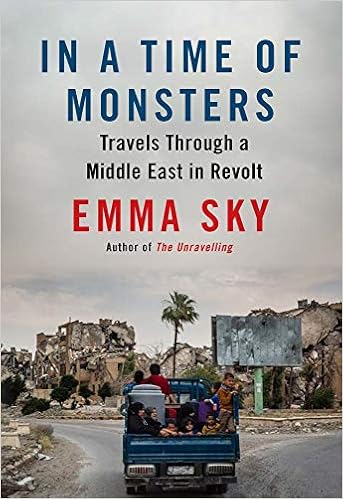
In a time of monsters – Travels through a Middle East in Revolt by Emma Sky

Encouraged to read this by Emma Sky’s sharp analysis in BBC radio interviews of the unintended consequences of the Iraq War, I realised too late that to find out more about her role as political advisor to the American commander General Ray Odierno in its aftermath, enabling her to give damning evidence at the Chilcot Enquiry, I should have started with her book “The Unravelling”.

“In a Time of Monsters” proves as is often the case with travel books to be very anecdotal and episodic, often revealing some telling insights through a chance encounter, but also frustrating, even confusing at times, in what it omits or glosses over. The background history of the Shias versus Sunni is a little too fragmented, while the explanation of the Caliphates from the death of Mohammed up to the recent attempts of Daesh to create a single Islamic state probably comes too late in the book, some two-thirds of the way through.

“Bored, bitter and twisted”, with an acute sense of anticlimax and loss of purpose after her return to London in 2010, perhaps even a little traumatised by her experience in Iraq as she suggests most westerners are, she resolves to make sense of events by visiting countries affected by the Arab Spring: Egypt, Tunisia, Syria, Iraq, Turkey, Saudi Arabia, Oman, Kurdistan and so on.

Making use of what seems like an inexhaustible network of obliging high level political contacts prepared to engage in boozy debates, Emma Sky has no difficulty in striking up conversations with strangers prepared to chat at length . Perhaps her childhood as the matron’s daughter at a boys’ boarding school gave her the confidence to act with such ease in “a man’s world” and also to embark on risky, physically tough journeys, solo or with a male guide for the reward of seeing beautiful, remote areas, like the mountains of Kyrgyzstan. Skimming along the river on a jet ski, white-water rafting, swimming into caves to scale waterfalls: sometimes, the socialising and exciting activities, seem too much of a digression from the lives of ordinary Arabs.

It is no surprise that Emma Sky criticises the US for allowing Daesh (or ISIS) to gain a foothold in Iraq in the anger over government corruption and discrimination against Sunnis following the fall of Saddam Hussein. She also condemns the failure to take early action against Assad in Syria to force him to negotiate. It is perhaps more of a surprise that she is so harsh on Obama, described as “leading from behind” and being too passive. However, she does not really provide convincing evidence that continued use of direct force by the West would have yielded the desired results without unacceptable levels of bloodshed, not to mention resentment over apparent attempts to dominate . She is also very critical of Iran as a somewhat malign and destabilising force, reaching tentacles even to the borders of Israel, but was perhaps unable to make the visit to the country which would assist a clear and more objective analysis.

There is a logical progression, in that, being in date order, the visits reflect the passage of events, so that by 2014 Emma Sky is at the refugee camp of Zaatari, close to the border in Jordan, which has become the fourth largest city in the country owing to the flood of refugees from Syria. By 2016 she is in Greece and Eastern Europe tracing the destabilising pressure of Arab refugees pushed out by the devastation in parts of the Middle East. She even visits London to suggest, perhaps too simplistically, that the Brexit vote itself was largely the result of concerns over migration triggered partly by the instability of the Middle East.

The Epilogue finds her on the pilgrim trail to Santiago de Compostela in Spain, a time of acceptance of her past naïve over-optimism, but clinging to the belief that “this is not a time for cynicism or despair” in the hope that her students will manage to leave the world a better place than they found it.

The Greengage Summer by Rumer Godden

Published in 1958, this modern classic, a subtle psychological drama which manages to be both poignant and amusing about the loss of childhood innocence in a confusing adult world, was inspired by the author’s own experiences on a family visit to France in the early 1930s. Whereas the well-known film of 1961 has dated, the book retains the power to hook both teenagers and older readers.

With a botanist father who spends most of his time travelling abroad, and a mother who struggles to cope, narrator Cecil Grey and her four siblings chafe against the tedium of life in the pebble-dash suburbia of “Southstone”. Their mother’s impulsive plan to shock them out of their self-centred moaning by showing them the French battlefields, goes awry when she develops septicaemia from a horse-fly bite, and has to be hospitalised. This coincides with the eldest sibling Joss being perhaps somewhat implausibly struck down with acute PMT for several days. It is a plot device to free the other children to run wild in the French hotel where they are reluctantly accepted as second-class guests. Superficially charming and characterful it is in fact the scene of some shady goings on, as gullible foreign visitors to the nearby battlefields of the Marne are conned with a regularly maintained bloodstain on a carpet, and a human skull buried daily in the garden to be dug up by the hotel’s dogs.

Gorging themselves on the windfall greengages in the orchard so that they are too full to eat them when served up at dinner, only Cecil who knows some French (from having to write out French poetry as a punishment at school) realises that they are being used as “camouflage” for the scandalous relationship between the proprietor Madame Zizi and her charismatic English lover Eliot. A kind of unofficial guardian for the children, who adore him, he is a complex character, showing empathy for them, as when he gives Willmouse, the only boy in the family, an art book to feed his precocious interest in fashion design, but the suspicion grows that Eliot is mainly motivated by his infatuation with Joss, a beautiful sixteen-year-old who is beginning to grasp and exploit the power of her sexual attraction.

Deeply evocative and nostalgic in its descriptions of life in a historic French town on the banks of the Marne, and lightened with many humorous moments, this slow-burn study of human interaction morphs into a faster paced, tense crime story with one of those abrupt endings which leaves one reflecting on events and deciding for oneself what happens next.

Very successful in her day, Rumer Godden is one of those now forgotten authors who repays revisiting.

“The Greengage Summer” by Rumer Godden – growing pains

Published in 1958, this modern classic, a subtle psychological drama  which manages to be both poignant and amusing about the loss of childhood innocence in a confusing adult world, was inspired by the author’s own experiences on a family visit to France in the early 1930s.  Whereas the well-known film of 1961 has dated, the book retains the power to hook both teenagers and older readers.

With a botanist  father who spends most of his time travelling abroad, and a mother who struggles to cope, narrator Cecil Grey and her four siblings chafe against the tedium of life  in the pebble-dash suburbia of “Southstone”. Their mother’s impulsive plan to shock them out of their self-centred moaning by showing them the French battlefields, goes awry when she develops septicaemia from a horse-fly bite, and has to be hospitalised. This coincides with the eldest sibling Joss being perhaps somewhat implausibly struck down with acute PMT for several days. It is a plot device to free the other children to run wild in the French hotel where they are reluctantly accepted as second-class guests. Superficially charming and characterful it is in fact the scene of some shady goings on, as gullible foreign visitors to the nearby battlefields of the Marne are conned with a regularly maintained bloodstain on a carpet, and a human skull buried daily in the garden to be dug up by the hotel’s dogs.

Gorging themselves on the windfall greengages in the orchard so that they are too full to eat them when served up at dinner, only Cecil who knows some French (from having to write out French poetry as a punishment at school) realises that they are being used as “camouflage” for the scandalous relationship between the proprietor Madame Zizi and her charismatic English lover Eliot. A kind of unofficial guardian for the children, who adore him, he is a complex character, showing empathy for them, as when he gives Willmouse, the only boy in the family, an art book to feed his precocious interest in fashion design, but the suspicion grows that Eliot is mainly motivated by his infatuation with Joss, a beautiful sixteen-year-old who is beginning to grasp and exploit the power of her sexual attraction.

Deeply evocative and nostalgic in its descriptions of life in a historic French town on the banks of the Marne, and lightened with many humorous moments, this slow-burn study of human interaction morphs into a faster paced, tense crime story with one of those abrupt endings which leaves one reflecting on events and deciding for oneself what happens next.

Very successful in her day, Rumer Godden is one of those now forgotten authors who repays revisiting.


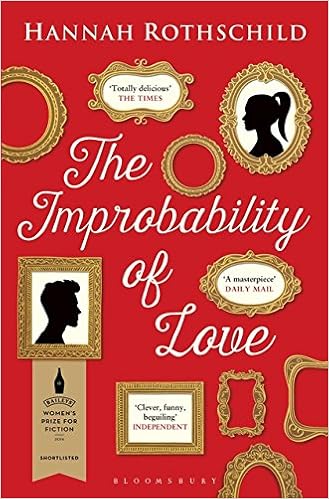
“The improbability of love” by Hannah Rothschild – pas pour “Moi”

Whereas the prologue to a novel is usually a short, sharp dramatic incident to “hook” the reader,  this starts with an indigestible litany of the caricatured stereotypes of super-rich clients converging on the Monachorum auction house, and the staff baited to lure them into bidding up the price of “The Improbability of Love”,  a painting hyped as likely to sell for a record sum. The storyline then switches back six months to the lovelorn Annie buying the painting for only £75 on an impulse, thus rescuing the masterpiece in its neglected and unrecognised state from half a century spent in a rundown antique shop.

The author is undeniably articulate with a vivid imagination,  her professional knowledge of how paintings may be cleaned, dated, attributed and interpreted is quite interesting, and the book seems to have delighted many reviewers, but I found it almost unreadable, a frothy confection with a hollow centre.

Part farce, part Mills and Boon romance, past crime thriller, it falls short for me by reason of its ramshackle plot, with implausible twists and many niggling inconsistencies in the basic telling. It is too long, by reason of the continual wordy digressions. Even the painting, which adopts the irritating habit of addressing us, has to remind us in a gimmicky seven line Chapter 11: “Hello. I am still here…….Moi”. Arch and snobbish after spending centuries in gilded salons, it cannot identify modern cars by name but has somehow acquired some knowledge of modern life despite being stuck in a shop for fifty years.  I would rather have had a thread about the painter’s creator Antoine Watteau running through the book.

Was this written as a ludicrous parody of the art world to amuse friends “in the know”?  I was struck by the chapter which, instead of creating an exaggerated stereotype, dissects a real-life artist in the form of Damien Hirst.  When boorish exiled Russian oligarch Vlad visits the Tate Modern retrospective, he encounters sharks in formaldehyde in glass tanks, rooms full of medical equipment and a piece made of dead flies and diamonds. “Suddenly he got Hirst: the man was a brilliant comedian making a joke out of life and the art world and all those who took it seriously……you can encase anything, add jewels and precious metals, but it’s still the same old s***.”  (This is a quotation from th book). Presumably, Hirst is happy about this representation, as a form of free  publicity.

In contrast to the turgid detail of earlier chapters, the ending feels quite condensed and rushed, as if the author has bored herself and grown anxious to finish it.

Truth seems stranger and more entertaining than fiction, also provoking a real debate over the value we put on works of art.

A recent example is the purchase at the record price of $450.3 million dollars of  the long lost “Salvator Mundi” which may well be, though possibly only in part, the work of Leonardo da Vinci but claimed to have been so heavily restored that the Louvre Abu Dhabi postponed its initial plan to display it.

I am also  reminded of the excellent and highly recommended “The Vanishing Man: In Pursuit of Velazquez” by Laura Cumming,  who  demonstrates some of the problems of attributing paintings correctly to their creators. It is also disturbing to read about the dealer who, having cleaned up a “Velasquez” to make it more attractive to a buyer, had it darkened and aged to fetch a better price.

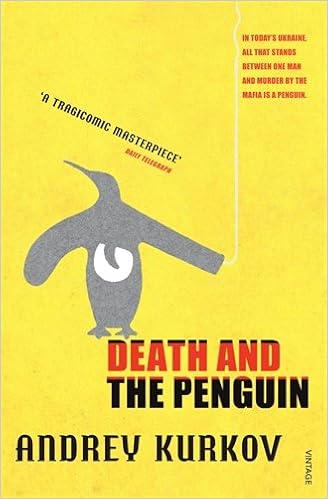
“Death and the Penguin” by Andrey Kurkov – modern Kafka’s comic black art imitated by life

What is on the surface the whimsical tale of a lonely failed writer who forms a bond with the penguin he saves from Kiev Zoo when it can no longer afford to feed its exhibits, is underlain by the bleakness and black humour of the searing indictment of a state recently emerged from communism but still bedevilled by acute shortages and corruption.

Viktor is initially delighted to be given what seems like a well-played sinecure writing “obelisks” or obituaries of influential people for a newspaper, until the realisation dawns that he is somehow implicated in the premature demise of the subjects involved. In a modern take on Kafka, he is not quite clear about the nature of the crime to which he is turning a blind eye, but grasps that if ever it is explained to him, it will mean that he too has become dispensable and his own life will be on the line.  The fact that, as a reader, one feels frustrated and a bit wanting in not fully understanding what is going on only adds to the surreal nature of the story.

It is not surprising that everyone seems to consume so much alcohol to deaden their feelings in this grim society. This provides one of the many examples of dark comedy, in which Sergey, the kindly district militiaman who becomes Viktor’s only true human friend, assures a drunken angler that he is “seeing things” when Misha the penguin pops up out of the ice hole in which he is fishing: “Perhaps he’ll ease off the drink a bit” he quips, unable to give  up  policing people’s habits even when off duty, and somewhat hypocritically since he too knocks back large amounts of cognac.

The Ukraine is portrayed as a country in which ambulance drivers have to be bribed to take a sick man to hospital where there is a lack of medicine to treat him anyway, and potatoes seem to be the staple diet, while wealthy criminals will pay $1000 to hire a penguin as a gimmick at the fashionable funeral of a contract killing victim featured in one of Viktor’s obituaries – the irony is endless.

The author does not judge Ukrainians who have been driven to a pragmatic acceptance of corruption,  but describes the lonely penguin, by nature a creature evolved to work in a supportive community, as a metaphor for people living in a post-communist society who suddenly find themselves cut adrift from a mutually supportive community, and alone in a world with new, unfamiliar rules of life.

Having written the novel in 1996, Kurkov has been only temporarily gratified and ultimately depressed to find his art imitated by life in the recent moral and political chaos of the Ukraine. With first-hand experience of  artistic friends liquidated by contract killers, one hopes that this perceptive writer will be safe.

The dramatic climax of this book seems unduly rushed and the ending abrupt, but also quite neat, leaving at least one striking loose end but paving the way for a sequel, or two.

“The Silence of the Girls” by Pat Barker – unimaginably distant times

The Silence of the Girls by [Barker, Pat]

In this retelling of the aftermath of the fateful argument between Achilles and Agamemnon during the Trojan Wars, Pat Barker takes the viewpoint of Briseis, the high-born woman taken captive as part of the booty from the city of Lyrnessus. Having witnessed Achilles actively involved in the brutal killing of her husband and brothers, she suffers the further trauma of being accepted as his “sex slave”. She is scornful of the women who fawn on the men who possess them to wheedle favours, but knows there is a fine line between this and annoying Achilles so that he hands her over to the common soldiers to share, in what she describes as “a rape camp”. When Patroclus, the friend of Achilles with whom Briseis forms an unlikely friendship offers to persuade Achilles to marry her, she observes how it must appear shocking that she can contemplate such a course of action, yet when reduced to slavery one is prepared to consider almost any way of improving one’s lot.

No doubt hardened by her string of First and Second World War novels, Pat Barker does not flinch from describing scenes of great brutality in battle, alternating with the somewhat contradictory and ludicrous rituals to both desecrate and honour and the person one has killed. Yet her main interest is clearly the role of women in the Trojan wars, the stoical acceptance of their lot as they prepare food, wash clothes and care for the sick to keep the camp going.

The tone is often deliberately modern, colloquial, foul-mouthed, I assume in an attempt to draw parallels between people past and present, enabling us to identify better with the former as “real”. I agree with readers who find the attempt to punctuate an ancient legend with modern anachronisms jarring and who are irritated by the sudden switch part-way to the point of view of Achilles, which tends to undermine a distinct focus on the lives of the forgotten and undervalued women. This is not a feminist novel in the sense that women do not rise up in rebellion against their treatment, nor seriously question the constraints under which they have to live. Descriptions of roles in the camp are often quite dull, for that is what they were.

I found myself curiously unengaged by the book, perhaps because too many incidents rely on magic. So we see the capricious gods punishing the camp with a plague of rats since Agamemnon refuses to release his “bed woman” to her priestly father. Achilles is able to shout so loudly from the camp that his war-cry can be heard in Troy, causing strong men quake. Since he is in need of a suit of protective armour, his mother the goddess Thetis rises from the waves to supply him with a perfectly fitting and flexible one. Having slain Hector, he drags the body behind a chariot daily to dishonour it, only to find that the gods have “defied” him by restoring the corpse to its original state.

Although it is very readable and quite imaginative in reworking the “facts” of the Iliad, I am more impressed by Pat Barker’s books on C20 wars, which seem to provide greater scope for creative writing with character development and plot twists. As it is, Achilles seems merely moody and brutish, fated to die shortly as the price of becoming a legendary super killing machine; Patroclus is portrayed as implausibly empathetic and kind, since he massacres the enemy alongside Achilles without any evident qualms, and the nature of the relationship between the two remains blurred. Briseis is parcelled up like a commodity for a decent enough new husband who will protect her, so her feminism is limited to a C21 awareness of brutality and exploitation which she is unlikely to possess. The final chapter is disappointing: a rushed information dump of bloodthirsty violence to round off the tale.


Normal People by Sally Rooney – What does it mean to be “normal?

This is an in-depth portrayal of the evolving relationship in the four life-changing years from leaving school to starting on a career of two young people in present-day Ireland. It is perhaps inspired by George Eliot’s observation, quoted at the outset,  and no doubted garbled here into plain English, on the profound  and unexpected way in which one personality may influence another.

The bright but troubled product of a well-off yet dysfunctional family, Marianne is a loner and misfit at secondary school, continually provoking rejection and bullying by her peers. The one exception is Connell whom she can meet in a neutral setting outside school because his mother cleans for Marianne’s family. Supported by his poor but well-balanced and tolerant single mother Lorraine, the charming, athletic and academic high-flier Connell is the complete opposite of Marianne in being very popular, a situation he is afraid of sacrificing by the admission that he not only likes her but they are in a sexual relationship.  In his immaturity he behaves callously, despite the sensitivity which feeds his love of English and leads Marianne to encourage him to apply to study literature at Trinity, her university choice.

Once at somewhat exclusive middle-class Trinity, the tables are turned: with the chance of a clean slate, it is Marianne’s turn to become accepted and sought after, whereas the working-class Connell feels out of his depth, judged by his thick regional accent and cheap, unfashionable clothes. Yet through indications of her lack of self-esteem and sexual masochism in her relations with men, the degree to which Marianne has been physically and mentally abused is revealed: although details remain sketchy as to her dead father, they are painfully clear as regards her cold mother, and brutal, manipulative brother, both themselves the victims of abuse, but not portrayed with any sympathy like Marianne. Throughout, she and Connell may no longer be lovers but share some deep bond, yet not always with complete openness and self-knowledge. Though highly intelligent and perceptive, immaturity and lack of experience inevitably plunge them into frequent uncertainty and confusion, unable to express their complex, shifting emotions.

This is an insightful and often moving page turner, with the tension of knowing that matters could end in tragedy. Born in 1991, Sally Rooney has the advantage of being close enough to her school years to write with authenticity about the pressure to conform and bullying aggravated by social media. She gets inside the head of the two main characters to create a convincing stream of the changing and conflicting emotions of being on the cusp of adolescence and adulthood.

It may well be that this novel has been over-hyped, although I would not criticise the simple style which is probably  harder to write than it seems and serves to convey  the characters’ thoughts more effectively than  many a self-regarding literary turn of phrase.  I agree that apart from Marianne and Connell, the characters are mostly two-dimensional caricatures, with no indication of their inner motivations and thoughts. The main flaw for me is that periods of mental illness, which figure strongly in the book, seem to be slipped into, or recovered from rather too abruptly, with insufficient development of the situation. However, I was satisfied by the ending which seemed a well-chosen point for conclusion, leaving it open to the reader to decide what happens next in their lives. This is not a depressing read for there are moments of humour despite the emotional intensity.