Six Fourmis Blanches by Sandrine Collette – Tempting Fate

Six fourmis blanches (Sueurs froides) (French Edition) by [Sandrine Collette]

In an isolated Albanian mountain valley steeped in superstition and reputed to be cursed, Matthias is believed to have inherited the gift of keeping bad luck at bay before a wedding or suchlike, by choosing a suitable goat to hurl as a sacrifice from a high point to appease evil spirits – this is not a book for animal lovers. Despite the respect, even wary awe in which he is held, when Matthias inadvertently falls foul of the local mafia-style boss Carche, his only option is to abandon everything and go on the run.

The parallel storyline which will eventually converge with it, starts out in a much lighter vein. Lou and her partner Elias, a pair of young urban French professionals, follow an impulse to spend a long weekend trekking in the Albanian mountains in early spring in the company of four other compatriots whom they barely know, led by Vigan, a hardy-looking local guide who inspires confidence and is even fancied a bit by the two women in the group. After a day of idyllic wandering, the walkers wake to a world transformed by a freezing blizzard. The novel becomes a psychological thriller in which they are challenged beyond their capacities both physically and mentally by the forces of nature and an unrelenting sequence of mishaps. The group members prove all too human in their flaws, apart from the almost saintly Elias.

The author is skilful in creating a powerful sense of the intense cold, the mood swings between giving up and fighting on against the odds, the changed perceptions in which malign spirits and devils suddenly do not seem so preposterous, the dilemma between instinctively saving oneself and cooperating in risky efforts to save others. In a thriller which does not flinch from the macabre, it is not at all clear until the last page, and possibly even then, who will survive and how.

This novel works on two levels: both as a well-plotted page-turner thriller with a strong sense of place (admittedly frequently far-fetched, particularly the dénouement, but that is par for the course in this genre) and also a perceptive in-depth study of character in the case of the alternating narrators, Matthias and Lou.

I read this in the original French and imagine it would need a good translator to pack the same punch in English.
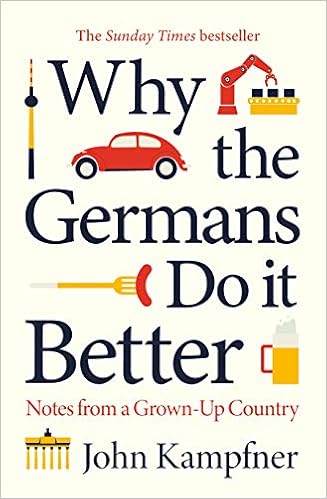
Why the Germans do it Better – Notes from a Grown-Up Country by John Kampfner: Wisdom after the Fall

Clearly driven by disappointed rage over the Brexit decision, subsequent bungling of negotiations for a trade deal and incompetent handling of the coronavirus, the author may have over-egged the pudding of German superiority, which his German acquaintances seem to disclaim or at least play down, mindful of the Nazi past which has made them continually self-questioning and reluctant to praise their country. They retain compound nouns for “coming to terms with history”, “culture of remembrance” and “collective guilt”: no longstanding national day ceremonies, no pageantry.

Kampfner sets his analysis in the context of key factors: the post war reconstruction through competent leader Erhard’s “Economic Miracle” with the Basic Law to develop political consciousness and strengthen democracy; the visionary, ambitious, inevitably costly Unification which has raised living standards and reduced pollution in the East, but not without ongoing tensions; the recent absorption of a million refugees with the pragmatic justification of easing an acute labour shortage, but at the cost of triggering the rise of the right-wing anti-immigration AfD.

The author attributes Germany’s relative success to the intelligent way decisions are made reflecting the emotional maturity and solidity of Angela Merkel. From the 1980s Germany diverged from US and UK which opted for more deregulation and a get-rich-quick, “look after number one” culture. Instead, Germans place less reliance on individual acquisitiveness as indicated by their more restrictive shopping hours and a greater tendency to save, even if interest rates low, rather than speculate.

German society is based more on “a sense of mutual obligation, shared endeavour and the belief that people need rules to keep themselves in check”. There is a high degree of consensus in underlying values – commitment to a free market economy involving organised and responsible capitalism with a legal requirement for worker representation on company boards rather than conflict in the work place, and investment in skills and productivity of workers. Wealth produced by the market is redistributed to achieve social justice and reduce inequalities between regions. Small and medium-sized family owned enterprises spread round the country play a major role in creating employment and wealth. They are typified by social awareness and active support for local communities.

If this sounds too good to be true, there are weaknesses and flaws. The Deutsche Bank investment in sub-prime mortgages, and VW’s manipulation of tests on emissions to make diesel cars appear less polluting are well known. Yet I was surprised to learn of: Germany’s slow adoption of digital innovation and Artificial Intelligence; lack of investment in infrastructure resulting in rundown school buildings, crumbling road bridges, unreliable internet and trains that do not run on time – ironical in view of Germanic concern with punctuality; an airport designed to serve the unified Berlin has been delayed for years by a plethora of faults. Austerity measures after the 2008 financial crash meant that the states were starved of cash for vital investment while the central government had run up an embarrassing surplus by 2018.

Despite the growing strength of the Green Party and the good intentions to develop wind and solar power and close nuclear power stations by 2021 and coal-fired plants by 2038, external political considerations like concerns over the reliability of a gas pipe-line from Russia and strong counter lobbying from state-subsidised east German lignite mines may well prevent this.

Although many facts will inevitably date quite quickly, this is an informative and thought-provoking read. It seems we have something to learn from a society in which compromise, cooperation and redistribution to achieve justice are accepted for ethical and practical reasons rather than regarded as naïve extremism. On the other hand, the Germans were rather hard on the Greeks…….

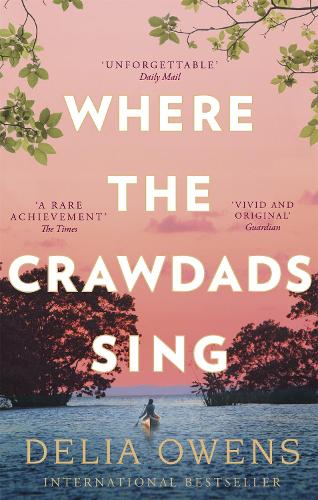
“Where the crawdads sing” by Delia Owens – how to explain the path taken

Where the Crawdads Sing (Paperback)

In the marshland of North Carolina, still unspoilt in the early 1950s, inhabited only by a few down-and-outs or those escaping justice, branded “marsh trash” by the residents of nearly Barkley Cove, six-year-old Kya knows there is something amiss when her mother leaves their decrepit coastal shack, carrying a suitcase. Kya’s four older siblings soon follow suit, driven away by the violence of their drunken father. Expected to earn her keep by doing chores, she avoids him as much as possible, seeking refuge collecting shells and watching herons with flocks of the gulls soaring over the lagoon shore. Bribed with the promise of chicken pie, Kya endures a day of bullying at the town school, but evades the truancy officers thereafter. Abandoned by her father, she manages to survive alone with the help of strangers, including a boy called Tate who teaches her to read. So she somehow grows into a beautiful and intelligent woman, desperately lonely but unable to fit into the community of Barkley Cove, where she is scorned as the “Marsh Girl”.

This storyline alternates and contrasts with a mystery in 1969 when the body of Chase Andrews is discovered in the mud at the base of an old fire tower near Barkley Cove, with foul play soon suspected. Handsome, athletic popular and married, he is also known to have been a womaniser, with Kya among his list of conquests.

This novel is remarkable for its mesmerising descriptions of the natural world, informed by the author’s knowledge as a zoologist combined with a skill which has won her at least one award and plaudits for nature writing. One can visualise every change in the landscape and wildlife as Kya makes her first journey alone by boat between the low-hanging limbs of giant trees, where “duckweed colours the water as green as the leafy ceiling, creating an emerald tunnel” then out to an estuary where “waves slammed against one another awash in their own white saliva….. breaking with loud booms …. then… flattened into tongues of foam”.

The novel is also strong on the psychology of someone who has lost trust through repeated abandonment and also the impact of the world on one accustomed to isolation. So, on her first journey by car to a distant large town, travel on a main road is akin to a roller coaster without a security harness, in contrast to the wide skies of the marshes, mountains are disturbing because the sun keeps setting behind them only to reappear while the tower blocks and crowds of people at her destination are bewildering.

Some who know North Caroline have criticised the factual accuracy of certain points but I can accept any errors as “dramatic licence”. It is harder to deny the implausibility of a young child being able to survive for so long, in apparent perfect health and no major accidents with such poor food, no innoculations. To have been left in this state is unlikely. Kya’s ability to teach herself to such a high level, express herself so articulately, seems far-fetched. Like many novels, the plot is awash with coincidences, most of the characters are stereotypes, the harshness of Kya’s situation is too often leavened with excessive sentimentality, the final twist is rendered improbable by previous arguments and presented as morally justifiable when it is in fact questionable.
The author herself caught my interest by reason of her time in Africa where she and her former husband became embroiled in controversy over their campaigning against ivory poachers, in circumstances which may have inspired this book in some respects.

Despite my reservations which are clearly a minority view on this international bestseller, I found it a page-turner and worth reading although I would be interested to know how male readers tend to rate it.

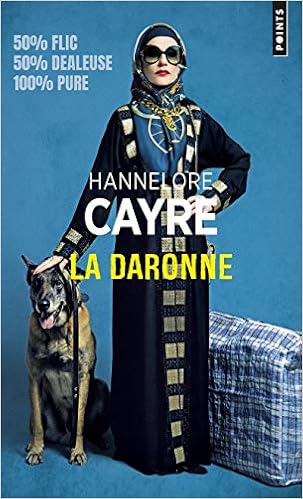
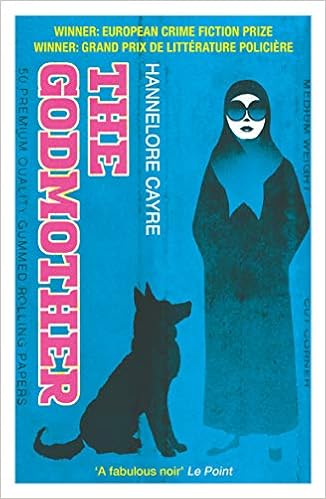
La Daronne or The Godmother by Hannelore Cayre: “The sins of the fathers”

Widowed young, now in her fifties, the misnamed narrator Patience finds that her work as an Arab interpreter/translator for the Paris judiciary does not pay enough to cover the care home costs for her demanding aged mother. Listening to the recorded conversations of suspected Arab drug dealers under police surveillance, her imagination is caught by a close-knit Moroccan family who have switched from legal farming to growing high grade khardala, or hashish, and when she knows that a stash of this has been hidden to evade near Paris to evade a police search, temptation proves too great.

Can she find the precise location of the drug, aided by DNA (ADN in the original French), a retired police sniffer dog she has saved from the standard fate of euthanasia when no longer useful? Will she succeed in selling the drug on and laundering the proceeds without being either detected by the police, including the senior office Philippe who happens to be her lover, or exposing herself to the vengeance of thwarted dealers?

Apart from being a crime thriller which depends too heavily on coincidences and glosses over plot flaws, this is also a psychological study of a somewhat cold, calculating woman, lacking in empathy, who on her own admission has no friends, only acquaintances, since she makes no effort to hide her impatience with people she finds slow or boring. Apparently only capable of feeling love for her dead husband or dumb animals – the first luxury she buys with her illgotten games is an expensive collar for DNA – she is secretly repelled by Philippe’s lovemaking and displays a troubling lack of compassion for her mother. Has her personality been moulded by an amoral, emotionally deprived upbringing with her criminal wheeler-dealer Tunisian father and Jewish mother traumatised by time spent in a concentration camp? Apart from holidays in luxury hotels abroad, Patience grew up on a property next to a motorway, where unwelcome intruders were shot down by her father, to be buried in a corner plot where the grass grew abnormally green, fed by a phosphate-filled soil – a typical macabre allusion.

Patience’s cynicism can be amusing, as when she cites Philippe’s great fault: he believes in God. “If he’d told me he believed in a human destiny governed by a plate of celestial noodles, I couldn’t have found it more ridiculous”. She is acutely aware of the irony of situation: criminalisation of cannabis stimulates “the web-of drug-taking which drowns France” on one hand, and costly legal action on the other, as the police and lawyers pursue the dealers who are selling drugs for inflated prices to their children. Still, at least it creates employment.

The pace seems quite uneven, with abrupt digressions into Patience’s past life interrupting the narrative flow. Tedious detail at some points contrasts with overly rapid treatment of the occasional highly dramatic incidents at others. Most of the characters seem too highly exaggerated to be either convincing or engaging. The result is a patchy black farce which sits oddly with potentially moving explorations of human nature.

“La Daronne”, meaning “mother” or “boss lady” in French was presumably translated as “The Godmother” in the mafia sense of the word. Seemingly written with a film in mind, it has been dramatised with the title “Mama Weed” and Isabelle Huppert in the lead. Is this the kind of book which “works better” in the visual images of a film, perhaps losing some complexity in the process?

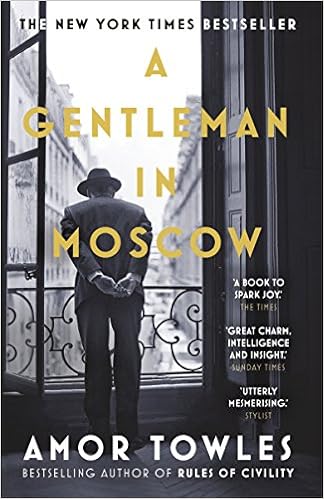
A Gentleman in Moscow by Amor Towles: In for the Count

In the newly Communist Russia of 1922, Count Alexander Ilyich Rostov, as a gentleman, prides himself on having no occupation, and describes his pastimes as, “dining, discussing. Reading, reflecting. The usual rigmarole”. Found guilty of posing a threat to the ideals of society, he is sentenced to life imprisonment in the Metropol Hotel near Red Square where he has resided for four years: if he sets foot outside, he will be shot. Although still permitted to frequent the hotel’s grand restaurant and bar, he is obliged to vacate his grand suite for a former servant’s room in the attic.

Over some 460 pages, the author sustains a flowery prose with fanciful digressions and far-fetched incidents which chime with the Count’s ebullient eccentricity, all likely to charm some readers but irritate others. Falling at first into the latter category, I abandoned this novel until forced to resume it by a pressing book group deadline which caused me to revise my initial prejudice, although I never came to terms with the intrusive narrator, and the useful but distracting footnotes to explain the history.

After a somewhat turgid start, the author manages to entertain the reader with his ingenuity, provide a very articulate expression of the Count’s thoughts and develop a farce which proves quite effective in revealing the flaws and contradictions of the Soviet system. As party officials begin to wine and dine at the hotel, it is simply a case of one privileged élite replacing another. The ignorant and incompetent are over-promoted for their loyalty to the Party, and bureaucratic measures intended to impose equality have ludicrous consequences. Following a complaint from the waiter whom the Count has imprudently humiliated as regards knowing the correct wine to drink with Latvian stew, an order comes from on high for all the labels to be removed from the bottles in the hotel cellar to destroy any concept of some wines being superior to others – an outrage to a connoisseur of fine wines like the Count, who can of course still detect a superior favourite by the trademark design of the bottle.

This is essentially a soft-centred, escapist read, which gives more space to the count’s eternal word games (“name famous threesomes”, “ a black and white creature”) than to the sufferings of individuals, glossing over the true grimness of life for millions under Stalin. The fate of the young prince who has been reduced to playing for diners in a string quartet is relegated to a footnote: he is questioned in the Lubyanka prison for having committed the crime of possessing a picture of the deposed Tsar which happened to be in one of his books, and banned from ever entering any of the country’s six main cities, while the eminent musician who hired him suffers the worse fate of being sent to a labour camp.

One could argue that this tale of how the count manages to pass thirty years in the hotel, unable to walk through the swing doors of the entrance through which he can glimpse the outside world, is an exploration of the resilience of the human spirit, and a consideration of how one can make something positive out of adversity. Perhaps a period of lockdown is a particularly relevant time to read it!

Since, the Russians have tended to restore and value some of their great buildings from the past, or emulate them “for the people” as in the Moscow metro system, it is interesting to look up online images of the Metropol hotel as it is today.

“L’Été Circulaire” or “Summer of Reckoning” by Marion Brunet

In the picturesque setting in  and around Cavaillon, the “capital of the cantaloupe melon” and gateway to the Luberon in Provence, sixteen-year-old schoolgirl Céline, too pretty and promiscuous for her own good, has got pregnant, but refuses to divulge by whom, not even to her more savvy sister Jo, let alone to her father Manuel when he tries to beat the truth out of her.

Described on the cover as a “policier” or crime novel,  but really more of a psychological drama, one  could dismiss this as a light potboiler,  when in fact it conveys a vivid sense of place, a telling portrayal of what it feels like to be an adolescent, and the convincing development of a wide range of different characters, arousing sympathy for all of them despite their all to evident flaws.

There is the hard-working, hard-drinking builder Manuel who finds it easier to express frustration and rage through his fists.  Despite his own family having migrated from Spain, he feels no empathy with the Arab migrants a few pegs down the pecking order, which feeds his resentment of the youth Said who drives a hard bargain fencing the antiques Manuel steals to supplement his income.

Then we have his wife Séverine, steered too young into a shotgun marriage,  claiming to be content with her lot but destabilised by a single friend’s apparently more glamorous lifestyle together with the shock of becoming a grandmother at thirty-four.

The undercurrents are gradually exposed and clues dropped.  As Céline’s pregnancy becomes more obvious, relationships with her school-friends change. Accustomed to admiration, she becomes an object of curiosity and mockery. “Making herself useful” on her grandparents’ farm, it seems that her grandmother, surprisingly tolerant of her pregnancy, is mostly disappointed to learn that the child will not be  boy. Her childhood innocence is fractured further by the knowledge that her grandfather has employed migrants without papers so that he can avoid paying them by turning them over to the police when their seasonal work is done.

Jo, who surprises her teachers with her academic ability, “given her background”, puzzles her father by her desire to watch plays at the nearby Avignon Festival, but  is soon disillusioned by the privileged, casually  friendly  group of middle-class young people she encounters.

Summer of Reckoning by [Marion Brunet, Katherine Gregor]

Gradually building to a dramatic  climax, the novel ends as it began at the annual summer fair, at which, beneath an apparently rather similar surface, much has changed in what the English translation of the title aptly calls  “A Summer of Reckoning”.

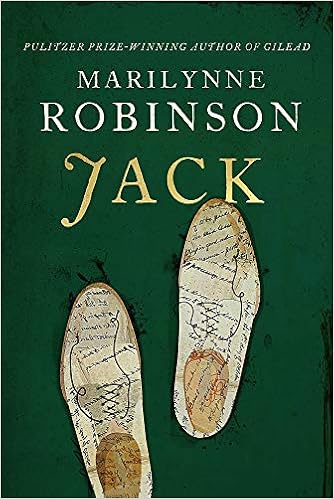
“Jack” by Marilynne Robinson: Theft of Happiness

I am not sure what readers will make of this, if they have not already read Gilead (2004), Home (2008), and Lila (2014), novels about members of the Ames and Boughton families, set in the fictional rural Iowa backwater of Gilead. Certainly, it seems necessary to have read “Home” to make more sense of Jack Boughton, black sheep of the family from which he has exiled himself for years, most particularly from his pious clergyman father’s attempt to bring him back into the fold, even to the extent of twisting his Presbyterian doctrine into contradictory knots.

Apparently, the author did not originally intend to write a book about Jack, but her ideas about him must have evolved over the years to make this seem imperative. Chronologically, it covers a time before the other novels, I believe in the late 1940s. Jack is a complex character, hard to pin down. I was continually aware of his self-absorption and tendency to overthink everything while trying to define the qualities which make him appeal to those who look beyond the frayed cuffs and raffish air. Intelligent, good-looking, musical and artistic, charming, polite, surprisingly competent when he puts his mind to a practical task, Jack is also a loner and drifter, who finds it hard to fit into the world as it is, fated to blow every chance he gets, his life being a chain of tragicomic mishaps.

Apart from inexplicable misdeeds, he has a tendency to do the wrong thing for the right reason. As a child he was always slipping off, thieving objects he did not really want for reasons he could not explain, and challenging his father with theological questions. Is the root of his problem the tendency to “think outside the box” but to have been born into a profoundly respectable family, and a set of beliefs and sense of duty he was bound to kick against instinctively? Has he been influenced by the Presbyterian doctrine of predestination into thinking that he is fated to fail, so when things are going badly he tries to have as little contact with others as possible?
Matters only grew worse when he got a local girl pregnant and flunked college. Years later we find him shabby and on the breadline, a compulsive kleptomaniac who drinks to ward off his mental pain, doing odd jobs but reliant on the envelopes of cash his kindly brother leaves for him. A recently served prison sentence was ironically for a crime he did not commit, although arguably a just penalty for all his petty thefts. Life is made doubly hard by his obvious education and genteel manner which set him apart from the kind of company he has been reduced to keeping.

With his talent for making life difficult, he falls for Della, a beautiful young teacher who shares his love of poetry but just happens to be black in the segregated city of St. Louis, where it is a crime for them have a relationship, and unwise even to be seen together. Perfect in his eyes, Della remains an enigma. We never really know what makes her tick, but she seems drawn to him by his “pure soul”, essential innocence, plus perhaps the appeal of his patent vulnerability.

The two establish their fateful bond during a night spent in the St Louis cemetery where Jack has gone because he has let out his room to make some money, and she has been accidentally locked in. In a section of nearly eighty pages, more than a quarter of the book, the dialogue often seems stilted, artificial, even obscure, although this may be deliberate to contrast with their later easy but still thoughtful exchanges. It also shows symbolically how, if the two could exist in a world of their own, without society’s restrictions and taboos, they could be happy. Perhaps only a writer hailed as one of the greatest in this century could have risked such a difficult and for many off-putting beginning to a book. Perseverance pays off, since many of the succeeding sections are quite lively and humorous, although poignantly so.

This is the kind of novel which needs to be read slowly and thoughtfully, probably at least twice, to appreciate the insights on human relations which are really more important than plot, and may also explain why the ending just fades out. Marilynne Robinson is clearly steeped in religious philosophy which sometimes lost me. She casually using words like “apophatic” which strike an incongruous note in the more down-to-earth passages and wry humour. Taken as a whole, the four related novels are intriguing, although I suspect an acquired taste.

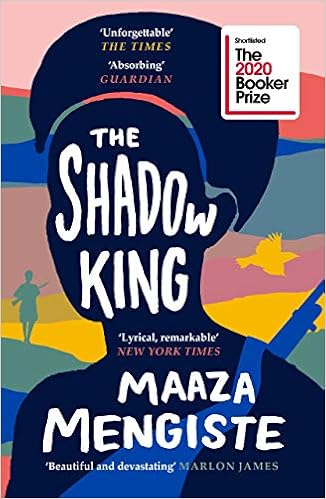
“The Shadow King” by Maaze Mengiste: when more is less

This ambitious novel, partly inspired by the author’s own great-grandmother who insisted on going into battle armed with her father’s rifle because her brothers were too young to fight, recalls Mussolini’s long-forgotten invasion of Ethiopia in 1935 to expunge the humiliation Italian soldiers had suffered unexpectedly at the hands of native warriors forty years earlier. Since this time, the Italians are equipped with planes, tanks and mustard gas, it seems inevitable that they will win.

The drama is played out largely from the viewpoints of two main characters: the young Ethiopian girl Hirut, and Jewish Italian soldier Ettore, who takes on the role of war photographer.

The orphaned Hirut has been taken into the household of warrior leader Kidane, ostensibly because of his fond memories of her mother, but arousing the jealous of his wife Aster, already quite disturbed through the recent death of her infant son, and repressed frustration over being forced to submit to her husband’s will. As propaganda leaflets fomenting rebellion against Emperor Haile Selassie fall from Italian planes, and an invasion fleet lands in nearby Eritrea, Kidane musters his fighters, but the women wish to do more than merely provide the food and bandages.

Ettore’s father exhorts him to use his camera to “bear witness to what is happening. Make living your act of defiance. Record it all. Do it relentlessly….” but living with the fear of exposure under an anti-semitic regime lays Ettore open to blackmail by his sadistic senior office Fucelli, who forces him to photograph mutiliated soldiers and abused captive women for propaganda purposes. In the process, his work becomes perverted by an obsession with the artistry of a hanging body, or a form plunging into a ravine.

In a cast of complex but generally underdeveloped characters, only the brutal Colonel Fucelli is almost unremittingly stereotyped, although even he can blame a cruel father for his warped nature.

The shadowy presence of Haile Selassie hovers in the background, portrayed as a weak figure who takes refuge in listening endlessly to Aida, eventually fleeing to the safety of Bath in England. His loyal subjects resort to the tradition of using a “shadow king” or body double of the Emperor to restore the morale of a population willing to be conned. Which of these two men is the real “Shadow King”?

The key to understanding this novel lies in Salman Rushdie’s description of it as “lyrically lifting history towards myth”. Yet in imitating the style of “The Iliad” or Greek tragedies like “The Oresteia”, chorus included, the novel often has a stylised, theatrical quality which makes the characters less realistic and moving , and also tends to objectify battle into a troubling kind of art form.

The style is intensely visual, with hardly a description failing to mention how the quality of the light and how it falls. There are continual references to the photographs poignantly or grotesquely capturing the moment. Yet all this is with diminishing effect, eventually counterproductive, as the novel becomes simply too wordy, too repetitious, too overblown, too contrived, too implausible, too long. The bludgeoning from incessant, overwrought sentences which on analysis often mean nothing, wore me down.

There is great potential in the interesting multi-stranded theme and I admired the author’s depth of research and appreciated her passion. Although I was left feeling frustrated by a flawed novel in which so many possible insights are obscured, it has at least motivated me to find out more about Ethiopia.

Twilight of Democracy – The Failure of Politics and the parting of Friends by Anne Applebaum: “Uncertainty has always been there”

On the surface, this is a timely and readable assessment of the disturbing situation in which many Europeans and Americans now find themselves as the solid ground of democracy, rule of law and free press they had come to take for granted begins to give way, and prove disappointingly short-lived in countries like Poland and Hungary which had the chance to regain it after the collapse of Communism.

Readers with draw different insights. I was struck by the ominous  parallels between the Polish Law and Justice Party  and the Tories under Boris Johnson since 2019: the former has undermined the independence of the judiciary, forced out experienced civil servants in favour of loyal party stooges, and appointed as director of state television a crony of the President who proceeded to fire respected journalists, replace them with those supporting the far right,  and soon abandoned “any pretence of objectivity and neutrality” in news broadcasts. One thinks inevitably of the attempt in the UK to prorogue Parliament in order to force through the Government’s will on Brexit, the criticism of judges who tried to take a stand, the replacement of experienced, moderate senior civil servants and ministers, and the rumours (at the time of writing) of government pressure to appoint a right-wing Director of the BBC to muzzle justifiable criticism which is seen as too “woke” and left-wing.

Anne Applebaum describes how democracy may be undermined by the “authoritarian predisposition”  of some leaders,  “that favours homogeneity and order”  and the way it may appeal to people who are “suspicious of those with different ideas”,  and who latch on to simple messages because they cannot cope with complexity. She made me aware of the different types of nostalgia, the more common “reflective” kind,  for those who miss the past but don’t really want it back because they know it wasn’t perfect, and the “restorative nostalgia” of those who set out to recreate the past in  “nationalist political projects” based on a simplified “cartoon version of history”,  in which they may either believe, or see cynically as a means of control.

In what I found one of the most interesting chapters, “Cascades of Falsehood”,  she reminds us forcefully how the Internet has created an uncontrolled “information sphere” with no easy way to know what is true: “People have always had different opinions. Now they have different facts…People click on  the news they want to hear”, and social media uses algorithms to feed them yet more of what they may have been conditioned to want. “Make America Great” and fake news obviously comes to mind.

As the wife of a former leading Polish politician,  with her own experience as a high-flying journalist and respected academic, the author should be well-equipped to analyse the situation.  I was prepared to accept that an outlook likely to be to the right of mine would at least give understanding of a different viewpoint.  I was therefore disillusioned to find so much of the book quite superficial (as reflected in the lack of an index), and anecdotal,  periodically digressing into an overly gossipy focus on some former friend or acquaintance who has become too extreme, like the US television presenter Laura McGraham.

With an analysis which could have been covered in an extended article, this works less well when padded out to a possibly hastily written book. The name-dropping, the glamorous boozy parties with former friends who have now swung even further right than they were before becomes somewhat tedious. I began to feel her analysis was limited by her apparent membership of a bubble of elitist privilege, such that she was out of touch with some of the real reasons why ordinary people might vote for right-wing autocrats against their best interests.

Suggesting at one point that people in the Western world feel themselves deprived if they lack air conditioning or WiFi, she overlooks the widening inequality indicated by the rise in  UK food banks, the large number of families two pay cheques removed from poverty. Perhaps because, living in the UK, I have a good understanding of the Brexit saga,  her coverage of this seemed particularly weak, partly since her reasons for the Leave vote seemed based on conversations with a small number of fogeyish, highly conservative former friends.

She herself shows continual flashes of bias, condemning Jeremy Corbyn’s brand of socialism out of hand without justification, condoning Israel with never a flash of criticism and no sympathy for the Palestinians. A self-confessed rightwinger, she does not show any awareness of how this might be distorting her own arguments.

Her conclusion that “uncertainty has always been there” but  we should live in hope, “picking our way through the darkness”  seems true, yet too lame.

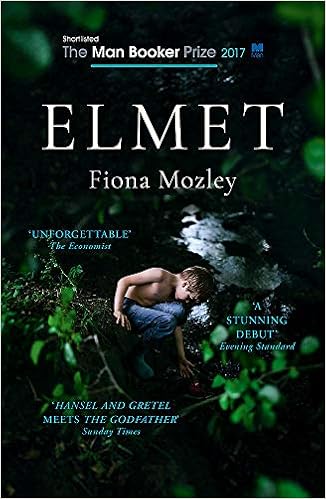
“Elmet” by Fiona Mozley: an inevitable descent?

Teenagers Daniel and his elder sister Cathy help their father to construct the isolated house in a hill-top copse which he does not own within earshot of the East Coast Main Line through Yorkshire, an odd choice for a rural retreat. Apart from a period attending school, where they found it hard to fit in, the pair have spent their childhoods as outsiders, dominated by their “Daddy” John, throwback to a former, simpler age, who wishes to have no truck with modern life, although to earn the money to make this possible, he engages at times with the sleazier parts of it, using his remarkable strength and skill as a bare-knuckle fighter (the name alone makes one wince in pain) in bouts arranged by gypsies and crooks. Portrayed as a kind of latter-day Robin Hood, he often channels his violence to settle scores against villains on behalf of those too physically weak to do so. Narrator Daniel describes how humanely “Daddy” traps and kills animals for food, but is he really a good man?

Daddy’s unconventional views are demonstrated in his attitude to land. “It’s idea a person can write summat on a bit of paper about a piece of land that lives and breathes, and changes and quakes and floods and dries, and that that person can used it as he will, or not at all, and that he can keep others off it, all because of a piece of paper. That’s part which means nowt to me.”

Unsurprisingly, owner of the land in question, Mr Price, takes issue with him over this, although there turn out to be other reasons for a long-term grievance between the two men. Can Daddy really hope to win against a wealthy wily, unscrupulous landowner? Brought up to defend themselves, how well will Daniel and Cathy be able to support their father when it comes to the crunch?

The location “Elmet” is inspired by the poetry of Ted Hughes, “The Remains of Elmet”, which he described as, “The Calder valley, west of Halifax, was the last ditch of Elmet, the last British Celtic kingdom to fall to the Angles. For centuries it was considered a more or less uninhabitable wilderness, a notorious refuge for criminals, a hide-out for refugees”. The novel also has hints of a latterday “Wuthering Heights”.

Author Fiona Mozley succeeds in creating a vivid sense of place, as regards both the natural landscape and the local community, impoverished by mine closures, where people struggle on zero hours contracts at the mercy of dishonest local employers. There is a convincing portrayal of the complex bond between the father and his children: caring and protective on one hand, he is unintentionally neglectful and damaging on the other. The children’s roles are a reversal of the norm, with Cathy strong and aggressive and Daniel gentle and domesticated.

I understand why many readers have praised this book, even how it came to be short-listed for the Man Booker Prize. Yet, although an original debut novel, it falls short for me in some fundamental ways. Perhaps the author wanted to portray Daniel as both immature and perceptive for his age, but his “voice” is inconsistent, switching between that of a naïve, inexperienced boy to observations and insights beyond his years. Poetic passages often sit oddly in the text, by turns overly sophisticated or grating:

“He was a human, and the gamut upon which his inner life trilled ranged from the translucent surface to beyond the deepest crevice of any sea. His music pitched above the hearing of hounds and below the trembling of trees.”
Since the author grew up in Yorkshire, I have to assume she has “captured” the local dialect, but many of the longer dialogues contain too much exposition. Some characters, like the children’s absent mother, or their neighbour Vivien, are underdeveloped. The violence of the climax surpasses everything which precedes it, but becomes quite implausible in the process. Also, the novel gains little from what has become the formulaic prologue trying to hook the reader by “giving away” some of the ultimate violent outcome, nor from the “flash forward” passages also in italics which show Daniel in the aftermath of events.