“Ru” by Kim Thuy: hypnotic memories in a waking dream

Born to a wealthy family during the 1968 Tet Offensive when the North Vietnamese communists launched their surprise attacks on the South during the Lunar New Year festivities, mingling machine gun fire with firecrackers, Kim Thuy has drawn on her own experiences to produce this fictionalised memoir. Half the family is home partitioned off with a brick wall to be taken over by communist soldiers who spy on them continuously. Their wealth in the form of diamonds inserted in the pink plastic of dental prosthetics, the narrator’s family joins the flood of boat people, passing via a muddy Malaysian camp to Canada which has extended a generous welcome to many Vietnamese refugees. Years later, as a naturalised Canadian, she is able to revisit her country of origin to reevaluate it from a westernised perspective.

At first, certain aspects of the evidently original and distinctive style irritated me. I felt somewhat cheated by the mainly one page chapters, often more than fifty per cent white space. The way they flitted back and forth in time made it hard to keep characters in mind and grasp the order of events. It is difficult to refer back to points quickly unless one is using a Kindle! I found it easier to read once I had accepted the novel as a series of anecdotes, often poetic, with a rhythmic, hypnotic quality, the white space encouraging a pause for reflection, the underlying aim being to mirror how memory works in fragmented, jumbled recollections.

“Ru”, a French word which can mean “Flow”, seems a more apt title than “Ru” in the sense of “Lullaby”, many memories being quite brutal or harrowing, mixed with beauty, humour or banality. This may render them all the more shocking, in seeming unreal while manifestly true. For instance, Mr. An, met in Canada, is still traumatised by the Russian roulette played by the Communist soldiers, causing him to observe for the first time the varied shades of blue in the sky he thought he was seeing for the last time. The narrator’s objectivity in describing such things is a way of coping with suffering and loss. Yet is it also at the price of making the reader feel too disengaged as well?

Despite their brevity, the paragraphs need to be read slowly, with concentration, because they are so full of images which evoke yet further ones. Each reader will draw something different from the myriad of impressions. Perhaps because they give insights into a different culture, I found the passages on Vietnam the most striking and moving – the nostalgic image of a past tradition, in which old ladies in a boat on a small lake place tea leaves in lotus flowers for them to absorb their scent during the night.

Then there is Aunt Five (the Vietnamese name their family members by number), a spinster who has dedicated her life to her parents. Rewarded after their death by being driven out of the house, she takes refuge in a hut near a Buddhist temple, virtually her sole possession being the four bowls in which she gave her old father his daily rice. These blue and white bowls with silver rims, partly translucent when held up to the sunlight, are a symbol of a lost way of life.

There is subtlety in the anecdote of the refugee boys machining clothes in a Quebec garage after school to earn some pocket money, who recall the dark period in Vietnam when they were abused by men in for the price of a bowl of soup. Yet their ability to maintain a kind of innocence, divorced from the sordid deeds of adults, and become balanced young men, Canadian engineers, is an affirmation of human resilience.

Kim Thuy evokes our empathy with the refugees, and a sense of how having been uprooted from one culture, they inevitably retain a nostalgia for certain aspects of it, some fated to occupy a kind of limbo, unable to shed a sense of disconnection from the host country, no matter how well they appear to have integrated into it: “one horizon always conceals another…… one advances through life in the footsteps of those who have gone before, in a kind of waking dream”.
“Slow horses” by Mick Herron: “practise to deceive”

“Come, friendly bombs, and fall on Slough
It isn’t fit for humans now,
There isn’t grass to graze a cow
Swarm over, Death!”

This well-known attack on Slough by John Betjeman is the source of the name Slough House, in turn easily corrupted into “Slow horses”, the derogatory nickname of disgraced MI5 intelligence officers sent to work there on pointless tasks, until they are driven to leave the service at no further cost to the organisation. The particular failure of their slovenly, foul-mouthed boss Jackson Lamb has not been disclosed, but for his hapless underlings it ranges from leaving a highly confidential computer disc on the Tube, handed in at the BBC, to making a careless error when tailing a suicide bomber at Kings Cross, resulting in massive and costly damage. This was bad enough for River Cartwright to be sacked, but for the string-pulling of his grandfather, retired spook the “OB” which turns out to mean the “Old Boy”.

The narrative starts slowly, setting the scene and filling in the backgrounds of the main characters, but it is always vital to pay close attention, particularly in view of the author’s penchant for making an incident clear only after the event. Matters hot up when a young man is kidnapped by extremists who threaten on camera to behead him but nothing is as it first seems in this increasingly tangled plot. Mick Herron does not baulk at killing characters off, both good and bad, which serves to raise the suspense. As the slow horses get embroiled in some unintended consequences and real action, will then end up as scapegoats or heroes?

With shades of John le Carré and Raymond Chandler, I found this book a page turner by reason of the plot twists, wry humour and cynical comments on our society. Some readers may disagree if they are put off by a tendency to repetition, long-windedness, implausible moments and points which remain frustratingly unclear (perhaps a few loose ends are to be picked up in a sequel). The ambitious politician Peter Judd is an obvious parody of Boris Johnson, but is it wise to bring in current named celebrities whose names may not mean much in a few years? For instance, Jackson Lamb is described as “Timothy Spall gone to seed (which left open the question of what Timothy Spall not gone to seed might look like)”.

I found some aspects of the final denouement confusing, too rushed and something of an anticlimax. Perhaps it is a pitfall for elaborate plotters to run out of steam for a mind-blowing revelation at the end.

“Slow Horses” is the first of seven full-length novels in a series as at 2021. I believe it is best to read these chronologically, not least in order to understand the allusions in the successive books. I may read one or two more in a while, but fear they might prove “too much of the same”.

Dostoevsky in Love by Alex Christofi – Brilliant novel approach

Dostoevsky did not live to complete his intended autobiography, but Alex Christofi has done both him and us a great service in this daringly original fictionalised biography, based on meticulous research, which skilfully weaves in Dostoevsky’s own words, printed in italics. It seems as if many of the quotations are taken from a piece of fiction, but applied here with astonishing aptness. Despite revealing Dostoevsky’s many flaws, literally warts and all, the author succeeds overall in painting him in a sympathetic light.

The dramatic hook of a prologue, largely in these italics, presents what Dostoevsky believed would be his final thoughts in December 1849 during the last moments before execution by firing squad for involvement in a group which had acquired a printing press to organise a coup against the Tsar. “The most terrible part of the punishment is…the certainty…that in half a minute your soul will quit your body and you will no longer be a man”.

Reprieved but sentenced to four years of hard labour in Siberia, at first “broken by the monstrous strangeness”, he began to absorb every impression of his new world, even questioning fellow convicts about what it felt like to receive more than 500 lashes: “But I could not get a satisfactory answer…it scorches like fire, as though your back were being roasted”. The prison hospital was the only place where he could record all this on smuggled paper.

Although I have only read “Crime and Punishment”, it was fascinating to see how much of it is drawn from his own thoughts and experiences. Dostoevsky practised his belief that a great writer needs to suffer. The circumstances of his early life were tragic enough. The small country estate awarded to his father for “zealous service” as a doctor was burned down. His mother died of TB when he was fifteen. Driven to drink, his father was found dead in a ditch, possibly murdered by a disaffected serf.

Perhaps his worst misfortune was debilitating epilepsy which repelled his first wife Maria, and made it increasingly difficult for him to work in later life: “As a result of the falling sickness..I have forgotten the plots of my novels. I do remember the general outline of my life.” Yet he even found something positive in his first full fit. “The sense of life, the consciousness of self, were multiplied ten times in that lightning strike…. My mind and heart…flooded with extraordinary light… all unease…..anxieties…. submerged in a lofty calm…serene harmony, joy and hope”. The next part was of course “unendurable”.

The serious gambling addiction which should have destroyed his second marriage to Anna, but for her at times inexplicable love, makes painful reading. Christofi gives us blow by blow accounts of the cycle of Dostoevsky borrowing yet more money to win initially, fail to quit, lose the lot, pawn his watch, pawn Anna’s jewelry, lose some more and lack the funds to return from the fatal attraction of the German casinos to Russia where such gambling was not allowed. Apart from his obsession with finding the formula “to overcome the crudity of blind chance and win” the money he needed to be free to write without continual worries over debts – he was not a rich landowner like Tolstoy or Turgenev – he admits to deriving “acute enjoyment” from the risk of gambling “at the cost of torture” in the process.

With acute self awareness, he had a character confess how an “exceptionally shameful position, some more than usually humiliating, despicable and, above all, ridiculous situation always aroused in me not only boundless anger but ….an incredible sense of pleasure, an intoxication…..from the agonising awareness of my own depravity. I confess that I often sought it out because for me it was the most powerful of all such sensations.”

Sensitive and romantic, too quick to propose, appeared Dostoevsky easily obsessed with the idea of love rather than the woman concerned. Maria, at first unobtainable because she was married, and reluctant to wed him when she was widowed because he was by then a low-ranking soldier, seemed to lose her appeal once she became his wife, her bitterness no doubt fed by his neglect. Did he become infatuated with the beautiful, intelligent student Polina because she strung him along so tantalisingly? If he had been prepared to leave his dying wife for her, would his love for Polina have evaporated in turn? Even during his second loving marriage to the highly supportive and collaborative Anna who also proved to have a sharp business sense, despite a deep love for their children, with the single-mindness of a creative artist, his work came first. His routine was to sleep every morning in order to write through the night without interruption.

Criticised by former colleagues for attacking the nihilism of the next generation of rebels, briefly editing a journal regarded as arch-conservative, Dostoevsky was in fact an independent thinker whose ideas evolved over time, “chopped and changed” in the unceasing attempt to communicate them. Having developed a strong religious sense during his imprisonment, he observed that “if someone succeeded in proving to me that Christ wasn’t real, I would rather stay with Christ than with the truth”.

Dostoevsky crammed a wealth of diverse experience into his fifty-six years. He managed to regain and surpass his early success as a writer so that, by the end, Victor Hugo was inviting him to a prestigious conference in Paris, the Tsar was demanding a copy of his latest book and his speech in celebration of Pushkin was met with an extraordinary emotional ovation, and a laurel wreath a metre-and-a-half wide.

Dostoevsky’s concern with social justice for serfs and social outcasts mirrored that of Dickens whom he revered. Unable to understand Tolstoy’s popularity, rather despising his focus on the world of aristocrats and gentry, Dostoevsky was groundbreaking in exploring human nature even to the depths of depravity, paving the way for modern prose via those he inspired in turn: Joseph Conrad, Virginia Woolf and James Joyce.

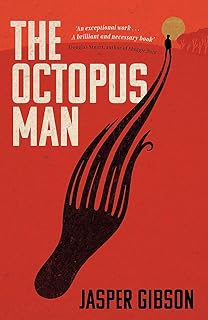
“The Octopus Man” by Jasper Gibson: Being Mindful

The Octopus Man

Tom is given to talking out loud and offering a chair to Malamock the Octopus God, whose voice he continually hears, on whom he depends to guide him through life. Needless to say, the medical profession regards Malamock as a problem, a barrier to Tom’s well-being to be removed through medication. All previous approved drugs having failed, Tom is under pressure to take part in an experimental drugs trial. It is a controversial view, but Tom wishes to live free of drugs with their generally negative side effects, not least the rendering of his mind to a deadened and sluggish state. Tom simply wants the world to accept him as he is, with Malamock.

Once a high-achieving law student with a promising career ahead, together with a tendency to overconsume recreational drugs, Tom has been reduced to a life on benefits and medication, dogged by spells in mental hospitals and stoically supported by his hard-pressed sister, torn between him and her partner who represents the uncomprehending and intolerant “real world”. The viewpoints of these three, and the relationships between them are brilliantly captured in the final chapter.

It is a daring and original book, written from Tom’s viewpoint, with a tragi-comic blend of lunacy and lucidity, and Pinteresque exchanges between the sharp-witted if technically deluded patient and the too often rigid, imperceptive, or perhaps just overworked professionals who try to treat him. It may be too one-sided, but there are also some telling scenes to show how patients in mental institutions may be manipulated by unscrupulous staff, and how they may have negative effects on each other with their different types of condition.

The Octopus Man was apparently inspired by the death of one of the author’s close relatives, for no apparent reason other than that he had spent years on various types of medication for psychotic mental illness.

I do not know what those suffering from mental illness will make of this novel. Having experience myself of a close relative with longstanding mental illness involving psychosis, I found this novel, which is actually quite funny at times, too distressing and near the bone for me to be able to read it from cover to cover as I normally would. This is a compliment to the author’s skill. It is well worth reading for someone with little or no familiarity with the issues involved – a relatively painless way of gaining understanding.

“Summerwater” by Sarah Moss: like waiting for it to dry

“Summerwater” is like a series of short stories, each chapter a stream of consciousness for a holidaymaker whiling away yet another wet day at a rundown chalet park on the shores of a Scottish loch. Varying in age from children to pensioners, they are all ordinary, somewhat stereotyped, their thoughts in general banal yet a tad contrived, often mean, unpleasant or devious. The short passages, mostly about nature, which separate the chapters, also seem laboured. There’s a distinct lack of positive humour or joy, perhaps unsurprising, given the weather, the setting and inconsiderate noisy neighbours.

We meet in turn a midde-aged wife and mother who runs miles before breakfast to find fulfilment, a retired doctor who fights against the onset of old age, solicitous towards his wife while despising her for “giving in”, a young woman faking a simultaneous orgasm with her fiancé, being more excited by Don Draper of Mad Men fame and bacon butties. The fact that we are never given the viewpoint of the noisy neighbours, assumed to be Romanian when not Bulgarians or Poles, is a way of increasing the sense of alienation from those who do not “fit in”.

And so the narrative drifts on to the final chapter which ends in the book’s single dramatic event, perhaps most shocking in leaving one insufficiently moved. Is this because we haven’t been given enough scope to engage with any one character, or the climax is too abrupt and disconnected from the previous chapters?

It may have been relief at reaching the end, but the final poetic passage “Drums” and last chapter “Noise in his Body” were for me the best-written part, reminiscent of what impressed me in the writer’s earlier novel, “Ghost Wall”.

“Drums. …Music crosses raindrops, the air full of noises and riddled with movement…The anthill pulses. Damp trees absorb the higher frequencies, swallow the energy into wetness and wood-flesh, so it is the bass that penetrates your head and drums on the drums inside.”

I came to this book with raised expectations, only to be sadly disappointed. What reads like a collection of exercises in creative writing while waiting for inspiration to flare, seems rather bleak and pointless.


Rose by Tatiana de Rosnay: Warped Vision

Rose (French Edition) by [Tatiana de Rosnay, Raymond Clarinard]

It is well-known how the ambitious “beaver” Baron Haussmann implemented Emperor Napoleon III’s vision of a modernised Paris. Elegant C19 classical boulevards replaced insanitary slums and overcrowded alleys dating from medieval times. On reflection, the wide new avenues must also have required the demolition of sound buildings, some of historic interest, destroying close-knit, thriving communities in the process. Not all the 350,000 people displaced needed to be rehoused, or benefited from the upheaval.

Rose Bazelet, the heroine of this novel, is one such person. Living her entire life in central Paris, mostly in the family home of her husband in the Rue Childebert, of which photographs can still be found on the internet, she fondly imagines that her house will be protected by its proximity to the ancient Church of St Germain-des-Prés. It is a shock to the whole community when the letters arrive, bluntly announcing the planned demolition of their properties. All resign themselves to accepting the compensation offered to go and start a new life, as Rose’s own brother has already done in another district already razed for redevelopment. Unable to leave a house suffused with memories of her husband and son, Rose has other plans, so we find her hiding in the basement, reading treasured letters, revisiting her past life, and writing a few unexpected confessions to the husband to whom she still feels exceptionally close a decade after this premature death.

This novel is at its best in powerful descriptions of the vast building sites which resemble war zones, where all the old landmarks have be obliterated, leaving only gigantic holes bordered by unstable ruins with hanging strips of wallpaper, doors swinging on hinges and steps spiralling into a void – hallucinatory images. The author weaves the main points in Rose’s essentially narrow bourgeois life with actual historical events: the painful birth of the daughter Violette with whom she never manages to bond takes place against the backdrop of street riots, part of the July 1830 uprising to oust the Bourbon king Charles X. The bookseller who rents a premise on her ground floor introduces the widowed Rose to the best-selling book at first considered such an outrage to public morals and religions that its publication was blocked: Flaubert’s “Madame Bovary”, no less. The pervading sense of nostalgia, both for a lost community and way of life, mingled with longing for those one has loved, is very strong. We also see how Rose’s personality develops in later life, as her experiences make her both more open minded and self aware.

This may be too saccharine and mawkish at times for some tastes, although it could be argued that the tone is authentic for a C19 woman who has led an essentially sheltered, conventional, comfortable life with limited experience and education. However, a sudden switch to the shocking or macabre, perhaps when least expected, adds some depth and bite to the tale.

I was for the most past irritated by Rose’s inability to accept reality like everyone else, and move on. However, apart from the fact that the plot obviously depends on this, I have to admit that Tatiana de Rosnay succeeds in evoking empathy with Rose rather than simply regarding her as self-absorbed, even selfish. A final twist also adds to the aspects for discussion which make this a fruitful choice for a book group. I read it in French translated from English (the author is Anglo-French), which gave it a more authentic feel.

Golden Child by Claire Adams “Paying for Peter”

Growing up in Trinidad, from a poor family with a violent father, Clyde Deyalsingh learned at a young age not to rely on other people. In a community where corruption is rife, even the police take bribes, everyone knows where the drug lords live in their fortified compounds and too many men take refuge in rum, Clyde works hard, avoids trouble, and keeps rottweilers to guard against intruders. With twin sons to raise, and brothers-in-law in the habit of coming round for free meals at the weekend, despite being better off than he is, Clyde reluctantly accepts help, both cash and string-pulling to get him a better paid job, from his wife’s generous uncle Vishnu, a widely admired doctor. Caring little for material goods himself, Vishnu is keen to support those he thinks deserving, not only Clyde, but his unusually gifted son Peter, predicted to gain a place at Harvard. Vishnu casually ignores the resentment this arouses in Clyde’s brother-in-law Romesh, who has gained security by marrying into a well-off family.

Clyde is troubled by the disparity between his sons, physically alike but very different in personality and apparent ability. Unlike Peter, Paul has learning difficulties and behavioural problems believed to be due to oxygen deprivation at birth, and is accustomed to hearing himself called “retarded” and threatened with the dreaded “St. Ann’s” mental hospital. His mother Joy insists Paul must be treated as much like Peter as possible even to the point of a place being wangled for him at the prestigious secondary school to which Peter has won a place. But as they reach the age of thirteen, how long can this “equality” be maintained? When Paul disappears one day after school, Clyde is torn between irritation and disquiet.

This debut novel by an author who grew up in Trinidad has a strong sense of place, whether in downtown Port of Spain or the seashore lined with coconut palms, which feels authentic even for a reader like me who has never set foot there. In the bush, the flitting batty-mamzel dragonflies; “the dull thud of a falling mango” compared to the “sharp, knocking sound a coconut would make”; “the shushing of raindrops landing on the canopy above; just a little drizzle… spattering off at odd angles”. This is what Paul notices, revealing that he is a more complex, thoughtful individual than his father can imagine, probably suffering mainly from acute dyslexia, yet with a practical bent which as an adult might make him as successful as his brother, in his own way.

This is a well-observed psychological drama involving an Indo-Caribbean family, and the young Irish priest who tries to help Paul, enabling us to see how the main characters appear to each other, with the exception of Peter, the “golden child”, who reveals little of his personality apart from conformity and a patient acceptance of his twin.

Throughout the slow-burning tale, there are occasional incidents of sudden violence, so it should not come as a shock when, three-quarters of the way through, it shifts up into a tense thriller in which Clyde will clearly have to make a difficult decision.

I was left disappointed by the ending, not because I dislike it, but owing to the rushed, disjointed final scenes in which the characters became two-dimensional and underdeveloped with too many implausible incidents or unexplained reactions. Admittedly, this provides many talking points for a book group. It leaves the scope to fill in the gaps with one’s own interpretations. However, for me the conclusion was too abrupt, ducking the challenge of writing the hardest part of the novel.

“My Childhood” by Maxim Gorky: staying humane in a barbarous world

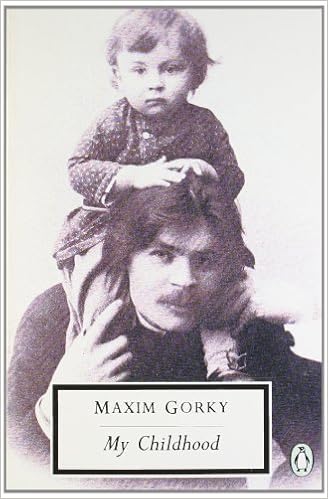
Gorky as a child with his father

When his young father dies of cholera, and his mother Varvara has a miscarriage, no doubt triggered by grief, five-year-old Alexei is taken back to her family home: “Angry people rushed about in all directions like passengers about to disembark from a ship, ragged children swarmed all over the place like thieving sparrows, and the whole house was filled with a strange pungent smell”. This is his introduction to the house-cum-dyeworks presided over by his grandfather, a self-made man who flogs him for minor acts of mischief, sometimes to the point of losing consciousness, through a mixture of sadism and the genuine twisted belief that it will “do him good”. Recognising his intelligence, Grandfather also teaches him to read, tells him stories, works with him companionably in the garden, yet ultimately casts him out to make his way in a harsh world when he is still a child.

By contrast, his peasant grandmother, despite showing great presence of mind in a crisis, for the most part escapes harsh reality through a mixture of snuff, vodka, veneration of bejewelled icons and folk tales which stimulate his vivid imagination, also showing him the affection he needs for emotional support.

This account of Gorky’s childhood is so bleak in some respects that I could usually only manage to read a chapter at a time. Yet I also found it compelling in his ability to capture how an observant, inquisitive child, with a rudimentary sense of justice presumably gained from his kindly father, continuously tries to make sense of the world. Often, we cannot quite grasp what is going on because he cannot do so. Only gradually does he piece together the grim backstory of the dysfunctional Kashirin family.

Yet in the midst of a childhood often made tedious and unhappy, either by poverty or the oppression of adults who have themselves been warped by hardship or a lack of love, Gorky manages to show us the moments of unexpected beauty in a grim existence: “watching the black crows circling and wheeling in the red evening sky round the golden cupolas of the Church…diving down to earth and draping the fading sky with a black net”. There is also “the new kind of life, entertaining beyond description” which comes alive in the kitchen when Grandfather has gone to the Sunday evening service: races on the table between cockroaches harnessed to paper runners, followed by the “uninhibited but strange gaiety” of the songs and dancing contrasting with guitar laments, all fuelled by vodka as the samovar “softly hummed.”

We see a future writer’s continual fascination in the variety of people he meets – the long-suffering workers who slave for Grandfather; the motley crew of lodgers in the “large, interesting house” over a tavern which the old man buys when he retires; when poverty strikes, the wily band of urchins whom Alexei eventually joins in stealing wood – “wasn’t considered a sin”, to help their families. Most of these characters are a complex mix of good and bad. The few who seem completely beyond the pale belong to his mother’s family the Kashirins, namely the two warring uncles, Mikhail and Yakov, each desperate to get one over the other in extracting enough money from Grandfather to set up an independent dyeworks, but too incompetent to succeed.

My Childhood (Illustrated) by [Maxim Gorky]

“When I try to recall those vile abominations of that barbarous life in Russia, at times I find myself asking the question: is it worth while recording them” He answers for himself in the affirmative. Firstly, it is necessary to understand and face up to the truth, in order to be able to erase it in the future. Secondly, he is confident that life will always surprise us by the creative human powers of goodness that are for ever forcing their way up through “the bestial refuse”, awakening our “indestructible faith” in a better and more humane future.

This may appear over-optimistic and undermined by the lack of corruption and democracy still all to evident in Russia as I write this. Ironically, having been proclaimed the father of Soviet Literature, Gorky died in 1936 from poisoning at the instigation of his political enemies, unlike the modern dissident Navalny who survived Novichok poisoning.

“All for Nothing” by Walter Kempowski: Beyond Understanding

The Georgenhof manor house on the road to the Prussian border with Russia is falling into disrepair in the final stages of World War 2. Owner Erhard Von Globig is serving in Italy while his beautiful wife Katharina, whose dreamy vagueness, “it was all so complicated”, may be an inward escape from an unhappy marriage and the tedium of life in a rural backwater, leaves all the work to a handful of foreign servants escaped from the east, under the control of bossy spinster “Auntie”. Katharina’s inquisitive twelve-year old son Peter (probably modelled on the author himself) conveniently avoids co-option into the Hitler Youth by reason of a persistent bad throat.

With a gradual flow of refugee carts travelling from the east and rumours of a vengeful Russian invasion as Hitler loses his grip, Auntie packs a suitcase and shrewd Polish farmhand Vladimir stows items on a large cart, but that is as far as any plans get for the journey to the relative safety of “the Reich” while there is still time. A mixture of inertia, nostalgic attachment to unnecessary possessions and lack of imagination over just how bad life could become, keeps them chained to their familiar routine. And, after all, where would they go? What could they bear to leave behind?

Even when Drygalski, the bigoted deputy mayor of the local housing estate, succeeds in billeting refugee families at the Georgenhof, the Von Globigs are happy to receive them almost as a form of home entertainment. Eventually, with the refugee flight increased to a flood, sounds of gunfire and ominous lights in the eastern sky, the decision is made to leave. Yet this is too late to prevent a fateful and shameful incident. Also, despite the semblance of orderly flight with provision of soup kitchens and strict guidelines for crossing the ice on the shortcut route to safety, the imminent collapse into chaos of a defeated society seems inevitable.

An unathletic teenager during World War 2, author Walter Kempowski found it hard to accept the discipline of compulsory service under the Hitler Youth to the extent that he was transferred to a penal unit – it seems his main crime was a love of “degenerate” jazz – and later drafted as a courier into the youth branch of the Luftwaffe. His father, killed in action at the end of the war after five years of combat, owned one of the ships deployed to shuttle thousands of refugee Germans from Prussia across to Rostok where the Kempowskis lived. The teenager observed the flight in which some 300,000 people starved, froze or drowned to death or were killed by the Russians.

Found guilty by the occupying Soviets of collaboration because of his work for the American Army of Occupation, Kempowski received a 25 year sentence, but was released after 8 years and deported to the west.
His ten volume “Echolot”, “Echo Soundings” is a “collective diary” of firsthand accounts, diaries, letters, and memoirs of those who live through the war. Added to his own experiences, all this has culminated in “All For Nothing” , a wrily cynical fictionalised observation of events which shocks the reader through the unflinching objectivity which reduces both “normal daily life” and the horrors of war for civilians to the same level of banality. It was his last novel, published in 2006, sixty years after the events they describe and only a year before his death.

The author reveals human flaws in all his characters in an approach based on “personal relativism”, the theory that that there are no absolute truths, so that an individual’s morality is defined by one’s particular perspective on life, inevitably conditioned by culture, which some will blindly accept, such as, in this case, unquestioning antisemitism or conformity to “the rules”, but others kick against. Katharina Von Globig seems to rise above the enforced prejudices and regulations by swimming with the foreign maids (while exploiting them as cheap labour), listening to enemy radio channels and harbouring a Jew on the run, but does she do this out of liberal principles, or because she lives too much in a world of her own to care? Drygalski, caricature of a trumped-up Nazi bigot, exercises his petty power to make life hard for his over-privileged neighbours, yet at the end he behaves out of character in what seems like a selfless act – but is it really so?

This novel lingers in one’s thoughts, reminding me of Irene Nemirovsky’s “Suite Française”. A bestseller in Germany where it struck a chord with a nation coming to terms with and seeking to understand a guilty past, I wonder to what extent it has suffered from translation into English. There is a repetitive, slightly “children’s storybook” turn of phrase which jarred on me, and I am unsure whether this due to choices made by Anthea Bell, the award-winning translator whose work happens to have included a good deal of children’s literature. Yet Kempowski undeniably repeats small details like a mantra – Katharina’s admirer Lothar Sarkander is rarely mentioned without his “stiff leg and duelling scars on his cheeks”. Some passages prove a bit tedious, like the initial sequence of eccentric visitors casually accepted by the family as a kind of entertainment, although there is black humour in the political economist dabbing black paint on every image of Hitler in Peter’s stamp collection – “Suppose a Russian opens the album and sees the Fuhrer grinning…?”

“The New Silk Roads” – The Present and Future of the World

The Silk Road was the network of trade routes which began as long ago as 200 BCE, linking China to Southern Europe and named after the lucrative sale of silk developed by the Han Dynasty. The Chinese also traded high value luxury goods that were easier to transport: porcelain, spices, teas, sugar and salt. In exchange they bought goods like cotton and wool, together with ivory, gold, and silver. The Silk Road was also a channel for cultural exchanges: religion, philosophy, science and technological “advances” like the use of gunpowder and papermaking.

Peter Frankopan’s book “The New Silk Roads: The Present and Future of the World” is apparently an extended appendix to his highly praised major academic work, “The Silk Roads: A New History of the World”, inspired by the desire to broaden the outlook of a somewhat inward-looking, complacent North American and European world.

“The New Silk Roads” is designed to alert readers to the recent rapid and significant changes in the countries lying across these old trade routes, which will inevitably alter the balance of power to the disadvantage of countries like Britain and the United States, now forced to realise that their periods of world domination have proven transient. In the latest swing of the pendulum, China has since 2013 invested heavily in the “Belt and Road Initiative” involving railways and highways, power grids, construction material, vehicles, real estate, education and telecommunications.

Intended ” to enhance regional connectivity and embrace a brighter future”, the project with a target completion date of 2049 is also seen as a strategy for world domination. Trade along this new Silk Road using both land and parallel sea routes is expected to account for over 40% of world activity. In the process, in regions still torn by wars and marked by poverty and under-development, there is growing evidence of cooperation between central Asian Republics like the joint ventures between state-owned oil companies in Uzbekistan, Turkmenistan and Azerbaijan.

My problem with Peter Frankopan’s book is that it resembles a series of hastily written newspaper articles cobbled together in a mixture of dissociated facts which are quite hard to absorb without analysis or much context, and reference to political situations at the time of writing which will soon be out-of-date, if not already, such as Brexit negotiations or the presidency of Donald Trump. A few maps would have been useful.

There is the potential for several books here. Although I appreciate the value of a book which gives an overview and appreciation of the complexity of relationships between countries, there is an art to achieving a sufficient degree of analysis without bombarding readers with examples.