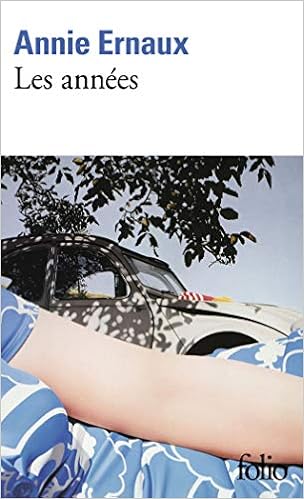
 This is an autobiography which aims to avoid “sentiment”: “The point is not to speak of the personal”. Instead, referring to herself in the third person, or writing collectively as “we”, Annie Ernaux adopts a fragmented approach which tends to distance the reader from her.
As implied by the choice of quotations at the outset, she is preoccupied with our insignificance in the scale of things – not only shall we be forgotten as individuals, but matters of great importance to us will seem trivial to our descendants, and our way of living may come to seem ludicrous, even blameworthy. This has become very topical since our materialist way of life, justified by “the need for growth” is now under criticism for destroying the planet for future generations.
Annie Ernaux’s attitude may explain her tendency to give more importance to fleeting, often banal memories than to major events in her life. The opening pages are a list of ephemeral images, some from before she was born, reflecting her insight that, influenced by our parents’ talk, we may have a kind of false memory of events which happened to other people in the past before we even existed. Many of the images are sordid or grim, and it would seem quite arbitrary – a woman urinating behind a café, the glimpse of a thalidomide victim with no arms. This sets from the outset a somewhat depressing, negative, joyless tone which is never fully dispelled.
She often seems more interested in the social history through which she has lived than in recounting the main events of her life. So, on one hand she writes a good deal about the impact of the 1968 riots, the social revolution resulting from the availability of the pill or the arrival of a consumer- driven society which also discarded the taboos and traditions which constrained our childhood until the 1960s. On the other, I never learned, for instance, whom she married, nor when and how the couple parted. She makes no allowance for the reader’s frustration if significant details are hinted at but kept hidden. She writes about a woman’s desire for divorce, mixed with fear of rupture and independence, in an abstract, generalised way. In just one poignant scene, which reveals complex feelings during what may be the last family holiday with her husband in Spain, she becomes an individual with whom one can sympathise, suggesting that a little more “sentiment” in the book would not have gone amiss.
I formed the impression of a bright girl from a narrow, working class background, who “escaped” via the encouragement of her teachers and a good education. However, breaking the taboos over sex outside marriage just a few years ahead of “the pill” and loosening of the abortion laws, she joined the ranks of those obliged to marry and start a family before they would have chosen to do so. She seemed dissatisfied with her lot as a teacher, perhaps because of her long-held desire to be a writer. Drawn to left-wing movements, uneasy over consumerism and the faceless development of new urban areas, Annie Ernaux nevertheless comes across as an “academic” socialist, actually rather contemptuous of workers in the unappealing new suburbs built for them, where she would never willingly set foot.
It is not her style to discuss explicitly her frustration over being diverted by family responsibilities from achieving the ambition to become an admired author. Instead, it is revealed when, oppressed by the annual ritual of the Christmas celebrations in which she now occupies the head of the table, she imagines the crazed action of overturning the table and screaming. Perhaps because she is a writer, a recurring theme is her panicked sense of only having one life, which she has allowed to slip by, without realising it: the living of her past life amounts to a book, but one that has not yet been written – until now.
I found the book hard-going at times. The repetition and lists of people and events are quite tedious and I was not familiar with many of the cultural references. It was fascinating to learn about, say, Ranucci, the last French citizen to be sentenced to death as recently as 1976 by guillotine, which seemed particularly barbaric and antiquated although it was originally seen as more humane than other methods, but the need to look things up continually fragmented the reading of an already disjointed text which rambles on for over two hundred and fifty pages in short sections with no chapters to form natural breaks.
Annie Ernaux has said: “This is the story of events and progress and everything that has changed in 60 years of an individual existence but transmitted through the “we” and “them”. The events in my book belong to everyone, to history, to sociology”.
Yet this approach only works if the events are clearly explained in context to those who did not experience them at the time, and may be ignorant of them now. Admittedly, those who can share her experiences may derive a nostalgic pleasure from being reminded of them.
 When Ainsley Channon finds that his son is not unexpectedly making a hash of running the Paris branch of his piano manufacturing and sales company, he sends his protégé, young Scottish piano-tuner Brodie Moncur to use his initiative to improve business. In the process, Brodie becomes infatuated with Lika, a beautiful Russian aspiring opera singer. Their relationship has to be conducted in secret, since she is the mistress of the once celebrated but now physically declining and alcoholic pianist John Kilbarron. From the outset it seems doomed to fail, owing not only to Kilbarron’s jealous and unstable character but also the menacing presence of his “minder” brother Malachi, who may have designs on, even some hold over Lika as well.
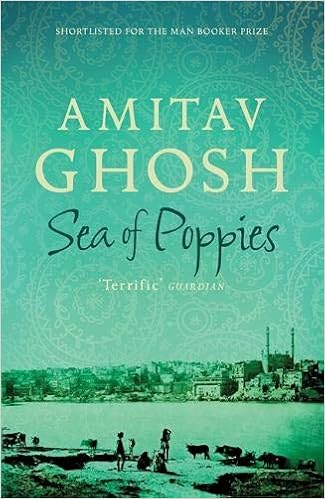 The first book in the “Ibis” trilogy, named after the sailing ship which is the setting for some of the action, “Sea of Poppies” focuses on the C19 opium trade operated by the ruthless East India Company. It begins in rural India, where Deeti struggles to make a living from the poppy harvest which has replaced the crops which at least guaranteed a level of self-suffciency. She is resigned to marriage with a man who has become addicted to opium to ease the pain of his wounds, gained in fighting for the British colonialists. The fact he is employed in an opium factory does not help.
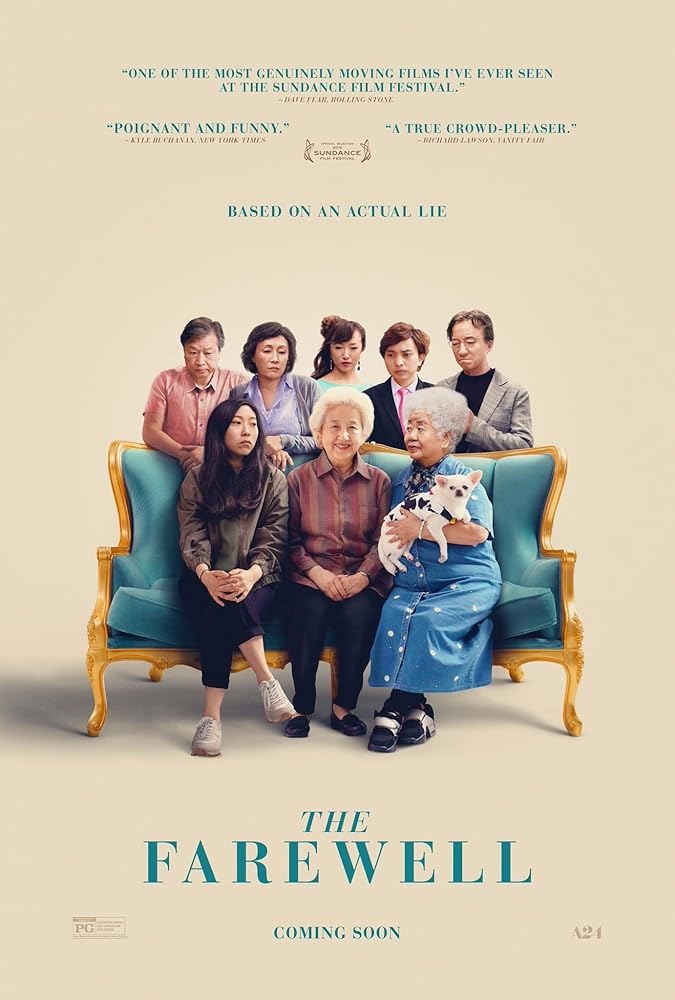 As Chinese American Billi wanders the New York streets chatting by phone to her Nai Nai or grandmother, still living on the other side of the world, she casually supplies the white lies to keep the old lady happy. Yes, she is wearing a hat to keep warm but no earrings which might be grabbed by thieves, tearing her lobes. Meanwhile, Nai Nai tells a lie in turn, pretending to be at her sister’s house when she is actually in hospital for tests.
![Pain and Glory DVD [2019]](https://images-na.ssl-images-amazon.com/images/I/81IE5w1kb1L._AC_SY445_.jpg) Superbly acted by Antonio Banderas, Salvador Mallo is a celebrated sixty-something film director whose sense that his career has come to an end is aggravated by poor health, particularly an aching back and tendency to choke. Desperate for pain relief, he is prompted to begin a drastic course of action which may prove self-destructive during his reunion with the charismatic but heroin-addicted former star of the film which fed his fame thirty years previously. At the same time, the meeting sets in motion a chain of events which may set him back on the path of creativity.
Superbly acted by Antonio Banderas, Salvador Mallo is a celebrated sixty-something film director whose sense that his career has come to an end is aggravated by poor health, particularly an aching back and tendency to choke. Desperate for pain relief, he is prompted to begin a drastic course of action which may prove self-destructive during his reunion with the charismatic but heroin-addicted former star of the film which fed his fame thirty years previously. At the same time, the meeting sets in motion a chain of events which may set him back on the path of creativity.![BAIT [Dual Format] [Blu-ray]](https://images-na.ssl-images-amazon.com/images/I/51uJRnbTDeL._AC_SY445_.jpg) This is the tale of a fateful chain of events in a coastal Cornish community where there are tensions between locals no longer able to make a decent living from the traditional activity of fishing, and wealthy outsiders who can afford to buy picturesque cottages as second homes, but contribute nothing to the local community on their summer visits apart from their spoilt, bored kids patronising the local pub. The focus is on Martin who persists in trying to work as a fisherman, despite his lack of a boat – his laborious stretching of nets along the beach and planting of a single lobster pot yield meagre results . He has fallen out with his pragmatic brother, who has decided to use his boat to provide trips for tourists, and is full of brooding resentment against the couple to whom he has been forced to sell the family home. It is not just a question of fish bait, but of people baiting each other.
This is the tale of a fateful chain of events in a coastal Cornish community where there are tensions between locals no longer able to make a decent living from the traditional activity of fishing, and wealthy outsiders who can afford to buy picturesque cottages as second homes, but contribute nothing to the local community on their summer visits apart from their spoilt, bored kids patronising the local pub. The focus is on Martin who persists in trying to work as a fisherman, despite his lack of a boat – his laborious stretching of nets along the beach and planting of a single lobster pot yield meagre results . He has fallen out with his pragmatic brother, who has decided to use his boat to provide trips for tourists, and is full of brooding resentment against the couple to whom he has been forced to sell the family home. It is not just a question of fish bait, but of people baiting each other. In the 1960s, Leonard Cohen joined the colony of aspiring writers on the exquisite Greek island of Hydra, with the lures of casual sex, cheap alcohol and easy access to drugs. He soon began to receive practical and emotional support from Marianne Ihlen, the beautiful young Norwegian who was for several years his lover and “muse”. Apart from not seeming in awe of him, she was a good listener with a gift for drawing out the talent in others. Abandoned by her husband and the mother of an appealing child, “Little Alex”, Marianne was open to ideas of “free love”, but as Leonard developed his megastar status as a singer/songwriter, she could not cope with hectic lifestyle involving long visits to the States, and having to share him with the hoards of fans who also wanted a piece of him.
![The Body Lies by [Baker, Jo]](https://images-eu.ssl-images-amazon.com/images/I/41149oLTzwL.jpg) In this slow-building psychological thriller, a young creative writing lecturer discovers to her cost that she has become the obsessive focus of her most talented student Nicholas Palmer’s work, with the risk that he may move from “merely” recording his close observation of her, intrusive as that is, to actively manipulating her to fit his story, in his belief that, to be authentic, writing must be based on real experience.
In this slow-building psychological thriller, a young creative writing lecturer discovers to her cost that she has become the obsessive focus of her most talented student Nicholas Palmer’s work, with the risk that he may move from “merely” recording his close observation of her, intrusive as that is, to actively manipulating her to fit his story, in his belief that, to be authentic, writing must be based on real experience.![Galileo: Watcher of the Skies by [Wootton, David]](https://images-eu.ssl-images-amazon.com/images/I/41tr5pv0zmL.jpg) My fascination with Galileo, the brilliant thinker who was eventually gagged by a bigoted Inquisition, was fed by Michael White’s absorbing biography, “Galileo Antichrist”. Although very strong on childhood influences, personality, dealings with friends and family, his inventions and the tortuous path by which he fell foul of the priests pulling the strings behind an insecure and neurotic Pope, the biography seemed a little thin on the all-important scientific theories to do with motion and astronomy, and to have gone too far into trying to make ideas accessible by “dumbing down” the details.
My fascination with Galileo, the brilliant thinker who was eventually gagged by a bigoted Inquisition, was fed by Michael White’s absorbing biography, “Galileo Antichrist”. Although very strong on childhood influences, personality, dealings with friends and family, his inventions and the tortuous path by which he fell foul of the priests pulling the strings behind an insecure and neurotic Pope, the biography seemed a little thin on the all-important scientific theories to do with motion and astronomy, and to have gone too far into trying to make ideas accessible by “dumbing down” the details.
