Most family sagas covering three generations require at least a trilogy of novels, or a thousand page door-stopper volume, but Marie-Hélène Lafon has managed to cover this in less than two hundred pages. She has achieved it by selecting a dozen dates spanning the century from 1908 to 2008, each with a chapter focusing on a specific family member and a significant incident, but not in chronological order.
The most dramatic events may not be revealed until the last few lines, like a shocking accident which befalls a small boy in the first chapter, or much later, a young man learning on his wedding day the identity of the father he has never met. Some chapters are largely a flow of thoughts, as when an independent-minded woman revels in her pregnancy in the full knowledge that her much younger lover is unready and unsuited to being a father. Years later, her sweet-tempered married sister who has willingly absorbed the child into her family, reflects on the past as she knits socks for her grandson. As is probably the case with most families, there is a lot of banal detail, laced with the poignancy of situations which cast a long shadow, or are unexpectedly revealed years later.
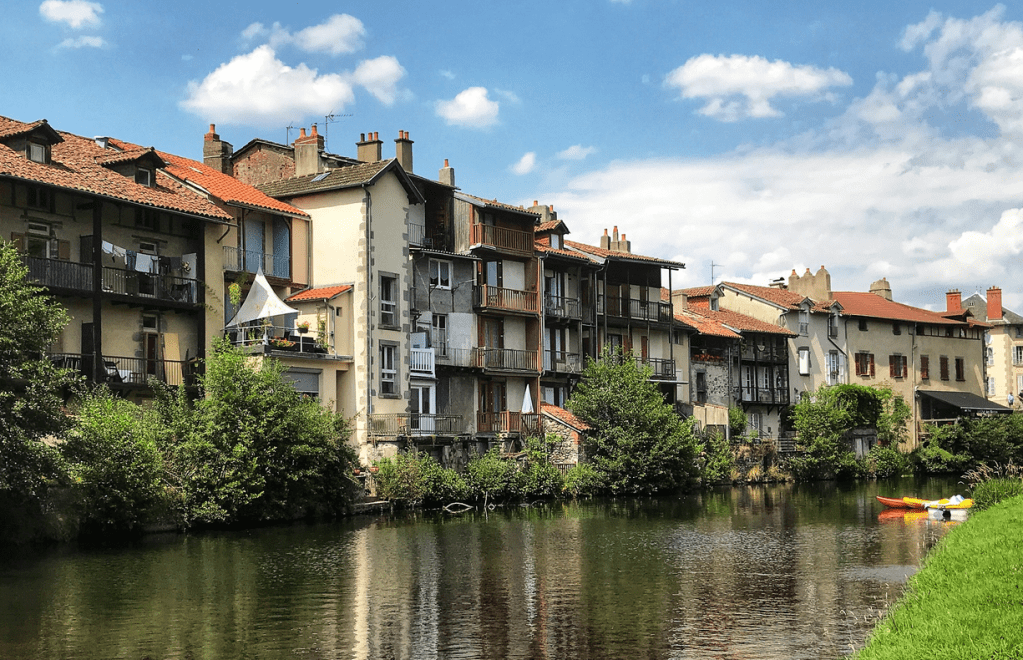
The author grew up on a farm in the department of Cantal and subsequently studied and worked in Paris. These locations feature in the novel, giving a sense of place to some extent, particularly for the Auvergne.
Marie-Hélène Lafon is a prize-winning author and this novel has attracted mostly positive reviews. Since French is my second language, I may not be qualified to appreciate it fully, but I only persisted with this novel because it was a book group choice. I found the total lack of paragraphs with a complete lack of dialogue very off-putting. This feeling was compounded by frequent extremely long sentences, often ten, even fourteen lines in length, packed with disparate, densely packed information. As a student and later teacher of classical Latin and Greek, her “streams of consciousness” are generally expressed in formal, grammatically correct French. One has to concentrate to glean the key points and work out who the characters are, how they are connected, whether they are important. One could have done with the family tree scribbled on an envelope which is mentioned in passing near the end! At times, one feels as if buttonholed by a stranger on a train journey who pours out a life history with a stream of indistinguishable characters.
With a plot which could be summarised in a few lines, it all hangs on how the tale is revealed. The approach is completely one of “telling” the reader what to think, albeit in a rather tortuous way, repetitious but with frustrating gaps, such as the fact that we know the central character André was active in the French resistance as a very young man, but know nothing more than this. Also, what amounts to the parallel lives of two families, linked by André, proves an underdeveloped aspect – perhaps this is intentional since a much-repeated point is that he knows little about his father’s family, but perhaps fears the consequences of making a real effort to find out more.
For me, the book would have worked better as a series of short stories involving the characters over time.

