“Natasha’s Dance: A Cultural History of Russia” by Orlando FigesInteresting but would have been better with a good edit!

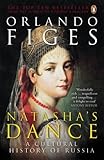
This is my review of Natasha’s Dance: A Cultural History of Russia by Orlando Figes.

“Natasha’s Dance” weaves a dense canvas of information round the average reader’s ragbag of knowledge about Russia.

Figes begins with Peter the Great’s attempt to drag Russia into the mainstream of European culture with the imposition of the classical style city of St. Petersburg on the marshlands of the River Neva. He contrasts this with Moscow and “Old Russia” based on the Eastern Orthodox Church, onion domes and icons, and the close ties with the land, and the sometimes romanticised simple life of the serfs. He traces the early attempts of some aristocrats, radicalised by fighting alongside their serfs against Napoleon, to introduce the democracy which Russia has never really been able to achieve. Then there is the strong influence of Asia, brought partly by the Tartars sweeping in across the vast steppes.

The chapter I enjoyed most was “Russia through the Soviet lens” in which the authorities rejected “art for art’s sake” and tried to use it as a tool to transform workers into efficient and compliant machines. The sense of loss of those who were forced into exile is moving, as is Stalin’s crazy persecution of those who remained.

Although I am very interested in the subject matter, I found this book hard going. It is quite longwinded and repetitious, as if the author himself sometimes loses sight of the wood for the trees in the vast amount of information he has gathered. There are too many overlong extracts from novels and romantic poems which now seem quite dated. However, I liked the inclusion of Akhmatova’s poetry, perhaps because it conveys so vividly what it was like to live under the Soviet regime.

Figes refers to a large number of lesser known writers and composers, no doubt in the interest of academic rigour but this is off-putting for the general reader – the names are hard to take in and we learn too little about them for it to be worth the effort. Perhaps this type of detail would have been better in a glossary at the end.

Coverage of major figures is quite fragmented which can be confusing. The author’s choice of whom to cover and in what depth seems quite arbitrary. I now have a much better appreciation of Stravinsky but Tchaikovsky gets far less mention than the female poet Tsetaeva who is no longer widely known.

Although the book would have benefited from a thorough edit, on balance I recommend it for the wealth of fascinating anecdotes. To do it justice, it needs to be read a second time, possibly after a few months at least, to give time to absorb more of the detail – say to get a better grasp of the roles of Prokofiev as opposed to Shostakovitch.

⭐⭐⭐⭐ 4 Stars

Fascinating

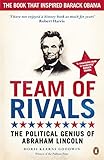
This is my review of Team of Rivals: The Political Genius of Abraham Lincoln by Doris Kearns Goodwin.

I was sorry to finish this engrossing study of the self-educated "prairie lawyer" who, despite a poverty-stricken childhood and youth spent in manual labour, which saddled him with the nickname "the rail-splitter" in later life, managed not only to win the 1860 presidency against much more experienced and illustrious rivals, but to persuade them to work in his cabinet.

The author may view Lincoln through somewhat rose-tinted spectacles – his homely anecdotes for every occasion must have been irritating at times, his tardiness in sacking the preposterous waste of space, General McClellan must have cost many lives and considerable resources, and his inducement of northern Democrats to "swing the vote" in favour of the emancipation of slaves amounted to bribery -even if for a noble cause.

Yet, this seems like nitpicking against the tide of evidence for Lincoln's greatness. He combined unusual integrity, courage, resilience, patience, and a lack of personal vanity and pettiness which made him "above" displays of malice, or the bearing of grudges. In addition to a gift for clear and simple communication, aided by a sharp wit, he applied logic and pragmatism to every situation before making a decision, and all these factors combined to give a distinctive management style which must have been unusual for his day – quite laid-back, egalitarian, consultative and delegating, avoiding a blame culture – although he saw it as his duty ultimately to make the crucial decisions himself.

His rivals are also developed as complex characters – such as the urbane, sociable Seward who was so complacent about winning the presidency that he went off on a long holiday in Europe instead of campaigning, or the pompous Salmon Chase – who disliked his fishy name, but at least wasn't called "Philander" like his sadistic uncle – who obsessively machinated to get elected in '64, unable to appreciate his lack of popularity, yet had a genuine concern to abolish slavery, and was one of the first to welcome the former slave Douglass into his home.

The book really "took off" for me in the chapters on the origin and progress of the Civil War. Although triggered by the issue of slavery – which the southern states wished to retain, and extend to the developing western regions, the ostensible reason was to maintain the unity of the young Republic, which had to prove to the world the value and viability of "true" democracy.

Although the repetition of some details helps the reader to keep track, this would be unnecessary if Goodwin had undertaken a final editing to make the text more concise and streamlined. A list of key characters, time-line of main events, and clearer maps placed at the front for easy reference would have helped. However, these defects apply to most serious history books and biographies, and overall I recommend this as very informative and more gripping than many historical novels.

⭐⭐⭐⭐⭐ 5 Stars

“Lloyd George and Churchill: Rivals for Greatness” by Richard Toye – The Goat and the Bulldog

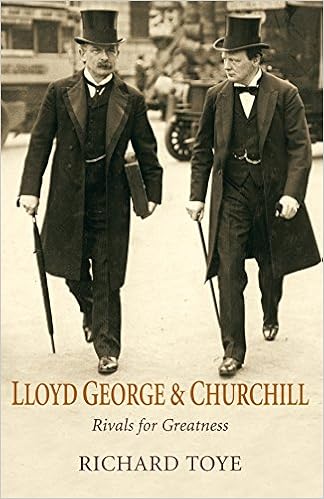
This is my review of Lloyd George and Churchill: Rivals for Greatness by Richard Toye.

This for the most part very readable analysis of the surprising and complex “friendship” between two major political figures keeps to the point and, unlike many historical accounts summarises the key aspects of events very clearly, helping the reader to see the wood for the trees.

Lloyd George and Churchill lived through an unusually interesting and significant period: on an international scale, two world wars, the Russian Revolution, decline of the Turkish Empire, establishment of Israel, question of independence for India, to name a few. At home, there was the partition of Ireland, the attempts to reform the Lords, the rise of Labour, split and demise of the Liberals, attempts at coalition, votes for women, and first serious measures to provide pensions and unemployment benefit, leading to the creation of the welfare state. It is salutary to realise how many of these issues still remain to be resolved. The shifting relationships within the various coalitions seem very topical now. One should also mention the growing power and influence of the press barons – Northcliffe and Rothermere.

Against this background, which in many ways interested me most, we see the saga of the personal relationship between Churchill and Lloyd George. Initially the latter was “top dog”, a man whom Churchill admired, sought to emulate and surpass, and often relied upon, both as a means of getting office, and also as something of a mentor and emotional support. Largely because of the age difference, the tables were turned in World War 2: Churchill became the leader with power to offer Lloyd George a cabinet post, but the latter was “past it” – age having taken the edge off his ambition, and rendering him so pragmatic and “amenable to reason” that he seemed too much of an appeaser. For much of their political careers, both were widely despised and scorned as over-ambitious political troublemakers and schemers, although there was clearly a good deal of entertaining plotting and gossip from other quarters as well. Yet both seemed to have an energy and vision which were wasted when they were out of power.

Richard Toye has clearly set out to change the balance in modern public perception, which tends to revere Churchill more highly as the greater statesman, as exemplified by the dominance of his statue over Lloyd George’s at the Commons. Thus he consistently portrays Lloyd George as the subtler thinker and negotiator, more genuinely interested in social reform, not to mention his humour, charm and wit, whereas Churchill comes across as courageous to the point of foolhardiness, but a loose cannon, John “bull in the china shop”, whose reputation has been unduly inflated by his success as a rock-like war leader in the 1940s.

I recommend this biography with only two caveats: the passages quoting recollections of someone quoting someone quoting someone else are sometimes hard to follow, or tedious, plus for pages on end there are often references to the months when events occurred, but too few reminders of the year in question! Inevitably, Toye has left out a good deal of detail, but the rationale is his focus on the relationship between these two rivals.

⭐⭐⭐⭐⭐ 5 Stars

“Crimea” (Allen Lane History) by Orlando Figes – The Crime of Crimea

This is my review of Crimea (Allen Lane History) by Orlando Figes.

“Crimea” explains the power struggles of mid-nineteenth century Europe: the ramshackle Ottoman Empire, ironically dismissed by the Russian Tsar Nicholas 1 as “the Sick Man of Europe” as he falls prey to his growing obsession to liberate the Eastern Orthodox Christians from Turkish dominance; Austria, traditionally an ally of Russia, but now unwilling to go beyond “armed neutrality”, for fear that encouragement of uprisings of Slavs in Turkey will give its own minority groups ideas of rebellion. France is keen to gain victory against Russia after its earlier humiliation under Napoleon Bonaparte, and the English – concerned more about commerce than religious rights- wish to deflect the Russians from their suspected designs on India. This melting pot of conflicting aims causes one of the frequent wars between Russia and Turkey to boil over into the conflict which has left the fragmented legacy in our history of the “Lady with the Lamp”, Florence Nightingale (who gets scant mention here, including her failure to realise that soldiers were dying in droves because the local water supply was contaminated), the balaclava hat against the perishing winters and the heroic, misconceived charge of the Light Brigade (which was not quite the disaster it was portrayed).

Once he “gets into” the battles in the Crimea, Figes’ account is gripping. He brings out clearly the chaos, incompetence and misplaced courage under fire – yet frequent barbarism with looting of the dead, beheading them in the hope of monetary reward being one Turkish tradition . WW1 is foreshadowed, with the accounts of soldiers fraternising between onslaughts – the officers from opposing sides sometimes sipped champagne together as their men cleared away bodies so that the battle could continue.

Although I found interesting the first chapter on the unholy disputes between different religious factions in Jerusalem, and there is the intriguing incident of the Tsar travelling incognito (for fear of assassination) to England to persuade Queen Victoria and the Prime Minister to agree to a future carve-up of Turkey, not realising that Parliament might need to be consulted, the opening chapters are hard to follow in places, particularly the important section on “The Eastern Question”. Figes invites you to skip the first 130 pages, but the analysis of the background is important and it would have been better if he had simply provided better maps, a glossary of key characters, and a simple “time line” of critical events. I suppose this reflects the historian’s usual dilemma as to how much prior knowledge to expect of the reader.

The evaluation of the aftermath gives food for thought: the Russians focussed on their victories during the war, rather than their overall failure, and managed to recoup within 25 years their losses under the Paris Peace Treaty. They proceeded quite quickly to fight the Turks again, having made strenuous attempts to update their military organisation. The epilogue on the British commemoration of the Crimean War in rather sickly Victorian poetry is a bit of an anticlimax.

Overall, this is more digestible than many historical tomes, and I found much of it fascinating.

⭐⭐⭐⭐ 4 Stars

“John Adams” by David McCullough – A Neglected Hero

This is my review of “John Adams” by David McCullough.

It is not widely known in the UK that John Adams was the second President of the new republic – as his eldest son was the sixth- but this biography goes some way to compensate for our ignorance of the book-loving New England farmer turned lawyer. After a somewhat confused and dull start, it gets into its stride with the scene where Adams earnestly argues with pacifist Quaker grandee John Dickinson the case for American independence at the Continental Congress in Philadelphia. Then we see Adams leaving his long-suffering wife Abigail, and risking the life of his eldest son, to take the perilous voyage to France (including a broken mast and battle with an enemy vessel), where he is charged with the task of persuading the French to supply the support needed to succeed against the British. He goes on to play a part in supplying and organising the army and navy, framing the new American constitution, obtaining vital loans from the Dutch and negotiating the eventual peace treaty.

Although he may have been conceited, prickly, resentful of those with greater influence (such as Benjamin Franklin) and argumentative, his energetic ability and good intentions are not in doubt and he seems to have been savagely maligned by a scurrilous press, partly supported by his sometime friend Jefferson. The account of the complex and changing relationship between the two is fascinating. The more famous, and superficially more attractive, handsome and polished Jefferson, does not come too well out of this – a man who could condemn slavery in principle, while his own slaves worked outside the window. He could not afford to release people whose production helped to pay the debts arising from his extravagance. By contrast, Adams seems to have been a more prudent,straightforward and genuinely egalitarian “man of the people”, although his biographer may have painted too flattering a picture.

However, you cannot deny the evidence of Adams’ prodigious writing – although long-winded, he was a profound and sophisticated thinker, too often misunderstood. While the southerner Jefferson, a founder of Republicanism, accused Adams of having been corrupted by his time in Europe into becoming a monarchist sympathiser, Adams was convincing as a genuine democrat, who wanted the legislature and executive to be both elected and subject to checks and balances. Also, Adams was quick to see correctly the danger of the violence of the French Revolution, which Jefferson naively admired, overlooking the excesses of the guillotine.

This gripping biography provides many insights into the causes, progress and effects of the American Revolution together with a fascinating social history of the time, portrait of a marriage between two equals, and descriptions of the American landscape. It repays reading for an initial overview, and then rereading….

⭐⭐⭐⭐ 4 Stars

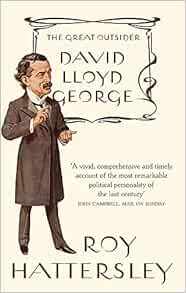
“David Lloyd George: The Great Outsider” by Roy Hattersley – Flawed genius and a dose of “Plus ça change!”

This is my review of David Lloyd George: The Great Outsider by Roy Hattersley.

“The more things change, the more they stay the same”. We see Lloyd George condemning the arms race and immoral wars, such as against the Boers – how would he have applied his razor-sharp scorn to the Iraq War? He campaigned for non-conformist teachers to be allowed to teach in Welsh schools , so presumably would have spoken against faith schools and for Welsh devolution, had he lived today. He foresaw how the embryonic labour party threatened the long-term survival of the liberal party and eventually advocated a “centrist” coalition with the Tories to effect constitutional change. The level of faction-fighting within the Liberal Party foreshadowed what may be about to happen again now. And then there were the issues of Irish independence and the power of the Lords to block legislation, eternal thorns in the flesh of Westminster.

Lloyd George got himself noticed by attacking people through breathtakingly rude yet witty insults, on a scale which would probably be quite unacceptable today. His “weathercock” attitude to many issues makes for confusing reading at times. He opposed votes for women on the practical grounds that this would give the Tories an unfair advantage until suffrage was extended to men without property. This illustrates the ultra-pragmatism which enabled him to negotiate with employers and unions to avert strikes, and bring peace to Ireland – yet always there was his tendency to give different parties different impressions – to the point of appearing to lie – so that “solutions” were too often short-lived.

We are told that LG “felt no loyalty to either institutions or individuals …yet he remained true … to a few ideas… for which he was prepared to sacrifice other political objectives”: he was unyielding on national insurance for sickness and invalidity, based on contributions from employers and workmen. For this and his leadership in WW1, he deserves praise – although he seems to have withheld vital troops from a military leader he wanted to remove, but lacked the power to do so.

On a personal level, he sailed close to the wind, risking scandal through indiscreet affairs, fathering illegitimate children. He sold honours for cash with astonishing blatancy, even joking about the “dirty money” which the Liberals held their noses and asked him to raise.

Ffion Hague’s recent biography of Lloyd George has already provided a detailed character study of the charismatic but selfish and manipulative “Welsh Wizard”, but it tends to focus on his relationships with women, notably his long-suffering (“blind” because it was the easiest option?) wife and emotionally abused mistress Frances Stephenson. I looked to Roy Hattersley for a clearer analysis of the political aspects of his life.

It is a challenge to produce a book which is accessible but suitably “scholarly”, without getting overly bogged down in detail. For the most part, the author manages this, with a good blend of analysis, telling quotations and fascinating anecdotes. Once Lloyd George achieves his ambition of cabinet office, first at the Board of Trade but then as Chancellor, the book gets into its stride and manages to be quite gripping, even over such a superficially dry but important topic as his battle to get the 1909 Finance Bill through the Lords – or did he want it to fail in order to force a crisis over the undemocratic power of the higher chamber?

I spotted a few errors – “wining” for “winning” etc, which gave me the confidence to think that has been a lack of editing. Also, some topics are introduced in a fragmented way, without sufficient initial explanation. So, I was often forced to break off reading and comb the index to piece together an understanding of, say, the aims and effects of various education acts (all tied up with the imposition of Anglican RE on nonconformist Wales) or the ins and outs of Irish dissidence, which then as now had the power to split and bring down Westminster parties. One of the worst omissions for me was the lack of explanation of the role of Joseph Chamberlain in breaking up the Liberal Party before LG attained office. I had to consult Wikipedia to find out about the formation of the Liberal Unionists (not mentioned in the index for this biography) who governed in coalition with the Tories. There are also some odd leaps in the text , such as the jump on p.367 from the need to produce shells in WW1 to the drive to reduce the consumption in alcohol.

Hattersley does not much like, but admires LG, a viewpoint which it is easy to share. I recommend this biography, although the 650 pages require a serious commitment of time and concentration – probably worth buying so you can reread to get the full benefit…..

⭐⭐⭐⭐ 4 Stars

Absolute power corrupts absolutely

This is my review of Fatal Purity: Robespierre and the French Revolution by Ruth Scurr.

This very readable account of the momentous, chilling, chaotic events of the French Revolution distinguishes itself from the many previous versions through its focus on one of the arch-villains – the coldly fanatical and ruthless Robespierre. The author points out the many contradictions in this complex figure: although he believed that even those too poor to pay tax should have the right to vote, he became a dictator who suppressed free speech and people's right to defend themselves; despite his dislike of bloodshed, he pushed through new laws to speed up the process of guillotining "traitors"; although he lacked qualities of leadership, was reclusive, made sick by tension and was not a naturally good speaker, he was quick to identify and exploit opportunities to gain power; he prided himself on being morally "incorruptible", yet fell prey to jealousy of talented revolutionaires such as Danton, and saw them as rivals who must be destoyed.

Ruth Scurr provides somes explanations for his personality and behaviour – the death of his mother when he was still very young, the influence of the College where he was "indoctrinated" with ideas of the republic in classical Rome and Greece. Yet, it remains unclear to what extent his ideas became more extreme over time, or whether he suppressed his fanaticism until there was a chance to exercise power. I was particularly struck by the way he rejected the atheism which you might expect to arise from the revolution, and the great arrogance with which he concocted single-handed the "new religion" of worship of "The Supreme Being".

As the book progressed, I became more convinced that Robespierre was mentally unstable and psychopathic, often changing his mind, indulging in very exaggerated language, and turning rapidly against former colleagues for whom he appeared to feel no empathy.

Ruth Scurr has done a good job overall, and obviously has to demonstrate her academic credentials. In general, I could have done with less detail and more emphasis on key events, players and their relationships. At times, I realised too late that a faction or individual was important, and had to use the index to search back and refresh my memory, only to find that e.g. the "Hébertistes" weren't explained as clearly as I would have liked. The important coverage of Robespierre's final bloodthirsty summer and his own death seemed too rushed. I also found irritating the author's tendency to imagine Robespierre doing or thinking in a certain way e.g. her analysis of his final scream seemed a bit "over the top".

Despite a few reservations, this book left me wanting to read more about the French Revolution and some of the other characters who fell by the wayside before Robespierre – Danton in particular caught my interest.

So, I recommend this biography to anyone wanting to increase their understanding of a fascinating period in history. If you are pressed for time, the author's introduction gives you quite a useful summary of Robespierre as a person.

⭐⭐⭐⭐ 4 Stars

Benjamin Franklin – Larger than Life Enlightenment Man

This is my review of Benjamin Franklin: An American Life by Walter Isaacson.

Vivid and gripping as a "good" novel, based on scholarly detail but always crystal clear, this is one of the best biographies I have read. My knowledge of Franklin was limited to his invention of the lightning conductor. Then, when his name cropped up in a book on Tom Paine, I realised that he was also a statesman, involved in the American Revolution and establishment of a new democratic republic. In fact, he was the epitome of "Eighteenth Century Enlightenment Man" – the kind of "all rounder" it was possible to be in the 1700s. Initially a printer from humble origins, he became a journalist, social reformer, promoter of self improvement through discussion groups, philosopher, and eventually Postmaster for the whole of America, in addition to the roles already mentioned. And all the time, right into his eighties, tirelessly inquisitive, he was observing the world and coming up with theories about how, say, to design efficient stoves and street lights, make boats go faster, avoid colds through exercise, reduce lead poisoning – he even created a musical instrument called the armonica, based on running a wet finger round a bowl, which Marie Antoinette took up playing!…. Then there were his social experiments, such as identifying thirteen virtues needed in life, and then trying to develop them week-by-week in a cycle!

Alongside all the veneration, he has been criticised fiercely for his pragmatism and over-readiness to compromise, said to stem from a lack of spiritual depth and absence of real passion and imagination – Keats condemned him as "full of mean and thrifty maxims". However, if you are a supporter of the Enlightenment, you could argue that in practice Franklin was capable of showing great vision and tolerance. He saw before others the need for the American colonies to work together, and used his great powers of negotiation and chess-playing skills – some would say manipulation – to obtain support from the French while managing to keep independent from their designs, then agree a peace with the British which gave America independence. When in his eighties, he was a prime move in agreeing a Constitution which has lasted to this day.

You can take this book on two levels. On one hand it is an entertaining yet thought-provoking analysis of a complex, interesting yet inevitably flawed man. For much of his life he made a point of being very industrious, relatively frugal, and was more than a bourgeois soul bent on making himself rich. His creed was to do what would make life better for people in general and oneself in the process, rather than a belief in the oppressive and divisive religious dogma which many Puritans had carried to the New World. It is hard not to be amazed and impressed by his vast energy, curiosity and inventiveness. The author conveys well what made Franklin so popular and effective: his obvious charm, ability to get on with a wide variety of people – the portrayal of his relations with other famous players such as the uptight John Adams is fascinating – frequent acts of generosity and such skills in communication that his self-deprecating wit and wisdom can speak to us now after more than two centuries. Yet, he was clearly capable of very devious behaviour to obtain his ends and often displayed a callous neglect towards close relatives, such as his wife, and was cruelly unforgiving towards his son in later life, despite having taken responsibility for him when an illegitimate infant.

On another level, this is an informative account of the development of America from a set of colonies to an independent republic. The American author may be a touch complacent about the current state of his country's democracy, but that is not down to Benjamin Franklin.

Anyway, seek this out since it deserves to be read more than many "hyped up" books.

⭐⭐⭐⭐⭐ 5 Stars

Absence of Mind

This is my review of Absence of Mind: The Dispelling of Inwardness from the Modern Myth of the Self (Terry Lectures) (The Terry Lectures) by Marilynne Robinson.

In reading this slim volume of four lectures, I wanted, as an atheist, to see what powerful arguments this award-winning author would bring to bear against the modern movement to use a scientific approach to refute religion. I was somewhat disappointed by the limited scope of her attack on say, Dawkins or Pinker. Behind the grammatically perfect but convoluted sentences, peppered with "hermeneuticization" and "autochthonous", her thesis seems to be that the "objectivity" of science is sterile and rigid in its denial of the aspects of the human mind that one might wish to label "the soul". Also, the very objectivity or "correctness" of science is itself open to question, since e.g. the world of physics is continually challenged and changed.

I agree with her reservations over the wave of "parascientific literature", which I take to be "pop psychology" which increasingly tells us what to think and replaces religion for some people, even affects the world of work, through "management training" and "performance management".

One of the most interesting sections for me is the presentation of Freud as a man whose theories may well have been in a part a reaction to the persecuted status of the Jews in Europe. I do not know what support this theory might find with experts.

Her choice of thinkers on whom to focus – Freud, Darwin, Comte, William James, Dawkins, Dennett, etc. assumes a good level of prior knowledge. In a lecture this may be fair enough. Yet I feel that the book falls between two stools. To make a mark with lay readers, there is a need for more explanation of philosophical ideas. For those already familiar with the ideas cited, her message seems rather slight.

I was left wanting to find out more about philosophy but my response to the author's argument was to say, "Yes, but just because some scientists may be wrong doesn't make right the kind of woolly spirituality one finds in the characters in her novels." She does not address the point that one may choose to be an atheist, because one's observations and experience make it impossible to be otherwise, without losing sight of the "beauty and strangeness of life".

⭐⭐⭐ 3 Stars

A Tall Story?

This is my review of The Long Walk: The True Story of a Trek to Freedom by Slavomir Rawicz.

Initially taking this tale at face value, I felt that I should take a positive view of it out of respect for the courage of the escaped political prisoners who showed such resourcefulness and persistence in their determination to survive. However, although it was relatively short and easy to read, I found the book all too easy to put down. This was partly because the incidents which would have been full of tensions and mishaps in a self-confessed adventure story were so straightforward: the escapees scaled prison walls without attracting notice, no dogs pursued them, everyone they met was friendly and gave them food, when hunger drove them to steal and slaughter an animal it all went without a hitch, and so on. Admittedly half the group died on the way, but I am not introducing a spoiler here: the author removes all suspense by telling us in the completely unnecessary chapter headings listed in the contents page how many people died and where. "Five By-Pass Lhasa" reminded me of a kind of "Enid Blyton meets Biggles" approach to it all. The characters were all somewhat two dimensional, and the rapid deaths without much warning or build up left me less moved than I should have been.

It could be argued that the lack of real action and personal drama reflected the fact we are dealing with a true story. However, consulting Amazon half-way through my reading, I found comments on the strong evidence that this tale is a pastiche of the story of another man's escape. I have no idea whether this is true or not, but it supported the doubts which had already arisen quite independently. My two first major queries arose over the fact that the narrator was able to repair the camp commandant's radio purely on the happily coincidental basis of having had the same model at home. This gave him convenient access to the commandant's wife, who not only spoke to him with the most surprising informality, but virtually incited him to escape, advised him on how to do so, and contributed to equipping him and his colleages to boot! As other reviewers have commented, the subsequent amazing capacity to cross the Gobi Desert without water, and the sight of the Abominable Snowmen were the final nails in the coffin of my belief. Out of all the characters, Kristina seemed to me to be the least convincing. I wondered if she was created to add a little more drama and was not surprised that she was the first to be eliminated from the tale.

I am sorry if I am misjudging this book.

⭐⭐⭐ 3 Stars