This is my review of Absence of Mind: The Dispelling of Inwardness from the Modern Myth of the Self (Terry Lectures) (The Terry Lectures) by Marilynne Robinson.
In reading this slim volume of four lectures, I wanted, as an atheist, to see what powerful arguments this award-winning author would bring to bear against the modern movement to use a scientific approach to refute religion. I was somewhat disappointed by the limited scope of her attack on say, Dawkins or Pinker. Behind the grammatically perfect but convoluted sentences, peppered with "hermeneuticization" and "autochthonous", her thesis seems to be that the "objectivity" of science is sterile and rigid in its denial of the aspects of the human mind that one might wish to label "the soul". Also, the very objectivity or "correctness" of science is itself open to question, since e.g. the world of physics is continually challenged and changed.
I agree with her reservations over the wave of "parascientific literature", which I take to be "pop psychology" which increasingly tells us what to think and replaces religion for some people, even affects the world of work, through "management training" and "performance management".
One of the most interesting sections for me is the presentation of Freud as a man whose theories may well have been in a part a reaction to the persecuted status of the Jews in Europe. I do not know what support this theory might find with experts.
Her choice of thinkers on whom to focus – Freud, Darwin, Comte, William James, Dawkins, Dennett, etc. assumes a good level of prior knowledge. In a lecture this may be fair enough. Yet I feel that the book falls between two stools. To make a mark with lay readers, there is a need for more explanation of philosophical ideas. For those already familiar with the ideas cited, her message seems rather slight.
I was left wanting to find out more about philosophy but my response to the author's argument was to say, "Yes, but just because some scientists may be wrong doesn't make right the kind of woolly spirituality one finds in the characters in her novels." She does not address the point that one may choose to be an atheist, because one's observations and experience make it impossible to be otherwise, without losing sight of the "beauty and strangeness of life".
3 Stars



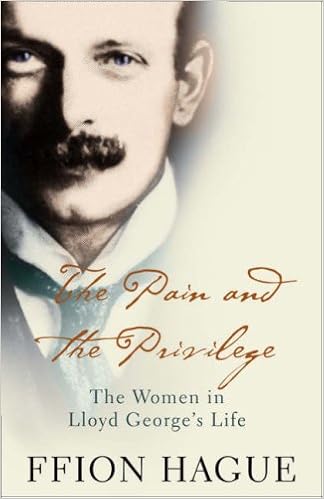 A serialisation of this book on Radio 4 caught my attention. A storyline intriguing enough to succeed as a novel was made all the more interesting through being based on real events – another case of truth being stranger than fiction. How could Lloyd George maintain the active political and moral support of his wife and his mistress when they were both fully aware of the situation even if choosing to delude themselves up to a point? Ffion Hague interprets in a compelling style the complex motivations and emotions involved. The way in which these two women played complementary roles to meet Lloyd George’s needs made me wonder how consciously he chose these two particular people for long-term relationships in an apparent sea of casual promiscuity.