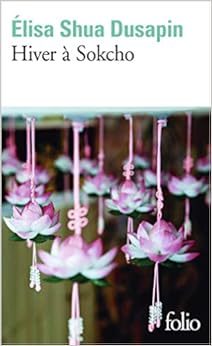
 I did not expect to be so gripped by this choice for a French book group, which has also been highly praised in its English translation.
A twenty-five-year-old narrator whose name we never learn, so I shall call her “N”, returns from studies in Seoul to her home town of Sokcho, a seaside resort more dead than alive in the winter snows near the grimly surreal border zone with North Korea. N seems to feel a perpetual “outsider”, through being only half Korean, her father a French engineer “passing through” of whom she has no memories. Since the author is also half-Korean and half-French, one has to hope that this is not too autobiographical.
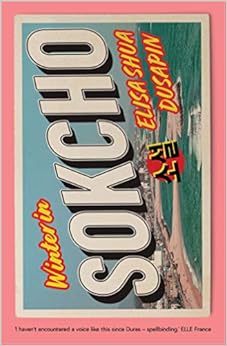 Into the rundown hotel where she skivvies for the grumpy Park, there appears Kerrand, a successful creator of graphic novels, with the added attraction of being French, who immediately uses N to help him buy art materials and guide him around. From the outset they are drawn to each other: both introverted, troubled and unfulfilled, which drives Kerrand to drift round the world seeking a purpose for the cartoon hero who may be his “alter ego”, while N tries to avoid facing up to her feelings by burying herself in routine tasks and clinging to the mantra that “her mother needs her”. Although on the same wavelength when discussing Kerrand’s art, they find it impossible to express, perhaps even acknowledge their emotions, as they keep making tentative advances and then withdrawing, always out of phase.
I admire the deceptive simplicity with which the author subtly conveys so much in such a short novel, with chapters rarely more than two pages, written in a clear style, switching between minute description and a kind of poetry to create vivid pictures. It is necessary to read every word to avoid missing some vital point.
Unable to predict the ending, I was not surprised that it proved ambiguous and in some respects sad, yet still somehow the right outcome of this skilfully crafted novel.
READ ON FOR MORE COMMENT
Reading between the lines, N’s incongruous engagement to the self-absorbed male model Jun-Oh, seems most likely to be a failed attempt to ward off her mother’s continual badgering for her to get married. Repressing her frustration, N’s at times almost bulimic stuffing of food to please her mother indicates her mental distress. Portrayed as a robust character less in need of help than her daughter, her mother runs a fish stall and takes pride in her cuisine, including her licence to remove the poison-filled liver from the puffer-fish, a Korean delicacy. Food, particularly of a fishy nature, plays an important role in this book as it does in Korean life.
We are given an intriguing insight into Korean life outside the westernised bubble of Seoul: the celebration of Seollal, the Korean New Year; the social life round the jjjmjilbang, or segregated Korean bathhouse; the “haenyeo”, hardy female divers with the unfamiliar (to us) range of edible creatures they cull from the sea.
Since Kerrand is keen to be driven to the border with North Korea, N visits it for the first time, because “only the tourists come here”. “Forbidden to leave the marked track, forbidden to raise one’s voice, forbidden to laugh” they pass through no man’s land “beige and grey as far as the eye can see”, where N can only tell that the grey-uniformed figure behind the souvenir counter is alive from the blink of her eyelids. The threat from the North even extends to the beach where a summer tourist who strays over the border risks being shot by an enemy machine gun.
N guides Kerrand round the Buddhist temple at Naksan, prompted by the stone statues to relate the folktale of the serpent which the dragon, guardian of the spring, must find to make the tortoise, guardian of the winter, cede his place.
Many phrases stick in the mind: “Pavane of dead leaves in the wind” or a striking description of fishermen preparing to catch squid: the slow rhythm of their boats on the swell, the switching on of bulbs attached to cables stretched from poop to prow to attract the molluscs, the pagoda at the end of the jetty from which N can watch their “light traps part towards the open waters, a slow and proud procession, the Milky Way of the sea” – all much more beautiful in the original French.
![La Peste (French Edition) by [Albert Camus]](https://m.media-amazon.com/images/I/51Md5wTTJML.jpg) Published in 1947, this French classic is often taken as a metaphor for the French resistance in its courageous but futile fight against the Nazi occupation. Those who have rushed to buy it in 2020, cannot fail to be taken aback by the similarities to the Covid-19 pandemic.
Published in 1947, this French classic is often taken as a metaphor for the French resistance in its courageous but futile fight against the Nazi occupation. Those who have rushed to buy it in 2020, cannot fail to be taken aback by the similarities to the Covid-19 pandemic.![Cheri (Vintage Classics) by [Colette]](https://m.media-amazon.com/images/I/41peGrca+2L._SY346_.jpg)
![Un brillant avenir (Folio t. 5023) (French Edition) by [Cusset, Catherine]](https://images-eu.ssl-images-amazon.com/images/I/51hhNUp1tIL.jpg)
![Mourir sur Seine: Best-seller ebook (ROMAN) (French Edition) by [Bussi, Michel]](https://images-eu.ssl-images-amazon.com/images/I/51nkQX1Zj8L.jpg)
![Le monte-charge (FREDERIC DARD) (French Edition) by [DARD, Frédéric]](https://images-eu.ssl-images-amazon.com/images/I/31CfonY3VoL.jpg)
![Bird in a Cage by [Dard, Frédéric]](https://images-eu.ssl-images-amazon.com/images/I/51aOGfiobaL.jpg)


 Despite its dry title, this short, unusual novel is a riveting masterpiece.

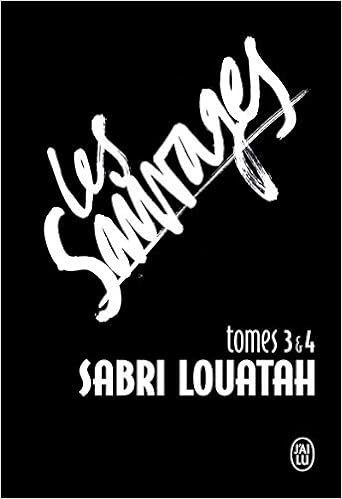 If you have not read Tomes 1 and 2 of “Les Sauvages”, the following review contains spoilers. Also, Tomes 3 and 4 will make little sense if you have not yet read the first half of the series. This review refers to both Tomes 3 and 4, which I bought combined in one volume.
 Antenna Reviews