This site will share with you hundreds of book and film reviews written since 2009. Also a chance to discuss these reviews together with some of my creative writing to be added.
A talented illustrator of children’s stories, the improbably named Halcyon aka Hassie Days finds that contracts have dried up following her decision to focus on caring for her dying father. Together with her sister Margot, she agrees to share their joint inheritance from him on the purchase of a neglected old house in the Shropshire village of Hope Wenlock. This is clearly not a good idea since the two have continued their childhood bickering into adult life, and have very different personalities and aspirations, Margot being smart, materialistic and employed in some form of high finance. It gradually becomes apparent that Hassie is going through a mid-life crisis, triggered by a recent love affair.
At first, I was hooked by Hassie’s wry humour, and insightful observation of varied local characters, or Margot’s friends, despite the apparent inability to manage her own life. The influences which have made the two sisters so different are intriguing. The descriptions of the scenery around Wenlock edge, and the garden which Hassie transforms with the help of the resourceful Albanian Murat, who may be lying low for reasons connected with immigration, are very vivid and compelling.
However, the last five chapters proved a growing disappointment: “So many things happened in quick succession around this time that I may have got the sequence confused”. I am inclined to speculate with other reviewers as to whether the author was pressed for time to finish, or even struggling to find a happy ending that would not seem too trite. While some loose ends or last minute crises are tied up too neatly, other threads are brought to the fore without being adequately woven into the tale. For instance, the accounts of the C7 abbess, St.Milburga, are rather tedious information dumps. As she reads the journals of Nelly East, the former occupant of the house who was so repressed by her husband, Hassie’s affinity with her seems too sudden and undeveloped. Several incidents appeared implausible, too rushed, or both. Murat remains a two-dimensional character to a frustrating degree.
I could appreciate the process by which Hassie might come to terms with fate, develop a sense of proportion and renewed purpose in life. However, the hint of magic realism, “away with the fairies”, was a step too far.
Violette has the unusual role of caretaker for the cemetery in the small French town of Brancion-en Chalon. With a tied house on site, the post was meant to be shared with her husband, but this idle philanderer, inaptly named Philippe Toussaint, rode out of her life on his motor cycle without warning nearly two decades previously.
In continual flashbacks, we learn how, born “Sous X” to an anonymous mother and brought up in children’s homes, the pretty but illiterate and unloved teenage Violette was an easy prey for control and exploitation by Toussaint. The birth of her daughter Leonine brings Violette great joy and a sense of purpose, but ties her more firmly to Philippe, until a tragic event which may also be a crime occurs.
Despite all this, the middle-aged Violette finds unexpected solace in the way of life which the cemetery provides: the ceremonies; the visitors; the incidents and anecdotes; the company of a team of undertakers, gravediggers and the Catholic priest with hearts of gold, if somewhat caricatured, and not least by the skill she has learned in planting her garden.
This novel has a filmic quality, no doubt due to Valerie Perrin’s work as a screenwriter, and her connection to the Director Claude Lelouch (of “Un Homme et Une Femme” fame). I wonder to what it extent it may have been inspired by John Irving’s “The Cider House Rules”, a book to which Violette appears to have become addicted.
A prize-winning bestseller in France, translated into many languages, “Changer l’Eau des Fleurs” (Fresh Water for Flowers) was the choice of my French reading group. I found the constant switches back and forth in time, including sub-plots to chart three often fraught love affairs over more than three decades, and clearly designed to build suspense, made it quite hard to keep track of the chronology – but by the end, this did not really matter. Also assuming different points of view, these flashbacks led to constant repetition, perhaps also intended to help the reader. A tendency to reel off a string of examples, when or two would do, and the inclusion of lengthy extracts from the lyrics of popular songs, contributed to the padding out of this book to 660 pages for a somewhat misnamed “Livre de Poche”. Admittedly, by checking out some of the singers on YouTube, I learned a little more about French popular culture.
Similarly, the novel is packed with colloquial idioms, but the desire to improve one’s French was stretched to the limit by the sense of being bombarded with melodrama, and some beyond ludicrous scenes, as when Violette, having somehow learned to ride a monocycle, scares the wits out of some noisy teenagers holding a midnight party in the cemetery, by careering down the alleys between the graves, draped in a shroud decorated with phosphorescent paint, a flashlight whistle between her lips. This was one of the points where I nearly abandoned reading, yet others have singled it out as hilarious. On the other hand, I appreciated a whole chapter devoted to random snatches of conversation heard by Violette as she gardened.
So, if one is not a reader who seeks to escape into a lengthy, sentimental soap opera, where flawed individuals sometimes redeem themselves, where events are often the result of tragic ironies, but the human spirit can survive with remarkable resilience despite it all, you can always choose a novel at the other end of the scale, like one of Claire Keegan’s, instead.
After graduating, French speaker Nathalie’s first contract is to design the costumes for a celebrated trio of athletes, dedicated to beating the women’s world record in the perilous feat of four consecutive triple leaps without landing in-between on the “Russian bar”, which you need to look up online if not familiar with it. This means an end-of-season journey to the Vladivostok Circus, located on the far eastern shore of Russia, where the team of two Russian “bases”, Anton and Nico, who support each end of the bar, and the young Ukrainian acrobat Anna, with their Canadian manager Leon, plan to prepare for their tour de force in the Siberian capital Ulan Ude – the author has a fascination for remote places.
Nathalie appears quite self-sufficient, and knows what to expect to some extent, having spent time in Vladivostok as a child, because of her father’ work. However, she has to win the trust of the group. Including Anton, who speaks little English, and to understand how they work, in order to conceive costumes which will enhance their performance without creating any physical or technical problems for them. There is an added stress in that Anna is a newcomer to the team, replacing the previous star Igor, who was crippled in a seven metre fall when he failed to land on the bar. Anna still has to prove herself, while Anton in particular may have been traumatised by the accident, plus he is possibly getting too old to continue the only way of life he knows.
Novels are often based on some specialism which the reader is unlikely to know much about: piano tuning, transplant surgery or trompe-l’œil painting to make a surface look like rare veined marble – in this case all aspects of circus performances on the Russian bar. This is revealed through detailed descriptions of the characters’ daily life, with a focus on the banal, while significant events tend to be implied, referred to in passing or covered in a single sentence – like Anna’s achievement of becoming the first woman to succeed in the four triples jumps with descending to the bar.
I discovered Elisa Shua Dusapin through her first novel, “Winter at Sokcho”, a quirky but brilliant portrayal of a young woman, who feels like an outsider, trapped in a dead-end seaside resort near the grim border with North Korea, never having known her father who was French engineer passing through, so attracted in turn to a French graphic designer who happens to visit Sokcho.
With my expectations perhaps raised too high, I found Vladivostock Circus a pale imitation of this. It lacks the striking, often beautiful prose of the earlier novel. There is still the strong sense of place, but although descriptions of the circus, closed down for the season, the port city and the long rail journeys all ring true, they are too often unbearably mundane, as for the most part are the characters’ activities and exchanges.
It may of course be the essential point that a good deal of tedium and dull routine lies behind great achievement – also that the moments of truest connection and deepest insight may occur in the course of nondescript, ordinary life.
This is the kind of low-key novel with a minimal plot, leaving much unclear, which has a “marmite” effect on readers who view it very differently. The chief interest for me lay in comparing the French text with the English translation, which is good, but dares to deviate a good deal from the original wording so that it give some scenes a different flavour.
Overall, there is too little substance to sustain a couple of hundred pages. Perhaps a shorter novella would have made a more powerful impact, with a wider appeal.
Set in the 1820s, this is a gripping, striking and memorable piece of historical fiction. It begins in the Australian outback of New South Wales, where a small band of troopers have the grim task of executing, under the rough justice of the colony, one Daniel Carney, the sole survivor of a gang of rebels, bushrangers as they are called, whom they have managed to track down. Adair, the Irish officer in charge, assumes the role of keeping an eye on Carney during the night, ostensibly to find out more about the gang. Even if you are not immediately hooked by the clear prose which creates a vivid sense of place at the remote Curlow Creek, and of the interactions between the characters, do not be deterred by the moments of violence in the first chapter.
Through a series of lengthy flashbacks, the storyline shifts back to Adair’s very different past. Orphaned as a very young child, he had the mixed blessing of being brought up in a wealthy, if eccentric household, where he formed, in a complex triangle, a close attachment to both Virgilia, an older girl who lives at a nearby country estate and to Fergus, born soon after to the lady of the manor who has taken Adair in. Whereas Adair is cautious and responsible, knowing he has to make his own way in the world, Fergus, the family heir, has a Heathcliff-style charisma and wildness. When this eventually takes him to Australia, where he takes up the cause of the underdogs, Virgilia tasks Adair with following Fergus there to find out what has happened to him. So it is that Adair’s long conversations with Daniel Carney in the last hours of his life are primarily to establish whether “Dolan”, the dead leader of the gang, was actually Fergus, and if so, what were his final motives and actions.
This is the framework of what turns out to be a well-constructed plot with moments of high tension, which is nevertheless secondary to the novel’s underlying purpose. It weaves together insights into the colonial experience from both sides in rural Ireland and Australia – different, yet with certain parallels, and also into human nature in general, and how we are shaped by a complex mixture of fate, chance and inheritance – so that in the course of being bound to suffer or impose “an insufficient law”, a man may come to terms with, or “find” himself.
This novel by Australian author David Malouf has a very poetic quality, which is not surprising since his books of verse began to be published before his fiction. His gift for expressing ideas with great clarity, precision, depth and range is very impressive. He deserves to be more widely known, and this book merits being read more than once.
It is an achievement to concoct the diary of a man from fifteen-year-old schoolboy in the early 1920s to death six decades later aged 85. It must have involved a good deal of research to select the series of C20 events to form the backdrop, and the book is possibly more appealing to readers of retirement age who can recall or have heard a lot about them in the past.
Logan Mountstuart has a comfortable childhood since his father is manager of a meat company, producing corned beef in Uruguay. On his return to England, a master at his minor public school who has taken a fancy to him steers Logan into an Oxford College from which he emerges with a third class degree, which matters not since his ambition is to become a writer. He has modest success in getting published quite quickly, but feels trapped after making the mistake of marrying an earl’s shallow daughter, on the rebound from rejection by a more intriguing woman. And so he embarks on a chequered life, where in the attempt to make the journal more interesting, his imaginary acquaintances mix with a succession of the rich and famous, movers and shakers, the likes of Hemingway, Picasso, Ian Fleming, even the Duke of Windsor and Wallace Simpson. All of these seem taken with Logan, at least initially. Then there is the US painter Nat Tate, whom some critics have been fooled into thinking actually existed.
However, all the name-dropping quickly becomes tiresome, and I suspect the book may appeal more to men, since it is written very much from a male perspective. William Boyd has explained that Logan was inspired by the journals dating from the 1920s of writer and critic Cyril Connolly, whom he describes as “selfish, promiscuous, talented, hard up, lazy, an epicurean and a particular kind of English intellectual (his tastes were refined but narrow), and I found something about his flawed personality deeply beguiling”. As a female reader, I do not.
Particularly in early life, Logan is not a very likeable character. He can’t resist sleeping with his best friend’s fiancée, he drinks far too much, and lusts after countless women, most of whom conveniently seem to find him attractive. Yet he has odd flashes of integrity, as when he refuses to plant incriminating evidence on a man whom the Duke of Windsor wants “out of the way”, and so years later still bears a grudge against him – Wallace hissing the word “traitor” at a chance meeting.
Logan is at his best in times of adversity. When unjustly imprisoned in Switzerland, which at least ensures he survives World War ll, he distracts himself with a small farm of insects found in his room – woodlice, a cockroach and ants which he “herds together in a small packet” but they keep escaping, which gives him “a vicarious sense of freedom”. Sometimes he is so impoverished that he has to live on tins of dog food, for which he develops a taste, but always lands on his feet. His home may be sold because he is believed dead, but in another stage of life someone will bequeath him a house, admittedly in a rundown state.
He may have to flee the US since he is suspected of underage sex with a girl he didn’t realise was only sixteen, but ends up with a cushy teaching post in Nigeria, where he has a chance to show his decency in trying to free a servant who has been pressganged into an army during the Biafran war. Boyd’s own childhood experience of living in Nigeria may have contributed to this section’s authentic ring.
There is wry, even black humour, in the scenes when, especially in old age, he decides it is not too late to take up a cause like joining a Socialist Patients’ Collective, after experiencing the shortcomings of the NHS, or finding out who is defacing a plaque to a hero of the Resistance in the French village where he has taken up residence – this altruism invariably backfires.
The disadvantages of the diary format is that the entries are often quite short and fragmented. There are too many banal sections, involving lists and humdrum events: how many made to measure summer suits Logan bought, just how much he boozed one night, how he furnished his flat. This may be realistic in terms of what a diary is like, but is pretty tedious. While skimming through the duller patches, it is easy to overlook the names and professions of people in passing, so that when they turn up again three hundred pages later one cannot be bothered to check who they are.
What often feels inevitably unstructured, because it is representing the course of life, and also unbearably long – I felt better disposed to it as my Kindle recorded 80 per cent read – is actually full of many imaginative incidents which could have been developed more fully, and some expressive pieces of writing which one would not normally find in a diary. In other words, would a series of short stories on particular events in the stages of Logan’s life had been more satisfying? Still, this book was longlisted for the 2002 Booker Prize, has been adapted for a television series, and has sold well, so who am I to carp?
In mid C17 Holland, Catrin, a young widow, sells the possessions inherited from her husband Govert, to fund her decision to leave her remote village on the edge of the Dutch polders. This is not only to escape the gossip of neighbours, suspicious about the cause of Govert’s sudden death, but also to see more of the world. Her natural skill as an artist, so far limited to painting flowers on the family’s wooden furniture, soon enables her to gain employment with a potter in Delft.
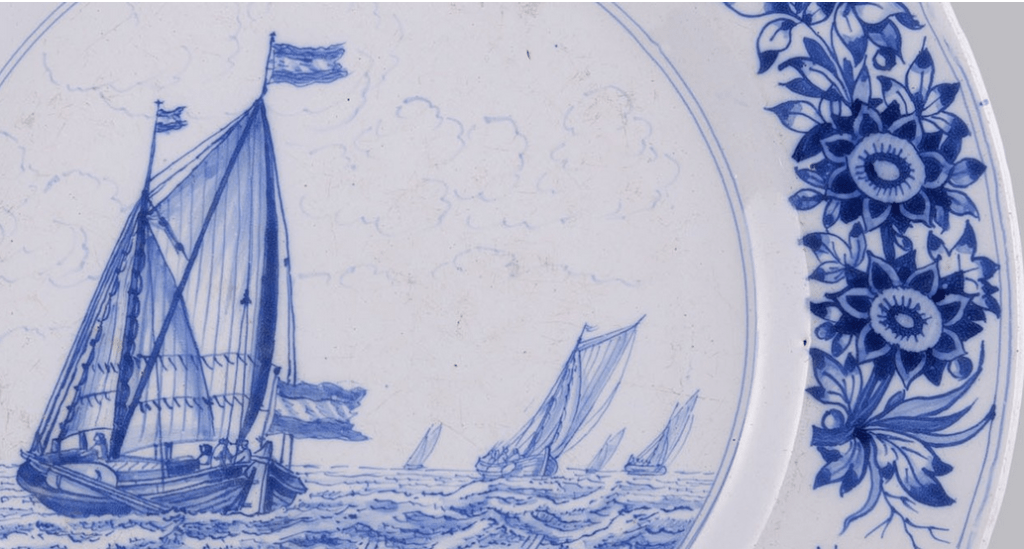
This is the cue for the fascinating history of the Dutch “Golden Age”, initially based on the import of fine white porcelain from China by the East India Company until distant civil wars disrupted the trade. These events encouraged the development of a domestic product, Delft faience with its striking blue images, which replaced the copied or imagined Chinese scenes with the sailing ships, windmills and rural scenes of Holland. All this forms the background to one of the “thrillers” for which the Dutch author is apparently best known.
Meetings with artists already or soon to be famous are shoehorned in: Catlin encounters Rembrandt who notes her true appreciation of art, and Vermeer, who runs an inn with his wife, becomes a friend. Catlin even come across Carel Fabritius the painter of “The Goldfinch”, shortly before he is a victim of the explosion of the gunpowder store which destroyed a quarter of Delft in 1654. Catlin has to endure not only this, but also the plague which devastated cities like Delft the following year, but we know she will survive, being the narrator of this tale of an action-packed eighteen-month period.
Despite being a potentially “good yarn”, this novel seems likely to disappoint readers looking for depth of character, and a certain degree of plausibility in a plot, which swings too often between sentimentality and violent melodrama. It is impossible to judge how much this novel has “lost” in translation from the Dutch, but the frequent clichés and tin-eared use of modern turns of phrase in the dialogues are continually jarring.
“You’re young, beautiful and you obviously have talent”. “I hope it was the last one that swung it for me”.
Catlin lives in a society in which a woman cannot pursue an apprenticeship to become a master potter, nor sign contracts herself when running a business. People believe that the plague is a punishment from God, which can be kept a bay with certain potions. Yet some of the exchanges would not sound out of place in a modern soap opera.
Despite the obvious flaws, at least Simone van der Vlugt’s historical research seems to be essentially accurate. By coincidence, the art historian Laura Cumming has produced in 2023 “Thunderclap: A Memoir of Art and Life & Sudden Death “ a study of Dutch art featuring Carel Fabritius, which could be of interest who have found this aspect the most rewarding part of “Midnight Blue”.
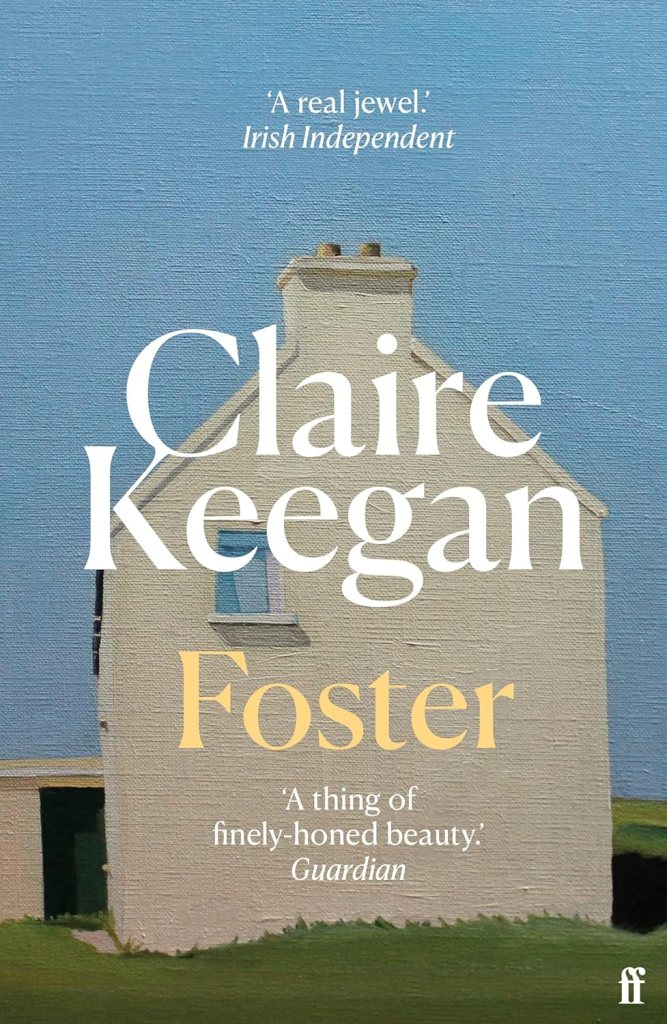
“The wind is high and hoarse in the trees, tearing fretfully though the high boughs…..A big loose hound whose coat is littered with the shadows of the trees lets out a few rough, half-hearted barks…..The presence of a black and white cat moves on the window ledge.” This spare, poetical prose sometimes sounds incongruous, too mature in the thoughts of the young girl narrating this story, unusually observant as she is. But does this really matter? Recounted in the present tense to give a sense of immediacy, this is one of those simple tales which hang on the subtle way in which the facts are revealed.
In the rural Wexford of southeast Ireland during the early 1980s (as we glean from references to the IRA hunger strike in the Maze Prison), a girl – whose name we are never told – is fostered with a farming couple, the Kinsellas, to ease the burden on her heavily pregnant mother. Home life sounds chaotic, since her mother already has to care for at least four children, and do more than her fair share of running the farm, with a husband who clearly drinks away what money there is, leaving too little to pay for the hay to be cut, gambles away a red Shorthorn cow, and casually accepts handouts of potatoes, rhubarb and “the odd bob” sent to his wife. His callousness is revealed when he forgets to unload the girl’s luggage as he drives away, but never seems to make any move to remedy his error.
The Kinsellas could not be more different. Working hard in quiet cooperation, they are keeping at bay a suppressed grief which the girl only discovers after some weeks, from a neighbour’s gossip. Yet although the girl’s presence can only enhance their sense of loss, they still give her the care and attention which she has lacked, so that she blossoms and develops in the space of a few weeks. Suddenly, it becomes clear, as it would to a child with little sense of time passing over a long summer holiday, that the school year is about to start, her mother has given birth and she must return to her old life. The sense of belonging and the affection which have grown make the parting all the harder, on both sides. As is the case with Claire Keegan’s novellas, the ending is ambiguous, leaving the reader to reflect on what happens next. Yet it seems that the girl has gained some permanent benefit from the experience, as perhaps the Kinsellas have as well.
Much of the emotion in this book is implied, together with the way in which observations are used to reveal the characters’ lives and the rural setting, laced with the Irish turn of phrase in the dialogues. As John Kinsella observes, “You don’t have to say anything. Always remember that as a thing you need never do. Many’s a man lost much just because he missed a perfect opportunity to say nothing”.
This novella has been made into the film “The Quiet Girl” which has also been highly praised.
In addition to his detective novels featuring the chief inspector Maigret and other works, Georges Simenon wrote 117 “romans durs”, literally “hard” but described in English as “psychological novels”. One of the best known of these, published towards the end of his writing career, is “Le Chat” or “The Cat”, so popular that it was made into a film in 1971.
“Le Chat” was apparently inspired by a visit to his mother in the 1950s, where Simenon was struck by how she and her partner did not speak to one another, but seemed to express a mutual hatred via the cruelty they inflicted on each other’s pet animals.
From this bizarre situation sprang the tale of two lonely, recently bereaved people in their sixties who happen to live in the same Parisian cul-de-sac and make the mistake of getting married, only to find that their differences in class, taste and habits make them completely incompatible and provoke a profound conflict. The husband Émile Bouin is painted in a more sympathetic light – he’s a simple working man, goodhearted if a bit vulgar, who likes to drink a glass or two in a café and smoke his “nauséabonds” cigars. By contrast, Marguerite is a dainty “petite bourgeoise”, daughter of the founder of a biscuit factory, eventually ruined through a partner’s financial mismanagement. Frail in appearance but with a will of iron, she is portrayed as self-centred, vindictive and superficial.
She detests her husband’s pet Joseph, an independent alley cat who seems to menace her beloved parrot. Despite being deeply religious, she is suspected by Émile of having murdered his cat. This is the beginning of a long-term feud which the pair conduct into their early seventies, communicating solely via written messages. So Émile’s “Attention au beurre” is loaded with meaning – implying malignly that the butter may be poisoned just as Marguerite did away with Joseph. Needless to say, the parrot has come to grief as well, but has been restored to its cage in stuffed form, to trouble Émile‘s conscience.
The monotonous, oppressive life the pair lead is revealed from the outset, and would soon become intolerable even to the reader, but for the continual touches of dark humour. Simenon also captures the nostalgia and melancholy of a former Paris in the 1960s when inner city neighbourhoods of close-knit communities in which people know each other’s business, or think they do, are being disrupted by redevelopment schemes. Even the couple’s cul-de-sac is being demolished by the bulldozer.
Deftly constructed with flashbacks and digressions, Simenon skilfully reveals past events which have shaped the characters, their motivations and emotions, against the atmospheric backdrop of open air cafes and bars, dance halls on the banks of the Seine, or meetings in the Parc Montsouris. Simenon’s clarity of expression and insight hook the reader despite the essential sadness of the theme as it draws to its ironic conclusion.
Simenon embarked on his “romans durs” with the intention of winning The Nobel Prize for Literature, but never achieved this ambition, causing him to change his career from “novelist” to “no profession” in his passport, in a surge of disillusion. The more French novels I read, the more I think he deserved such a prize.
This modern American take on Dickens’ David Copperfield is set in an impoverished part of the Appalachians, where closure of the coal mines has destroyed the local economy, and too many people, particular the young, fall prey to drug pushers and “Big Pharma” schemes to encourage consumption of their opioid painkillers like Oxycontin which led to widespread substance abuse and addiction.
The narrator is Damon aka Demon Copperhead, born on a trailer floor to a drug-addicted teenage single mother, shortly after his young father’s death by drowning. This is the cue for the author, who has switched her focus from the environment to social injustice, to expose the failings of the foster care system, the ravages caused by the underregulated use of drugs like “Oxy”, and the unfair labelling, even mockery, of the rural poor who in fact may benefit from a stronger sense of community and closeness to the natural world than their urban counterparts. Perhaps Barbara Kingsolver’s love of nature, which prompts some of her best prose, has made her express this view through Demon, who comes to believe that the “rural poor” do not deserve to be mocked as “hillbillies” since they can at least hunt or produce their own food without the need to “hustle” for cash, and are prepared to relate to strangers by looking them in the eye.
It may be beneficial to have read David Copperfield recently enough to be able to match the modern characters to the original ones, but this is not essential. The author’s ability to enter the mindset and sustain the speech pattern of a bright, talented, resilient but sadly deprived, ill-educated and often mistreated young man is an achievement, assisted by her personal knowledge of the language that years spent later outside Appalachia “tried to shame” from her tongue. On the other hand, the corny, wisecracking style often grates.
This novel is hard going for a non-American reader by reason of the copious slang, unfamiliar cultural references and acronyms – a few footnotes would have been useful. Heaven knows how it will stand translation into other languages. Dickens had to write his novels in instalments for magazines, presumably leaving readers panting for more, but I found it mentally exhausting to read Demon Copperhead for more than a few chapters at a time. This was partly owing to the style, but also to the relentless piling on of depressing, often unduly sordid events, leavened only occasionally by the odd dollop of sentimentality, or rare stroke of good fortune which one knows cannot last.
However, it is the sheer length of this book which is the problem. At nearly 550 pages in paperback, it would have benefited from the stripping out of a good deal of repetition and “filler” – something that it was much harder for Dickens to do, obliged to publish early chapters before he had finished the whole story. So perhaps the author has gone too far in imitating Dickens, by reproducing some of his flaws, also including a tendency to produce stereotypes or somewhat exaggerated, unconvincing characters
Yet Barbara Kingsolver has created a sympathetic person in Demon, raised awareness of some important social issues, and been quite ingenious at times in her reworking of Dickens’ original plot and cast of characters.
Following the vacuum created by Cromwell’s death, encouraging the restoration of the monarchy in England, the “Act of Oblivion” issued a general pardon, with a few exceptions including the “regicides” who had signed Charles l’s death warrant. Robert Harris makes two of these real men the central characters of his novel: Ned Whalley, turned loyal soldier prepared to be ruthless in the loyal support of his cousin Cromwell, and Ned’s son-in-law Will Goffe, a devout Puritan with a passion for preaching and a streak of fanaticism, as indicated in his unshakeable belief that the Second Coming will take place in the year 1666, as foretold in the Book of Revelation. This delusion at least makes their trials more bearable, as they endure a precarious existence on the run in the New World, with their nemesis, the fictional but plausible Richard Nayler, in unrelenting pursuit long after others have lost the taste for it, driven less by his desire to avenge the king’s execution, than by a deep personal grudge.
The author succeeds in maintaining a continuous sense of tension and menace, so that right to the end, one is unsure whether Whalley and Goffe will escape capture, let alone survive. If the narrative sometimes lacks pace, this perhaps serves to remind us of the inevitable tedium of being forced to lie low, often in very uncomfortable conditions, always on the alert and rarely certain of whom one can trust.
Robert Harris never misses the chance to reveal characters’ strengths and flaws, so that, wherever one’s sympathies lie in the first place, they tend to keep shifting. We see how, when they were in a position of power serving a triumphant Cromwell, the essentially decent Whalley and Goffe were capable of being as cruel as Nayler, who in turn sometimes has unexpected flashes of compassion. Writing a memoir to pass the time, Whalley comes to question some of Cromwell’s motives and actions, while Goffe seems rigidly set in his religious certainties. While perhaps King Charles ll and his brother James are portrayed as unremittingly debauched to the point of caricature, even they appear worthy as they trot round London on horseback, reassuring people in the aftermath of the Great Fire.
Having dragged somewhat in places, the narrative passes too rapidly through the events of the Plague and Great Fire of London which test the faith of Will’s long-suffering wife Frances. The unpredictable, nail-biting end is also quite abrupt. Yet overall, this novel is well-constructed, wears the detailed research on which it is based quite lightly, and certainly stimulates interest in a fascinating period of our history, which could have turned out very differently. It also raises the moral dilemma of how far to go in following one’s principles, at the price of losing almost everything else which one loves or enjoys.














 Antenna Reviews