“The Return of the Soldier”: The truth’s the truth

This is my review of   “The Return of the Soldier”   by Rebecca West.

First published in 1918, this novella is narrated by Jenny whose cousin and childhood playmate Chris is fighting in the trenches of WW1. Even if fully aware of the sexual nature of her love for him, she accepts that it will never be returned as she spends her days living in the family home with Chris’s beautiful but apparently shallow and materialistic wife Kitty. This may also be an assessment distorted by unconscious jealousy. Kitty has spent a fortune refurbishing the house and garden along tasteful modern lines, perhaps at least in part as a distraction from her husband’s absence and the recent tragic death of their three-year-old son.

The two women are appalled to learn not only that Chris has been invalided out of active service with amnesia, but that he remembers nothing of the last fifteen years of his adult life, including his marriage, being fixated instead on a youthful love affair with Margaret Allington, of whose existence both Kitty and Jenny are totally unaware. When Margaret proves to be a frumpy married women, with no dress sense and “horrible” hands seamed and reddened with housework, the two products of a genteel, snobbish Edwardian world imagine that it will not be difficult to wean Chris away from her. The more perceptive and empathic Jenny soon realises that it may have been Margaret’s inner, mental qualities which so attracted Chris.

Beneath the ensuing envy and resentment lies the essential dilemma. Is it better to humour Chris, and let him live happily in a false situation, free from adult responsibility, or must a way be found to “cure him”, which means bringing him to face the truth, with all which that entails.

The celebrated feminist novelist and journalist Rebecca West was neither deluding herself, nor being unduly immodest, in describing this her first novel, written in her early twenties as “rather good”. Well-written and skilfully constructed, down to the ambiguous title, it has a strong sense of place and unflinching dissection of human nature, particularly of women. A C21 reader may find it dated, and feel uneasy about the snobbery which may at times be unconscious on the author’s part, although her family knew financial hardship so she understood what it was like to be poor.

However, it is gives an interesting insight with an authentic ring as to how people thought a hundred years ago, and the different social constraints of the day imposed on them. Some of the descriptions of the area round Monkey Island near Bray on the Thames are very vivid and evocative of an area before it was engulfed by urban sprawl, and the pollution from mass car ownership and Heathrow Airport.

This is the kind of book one reads quickly to see what happens, then again more slowly to appreciate the quality of the descriptions, and the deeper layers of the story, such as the author’s anger over the futile damage caused by war and the complacency of those who expect others to fight it.

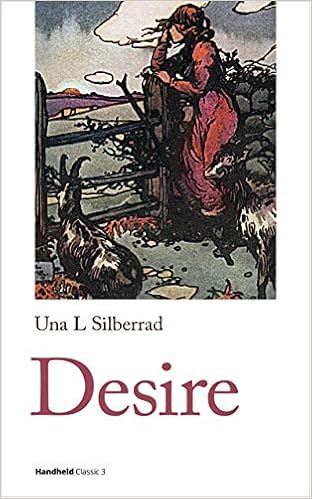
Desire by Una Silberrad – Dangerous goods


This is my review of  Desire by Una L Silberrad

First published in 1908 and recently reissued, this novel by a once popular but long forgotten novelist is on the cusp between an Edwardian viewpoint of the position of women and hints of a more emancipated state of affairs.

The unsubtly named heroine Desire’s unconventional behaviour in fashionable London society could be attributed at first to her privileged position, despite her illegitimacy, as the indulged and unrestrained  daughter of a  wealthy London-based financier. Desire’s step-mother is highly critical, mistaking her frank enjoyment of the mental stimulus of male company for flirting, but has abdicated responsibility for trying to guide or control her.

Desire is intrigued by the straightforward honesty of Peter Grimstone,  a would-be author who has managed to get a book published. She uses her connections to promote sales of the novel and is horrified when his father’s illness places Peter under the obligation to return to the provincial town of Twycross to run the family’s struggling pottery works ,  but the tables are turned when she suffers an unexpected blow and needs his help.

It seems like an attitude formed in the author’s Victorian childhood to describe as “the man side” of her nature, Desire’s decisive, assertive approach as she becomes involved in Peter’s pottery business. There may also be an autobiographical influence at work here, since Una Silberrad’s brother was a  renowned industrial chemist who discussed his ideas with her, which may have enabled her  to write confidently about Peter’s inventions for improving the production process.

There is also a somewhat inconsistent shift in the development of the two main players as the dutiful,  plodding, limited Peter is transformed into a creative, even  masterful character, while Desire becomes more of a traditional, romantic heroine, concealing her budding passion and accepting her would-be lover’s  reticence in a way the original bold Desire would never have done.

I agree with the  initial  reviews, as in “The Spectator”, which found the opening description of a London soirée too contrived and unconvincing. The portrayal of upper class London life is more endurable if assumed to be tongue in cheek, with a touch of wry humour, including Paddy the dog who lies “with his feet in the air to court further attention”.  The novel certainly takes off once the action moves to Twycross, and the world of work,  although the tendency to caricature persists in the portrayal of Peter’s scheming brother Alexander and his  unappealing gossipy wife.  There are striking contrasts in the different types of female role presented:  Desire as the “new woman” who can work on equal terms alongside a man; Peter’s mother as  the dutiful and submissive wife who devotes herself to the needs of others, asking nothing for herself as she stifles her sociability to work away in an oppressively silent house; “Mrs Alexander” who enjoys flashy material benefits in return for  being controlled and belittled by a  domineering spouse.

This novel reminded me at times of Arnold Bennet’s “Anna of the Five Towns”. It is particularly strong in the vivid descriptions of the bleak beauty of the countryside round Twycross, an antidote to the drudgery of the production line.

This is a curate’s egg of a book. Although entertaining in parts with a neatly developed if somewhat contrived plot, the novel is too long and disappointed me towards the end in seeming unable to deal with deep human emotions without slipping into purple prose or pious pontificating – a result, I suppose of the author being born in 1872, religiously devout and never married.

“Sing buried sing” by Jesmyn Ward

This is my review of “Sing Unburied Sing” by Jesmyn Ward.

This imaginative and unconventional novel links the experiences of two young black boys who suffer ingrained racial prejudice, two generations apart, in the US state of Mississippi. In the opening chapter, thirteen-year-old Jojo tries to prove he is becoming a man by helping “Pop”, his black grandfather, to slaughter and skin a goat. The explicit, unflinching description of this is a foretaste of what is to come. Jojo’s main concern is to care for his little sister Kayla, since his mother Leonie is neglectful between working long hours and “snorting crushed pills”, with his white father Michael is serving time in Parchman. This is a penitentiary in real life, notorious for its harsh treatment of black prisoners as farm labourers. The second boy, Richie, sent to Parchman when less than ten years old, is at first protected to some extent by “Pop” when also imprisoned there in his youth.

The bleakness of the accumulated circumstances, together with the tendency of two main characters to vomit as nauseam, came close to putting me off reading this, but I was drawn in by Jojo’s appealing character and the relationships between the family members. When the point of view switches to Leonie, she triggers more sympathy than one might expect, proving to be an immature mother infatuated with her partner Michael, rather than inherently evil, trapped in the vicious circle of wanting to love her children but not knowing how to show it, particularly since Jojo and Kayla have formed such a tight bond which excludes her. She is in fact traumatised, still grieving for her brother who was murdered in a racist attack.

I appreciate that the use of a first person narrative for Jojo, Leonie and Richie creates an authentic sense of immediacy and transports us directly into their thoughts, but I agree with reviewers who argue that too often their southern idioms interwoven with some vivid, quirky descriptions slip into the articulate, literary style of the author herself, which does not ring true in the context.

The theme is sufficiently powerful not to require the devices of magical realism and the ghosts which increasingly haunt the novel. Again, I can see that the title, “Sing, Unburied, Sing” reflects Jesmyn Ward’s desire to show how the suffering of past generations of slaves and exploited black Americans still burdens the present, with all its ongoing injustice, but this does not require the inclusion of ghosts, unless perhaps it is to indicate enduring superstitions.

Jesmyn Ward has a talent for creating a strong sense of place : “some kind of bad earth. Like the bayou when the water runs out after the moon or it ain’t rained and the muddy bottom, where the crawfish burrow, turns black and gummy under the blue sky and stinks”. Her lyrical prose has been compared to William Faulkner’s, but her style tends to become overblown, particularly towards the end of the book which seemed to me to run off the rails somewhat, with a rather contrived, mawkish ending. To admire this novel without major reservations, I think one has to believe in ghosts which can only be seen by those with psychic powers.

“Force of Nature” by Jane Harper

This is my review of Force of Nature by Jane Harper.

When Alice Russell fails to return from a corporate retreat involving a team-building exercise in the remote Australian Giralang Ranges with their sinister recent history as the haunt of a serial killer, Federal Agent Aaron Falk and his partner Carmen Cooper naturally assume a link with their undercover work to persuade Alice to obtain information which will incriminate her employers at BaileyTennants, a family firm suspected of long-term money laundering. As the story develops, alternating between the search for Alice and the flashbacks revealing the chain of events from the start of the four day retreat, it becomes clear that at least four of her work colleagues have a clear motive for killing her. Another possibility is of course the emergence of a new copy-cat serial killer. Or has Alice simply seized the opportunity to go AWOL for a whileas the least-worst option?

As in “The Dry” which made the author’s name on the bestseller list, Jane Harper sustains her talent for writing psychological thrillers, keeping a tight control on her material to drip-feed dramatic events and clues, and developing her characters in-depth as she ramps up the tension, exploiting to the full with a strong sense of place the “force of nature” in the menace of the wild rain-swept landscape, in which one tree is indistinguishable from another, paths peter out or offer confusing choices, carpet pythons lurk in rotten trunks, and communication with the outside world is abruptly cut off, the sole mobile phone smuggled onto the retreat providing too weak and fitful a signal to provide more than the odd tantalising fragment of contact.

In a kind of adult Aussie take on “Lord of the Flies”, the force of nature is also revealed in the rapid disintegration of the façade of civilised behaviour between the five women once they are transplanted from their structured work environment to the wilderness where basic survival becomes the main issue. There are parallels of course, between the way people bully and manipulate each other in their “normal” everyday world and the more physically brutal and critical way they may compete for vital scarce resources in situations of physical extremity. As one character observes, “It wasn’t any one thing that went wrong, it was a hundred little things.” Each inexorably adds to the ultimate crisis.

Although, when one reflects on it afterwards, not much happens, and the power of the tale depends on how the facts are revealed, the novel proved a gripping read at the time. Any repetition can be justified as reinforcing the oppressive situation in which the team of five women find themselves, and I also liked the way that the author knows when to stop, having given us the denouement but leaving the details of the outcomes to our imagination.

Home Fire by Kamila Shamsie – “Do not believe that you alone can be right”

This is my review of  Home Fire by Kamila Shamsie

Since it is a modern reworking of the classical tale of Antigone by Sophocles, although this was not specifically stated in the edition I read, the reader knows that “Home Fire” cannot end well, and that the author may be forgiven for a climax which may seem a little far-fetched and over-dramatic by modern standards.

The author draws on her experiences as a Pakistani to popularise ancient philosophical arguments into an emotionally charged exploration of the conflicting pressures to which Muslims may be exposed in Britain today: family loyalty and duty, ingrained religious beliefs, the desire to belong, be accepted, or succeed in not only one’s private life but also in the wider culture, versus love which may cut across any divide.

The story is told from the viewpoint of five characters who represent a spectrum of personalities and attitudes. Isma and her younger sister Anneka are two young, British Pakistani women pursuing academic courses in sociology and law respectively, who choose to wear a headscarf, are repelled even by the smell of wine and pray regularly, but here the similarities end. The serious-minded Isma puts her career ambitions on ice after graduation in order to care for Anneka and her twin brother Parvaiz when they were orphaned by their mother’s death, only pursuing an American PhD course in sociology when they seem old enough to live independently. The beautiful but passionate and reckless Anneka is devastated by her brother’s decision to join an extreme fundamentalist group in Raqqa, and furious with her sister for reporting this to the police, in a pragmatic attempt to protect the family from blame for his defection. Parvaiz himself seems immature and lost rather than evil, his main interest being in sound technology which can unfortunately be harnessed by the jihadists for their appalling videos of executions.

A contrasting view of integrated Muslims in Britain is provided by Eamonn Lone, the westernised, indulged son of the ambitious Karamat, who has achieved the goal of Home Secretary after a life-time of politicking, by turns trading on and repudiating his heritage. He has earned the undying hatred of Isma and her siblings by refusing to investigate how their absentee jihadist father died on the way to Guantanamo because, “They’re better off without him”.

Kamila Shamsie manages to include a wide range of viewpoints and arguments. Whereas the women are strong, the male characters tend to be weak or have very obvious feet of clay, which reduces one’s empathy with them. I agree with those who would like to have seen more of the thoughtful Isma who is studying sociology in an attempt “to understand why the world is so unfair”, or with those who found the section on Parvaiz too fragmented and rushed – although this could well have been intended to show his mental confusion as the scales fall from his eyes in the Jihadi hell to which he is transported.

The interplay between these characters provides the brew for an intriguing plot, the slow revelation of which made this into a page turner. However, knowing that it had won a major prize and been short-listed for another, I was initially very disappointed by the author’s style, in particular the tendency to slip into artificial, unnatural sentences. Even when I was hooked and admiring some of the strong dialogues, I was continually aware of passages that are too disjointed, condensed or overblown. I appreciate Kamila Shamsie’s up-to-date use of modern social media and internet technology to support her plot, but felt that the tone becomes too slick in later chapters, too larded with “House of Cards” cynicism and neat contrivances, with too many stereotypes like Farooq, who grooms Parvaiz with such a blatant lack of subtlety, together with the borderline Mills and Boon approach to romance.

I can understand the desire to write an accessible novel with wide appeal which lends itself readily to a film adaptation. This is a good choice for a reading group, or to provoke discussion, but I would have been more moved by a novel which dared to break away from the constraints of a classical tragedy in order to achieve a more measured and reflective approach, such as I have just found in Kazuo Ishiguru’s “An Artist of the Floating World”.

The Western Wind – If time or the wind could be reversed…….


This is my review of  “The Western Wind”  by Samantha Harvey.

It is Shrovetide 1491, the year presumably chosen to mark the end of the long medieval period of Catholic monopoly of belief mixed with intense superstition held by those at all levels of society.

John Reve, priest for the isolated and impoverished Somerset village of Oakham, is woken from his troubled sleep by the young neighbour Carter who has found the body of a man thought to have drowned three days earlier. The missing man is Newman, a charismatic, wealthy relative newcomer seen as the only hope for improving the fortunes of Oakham, largely by financing the construction of a bridge which will establish trading links with the wider world. His largescale purchase of local land, his novel religious ideas picked up from travels in Europe (“Newman wanted to find his own way to God”), perhaps illicit relationships with local women, suggest a number of potential enemies, although having lost his wife and child to “the sweating sickness” he may of course have taken his own life. Since he died “unshriven”, his tortured soul will cast a further blight on the village. His loss will also increase the likelihood of the village lands being acquired by the greedy monks of nearby Bruton, and it is unclear whether the dean from Wells, so keen to investigate the death, is really on the side of Reve and his flock.

This theme has the potential for an intriguing medieval mystery, which proves to be psychological drama and atmospheric portray of imagined life in a C15 village rather than a Cadfael type detective story. It is highly original in both style (poetic and using medieval or possibly “made up” words) and unusual structure, a very literary historical murder mystery, ambitious in its device of moving us back in time from Day 4 to Day 1 of a crisis. This plays on the idea of reversing time, and therefore altering the possible course of events.

To what extent does Reve remain an unreliable narrator, even when he discovers or reveals more evidence? The modern tone of the language (“Oakham is a low-hanging cherry waiting to be picked”) helps us to relate to the characters but sits oddly with the deep superstition over, say, “night air” contaminated by the evil spirits allowed by God to test us. The possible anachronisms which have bothered some reviewer did not trouble me unduly. Would John Reve have preached as he did in English, when I thought medieval services were rituals conducted in Latin? Would people really be putting sugar in the tea which would not be introduced to England for decades? Would Reve use an admittedly very makeshift confessional box, when this device is said to have been invented by Saint Charles Borromeo in the sixteenth century? The idea of revealing the background to a murder through the confessional is fundamental to the story, but perhaps historical inaccuracy does not matter too much, if the author needed to show a community in the very precise year of 1491, the year before Columbus discovered the New World and the concept of a round earth orbiting the sun began to crack apart the stranglehold of the Church on exploration of ideas and pursuit of fact-based knowledge.

I understand that the slow revelation of facts, the preoccupation with waterlogged mud, bodily dirt and the general misery of hard, poverty-stricken lives are necessary to the novel’s ambience, cues for what many will regard as a brilliant work of sustained creative writing. However, despite the thread of wry humour, I found the continual repetition and wordiness quite tedious, calling for more ruthless editing. I would have liked more development of Newman as a “Renaissance, Reformation” man, whose mind has been opened by in his European travels, in contrast to Reve, a perceptive man but limited by his narrow experience.

It was only in the last section “Day 1”, possibly because the end was in sight, that I felt fully engaged. I then felt the need to return and read Day 4 again, to check that the plot “stacked up” and to appreciate the impact of the true conclusion, which one could easily miss noting at the end of Day 4. This seems to be to be ambiguous in an interesting way, but I am not sure it is satisfactory for it to be so “buried” in the text and would like to hear the views of others on what they made of the “true” ending.

The President’s Hat – The power of suggestion, or something more?

This is a review of “The President’s Hat” by Antoine Laurain

When President Mitterrand leaves his distinctive hat in an upmarket Parisian restaurant, the mesmerised diner at the next table cannot resist the temptation to steal it. In a “La Ronde” type occurence chance events, the hat falls into the possession of a sequence of very different characters: a line-toeing manager who is bullied by his boss, a would-be writer who has drifted into being the mistress of a man eternally promising to leave his wife, a famous creator of perfumes who has lost his capacity to recognise scents, let alone create a best-selling new one, and so on. Despite having so little in common, thanks to the hat, each experiences the same sudden burst of confidence and creative impetus to act differently which radically alters the course of their lives.

The end, although essentially predictable, has enough ingenious twists to leave the reader satisfied. Despite a loss of momentum at times, as if it could just go on adding temporary owners of the hat until the author tires of the device, the plot is saved by the sheer pleasure of reading his polished, gently ironic prose. Even if one dislikes oysters, his description of eating one is so vivid that one can see and taste it. He also introduced me to some interesting buildings which can be looked up online, such as the courtyard of the Palais Royal in Paris with its “Colonnes de Buren”, the controversial installation of black-and white striped, columns resembling liquorice allsorts. Another example is the Palazzo Contarini del Bovolo with its stiking multi-arched spiral staircase, which sounds worth visiting on a trip to Venice.

Set in the 1980s, before the world of mobile phones, the internet and social media, the novel risks being dated by the reference to celebrities now long gone or forgotten, which may limit its appeal to younger readers. The cultural references sometimes feel a little contrived as if culled from a checklist of items researched to give the story an authentic setting. Antoine Laurain has said that he avoids reading modern novels, being depressed by their focus on violence and suffering. This novel, which flits like a butterfly over deep The President’s Hat by Antoine Laurain and real problems, dripping nostalgia for a more innocent, less fraught era which never quite existed, can be enjoyed as an ingenious, entertaining piece of escapism from grim reality.

The final sentence may provide the key to the novel, or the idea that inspired it, namely François Mitterrand’s intriguing conclusion of his last address to the public: “Je crois aux forces de l’esprit et the ne vous quitterai pas”. C’est-à-dire: I believe in the strength of the spirit, and will never leave you”

“The Lie of the Land” – “Who least hath some; who most hath never all”

This is a review of The Lie of the Land by Amanda Craig


Unable to accept her journalist husband Quentin’s philandering, architect Lottie’s desire for a divorce are scuppered by the financial crisis which leaves them both unemployed, and the value of their London home falling fast. Her solution is to rent it out, and uproot her three children to a surprisingly cheap house in the depths of rural Devon for a year, with the penniless Quentin in tow, tolerated only for his strong bond with their two daughters, precocious Stella and Rosie, and for his culinary skills.

It is of course much more plausible that Lottie would move into in her mother’s large six million pound London house, where she lived for years as the single mother of Xan before falling for Quentin, that she would get some kind of employment, and boot Quentin out. The relocation in Devon is simply a device for an exploration of family relationships and of our fractured society in C21, with a slow-burn murder mystery flickering away in the background. The pampered Xan begins to learn how the other half lives through his night shifts at Humbles pie factory, which will seriously make me think twice about ever buying a ready-made meat pie again. Quentin is brought to reconsider his attitude to life by the slow and painful death of his father – a gifted but underestimated poet and brilliant teacher, but also vicious-tongued and a flagrant, serial adulterer, to provide a life-time excuse for Quentin to follow suit.

Although the family members are quite well-developed as personalities, I agree with reviewers who describe the characters in general as stereotyped. Despite the carefully revealed plot, I found aspects of the denouement quite unconvincing or flawed, not to mention a point which bothered me more – a kind of ethical double standard in which it seems that men should be punished for lying, but women should be allowed their secrets.

I liked the wry humour, was impressed by the amount of wide-ranging topical social comment the author managed to shoe-horn in without sounding too contrived, and was continually struck by the vivid visual descriptions of a rural Devon through the changing seasons which she clearly knows well. “Frosts turn long grass the colour of old hair,”….”A veil of rain hangs in the west”…..at one point “flocculent clouds” are even “herded by the moon”. I also have to thank the author for introducing me to Robert Southwell’s wonderful C16 poem “Times Go by Turns” which begins, “The loppèd tree in time will grow again” ending, “Who least, hath some; who most, hath never all”.

Occasionally, paragraphs seem disconnected from the text, as if there has been a lack of editing after removing or altering a previous passage. The novel also sometimes feels a little too wordily repetitive and over-long.

Despite some reservations and disappointment at the end, I found this tragi-comedy a page-turner, likely to prove an absorbing yarn for a long journey or a wet week-end.

The Sheltering Sky – The point when there is no longer any turning back


This is my review of  The Sheltering Sky  by Paul Bowles.

In post-war North Africa, three young Americans, Port Moresby and his wife Kit with friend Tunner playing gooseberry, travel somewhat aimlessly to remote towns in the Algerian desert. Port is introspective, self-absorbed, fascinated by the desert, holding himself distant from others even in his promiscuity, whereas Kit is frightened by insecurity, dislikes being made too think too hard, rejects Port’s quest for meaning in the world and is passive and needy in her sexual adventures.

Although closely tied by a bond which is hard to understand, the marriage is clearly in trouble. The two occupy separate rooms, are casually unfaithful to each other, and have incompatible views. As Kit reflects, it “made her sad to realise that in spite of their so often having the same reactions, the same feelings, they never would reach the same conclusions, because their respective aims in life were almost diametrically opposed”.

It is only some way into the book that background details are provided on, for instance, how Port manages to support himself during his lengthy travels. I am not sure we are ever told how or why the couple left their social circle in New York to end up in Africa for an unlimited period. I concluded that it was the author’s intention to pare details down to focus on the remote beauty of the desert, and the isolation, disorientation and exposure to danger of westerners who leave their own culture to enter it. The fragility and irrelevance of a civilisation they have taken for granted as superior is suddenly revealed. Perhaps at a deeper level the aim is to show how to understand the true nature of our existence we have to be uprooted from familiar territory. As Port tells Kit, “The sky hides the night behind it and shelters the people beneath from the horror that lies above.” Bowles aims to fracture the protective sky to reveal the loneliness of living, and the delusory nature of our preoccupation with time – from which Kit is released eventually by the loss of her watch.

Paul Bowles was apparently a gifted composer, and there is a kind of poetic musicality in his writing: “the ereg with its sea of motionless waves”; at night “the brightness was intense; each grain of sand sent out a fragment from the polar light shed from above”; “the pale infected light of daybreak”, “the insistent wind”; the “sun-drugged stupor” of the towns with their “haphazard design of towers”; how the “angry lamps of the stallholders gutter and flare; the detritus of “fish skeletons and dust”.

For Bowles, speaking through Port, “the desert symbolises freedom, but it is also savage and arouses savagery in the characters who must choose their own bleak fate”. The author also has a gift for getting us inside the minds of his characters at critical points in their lives, however little we may engage with them.

A strong illustration of the author’s skill is in the following description of approaching an oasis , which reminded me of a striking scene in Lawrence of Arabia:

“Soon a solitary thing detached itself from the undecided mass of the horizon, rising suddenly like a djinn into the air. A moment later is subsided, shortened, was merely a distant palm standing quite still on the edge of the oasis. Quietly they continued for another hour or so, and presently they were among trees. The well was enclosed by a low wall. There were no people, no signs of people. The palms grew sparsely; their branches, still more grey than green, shone with a metallic glister and gave almost no shade.”

I understood the book better when I read that the author Paul Bowles and his wife Jane provide the models for Port and Kit. He wrote: “I wanted to tell the story of what the desert can do to us. . . . The desert is the protagonist. . . . It is an adventure story in which the adventures take place on two planes simultaneously: in the actual desert and in the inner desert of the spirit. The occasional oasis provides a relief from the natural desert, but the sexual adventures fail to provide relief”.

Paul, who spent year living in Tangier and wandering in North Africa was charming, self-controlled but essentially somewhat aloof, remaining discreet about his sexual adventures and regarding the use of hashish as essential to his creative writing, which may account for some of the more mind-bending passages, such as impressions at the point if death, or the experience of madness. Mainly homosexual, he amazed friends by marrying the extrovert, childish, attention-seeking, overtly promiscuous and heavy-drinking, essentially lesbian Jane. A close friend “was absolutely dumbfounded by the intimacy and closeness between them, more so than any two people I’ve ever known. They had remarkable, unique rapport”. This helps to explain why the marital relationship between Port and Kit is so outside the norm, and hard for the reader to empathise with and understand.

Overall, this is a bleak yet original novel, which Inspires admiration for its descriptions and insightful observations rather than a true liking or enjoyment.

Universal harvester: chaffing over the grain

This is my review of  Universal Harvester  by John Darnielle

I never came to understand why this novel is called “Universal Harvester”. It is well-written and original, but with its unresolved ambiguities, lack of development of the key characters apart from motherless Jeremy Heldt and his bereaved father, and rather limp conclusion, it left me feeling somewhat dissatisfied.

Part One of this short novel is very promising, a page-turning psychological drama  which subtly develops a sense of unease, even menace in a small Iowa town where nothing much happens and men pass the time of day talking about fishing. In danger of sinking into a rut at the local video rental store (VHS tapes because it’s the end of the 1990s),  Jeremy Heldt begins  to receive complaints about videos with “something” on them, and then becomes obsessed himself by  the unsettling shots someone has managed to insert into certain films.  The spare prose is effective not only in its vivid evocation of rural/ small-town life, creating a strong sense of place, but also in the portrayal of the relationship between Jeremy and his father as they try to provide mutual support and respect each other’s grief.

The second part dispels  the illusion that this is  working up to being a tale of horror or detective thriller, rupturing the narrative drive with an abrupt switch back to the 1960s with the focus on a different set of characters. The style become more “exposition” rather than reveal what goes on in Irene Sample’s mind to cause a dramatic  and life-changing action on her part.

Although it seemed clear who was responsible for altering the tapes, in the last two sections, my frustration grew over  the unresolved ambiguities as to why and exactly how this was being done, including what induced, even forced, others to take part as  “actors”.  The author begins the acknowledgements with:  “This is a book  largely about mothers”.  The only reason I can see for inclusion in Part Four of  the Pratts, who come to rent the house where the tapes were altered  some years previously,  is to introduce a “normal happy family” of comfortably off Californians to provide a contrast with those rendered dysfunctional by the loss of a mother. With perhaps rather thoughtless complacency, the Pratts display the confidence and resilience borne of good fortune that is only mildly or temporarily thrown off course by a troubling sense of other people’s distress. They also demonstrate how differently, partially and inaccurately strangers may view a place compared with previous occupiers unknown to them.

Having just read William Faulkner’s “As I lay dying”, I noted some similarities in the frequent focus on small details rather than the main issues, which one often has to deduce,  in the switches in viewpoint and in the idea that mystery of the altered tapes, even the effects of losing one’s mother, are not the essence of the story.  This seems to lie in the nature of being, in which, for instance, people may cease to exist for us when they move out of our lives,  or the difficulty of knowing what went on in a house or place before one lived there.

“She wondered what had gone missing from Iowa before she ever got there. There is no way of knowing. That’s what pictures are for, after all: to stand in place of the things that weren’t left behind, to bear witness to people and places and things that might otherwise go unnoticed”.