“Prodigal Summer” by Barbara Kingsolver – Ambitious tour de force to set one thinking

This is my review of Prodigal Summer by Barbara Kingsolver.

Middle-aged, reclusive warden for an Appalachian Forest Service, Deanna is unable to resist the charms of the young hunter Eddie Bondo, although she suspects that his chief motive is to claim the bounty for shooting the coyotes thought to have migrated into the area, creatures it has become her obsession to keep concealed and protect. Sexual attraction has led city-bred Lusa to abandon her budding career as a research biologist to become the wife of Cole, a down-to-earth farmer in rural Zebulon County, where she feels oppressed by the suspicion and narrow-minded prejudices of his family and driven to bicker with him over their different attitudes to nature: like Deanna, she is interested in how coyotes have come to migrate two thousand miles from the Grand Canyon, whereas he is more concerned about the intrusion of meat-eating animals on the local dairy farms. Thirdly in the three interwoven story threads which we know will eventually converge, old Garnett Walker conducts a feud with Nannie Rawley “his nearest neighbour and the bane of his life” who sabotages his attempts to control the weeds on his lands with pesticides. Having lost the past family wealth from the American chestnut woods now lost to blight, he labours at the painstaking process of cross-pollinating replacement trees with stock from China, to re-establish a resistant strain. n.b. I’m interested by the Goodreads review from a male reader who felt that the men in the story are stereotyped and portrayed unfairly as less in touch with ecosystems than women, and more guilty of trying to control nature.

Trained as a biologist before becoming a writer, Barbara Kingsolver brims over with a knowledge of the natural world, much apparently based on personal observation, impressive for a city dweller, and thought-provoking – as for the idea that that pesticides may only cause bugs to multiply, by also killing indiscriminately the creatures which prey upon them. I soon found this novel an absorbing page turner, with vivid descriptions, a range of interesting, distinctive characters, by turns poignant and wrily humorous – the kind of story one tries to read more slowly in the vain attempt to take in all the bubbling brew of ideas and information, and which one feels sorry to end.

Yet at the same time, the author’s primary aim to show how the primal force to reproduce drives everything – insect, bird, beast and man – often leads to an almost farcical plethora of examples. It feels at times like reading a biology text book masquerading as a literary Mills & Boon, often too overblown, wordy, corny and contrived for my taste, as when Lusa tries to bond with her prickly ten-year-old niece, or when Deanna, unexpectedly tracked down by Eddie, launches into the analysis that he has been guided by her pheromones: “I’m fertile, that’s what got to you……I sleep outside a lot..I’m on the same schedule as the moon”. This prompts Eddie to say “So back in the old days, when they slept on the ground around the fire, wrapped up in skins….You’re saying all the women in the world came into heat at the same time?” This conversation takes place as the pair “stomp down” on puffballs “releasing a cloud of spores that rose and curled like golden brown smoke, glittering in the sunlit air between them. Sex cells, they were, a mushroom’s bliss, its attempt to fill the world with its mushroom progeny.”

The novel repays rereading, perhaps after an elapse of time. Sincere and “heart-warming”, carefully thought out to trigger reflection on man’s place in nature, it would have been a technically better novel if pruned down but perhaps it was the author’s intention to create a cornucopia of words and ideas.

⭐⭐⭐⭐ 4 Stars

“The Evening Road” by Laird Hunt – “Ginning up a story to steal away my heart”

This is my review of The Evening Road by Laird Hunt.

This is an unusual take on the shocking theme of America’s last public lynching in 1930, immortalised in Billie Holliday’s rendition of “Strange Fruit”. The author explores in turn the experiences of three women whose paths cross fleetingly on the evening of the atrocity. Forming a menacing background theme, the lynching is never explicitly portrayed, often seeming oddly secondary to the preoccupation with the personal lives of the two main characters Ottie and Calla. Both are feisty, damaged by dysfunctional childhoods yet on opposite sides of the racial divide.

Ottie is a sassy young secretary who indulges her lecherous boss to boost her pay cheque and has a troubled relationship with her husband, connected with events from her childhood which gradually become apparent. The trio’s whisky-sodden attempt to join the herd travelling to the misnamed town of “Marvel” for the lynching as a kind of casual spectator sport takes on the quality of a bizarre Odyssey. which seems at times like a nightmarish version of the Coen brothers’ “Oh brother where art thou”. Ottie suppresses her sense of unease over the lynching to the point of encouraging the hijack of a cornflowers’ cart to get there. This is the peculiar, incongruously sweet choice of a name for black Americans as opposed to “cornsilks” for whites, or “cornroots” for American Indians.

Orphaned as a child, taken in by a couple on sufferance, torn between her affection for two men, Calla channels some of her personal violent anger into defiant rage over the lynching to the point of taking action, however futile, to prevent people from attending it. One of the most convincing scenes is her perverse desire to “stamp into the ground”, even shoot, the one white person who shows her kindness. She is enraged by the inadequacy of his statement that the lynching is “just plain wrong”. For her, it is “a thousand miles from what needed saying….what a cornsilk needed to do was just keep his kindly mouth stapled shut”: the honest prejudice of his mother seems preferable. This section reaches the strongest conclusion in the novel.

By contrast, the viewpoint of Sallie, a brain-damaged local white woman with mystical powers provides a short, inconclusive postscript.

“The Evening Road” evokes the sense of 1930s inward-looking small town America where the superficial cosiness of catfish suppers at the church is warped by ordinary people’s unthinking acceptance of slavery’s racist legacy, of sexism and the drowning of guilty sorrows in whisky, a reaction against the unrealistically oppressive prohibition of hard liquor.

Despite its striking metaphors (hell-poker hot) and visual images , this novel comes across as an over-contrived exercise in creative writing. Deliberately surreal and evading the norms of structure, it appears too fragmented and rambling, with details only half-revealed at random, threads allowed to drift away, characters half-developed and unengaging, overall a kind of verbal “modern art”. I read on in the hopes of some resolution or revelation which never came and did not feel any insight gained in the process.

⭐⭐⭐ 3 Stars

“Birdcage Walk” by Helen Dunmore – “What is left behind by a life”

This is my review of Birdcage Walk by Helen Dunmore.

Set in Bristol against the backdrop of unsettling news about the French Revolution in which idealism turns so quickly to extreme violence, the central character Lizzie Tredevant steers a course between two different worlds. On one hand she has learned to be unconventional, unmaterialistic and free-thinking from Julia Hawkes, her radical blue-stocking mother and a talented pamphleteer on human rights. On the other, she is drawn largely by sexual attraction to John Diner Tredevant, a clever and competent self-made man who has battled his way out of poverty to become a successful property developer. The widower of a French woman, he is much quicker than Julia and her idealistic companions to see the ethical flaws in a revolution which brutally guillotines anyone who happens to be an aristocrat, priest, or sympathiser of the old system. He also appreciates how political and economic uncertainty jeopardise the Bristol housing boom and his debt-laden dream of constructing a grand terrace on the edge of the Clifton gorge, which forms a dramatic backdrop to the story.

Julia, step-father Augustus and family friend Hannah have all advised against her marrying Diner, who in turn does not hide his contempt for what he sees as their naïve theories and practical incompetence: “They tear down the Bastille, but can they build it again? Augustus would not be able to put a roof on a doll’s house…. Can he turn a lathe?…. Can he lay a flagstone floor? No, he depends upon those who can. He is as much a guest in the world as a three-year-old child”. Gradually, her loyalty to Diner is strained by his controlling behaviour, and her curiosity about the French wife she is afraid to ask him about develops into fear over a secret which he may be concealing.

Helen Dunmore knows how to structure a story with a double hook at the beginning: the mystery of a long-dead woman writer who really existed but left no trace of her work, and the reasons why a man is burying a woman’s body in a woodland clearing on the opposite side of the Avon Gorge from Clifton. She develops complex characters and relationships, although the poet Will Forrest is a little too good to be true, with a strong sense of time and place particularly evocative for those who know Bristol – it is intriguing to imagine Clifton as a raw building site surrounded by countryside. The narrative drive drags a little at times, but builds up to a gripping if slightly contrived, borderline melodramatic conclusion. This is a very readable work of popular literary historical fiction.

⭐⭐⭐⭐ 4 Stars

“Days Without End” by Sebastian Barry – Rough justice in mid C19 America

This is my review of Days Without End by Sebastian Barry.

After his immediate family’s death in the Potato Famine, John McNulty joins the wave of Irish immigrants into the US where soldiering seems the only option for him and his lifelong companion and secret lover, John Dole. In the 1850s, this means, of course, “routing out” the Indians to leave the land clear for European settlers. After a brief return to civilian life, inspired by “the true and proper love of country and the call of Mr. Lincoln”, the two men see no irony in joining up again to fight for an end to slavery in the Civil War of the 1860s. Yet McNulty realises that Indian Chief Caught-His-Horse-First and his people have received a raw deal from the Americans whose actions show they are mistaken in thinking themselves morally superior. “Indians ain’t vermin to be burned out of the seams of the coats of the world”.

At first, this novel seems to have a plot so slight it could be summarised in a paragraph, so that what sets it apart is partly the power of Sebastian Barry’s poetical prose – “winter was tightening her noose on the world…then the rains came walking over the land… making the grass seeds drunk with ambition…just before a thunderstorm, when the land draws in its chest and holds a limitless breath…” – layer upon layer of images. There is also his skill in sustaining a distinctive “voice” for his narrator John McNulty in the form of an ungrammatical but expressive stream of consciousness. In fact, when the story gears up to a final dramatic climax, it becomes clear that most of the previous characters and incidents are jigsaw pieces in a carefully constructed plot.

The first of many striking, visceral descriptions is the unexpected encounter with a herd of two or three thousand buffalo, the thrill and danger of catching a few for meat, and the exhilaration of preparing and eating it. “The knives opened the flesh like they were painting paintings of a new country, sheer plains of dark land, with the red rivers bursting their banks everywhere.. The Shawnees ate the lights raw. Their mouths were sinkholes of dark blood”. When this unflinching style is applied to the massacre of Indians, it becomes very hard to read. I can understand Sebastian Barry’s urge to test his creative writing skills to the limit in capturing the reality of brutal events, perhaps he is honouring the victims in the process, yet reading it feels almost obscene. I certainly felt oppressed by unrelenting sequence of violent bloodshed clearly in store.

This sensation is at least partly offset by John McNulty’s wry humour, his sensitive eye for the landscape and weather, his acute observations of the rapid changes in the way of life, all more vivid and evocative than a social history of the period: the experience of a stream train, “Something in perpetual explosion. Huge long muscle body on her and four big men punching coal into her boiler…..Here is new-fangled luxury I guess. We tear on through country would of took long wretched hours by horse, the train traversing it like a spooked buffalo”. Or the freed slaves working confidently by “Vast wharf-houses tall as hills…The boss man is black and the shouting roars out of black lungs. No whips like heretofore. I don’t know but this looks like to be better. Still…(we) don’t see one Indian face”.

In another of McNulty’s flashes of insight: “When that old Cromwell came to Ireland he said he would leave nothing alive. Said the Irish were vermin and devils. Clean out the country for the good people to step into. Make a paradise. Now we make this American paradise, I guess. Guess it be strange so many Irish boys doing this work”.

Although the author manages to convey a good deal about his characters through what often seem like chance comments, and they are in general a realistic mixture of good and evil, apart from the impossibly perfect Indian girl Winona, the fragmented style at times makes them seem distant, two-dimensional, not arousing as much sympathy as they should. It may have been Barry’s intention, to portray people this way in an unstable world. Thus McNulty himself remarks towards the end. “I never think bad of John (Cole), just can’t. I don’t even truly know his nature. He’s a perpetual stranger and I delight in that”.

⭐⭐⭐⭐ 4 Stars

“Based on a True Story” by Delphine de Vigan – Interesting idea could have been handled better

This is my review of Based on a True Story by Delphine de Vigan.

Having written a fictionalised memoir of her bipolar mother’s life which ended in suicide, the award-winning author Delphine Le Vigan is well–placed to muse on the borders between reality, perceived truth and creative invention. In “Based on a True Story”, this theme is interwoven with the psychological drama of a vulnerable author finding her life being insidiously taken over by a charismatic but probably unstable individual who wants to go beyond being a ghost writer to control the life of a successful author. The inspiration for this comes at least in part from Stephen King’s novels, quotations from which, including “Misery”, at the beginning of each section give broad hints as to where matters are heading.

In giving the novel’s narrator her own name of Delphine, the author suggests a degree of autobiography, but although she herself may well have experienced a period of “writer’s block”, it is to be hoped that the bulk of the story is “made up”. Overwhelmed by the success of her novel revealing intimate family details, which has upset some relatives, bombarded at book signing sessions by fans whom she has given the confidence to unburden their own troubles, it is not surprising that the fictional Delphine is finding it impossible to write. With hindsight, she attributes her decline to the malign influence of her enigmatic friend “L” who at first seemed such a kindred spirit, so eager to help manage her life.

The tense, claustrophobic relationship rapidly established between Delphine and “L” is heightened by the absence of other characters. As regards Delphine’ family, this is conveniently explained by her childrens’ absence at college while her lover spends long periods on work projects in the States. While Delphine initially wants to write creative fiction, the ever more dominating “L” is determined that she should focus on real experiences, however painful, arguing that this is what people wish to read about and now expect from her. This seems a somewhat sterile argument over a false dichotomy, since apart from the fact that people see reality very differently, it is inevitably altered through a writer’s descriptions and interpretations into a “form of fiction”. A book may claim to be “a true story”, but even when “inspired by real facts” may in practice be largely invented.

Although this book has been highly praised, for me it falls short of the subtle and mind-bending work it could have been. The decision to present a retrospective explanation of events with indications of what was about to happen may feed a sense of “reality” but combined with the repetition of points “ad nauseum” makes for an often rather dull and tedious read. When the suspense does begin to ramp up, it tends to become rapidly too melodramatic, collapsing all too predictably into disappointingly mundane or even ludicrous anticlimax. Although the novel benefits from a twist towards the end, the author does not seem to know when to stop – the last two chapters in particular seem counterproductive.

I am tempted to see Polanski’s film on this, since I suspect that the director of “Rosemary’s Baby” will know how to create a real sense of menacing suspense, perhaps at the expense of the literary arguments.

⭐⭐⭐ 3 Stars

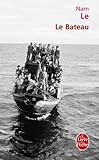
“Le Bateau” by Nam Le – Daring to fail

This is my review of Le Bateau (Litterature & Documents) by N Le.

Originality is the common theme in this collection of seven stories, varied in length, which range widely over different countries, cultures and themes, boldly shifting viewpoints by gender and age as if to “try them all out”.

The the last and most powerful story is “Le Bateau” which gives its name to the entire book Although the author Nam Le was only a baby when he made the perilous journey to Australia as one of the Vietnamese “boat people”, tales of this harrowing experience must have fed his vivid account of a young woman’s attempt to survive life on board as the ship is lashed by a storm and the stores of food and fresh water run out. She is befriended by a capricious woman, whose son, although disturbed by the effects of war, and possibly autistic, fascinates her and arouses in her a maternal love which the mother seems at times to lack.

This and the first story struck me as the most authentic and well-structured, perhaps because they are connected to the family culture and history with which Nam Le identifies, despite his absorption into life in Australia and the US. With its indigestibly long title “Love, honour, pity, pride, compassion, sacrifice, the opening story has aspects of autobiography in describing a young writer struggling to meet deadlines, ambivalent as to whether he should focus on “ethnic literature” to earn money. His dilemma is increased by the ethical question of whether he should use as a theme his father’s experience of a massacre at the hands of brutalised American GIs. Even if the older man is prepared to recall it in detail to iron out the “errors” in his son’s story, does that mean he is prepared to see it sold and read by westerners who will soon forget it? Although the ambiguous ending feels like a let-down at first, on reflection it is interesting to debate the various interpretations one can make.

Nam Le’s upbringing in Australia may have given a particular genuine and moving quality to the almost novella-length “Halfhead Bay”, in which teenage Jamie steels himself to face up to the school bully Dory after daring to make a play for his girlfriend. Should he be protected from Dory’s fists so that he can once again strike a winning goal for the school team, or for the sake of his dying mother? The subtle and complex “coming of age” drama takes place in the context of a family’s inability to face up to the reality of a crisis.

Despite the varied themes, the essential style remains the same. Each story develops gradually, so that the reader has to work out what it going on, and it is impossible to predict the outcome. Heavy use is made of flashbacks, which sometimes disrupt the narrative flow, although they could also be said to reflect the way the mind works, drifting back to past events triggered by experiences of the present, or perhaps as an escape from it. Nam Le creates some fascinating dilemmas, as when a young gangster is ordered to kill a friend to save his own life. He knows how to create page-turning tension, but the endings are often disappointing, an abrupt anti-climax. “Tehran calling” was so nebulous as to leave me completely unengaged.

Overall, Nam Le is a gifted writer, with a plain, clear style which draws one in. It is an effective vehicle for conveying subtle nuances in people’s relationships with each other, and descriptions filled with vividly striking images.

I agree with reviewers who feel that he is better at writing prose than structuring a short story. Each one is mined from a rich enough seam to fuel a full-length novel. He reminds me somewhat of Alice Munro’s short stories with their deceptively simple prose and sometimes meandering, unpredictable storyline.

I read these short stories in the French translation, which I would not recommend since the original English seems more suited to Nam Le’s style.

⭐⭐⭐⭐ 4 Stars

“Commonwealth” by Ann Patchett -Family fate

This is my review of Commonwealth by Ann Patchett.

When LA cop Fig admits uninvited guest Bert Cousins to his daughter Franny’s christening party, little does he realise that this will trigger the break-up of his marriage to the beautiful blonde Beverley. One cannot know to what extent this is autobiographical, but Ann Patchett’s personal experience of parental divorce and remarriage leading to the sudden acquisition of step-siblings and enforced living with strangers must provide plenty of material to develop this aspect of domestic drama. A further twist is Franny’s eventual marriage to a famous writer who sees the potential of her family story to create a bestselling novel, leading to further reactions of hostility, resentment or guilt over the exploitation of family members.

I was hooked by the kaleidoscopic impressions of the first chapter, as the party begins to spin out of control under the influence of Bert’s inappropriate gift of a large bottle of gin, inevitably prompting the opening of others. I could appreciate the author’s much-praised gift for using small often banal incidents to reveal much about situations and characters, seen from different points of view.

The nine chapters, some quite lengthy, may seem like linked short stories, relying heavily on flashbacks to reveal the chain of events, including a tragedy with the power to destroy the family. I regret that in the second chapter, I felt an abrupt loss of engagement. This is partly due to the grim setting of a cancer ward where Fig is to be found receiving chemotherapy, accompanied by an adult Franny. I was continuously distracted trying to work out how many decades have passed since the christening in 1964. The flitting sequence of reminiscences and thoughts felt quite contrived, a device for filling the reader in, but it is hard to keep track of all the characters mentioned – which of these have we already heard about or met in Chapter 1? It is disconcerting, for instance, to find that Albie, not yet born in Chapter 1, has become a delinquent arsonist, while Bert and Beverley have divorced before one knew for sure they had ever married. It is hard to relate to comments and anecdotes about characters before they have been clearly established in a story.

What seems like a promising theme therefore comes across as a bit of a mess in its execution. I wanted to like the novel, but too often found it boring and “spread too thinly” across an excessive number of largely underdeveloped characters. To be fair, perhaps the fact I had just read the exceptional “The Invention of Nature” made me set the bar too high, meaning I was not in the mood to make the effort to connect with this novel. I certainly admire the author’s desire to broach diverse, complex topics from different angles, having read “Bel Canto” , inspired by the hostage-taking of the President of Peru, where she explores the views of both terrorists and captives, revolving round the charismatic persona of the opera singer who is one of the prisoners. Very different again was “State of Wonder” in which a pharmaceutical researcher braves the remote Amazonian rainforest to discover what happened to her lover who had gone to work there.

In short, this is a book which divides opinion and promotes discussion.

⭐⭐⭐ 3 Stars

Becoming the people we should always have been

This is my review of The Gustav Sonata by Rose Tremain.

In the aftermath of World War 2, young Gustav Perle grows up in a quiet Swiss town, stoically trying to make sense of adult behaviour, win the love of his widowed mother Emilie, and live up to her exhortation to “master himself….be courageous, stay separate and strong…. like Switzerland”. Emilie is understandably depressed as she struggles to make ends meeting, making cheese and cleaning the Church, but is clearly ambivalent as regards her husband Erich, whose untimely death remains a mystery to Gustav. Although acknowledging Erich’s moral stance in saving Jews from the Nazis, she clearly resents the financial hardship and loss of status which this inflicted on his family, and she cannot warm to Anton, the Jewish boy who becomes Gustav’s best friend, despite the marked differences in their lifestyles and personalities. Anton is sensitive, a gifted pianist with wealthy, indulgent parents, but he proves unable to overcome his nerves sufficiently to achieve his ambition to become an internationally acclaimed soloist.

This moving and well-constructed books has three sections, like musical movements. For me the most powerful is the first part, the skilful and touching portrayal of childhood, and how we are influenced by our relationships. The second section takes us back in time to learn the truth about Emilie's and Erich's marriage, and the last leaps on half a century to the late’90s when Gustav and Anton are having to face up to the paths they have followed in life, and decide whether and how to change before it is too late.

Rose Tremain is an accomplished storyteller, capable of weaving an evocative, thought-provoking drama with a cast of complex characters out of a few strands of plot. Only occasionally in the middle chapters did the tone teeter on the brink of sentimentality, or the dialogue appear a little stilted as if translated from the German. A few plot details grated on me as unconvincing, such as the manner and timing of Erich’s death, or the two young boys’ game in the ruined sanatorium.

This is literary fiction with an eye to commercial success i.e. well-written, nuanced and thought-provoking combined with tragedy tempered by a feel-good soft centre and a few passages of raunchy sex – a page turner which is also worth reading.

⭐⭐⭐⭐ 4 Stars

No longer knowing where the real points are

This is my review of A Book of Common Prayer by Joan Didion.

Cynical and hard-boiled Grace Strasser-Mendana is the widow of the former President of the coconut palm Central American Republic of Boca Grande. Having married into one of the island’s “three or four solvent families”, she stays on to manage affairs for her seemingly weak and incompetent relatives, instead of returning to her native North America. Perhaps because she is an anthropologist by training, she becomes fascinated by the Charlotte Douglas, a “norteamericana” like herself who has come to Boca Grande as a tourist, as part of the abortive search for her daughter Marin, who has unaccountably rejected her privileged background to become an anti-capitalist terrorist. Charlotte seems neurotic, at times even crazy, by turns either aimlessly drifting through life via casual affairs or throwing herself with bursts of frenetic energy into do-gooding missions.

At first, I expected this to be a Graham Greene style political-cum-psychological drama. I may have missed something, but for me it turned out to be an endless portrayal of Charlotte’s intense and troubled relationship with two dominating husbands: needy, abusive even violent when drunk, Warren, who perhaps uses alcohol to blank out mental pain and sickness, and the suave, wise-cracking, control-freak lawyer Leonard.

I was initially entertained by the spiky dialogues at cross-purposes, which read like a bizarre mixture of Coward and Pinter, mini playscripts in the series of short chapters. However, once I “had the measure” of the mainly quite unappealing characters, their flaws exaggerated to the point of caricature, there seemed to be no further development and I began to find the novel tedious. In the sketchy plot, many questions remain unanswered, but perhaps "what happens" isn't the point.

I have read that Joan Didion took great pains to hone her work, but although distinctive and original with some passages of remarkably expressive clarity, the overall effect is so contrived, with a mantra-like (prayer book-book like?) repetition of staccato phrases, often included more for rhythmic sound than sense, that it forms a barrier preventing real engagement with the characters. “Charlotte’s breakfasts at the Caribe. Charlotte went to the Caribe for breakfast every morning for a while. She went to the Caribe for breakfast because….” Or another paragraph hypnotically repeating the words “Porter” and “Pontchartrain”.

There is the additional niggling problem with the point of view, since writing in the first person, it is quite implausible that the narrator Grace can reproduce so precisely Charlotte's thoughts, experiences and intimate conversations with others – or perhaps we are meant to think that much of the story is in Grace's imagination.

I agree with those who have found the characters too superficial and cut off from normal “real life” for one to care about them, the only emotion being irritation over their self-absorption. It seems that Joan Didion herself led a somewhat artificial life staying and partying in the houses of Hollywood celebrities, drinking heavily, all of which may have led her to create scenes to which most readers find it hard to relate. We are sucked into anticipating the gradual revelation of plot fragments for us to piece together, but the tendency to tell us what is going to befall Charlotte is the death knell to dramatic tension.

I am left uncertain as to what the author was trying to say about the world through the medium of this unprepossessing cast with their entertaining if stylised, sterile conversations. Although she may have chosen to write novels because of the scope they gave her to be inventive, her sardonic, detached style seems to lend itself more to biting journalism.

While continually sensing her talent, I became impatient with the brittle, shallow use to which it is put.

⭐⭐⭐ 3 Stars

Visually inventive, freewheeling imagination, but I could not really connect with her wavelength

This is my review of The Hearing Trumpet (Penguin Modern Classics) by Leonora Carrington.

Leonora Carrington defied her wealthy, conventional parents to become an artist, running away to Paris to join a group of Surrealist painters. Her short-lived, intense affair with German Max Ernst was destroyed when he was imprisoned on the outbreak of World War 2, escaping to the security of the States. Her nervous breakdown and appalling treatment in a Madrid asylum, from which she was rescued by the nanny who arrived in a submarine sheds light on the bizarre fantasies of her “modern classic”, “The Hearing Trumpet”. She went on to live for decades in Mexico, married to a Hungarian photographer, and far more famous in her adopted country than the Britain of her birth.

This short novel begins as a quirky satire on old age, showing the frequent lack of sympathy between generations, even the revulsion that youth may feel for old age, and the extent to which the elderly no longer care about conventions and often are far more “with it” than they appear. The ninety-two-year-old narrator Marian Leatherby discovers with the aid of a friend’s gift of a hearing trumpet that her selfish and mean-spirited family plan to put her in a home for senile old ladies. Despite its deceptive appearance, designed, “to trick the old people’s families that we led a childish and peaceful life” and the bogus religious background, Marian is mesmerised by the portrait of the “nun with a leer” which hangs over the dinner table, and entertained by the eccentric little band of residents.

Marian recalls a former admirer from her youth in England: “I remember your white flannels better than I remember you”. As for food: “I never eat meat as I think it wrong to deprive animals of life when they are so difficult to chew anyway”. “People under seventy and over seven are very unreliable if they are not cats”. All this kept me entertained until the verbal surrealism went haywire, as Marian’s world spins into a kind of post-atomic nuclear winter. The author seems to be attacking organised religion and authoritarian fascist governments, whilst harbouring a fascination for romantic legends of the Holy Grail: “the Great Mother cannot return to this planet until the Cup is restored to her filled with the Pneuma, and under the guard of her consort the Horned God”. All this is reminiscent of her paintings with their common theme of angular figures in flowing dresses, with the heads of animals, standing stiffly in artificial landscapes or slightly out of kilter rooms.

Although I admire her originality, I cannot engage with the author’s surrealism. Her sketches for the book strike me as crude and childish, although her paintings are better:in a subjective choice, I like the paintings “Green tea” or “La Dame Ovale”, “The Crow Catcher", and her large sculptures.

I am more interested by Leonora Carrington as an unusual character than in her work. I was intrigued, for instance, by an interview on YouTube between her and a young relative who had tracked her down in Mexico, still lucid and chain-smoking in extreme old age. “You are trying to intellectualise my work too much” was her recurring response, suggesting we try to analyse her more than she intended.

⭐⭐⭐ 3 Stars