“Nemesis” by Philip Roth – Unflinching

This is my review of Nemesis by Philip Roth.

In my first experience of a Roth novel, I was hooked from the first page by the flow of crystal-clear prose, so unlike the muddy rivers I have been wading through recently. Despite the unappealing theme of a polio epidemic in US Newark during World War 2, and the certainty that the tale would end in tragedy, I was compelled to read to the end.

The plot is perhaps too slight for the length of the book (280 pages) and you may feel that points are rammed home long after the reader has “got the point”. There is also the somewhat awkward device of introducing one of the young polio victims in passing as “I”, only for him to reappear in the last chapter, and listen to Bucky Cantor’s story in enough detail to be able to relate the whole tale of the promising young athlete from “the wrong side of town” who becomes a PE teacher with an overdeveloped sense of duty and “honour”. This has been stimulated by the strict upbringing received from his grandfather, and the need to expiate the failings of his father, an embezzler who abandoned his family. Bucky is haunted by the fact that his friends are dying in active service from which poor eyesight has debarred him and feels unduly responsible when the young boys in his charge begin to die with alarming speed from polio.

The strength of the story lies partly in the analysis of the factors which may form an individual personality, and the minute exploration of human emotions – the grief over the loss of a young life with great potential, the overwhelming desire to escape from a dreadful situation, with the accompanying guilt one may feel over so doing – also the corrosive effects of an inability to compromise when things go wrong. Then there are the interesting historical and cultural facets. Now that we take polio vaccine for granted, it is salutary to be reminded of what it must have been like, having to endure the fear of catching the disease every summer, not knowing where or how it would strike, or how it could be avoided. We are reminded of the gulf between the experiences of the comfortably off and the underprivileged, together with the rampant anti-Jewish prejudice in 1940s America. Also, there is the whole issue of religion: if you accept without question the existence of God, how can such a deity permit the random suffering of a polio epidemic, or the pointless slaughter of a world war?

This is a bleak novel, but in writing so unflinchingly about how chance affects our lives, for good or ill, and in reaching a conclusion which can be seen in some unexpected way as positive, I think it helps us to accept our own realities.

⭐⭐⭐⭐⭐ 5 Stars

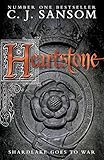
“Heartstone” (The Shardlake series) by C. J. Sansom – A lengthy meaty intrigue

This is my review of Heartstone (The Shardlake series) by C. J. Sansom.

Bearing in mind that this fifth Shardlake novel is a guaranteed bestseller whatever the quality, Sansom has taken the trouble to produce an intriguing and well-researched mystery which is an improvement, I think, on the last adventure, “Revelation”. What always impresses me most about his writing is the portrayal of the Tudor period – which tends to be romanticised in our minds – as a brutal, police state, in which many people lived in fear. Yet, in the midst of all the corruption and greed, a thread of justice prevails, enabling Shardlake to right some wrongs in the end. I also like the way in which the “goodies” are not perfect: even Shardlake offers small bribes to get information, and agrees to help cover up a murderer’s identity on compassionate grounds. Also, everything does not end completely happily at the end, and some details are left open to the reader’s imagination.

I did not mind the fairly slow pace of much of the book, although I was reminded of schools’ history programmes on the radio fifty years ago, in which an observer travelled back in time to describe past societies at work. However, Sansom’s descriptions are vivid – I was interested in the detailed account of how Henry VIII’s fleet against the French is provisioned down at Portsmouth, how ordinary people mistrust the silver coinage because it has been debased with copper, how stands of fine oaks are beginning to be ripped out to make ships’ masts and charcoal for iron foundries, how a deer hunt is organised. The details of the “Mary Rose” are fascinating, particularly since the reader knows its fate – I was struck by the accounts of the nets over the decks to hinder the enemy from boarding, but also making escape impossible if the top-heavy ship were to keel over.

The stereotyping does not bother me either – it’s quite amusing to draw parallels between Shardlake and sidekick Barak, and, say, Morse with Lewis. I can also accept Shardlake’s perpetual folly in getting himself into impossibly tight spots, but always surviving by dint of physical strength and endurance which an ageing, disabled man is unlikely to possess. The rather modern way of thinking and talking used by Shardlake and Barak does not grate too much. My only major criticism is that the denouement never lives up to expectations, when, with a man of Sansom’s writing abilities (as shown in “Winter in Madrid”), it could. Once again, I am left feeling that the critical dramatic scenes in which the details of mysteries are revealed tend to be a bit “hammy” and are not written as subtly and convincingly as they could be.

⭐⭐⭐⭐ 4 Stars

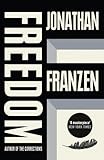
“Freedom” by Jonathan Franzen – The Bitternness of Bitterns

This is my review of Freedom by Jonathan Franzen.

At first I was engrossed by the wry humour and bordering on ludicrous but telling anecdotes which capture the lives of families in a “gentrified” US suburb, centred round one Patty and Walter Berglund. Although I did not understand all the Americanisms, the first chapter rang true for me. I thought afterwards that it would make a good satirical short story in its own right.

With the switch in the second section to Patty’s “autobiography suggested by a therapist”, my interest waned rapidly. Patty’s stilted use of the third person, often calling herself “the autobiographer”, jarred on me, together with her unlikely ability to reproduce verbatim conversations at which she was not present. I also agree with the criticism that Patty’s voice is too close to the narrator’s . In fact, all the characters tend to speak in the same witty, wizecracking way, which makes them less convincing.

The twice-used device of presenting sections of the narrative in a third person autobiography in the style of a novel which is then used as a way of communicating with other characters, does not work for me. Also, Patty’s and Walter’s extreme shifts in emotion seem exaggerated to the point of caricature, so that one does feel for them as one should.

It puzzles me that Franzen is more concerned about a few minor typing errors (I read the offending version and hardly noticed them – and wasn’t the pulping of thousands of copies a contribution to the waste of resources which he lambasts in the story?), than he is about the possible inclusion of too many self-indulgent ramblings and rants.

His theme of the paradox of freedom in the early C21 is interesting. This is set in the context of the disruptive effects of the Iraqi war, and issues of global pollution, overpopulation and global economic instability. It does not matter to me that some of the facts – names of US politicians etc – are already dated. Frantzen has a fertile imagination, giving rise to some entertaining incidents, and his dialogues are often sharp and pithy.

All this is undermined for me by the fact that he does not know when to prune, and when to stop. Conversations are often too long, and drift into cues for the author to express his views. The whole thing is bogged down in excessive detail and inclusion of “unnecessary” scenes which destroy the momentum of the tale. It is sometimes hard to distinguish major from minor characters. For instance, it took me a while to realise that Richard Katz is more central to the theme than either Eliza or Carter, and for pages he is a 2D character to whom I cannot relate.

Worst of all for me is Franzen’s tendency to pontificate, often in quite a clunky or turgid, over-earnest style, to tell me what is going to happen, what to think about someone’s behaviour or personality, or just to hold forth on some aspect of American life.

The author may have been aiming for a modern day “War and Peace” in the style of Updike-cum-Bellow but I am left thinking that if this book had been shorter, more ruthlessly pruned and edited, with a tighter structure, particularly in the first half, it would have had more of an impact – even made a brilliant novel.

Having said this, I have certainly thought a good deal about the plot, characters and evocation of American landscapes since finishing “Freedom”…..

⭐⭐⭐ 3 Stars

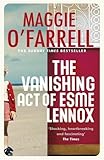
“The Vanishing Act of Esme Lennox” by Maggie O’Farrell. Unquenchable spirit against the odds

This is my review of The Vanishing Act of Esme Lennox by Maggie O’Farrell.

This intriguing, well-observed, at times intolerably sad and shocking tale is a cross-over between popular and literary fiction. The author reveals the drama with great skill, weaving back and forth in time from the different viewpoints of the three main female characters: Esme, her sister Kitty and great-niece, Iris. We piece together the chain of events, stemming from Esme’s lively curiosity and inability to conform to the stifling middle-class values of the early C20, which lead to her incarceration in a mental hospital for over sixty years. It is salutary to learn, or be reminded, that a number of women really did suffer this fate. This contrasts with the freedom taken for granted by Iris, two generations on, as she runs her own quirky business, lives independently with a dog but no partner, and has temporary affairs, always drawn back to what feels like an incestuous relationship with her married step-brother.

At first I thought that Esme had been implausibly unaffected psychologically by her ordeal, and that the mental institution was not nearly as grim as it would have been in reality. Gradually, the full horror of the regime Esme has suffered becomes apparent, all the more so because it is revealed subtly, with much implied and left to the imagination. It also becomes clear how Esme manages to hold on to her sanity by “vanishing” or retreating in her mind back to the happier moments of her life in India as a young child, or with the sister for whom she had a great affection. Part of the suspense lies in wondering what violence may be unleashed in the outwardly calm and rationale, if eccentric, Esme, when she allows herself to release some of the emotion that has been suppressed.

The plot relies on a few details which seem quite unlikely, but it is fairly easy to overlook this. Although other reviewers have criticised the ending, it seems on reflection to be perhaps the best the author could have come up with, leading as it does to debate on how and why it occurs, and what is likely to happen next.

The strength of this book lies in the fact that, although the theme is depressing in theory, and the sheer waste of Esme’s life is appalling, these aspects are offset by numerous humorous incidents together with her sheer vitality, thought-provoking comments on life and powers of endurance.

This story is likely to stay with you longer than other more pretentious and self-regarding works.

⭐⭐⭐⭐⭐ 5 Stars

“The Grass Is Singing” by Doris Lessing – Lingers in the mind and retains the power to shock

This is my review of The Grass Is Singing by Doris Lessing.

It is easy to understand why “The Grass is Singing” made such an impact in 1950, because the “no holds barred” presentation of naked racism, from which I suspect many current writers would now shy, must have served the purpose of shaming people into confronting their own prejudice, or galvanising them into trying to change the culture. The book may now seem a bit dated, with the end of apartheid in South Africa and of white colonialism in Southern Rhodesia – now Zimbabwe – where the book is set. Also, the recent revolution in feminism and sexual equality may make it less likely that a woman like Mary Turner would endure her grim life on a remote farm until it drove her mad.

However, the racism remains shocking, with the added point that it helps one to understand, although not condone, the recent “turning of tables”, with Mugabe’s extremism and the violence perpetrated on white farmers by embittered and impoverished black Zimbabweans.

From the first page, we are catapulted into the drama of the murder of Mary Turner, wife of a unsuccessful farmer, and witness the cynical closing of ranks of the local white community – Mary has somewhow broken the code of “keeping on top of the situation” by failing to control her native staff in the right way – not least the “house boy”, actually physically impressive man, Moses, who has accepted responsibility for her death. The rest of the book is a description of Mary’s life, showing the train of events leading inexorably to her murder. It provides a minutely observed analysis of her ongoing state of mind, shifts in her thinking and motivation, and her ultimate mental deterioration. The same applies to her husband Dick. The two are clearly incompatible, and destroy each other, but show redeeming features and finer qualities, so that one empathises with them both, despite Dick’s weakness and Mary’s excessive cruelty towards the workers.

Then there is the aspect which I admire most of all – Doris Lessing’s vivid evocation of the African landscape, the sights, scents, wildlife, shifting weather and seasons. This is what also struck me most in her very different and perhaps even more famous work, “The Golden Notebook”. She has the gift for bringing alive a continent one may never have seen, in all its wild beauty and oppressive heat – the bush is poised to reclaim in a few months the homestead and farm which Dick has slaved for years to cultivate.

At times, the bleak sadness of Mary’s life felt unendurable, and I was forced to put the book aside for a few hours. Towards the end, the sexual tension, perverted mutual hatred and fascination betwen Mary and Moses, is built up with great skill. I agree with reviewers who have said that the final chapter, although very powerful and imaginative, loses some of the striking clarity of the earlier prose as regards the behaviour of the two protagonists, Mary and Moses. Perhaps Doris Lessing intends to portray the confusion of Mary’s madness, but I am left a little uncertain as to what Moses’ precise motives for the murder are (plus I was half-expecting a final plot twist!). On a second reading,I saw how Moses might have been driven by misplaced jealousy rather than just the desire to dominate Mary.

On technical grounds, you could perhaps criticise Lessing for using too much of a “telling” style of narrative. Nevertheless, this Nobel-prize winning classic is worth reading, to remind one of what “good writing” – written from the heart, without any artifice but with startling insight – really is in a world where one’s mind can be blunted with the over-hyped pap of too many current bestsellers.

⭐⭐⭐⭐⭐ 5 Stars

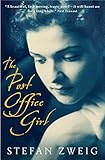
“The Post Office” Girl by Stefan Zweig – An unexpected gem

This is my review of The Post Office Girl by Stefan Zweig.

“The Post Office Girl” deserves to be more widely read. It has clearly not suffered in translation. The crystal-clear prose captures the changing moods of Christine, the young Austrian woman whose childhood and youth have been blighted by the effects of WW1. Running a village post office single-handed for a stifling bureaucracy, caring for a sick mother prematurely aged by war work, Christine’a life is transformed overnight when a rich aunt visiting from America casually invites her to stay at a luxury Swiss hotel. Christine is utterly entranced by the sudden immersion in wealth and apparent freedom. Her delight and eruption of enthusiasm and confidence attract fair-weather friends who imagine she is wealthy. When the aunt abruptly withdraws her hospitality, Christine returns to a dull routine made all the less tolerable because she has seen that the grass is greener! Then she meets a kindred spirit, Ferdinand, a young man who has been similarly embittered by ill fortune – the loss of his family fortune in hyperinflation, his years spent as a prisoner in Siberia which have left him disabled. The two then conceive a plan of action which will enable them to assert their freedom from the trap of their current lives.

Parts of this book make for gloomy “Jude the Obscure”- type reading, and Ferdinand’s self-absorbed rants did get on my nerves BUT my respect for the book was increased greatly through considering its context. Zweig was a wealthy Austrian Jew who was appalled by the destruction of European culture by the Great War and the rise of Hitler. Influenced by Freud (whom he knew personally) he was interested in the way that a chance event may trigger self awareness and a sense of being really alive. Zweig and this wife died in a suicide pact in 1942, so that it is haunting to reflect that he had his characters contemplate an extreme solution which he was prepared to carry out himself.

Although the relentless bleakness of some passages is at first repellent, Zweig has the power to enable you to view life from different perspectives, even to the extent of seeing a logic in apparent madness, and fulfilment in tragedy.

⭐⭐⭐⭐ 4 Stars

Creative Device Works – This Time

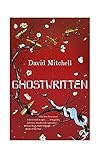
This is my review of Ghostwritten by David Mitchell.

Ghostwritten defies an accurate description of what it is really about, but seems best summarised as nine – or ten -short stories, each with a strong sense of place and well-developed main characters. Mitchell is very versatile and ultra-imaginative, so he can transport us from Japan to Hong Kong, then Mongolia, Russia, London and so on, with some ingenious plots, good sense of comedy, very humorous dialogues, yet also situations of great tension and menace, heightened because we know the author is ruthlessly prepared to destroy any character to serve the drama – although he seems to have a soft spot for his "nicer" creations.

The stories are loosely connected – in some cases these links could be missed, so that part of the fun is looking out for a familiar character or an event from a previous tale. Often, disproportionately serious outcomes arise from minor or random events.

Then there are the ghosts. I may have failed to notice them all but they take various forms: the mischievous poltergeist pestering the corrupt financial lawyer in Hong Kong, or the wise spirit in the Chinese Tea House Tree which turns out to be the transmigrating force which hops from body to body in Mongolia. Then, there is the charming London drifter perhaps on the brink of "facing up to responsibility" who is quite simply a ghostwriter for minor celebrities.

I was not always certain what purpose these ghosts served, and if you do not care for Sci-fi or magic realism, the paranormal aspect may be unappealing. The parts where I for one lose patience are where, say, the state of the migrating "non corpa" is analysed and "explained" with a kind of "ludicrous logic". Likewise, the AI taking control of the world's computerised defence systems is "over the top". Yet, I agree with those impressed by Mitchell's prescience. I had to check that the publication date preceded 9/11, the weapons of mass destruction and invasion of Iraq. I suppose that Reagan's "Star Wars" may have triggered the writer's imagination.

As a set of short stories, "Ghostwritten" is brilliant – well-written, creative and diverse in style and coverage.

As a novel, the whole seems less than the sum of the parts. I think this is because some of the links between stories are so tenuous. Also, although the stories are page turners (different styles will appeal to different readers), they oblige you to work hard mentally, getting to grips with a set of people and situations, only to end inconclusively (not necessarily a criticism) and force you to start afresh. This is not conducive to the kind of coherence, progression or "structure" a novel requires.

Also, although technically very clever and clearly sincere in, say, questioning our current values and misuse of resources, and the evil of one regime imposing ideas on others, I do not feel that Mitchell has the kind of clear, insightful message that a "great" novel might convey. Individual characters are often too busy wisecracking and being too clever by half to be genuinely moving.

This book is definitely worth reading, and may merit greater prizes than it has won, for its originality and skilful writing.

⭐⭐⭐⭐ 4 Stars

C

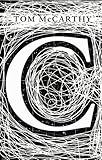
This is my review of C by Tom McCarthy.

Since the reviews so far have been small in number but very glowing, I feel the need to offer a different viewpoint. I have not included a plot outline, as others have done this already.

I found the lengthy descriptions of small scale events very tedious. Early examples of this are:

– where the doctor walks round the house to his host's workshop, finds it locked, so has to go back all the way round the building. Why did the author not just include a plan?

– the account of the pageant performed by the deaf children to their parents, together with the frequent focus on their repetitive language practice and the dreary poems they have to learn.

– references to long-superseded electrical and optical equipment without any brief notes of explanation: this means either reading stuff one does not understand, or having the flow of reading disrupted by the urge to go and research.

A few errors made me doubt the accuracy of the rest e.g. the description of chrysanthemums, tulips and irises growing together in an open bed. Then there was a paragraph about stamens, stigma and pistils that didn't seem quite right. This matters because reading detail that is inaccurate and serves no other purpose is a waste of time.

The emotional coldness of the book repelled me utterly. I think some of it is meant to be humorous, as when Carrefax senior considers attaching a tapping device to a coffin in case the deceased ( a very close relative) should come back to life. However, the upshot of the fact that the main characters observe the world so clinically, without a drop of empathy, is that one cannot engage with them or care about their fate.

I did not mind the lack of plot, or the disjointed structure. Some images are striking, as when the infant Carrefax observes the beauty of the wing he has plucked from an unfortunate fly, and peers at the Hatching Room through it. The reviewer who feels the book needs to be read slowly, and improves on a reread, may have a point – but life is short, and there are many books which make a positive impact from the outset!

I sense that other readers would like to make this into a kind of "cult book" – if so, I don't want to join.

⭐⭐ 2 Stars

So much motion in it the whole country seemed to be running

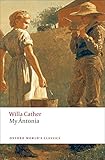
This is my review of My Antonia (Oxford World’s Classics) by Willa Cather.

My Antonia – pronounced "Anton-ee-a" is a "Little House on the Prairie for adults" classic that I would not have thought to read unless required to do so for a book group. Published in 1918, this "early modern" novel forms a bridge between the old and the new. It has all the flowing style and precision of a C19 work – reminded me of Thomas Hardy – yet is pared of any unnecessary verbiage to give a vivid impression of the striking landscape of Nebraska in the late C19 when it was developed largely by immigrants from Germany and Scandinavia.

We see the vast expanses of red prairie grass, "running" in the wind and the sunflowers following the bends of the country roads, perhaps where the Mormons scattered seeds as they travelled west to Salt Lake City. Based on her own childhood memories, Willa Cather has the successful lawyer Jim Burden recall his childhood, dominated by his friendship with the vivacious Antonia, daughter of a family of penniless Czech immigrants, forced by hardship and duty to give up any thought of education which would enable her to escape from a life of toil on the land. I feared the tale would be admirable but dull. In fact, it is brought to life by the varied cast of believable characters and the string of surprisingly entertaining anecdotes – the killing of a rattlesnake, dubious escapes from wild wolves, and so on.

The storyline is fragmented in structure and lacks a strong plot – yet it seems the author was deliberately experimenting with the structure. The long first "book" focused on prairie life is probably the best. The middle sections ramble through Jim's adolescence and college education. For a while we lose sight of Antonia altogether, but in the final part, the middle-aged Jim meets up with her – now a mature "matriarch" with a brood of children, still living on the land to which she has become too attached ever to think of leaving. The book questions the nature of success: despite his fine career, Jim is childless, and the people he met in his rural childhood have more "reality" for him than what he learns in his academic studies. A major point of the book seems to be that "the best days" of his life prove to be the earliest ones that he cannot recapture.

When describing his eleven-year-old self, Jim appears to be an unusually perceptive child, often slipping more into the voice of an educated mature woman – the author herself?! Although based on a real person, you may feel that Antonia is somewhat idealised as in part a creation of Jim's nostalgia. I sensed a touch of unconscious racism in the description of the blind negro pianist. You could say the ending is a little romanticised, although there is the subtle indication that Antonia's husband is a malleable man who fathers her children and allows her to live out her rural dream.

Although it is slow-paced, and the plot is fairly slight, I would definitely recommend this novel. If your version has an introduction, save it until afterwards, so as not to prejudice your reading of this evocative tale.

⭐⭐⭐⭐ 4 Stars

Union Atlantic

This is my review of Union Atlantic by Adam Haslett.

An American damaged by childhood and Gulf War traumas becomes a corrupt investment banker on the brink of what we know to be a major financial collapse. He comes into conflict with a well-connected but eccentric, slightly demented neighbour who sees the building of his grandiose mansion on a once rural riverbank as a symbol of all that is rotten in the state of America. This sounds like the recipe for a good read.

Drawn to this novel by a glowing newspaper review and interesting dust jacket blurb, I was soon disappointed. The warning signs come as early as the prologue, in which the author uses flashbacks and digressions to skirt round a US naval incident in the Gulf, rather than transporting readers into the heart of the drama. I did not mind the slow pace of the plot, but there are too many overlong minor scenes, such as Nate's druggy dealings with his mates, and the issue of his "being gay".

The dialogues tended to grate on me because they are unnatural. Although I realise that Charlotte Graves is meant to be an eccentric elderly lady, the monologues inflicted on her student Nate, and the diatribes of her two talking dogs (especially the bigoted preacher Wilkie – yes, I know it sounds odd) are tedious and very hard to follow, adding nothing I could see to an appreciation of what is rotten with current US society, which I took to be the point of the book.

The book is only occasionally moving – much less than it should be, as when we learn that Nate is haunted by the fact that he might have averted his father's suicide if he had looked for him further. And why not use the space to give us more insight into the main character, the financier Doug Fanning?

Haslett slips frequently into passages of reflective, philsophical creative writing which left me cold because they seem too "studied". He mentions Joyce at one point, so I wonder if he was attempting "stream of consciousness" at the points when the sentences become very long, rambling wildly from one point another. After one example too many of this on page 120 of the hardback, I decided the book was not worth reading.

BUT then it improves – for a while. From Part 2, the plot speeds up and there are some humorous and well-written scenes, in particular the court hearing of Charlotte's dispute over Doug's mansion, with a neat twist at the end, and also the observation of Henry's relationship with his sister Charlotte, his irritation yet affection, as she feeds him baked beans and gives the dogs prime steak because one of them "demands" it.

However, the dramatic potential of Doug's inevitable fall as a cheating financial dealer is missed. The book sputters on like a damp squib at the end with a few blandly descriptive chapters which shed little further light. Just the odd passage, like the evocation of "that nowhere place" the Arabian desert, on page 285 reveals a talent for writing which is in general absent.

I am left feeling that this story has the ingredients to be good, but needed much more attention to "narrative drive" and to clarity of important ideas and insights for it to be successful.

⭐⭐ 2 Stars