“Ending as often in disappointment as in success”

This is my review of A Visit From the Goon Squad by Jennifer Egan.

This is likely to divide opinion sharply since it rejects the convention of a clear plot, and flits back and forth in time with a variety of viewpoints and sheer number of characters which may prove confusing.

It is a series of short stories rather than a novel, focusing in turn on different members of an amorphous group who have in common only some kind of link to the music industry – they know, or know someone who knows, either Bennie the driven music manager, or Sasha, his light-fingered assistant whose kleptomania may have some deeper emotional cause.

I enjoyed the quirky incidents and offbeat humour of the first seven chapters, and the game of anticipating which character mentioned in passing would turn up as a key player in the next episode. I liked the way the author always managed to overcome my irritation at being dragged away from one group of characters, by skilfully hooking me in to the next one, only to be disappointed again at having to leave the new story with strands left unresolved, perhaps forever.

Some of the relationships are genuinely moving, such as the hard-bitten, selfish, corrupt Lou's love for his sweet, gentle son, whom he cannot help inadvertently damaging, just through being the bastard that he is. I was impressed by the study of Scotty, mentally ill but managing after a fashion, who convinces himself half the time that being a failure is as good as being a success.

My good opinion suffered a blow in Chapter 8, an over-farcical account of a disgraced PR manager trying to make ends meet by advising a genocidal dictator of some unnamed country, which was an annoyingly unconvincing mixture of Arab desert too close to lush African jungle. The there are two sections I grew too bored to read properly: an intentionally bad , I think, parody of a journalist's interview with a movie star, followed by an attempt to relate to an autistic boy, and to show his thought processes, through a PowerPoint presentation – a novel idea, but it goes on for 74 pages – has the author not heard of death by OHP? After that, the return of the final chapters to some of the original characters lacks the power to engage me, in a work which seems to have lost its way – perhaps because the subjects are essentially rather uninteresting and underdeveloped players in an artificial and shallow world.

On one hand, this book is unusual, often creative and original, with what you might call brave experiments (but shouldn't the author be clear-eyed enough to see where they may have fallen short?), yet there is too much that is contrived, gimmicky or glib for me to rate this as an indisputably worthy Pulitzer winner.

⭐⭐⭐ 3 Stars

“Some events take a lifetime to reveal their damage and influence”

This is my review of The Cat’s Table by Michael Ondaatje.

The cat's table is "the least privileged place" in the dining room aboard an ocean liner bound for Tilbury from Ceylon in 1954. The narrator, Michael , recalls how, as an eleven-year-old, this is where he meets not just two other unaccompanied boys, but a group of eccentric adults. In the accurate belief that they are invisible, at least until their mischief brings them to the captain's notice, these three racket around, experiencing the complex life of a ship, straying below deck and into first class, eavesdropping as they lie hidden in the lifeboats where they gorge the emergency chocolate rations, getting involved in bizarre events, hearing quirky, often unsuitable anecdotes, all of this related in short chapters which add to the fragmented, dreamlike quality of the voyage.

The "main plot" of the story, which revolves round a mysterious shackled prisoner who is brought out for exercise at night, proves rather thin and implausible with an unsatisfying ending, yet does not appear to be the author's main concern.

The novel seems to be mostly about the nature of memory and the way people relate to one another, so that fleeting impressions, brief incidents and passing friendships from early life may prove unexpectedly enduring and significant in adulthood.

I found the description of the voyage and numerous rambling into vignettes very evocative and absorbing. Less satisfactory are the frequent "flash forwards" to Michael's later life. His adult relationships with his cousin Emily and with his friend's sister Massi do not prove as convincing and moving as I think they are intended to be.

It is interesting to speculate to what extent the events of the voyage make Michael permanently mistrustful , someone who breaks too "easily away from intimacy", although having rather distant parents and uncaring relatives who think it in order to send him unaccompanied on a long voyage is probably the main reason.

Overall, this is an unusual novel which lingers in one's mind. It is brilliant in ways that will differ according to the reader's own cast of thought. An example of this for me is the description of the night-time sailing through the Suez canal, which years later Michael's friend Cassius captures in paintings which only Michael can appreciate have been drawn "from the exact angle of vision Cassius and I had that night". I like the humour in Michael's list of the irascible captain's "crimes committed (so far)" most of which are actually the children's fault. However, the tale is also flawed when some allusion or plot development misses the mark or falls flat.

⭐⭐⭐⭐ 4 Stars

Dated Wit

This is my review of Saki, The Complete Short Stories (Penguin Modern Classics) by Saki.

It is easy to understand why H.H.Munro, pen name Saki, is still regarded as one of the greatest writers of short stories. His elegant, ironic prose reminds me of P.G. Wodehouse with a sharp sting in the tale.

Although Saki mocked the snobbery and hypocrisy of upper class Edwardian England, he himself seems to have been limited by unexamined prejudice against the lower classes, women in general, and new social movements of his day like female suffrage and socialism.

Organised by date of collection, the tales show a clear progression. The early "Reginald" stories are remarkably short, often barely a page, very dated and a bit too precious in style for my taste. As the years pass, the stories gain in length and depth, culminating in works like "The Square Egg". This captures the muddiness of trench life in World War 1 – the streaming mud walls, the inches of soup-like mud at the entrance to the dug-out, the muddy biscuits eaten with mud-caked fingers. This story also shows Saki's talent for going off at an imaginative tangent, in this case based on a wily Frenchman's novel idea for using the idea of "square eggs" from specially bred hens to try to get some money out of the narrator.

I particularly enjoyed the stories which focus on real emotions and psychology which could be relevant to any age and society: "Peace Toys" in which an uncle tries to give his nephews toys which will discourage them from violent play; "Tobermory" which speculates on the practical disadvantages of having a cat which has learned to speak about all the compromising goings-on it has witnessed as it creeps around unnoticed; "The Lumber Room" in which a small boy takes advantage of a rare chance to have his revenge on a pious, bullying aunt – the many stories about children getting their own back on control-freak adults may stem from painful experiences in Saki's own motherless childhood. Then there is "The Story-teller" where a bachelor distracted by noisy children on a train ride subverts the normal rules about telling children only improving stories.

I have mixed feelings about Clovis, a favourite recurring character of Saki's, who acts as a mocking observer of the class to which he has been born, while sponging off it, and snobbishly maintaining many of its prejudices. Yet "Clovis on Parental Responsibilities" is amusing where, in a Pinterish talking at cross purposes with a Mrs Eggelby, bored by her endless prattle about her children's accomplishments, Clovis undermines all the accepted views on bringing up children.

I would have liked a brief introduction on Saki's life. It seems important to know that, enrolling as an ordinary private soldier when in his forties, he was killed by a sniper's bullet after vainly asking a colleague to put out the cigarette which was emitting a tell-tale trail of smoke.

⭐⭐⭐⭐ 4 Stars

Dark Wit for Dipping Into

This is my review of The Complete Short Stories of Saki (H. H. Munro) by Saki,H. H. Munro.

It is easy to understand why H.H.Munro, pen name Saki, is still regarded as one of the greatest writers of short stories. His elegant, ironic prose reminds me of P.G. Wodehouse with a sharp sting in the tale.

Although Saki mocked the snobbery and hypocrisy of upper class Edwardian England, he himself seems to have been limited by unexamined prejudice against the lower classes, women in general, and new social movements of his day like female suffrage and socialism.

Organised by date of collection, the tales show a clear progression. The early "Reginald" stories are remarkably short, often barely a page, very dated and a bit too precious in style for my taste. As the years pass, the stories gain in length and depth, culminating in works like "The Square Egg". This captures the muddiness of trench life in World War 1 – the streaming mud walls, the inches of soup-like mud at the entrance to the dug-out, the muddy biscuits eaten with mud-caked fingers. This story also shows Saki's talent for going off at an imaginative tangent, in this case based on a wily Frenchman's novel idea for using the idea of "square eggs" from specially bred hens to try to get some money out of the narrator.

I particularly enjoyed the stories which focus on real emotions and psychology which could be relevant to any age and society: "Peace Toys" in which an uncle tries to give his nephews toys which will discourage them from violent play; "Tobermory" which speculates on the practical disadvantages of having a cat which has learned to speak about all the compromising goings-on it has witnessed as it creeps around unnoticed; "The Lumber Room" in which a small boy takes advantage of a rare chance to have his revenge on a pious, bullying aunt – the many stories about children getting their own back on control-freak adults may stem from painful experiences in Saki's own motherless childhood. Then there is "The Story-teller" where a bachelor distracted by noisy children on a train ride subverts the normal rules about telling children only improving stories.

I have mixed feelings about Clovis, a favourite recurring character of Saki's, who acts as a mocking observer of the class to which he has been born, while sponging off it, and snobbishly maintaining many of its prejudices. Yet "Clovis on Parental Responsibilities" is amusing where, in a Pinterish talking at cross purposes with a Mrs Eggelby, bored by her endless prattle about her children's accomplishments, Clovis undermines all the accepted views on bringing up children.

I would have liked a brief introduction on Saki's life. It seems important to know that, enrolling as an ordinary private soldier when in his forties, he was killed by a sniper's bullet after vainly asking a colleague to put out the cigarette which was emitting a tell-tale trail of smoke.

⭐⭐⭐⭐ 4 Stars

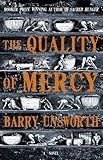
“The Quality of Mercy” by Barry Unsworth – Quality not strained

This is my review of The Quality of Mercy by Barry Unsworth.

Although it can stand alone, this excellent historical novel is a sequel to the Booker Prize Winner, “Sacred Hunger” which it is advisable to read first.

Set mainly in the London of 1767 and a Durham coastal mining village, there are four main plot strands which gradually interweave. The intense and somewhat humourless banker Erasmus Kemp is bent on bringing to trial in London the mutineers who made off with his father’s ship, thus reducing him to financial ruin and suicide. Frederick Ashton, a wealthy man who finds the cause of anti-slavery gives meaning to his life, is equally determined to get the sailors acquitted on the grounds that they were driven to violence by revulsion over the practice of throwing sick slaves overboard to maximise insurance claims. Sullivan, an Irish fiddler press-ganged onto the ill-fated ship has managed to escape from gaol before the trial, and resolves to travel north to Durham to fulfil a pledge to explain to the family of a dead friend how he came to die after the mutiny. This family are the Bordens, headed by James who can barely repress his frustration over being forced to work underground, scarcely seeing the sunlight, and who dreams of buying a sheltered plot in the dene, a beautiful wooded ravine near the village. These main characters together with Frederick’s spirited sister Jane, and James’s son Michael are all developed very fully: Unsworth’s striking observations on human nature are what make the book exceptional.

This well-paced and skilfully plotted novel with close attention to period detail provides a vivid insight into life during the early stages of the Industrial Revolution, when coalmines tended to have long galleries rather than deep shafts. Men swung down the shaft on ropes, with children on the their knees. Boys as young as seven worked for hours opening trapdoors to ventilate the mines, progressing to pulling heavy wooden containers loaded with coal. Partly through some lively discussions and absorbing court scenes, the importance of another form of exploitation, black slavery linked to the sugar trade, in the growth of prosperity of England at the time is also made very clear. Then there is the acceptance of the class structure in which rich and poor were breeds apart, although there were signs of change as the merchant class began to narrow the gap with the aristocrats, who took their wealth too much for granted, and a few workers could advance through ability and good fortune. It is hard to avoid uncomfortable parallels between the casual acceptance of injustice then and now, when we assume that we are more democratic and enlightened.

The story is also realistic in being a blend of good and harsh fortune. This is demonstrated most clearly in the alternating luck of Sullivan, who comes by money one minute (perhaps dishonestly) only to be robbed the next, or is locked up in the workhouse but then transported free to the next county which is his final destination. Overall, often through chance or fate, some characters come to a sad end while others flourish. Unsworth does not deal in sentimental happy endings for all those for whom he has aroused your sympathy, but neither is he ever bleak or depressing, just moving and thought-provoking.

As a writer in his eighties, Unsworth’s wisdom shines through – the results of a lifetime of reflection. The no doubt deliberately slightly oldfashioned, flowing and literary style, fits well with the period covered, although the dialect of the Durham miners also rings true, perhaps because Unsworth was born there.

To leave the last word to the illiterate Sullivan,

“It is the power of imaginin’ that makes a man stand out, an’ it is rarer than you might think, it is similar to the power of music.”

⭐⭐⭐⭐⭐ 5 Stars

And then they came for me and there was no one left to speak out

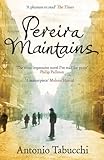
This is my review of Pereira Maintains by Antonio Tabucchi.

This novel demonstrates why my previous policy of avoiding novels translated into English is a mistake. In the same way, to assume that such a short, very readable novel must be lightweight is another error.

Impeccably translated from Italian, this subtly humorous story with a growing underlying sense of menace captures Lisbon in the summer heat of 1938, as Portugal slides into fascist dictatorship on the coattails of its aggressive neighbour, Spain, under the influence of Franco.

Punctuated with the refrain, "Pereira maintains", this is the testimony of a journalist employed in a sinecure to produce the new weekly cultural page for a small newspaper, "The Lisboa". Sunk into a dull routine, overweight and unhealthy, Pereira's life revolves around eating "omelettes aux fines herbes", drinking sugary lemonade at the Cafe Orchidea, and communing with a photograph of his dead wife.

Since he is a humane man with principles, he is gradually forced out of his ostrichlike state by the examples of repression which become increasingly hard to ignore. A carter is murdered by the police for being a socialist, but staff on "The Lisboa" are too scared to report the story in the boss's absence: information on the real state of affairs has to be gleaned from listening to the BBC or obtaining a foreign newspaper. An attractive woman whom Pereira meets on a train confides that she is planning emigration to the US, because she is Jewish. The office telephone system is altered without warning so that all calls come through the nosy female caretaker, clearly a police spy. Yet the main trigger for what a sympathetic doctor calls the "rise of a new ruling ego" in Pereira is the youthful political idealism of a young couple he meets by chance and drifts into helping, with fateful consequences.

Tightly plotted, despite its misleadingly gentle rhythm, the book builds up to a dramatic and effective climax. Perhaps the "last straw" that drives Pereira to take a stand is the extension of censorship and bigotry even to his little page, where he finds himself no longer free to publish his translations of foreign authors, after a piece by Alphonse Daudet is seen by the philistines in power as anti the Germans who are propping up the corrupt Portuguese regime.

This is one of the few novels I would like to retain and reread again, to enjoy all the allusions and observations which you may miss on a first reading in the pressing need to know what happens.

⭐⭐⭐⭐⭐ 5 Stars

A Soft-centred Heart of Darkness

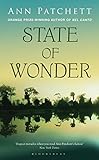
This is my review of State of Wonder by Ann Patchett.

The reputation of the award-winning "Bel Canto" inspired me to read this novel.

The theme is promising. Marina, a doctor turned researcher for Vogel, a US pharmaceuticals manufacturer, is sent to Brazil to persuade the eccentric Dr. Svenson to submit details of her progress on what could be an important new fertility drug, based on studies with the remote Lakashi tribe where women seem capable of childbirth well into old age. Marina has also promised to find out more about the death of Anders, the colleague who was sent on the same mission but died of a fever in the jungle.

It is soon clear that this is by design a slow-paced book focused on detailed descriptions of people's feeling and interactions, such as the painful business of telling Karen Anders that her husband has died and been buried somewhere in the depths of the Brazilian rainforest, leaving her with three young children. There is also a strong evocation of place, such as the unbearable heat of Manaus, and the vast, anonymous scale of the rainforest, teeming with unfamiliar and often hostile life, so that Marina realises she has crossed the line away from civilisation not on leaving Manaus, but when penetrating the solid line of undifferentiated trees close-packed along the banks of a remote tributary.

There are a few good scenes, as when Marina, mistaken for a native because of her half-Indian parentage, consents to dance with the locals because it is "somehow less humiliating, less disrespectful" to do this than simply to stand with the other tourists watching them.

However, by Chapter 6 I began to consider giving up, and only motivated myself to read on by analysing the deficiencies in the style: the plywood cast of minor characters, the often stilted dialogue, the wordy descriptions which at times seem either banal or do not quite ring true.

Two-thirds in, the plot picks up with a startling revelation which I failed to anticipate, and then builds up to a satisfying climax which redeems the book, despite a few flaws. In the process, it raises, although does not explore in any depth, some interesting social and ethical issues. Are the researchers exploiting the natives, or rediscovering from them a better way of living, close to nature, accepting fate in the form of the attendant risks from poisonous snakes or lack of access to medicines?

Overall verdict: interesting plot, limited, soft-centred style, inadequate to the task.

⭐⭐⭐ 3 Stars

And Sometimes They Were Very Sad

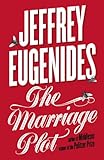
This is my review of The Marriage Plot by Jeffrey Eugenides.

Not having reading anything by Eugenides before, I was curious to discover what has made him a Pullitzer prize-winner.

This is the story of the triangular relationship between three young Americans who meet at university in the early 1980s: Madeleine, a diligent student of English literature, but lacking in a sense of direction, falls for the brilliant, charismatic but manic depressive biologist, Leonard. Meanwhile, after a brief friendship which comes to nothing, Mitchell loves her from afar, and seeks escapism in religious theory, and a circuitous journey to India to work as a volunteer for Mother Theresa.

The novel is a modern take on the "marriage plot", seen by one of Madeleine's English professors as the dominant theme of novels up to 1900, based on the idea that women could only achieve success through marrying men, ideally with money, after which they "lived happily ever after" or endured their fate, since there was no easy escape route via divorce.

The author's technical talent is displayed through some vivid and imaginative descriptions, and his sharp ear for dialogue. The recreation of the events and attitudes of the 1980s rings true, and brings back memories for those who lived through them. Many scenes are funny or poignant. In particular, the analysis of Leonard's manic depression in its various phases strikes close to the bone and often makes for unbearably painful reading.

Ironically, it is the at times almost manic nature of the writing which weakens the structure of the novel, so that the whole may seem less than the sum of the parts. Eugenides spirals off at a tangent where his imagination leads him. For instance, in the early chapters he launches into structuralism and specific works like Barthes' "A Lover's Discourse" without considering or caring how many readers will be able or willing to follow him. In fact, I only needed to "google" for a few minutes to fill the essential gaps in my knowledge, or to check later that the custom-printed wallpaper on Madeleine's bedroom wall was based on a real set of stories about "Madeline" by Ludwig Bemelman. When it came to the genetics of yeast I just let Leonard's explanations wash over me. However, although I have learned more about literature from this book, and extended my vocabulary ("chancre", "pentiment", etc), I feel that the lengthy digressions have been at the expense of the narrative drive.

There is also the author's tendency to meander back and forth in time, which means that many important events are reported, rather than enacted, which would have made them more dramatic.

I was left feeling that I had read a series of on occasion brilliant short stories or thumbnail sketches, held together by a loose plot which at times seems to be about the pain, loss and waste caused by manic depression, although I am sure that is not meant to be the main point. If Eugenides had focused more tightly on the three main characters and developed their interactions more fully, I think I would have cared more about their dilemmas, particularly Madeleine's and Mitchell's.

⭐⭐⭐⭐ 4 Stars

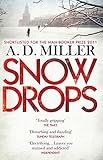
A Snowstorm in a Paperweight

This is my review of Snowdrops by A. D. Miller.

I can understand why "Snowdrops" reached the Booker Shortlist, but also why some people think is should not have done so.

On the plus side, Miller puts his firsthand knowledge of Russia to good use by recreating the tasteless materialism and perpetual undercurrent of violence and sleaze in the raw capitalism following the collapse of Communism. He describes well how individuals are inexorably contaminated by exposure to corruption, even if they think themselves to be morally superior, or immune.

In what turns out to be a psychological drama rather than a crime thiller, the narrator Nicholas, a thirty something commercial lawyer posted from London to Moscow, builds up tension as he is gets ever more entangled with the beautiful Masha and her younger "sister" Katya. Even though he suspects they are not what they seem, he suppresses any doubts and passively goes along with them in providing legal support for what is on the surface a simple property exchange without questioning their actions.

I like the introduction to a new vocabulary: "minigarch" for a rich Russian who isn't quite in the oligarch league, "krysha" for the shady character who provides protection and "fixes" things, or "elitny" to describe a smart restaurant or club. Miller is also good on all the different kinds of snow – from the light, damp October snow called "mokri sneg", through the deep heavy snow falling overnight "like a practical joke", the mounds of snow which make walking an obstacle, and finally the end-of-May snow… by which God lets the Russians know he hasn't finished with them yet". He brings home how the weather dominates Russians' lives through the course of the almost unbearably long and cold winters and the all too short hot summers.

There are some striking descriptions of places e.g. of the Moscow river, "the ice on the river was buckling and cracking, great plates of it rubbing and jostling each other, as the water shrugged it off, a vast snake sloughing of its skin."

Likewise, the sharp descriptions of people e.g. of a man who has allowed himself to become corrupted, " He was a short, pale man with thick hair, thick Soviet glasses and worried eyes. I suppose if you wanted to you could say he looked like a sort of compressed and stunted version of me."

On the down side, I wondered whether it was advisable to tell the reader quite so often that certain characters are liars or cheats, or to imply what is about to happen. It might have been more powerful to have left the reader to deduce all this, and only have Nicholas acknowledge his own culpability at the end. As it is, the climax of the book proves underwhelming, like a balloon that fails to burst with a startling bang because so much air has leaked out of it already.

Overall, this is an impressive "first novel". Much of the writing is good, as is the basic plot idea. However it is a quick, absorbing, mildly thought-provoking and moving read rather than the shattering emotional experience it could have been.

⭐⭐⭐⭐ 4 Stars

“The Brooklyn Follies” by Paul Auster – “Never underestimate the power of books”

This is my review of The Brooklyn Follies by Paul Auster.

“The Brooklyn Follies” reminds me what a skilful wordsmith Paul Auster is: he can capture startling insights, create intriguing characters and describe a beautiful spring day with memorable originality.

Page after page is a pleasure to read until some unconvincing note trips the reader up.

This is the gently rambling tale of the sixty-year old Nathan, at a loose end after surviving a cancer scare, who decides to pass the time compiling “The Book of Human Folly”, a collection of every “blunder, ……. embarrassment , every idiocy, every foible and inane act” of his own and others’ lives. This is an opportunity for Auster both to exercise his fertile imagination, and to regale us with the lists of facts that he likes to record.

I enjoyed the first part of the book in which Nathan, revelling in his rediscovery of the diverse street life of Brooklyn, renews contact with Tom, the brilliant young nephew who has lost his way in life, and gets to know his flamboyant bookshop employer Harry who is not all that he seems, and who in due course reveals a risky plot to make himself rich. I liked their “deep”, but humorous philosophical discussions, in one chapter written like a play.

With the arrival of Nathan’s great-niece Lucy, pretending to be mute, I felt the plot begin to get ragged. Some opportunities for drama are missed, plotlines are resolved too quickly, or become frankly implausible, and I agree with reviewers who think Auster goes in for far too much “telling” rather than “showing”. It’s also just occurred to me that he may not be very good at portraying convincing female characters. I have come to the conclusion that he is not very interested in structuring a plot, creating suspense or working towards a grand denouement – he just loves playing with words and using them to create interesting situations or explore ideas as the fancy takes him, so that the parts are greater than the whole.

I appreciated his swipes at Bush Junior and manipulative American preachers. I was not so keen on the frequent lapses into a corny, wisecracking tone, perhaps meant to convey Nathan’s New York background.

This seems an intentionally lighthearted book, a kind of homage to Brooklyn, in which the follies of the characters rival the contents of Nathan’s unfinished book, but Auster can never totally dispense with the dark undercurrents of reflection on the meaning of life.

⭐⭐⭐ 3 Stars