In the land of the free

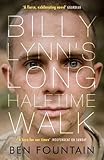
This is my review of Billy Lynn’s Long Halftime Walk by Ben Fountain.

After a heroic attack on the enemy which just happened to be filmed by an embedded TV crew, "Bravo squad" is touted round the States for a disorienting fortnight in an insensitive PR bid to revive flagging support for the Iraq War.

Billy Flynn is one of the soldiers, a decent and perceptive young man beneath a fairly thick layer of nineteen-year-old laddishness. As he tries to make sense of his unreal situation, we see the Bravos pawed like public property, fawned over by celebrities, glamorous couples and business tycoons who would not normally give them the time of day.

Inevitably, conversations tend to descend to the prurient question of what it is like to kill a man. Billy always manages to fob people off with the gung-ho answers they want to hear, but is left feeling that he has betrayed his comrade Shroom who died in the "heroic" attack. Beneath it all lurks the knowledge that Billy must return to the front, where there is a high probability he will meet his own death.

Although this may sound grim, the novel is often very funny – a blistering attack on the worst aspects of American culture: the tasteless mixture of God and mammon, rednecked patriotism, unquestioning sense of superiority fed by crass ignorance of the rest of the world. Since it will probably only appeal to the anti-war converted I cannot imagine what those parodied in the book would make of it.

I had to concentrate hard to grasp Ben Fountain's quicksilver train of ideas and cope with the American slang. I understand the criticism that Billy's inner thoughts are too often tangled up with the knowing, cynical voice of the articulate third person narrator, but you could argue this is the influence of Billy's deceased intellectual friend Shroom.

The unshackled style veers between moments of original beauty and moving insight, hyperbole, occasional corniness and cartoon-speak. I like the way Fountain uses the sounds of words rather than their correct spelling to convey how Billy often feels overwhelmed by his unfamiliar surroundings and lets everything "wash" over him: Eye-rack, Eaaaar-rock, nina leven, soooh-preeeeme sacrifice, etcetera. This also highlights the emptiness, lack of meaning of the sentiments poured over the Bravos.

I am not sure at what point Fountain's original and creative prose tips over into gimmickry,

but

the

whiiiiirrrrrrr

BAM

of it all is sometimes a bit too much to take.

The scene where Billy returns home for Thanksgiving lost some of the momentum of what perhaps should have been a shorter novella for maximum effect, and reduced the tale to soap opera for a while.

Overall, it's an imaginative, somewhat shaming take on modern America.

⭐⭐⭐⭐ 4 Stars

The wrongdoing of others

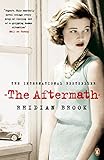
This is my review of The Aftermath by Rhidian Brook.

Promoted to Colonel's rank for an act of courage, Lewis Morgan is posted to the British Zone in Hamburg, devastated by the force of Allied bombing, to supervise the "denazification" and restoration of civilian life in the aftermath of World War 2. It seems clear that his dislike of bureaucracy and evident sympathy for ordinary Germans will land him in hot water. Sadly, his empathy does not extend to his wife Rachael: prolonged separation and a family tragedy have driven a wedge between the two. Tensions are compounded by Lewis's unconventional, perhaps naïve decision (inspired by a similar real event in the author's family history) to share the impressive dwelling in which his family has been billeted with its defeated German owners, the cultured, spontaneous architect Lubert and his stroppy teenage daughter Frieda.

From the outset, I felt in the hands of a writer confident in his skilful plot and complex, well-drawn characters. He makes it all look deceptively easy, and slips in evidence of detailed period research quite subtly. Although you can guess some of the main plot developments, the denouement is always in doubt so that the tension builds strongly to an unpredictable ending.

Some reviewers have found the character development weak, and I admit to never quite believing in the unpleasant Major Burnham whose eyes both men and women seemed to find "pretty", whilst the half-crazed dissident Berti did not quite work for me either. Some of the minor characters, like the officers' wives, seem like caricatures, although may sadly be an accurate portrayal of the prejudice and snobbery rife at the time in their society. Despite this, the main players come across quite strongly. I particularly liked the character of Lewis's son Edmund, an appealing mixture of innocence and guile, as he earnestly attempts to read the codes of the adult world, frequently "getting it wrong". Rachael's shifting emotions in the course of the tale also appear both convincing and moving.

Others have spotted the odd anachronism, or grating, even misued word, and I was a little disappointed to learn that the book was written with a film in mind, so that some descriptions are guidelines for props departments rather than how a character might have perceived a situation. Yet all these are minor quibbles over a page turner which brings alive a neglected aspect of World War 2.

⭐⭐⭐⭐⭐ 5 Stars

Shaped by other forces

This is my review of The Siege Of Krishnapur by J. G. Farrell.

At first, this 1973 Booker winner seems too much of a conventionally structured "good yarn", a kind of Somerset Maugham with humour, to gain the prize today, but as the plot darkens and becomes more bizarre, I revised this initial view.

Inspired by the 1857 Indian Mutiny, the novel covers the siege of the "Residency" of "the Collector", a senior representative of the East India Company at the fictional although authentic-sounding Krishnapur. The Collector is the only person to foresee the rebellion, but his insistence on constructing security walls is dismissed as evidence of eccentricity, even madness. Meanwhile, we are introduced to a range of distinctive characters, members of the British expatriate community, in the main complacent, ignorant and contemptuous of Indian religion and culture, casually exploiting the locals as a source of cheap labour to support a luxurious lifestyle. There are moments of droll comedy, as when Lieutenant Cutter gallops on horseback onto a friend's verandah, spearing feather cushions to alarm and delight the ladies. Similarly, the culture clash is shown with amusing irony when the self-absorbed Fleury, obsessed with poetry, fails to grasp the bitter sarcasm of the local Maharajah's son, who finds himself frustrated in the attempt to discuss technical inventions with a westerner. Throughout this scene-setting, the reader anticipates that the peace is about to be brutally shattered.

With the siege in progress, I felt the book started to lose its way. A major flaw is that it seems utterly implausible that such an inexperienced and inadequate bunch of defenders could possibly hold out against a band of determined sepoys for more than a day. Also, the callous, facetious tone used to describe brutality begins to grate after a while, and certainly inures one to shocking and poignant events. I was unconvinced by the contrived nature of some of the philosophical debates which Fleury, or the doctors, or the padre are prone to launch into despite the pressing ongoing need to fight off the enemy.

The story begins to rally, ironically, as we see the characters reduced to starving skeletons, stripped of many of their former prejudices and worldly preoccupations. This is one of those books peppered with arresting insights as applicable to us today as to the Victorians, and with striking descriptions, such as the Collector's admiration for vultures for which he had grown fond: "by their diligent eating of carcases they had probably spared the garrison an epidemic" whilst, in flight "they ascended into limitless blue until they became lost to sight…. They more resembled fish than birds, sliding in gentle circles in a clear pool of infinite depth".

Tension is aroused in the final pages, since the eventual outcome is unclear. One senses Farrell is all too capable of wiping out at the end every character who has survived against the odds. He was a daring risktaker of a writer. Some passages are brilliantly original and quirky, others miss the mark with an element of Boys' Own fantasy. And underlying all the thud and blunder, there are perceptive comments on the meaning of life.

⭐⭐⭐⭐ 4 Stars

Damb Squib

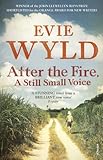
This is my review of After the Fire, A Still Small Voice by Evie Wyld.

There is endless potential in the theme of how men may be damaged when drafted to fight in distant lands for causes which do not arouse their allegiance, like the Korean or Vietnam Wars. Unable to express their emotions, they may drift into abusive relationships and neglect their children, damaging them in turn without meaning to do so.

If this sounds bleak, it could be made gripping and moving by the quality of the prose. Many reviewers have found this to be the case here, but after struggling with this book I had to admit defeat. I liked the evocation of an unfamiliar Australian landscape and culture. It did not bother me that the key points of the story are revealed only gradually and in some cases remain unclear. I did not mind its initial slow pace, but, in terms of structure it is too meandering. Also finding the opening pages so preoccupied with mundane aspects of daily life and the inner thoughts of Leon who seemed to me to be mentally ill, I felt the need for a touch of underlying humour, even of the wry or black variety.

Although the images used are at times striking and original, I agree with reviewers who have found the writing often banal – it really irks me when an author keeps using "like" instead of "as if".

Again like some other reviewers, I found the introduction of large numbers of minor characters together with frequent switches of time and place not so much confusing as irritating. Certainly, this contributed to my not feeling as much for the main players, Leon and Frank, as I think was intended.

I was left feeling frustrated: "here's the skeleton of a good novel, but this isn't it". Having read a number of classics recently, perhaps I have set the bar too high. In view of the quite polarised reaction to this book, I wonder whether it tends to appeal more say, to young men, than to older women like me.

⭐⭐⭐ 3 Stars

Talented writing, plot wanting

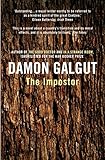
This is my review of The Impostor by Damon Galgut.

In the interests of positive discrimination, Adam loses his job to the young black intern he has trained. I was looking forward to a South African writer's take on the reality of the curdled idealism of life in the post-apartheid system. Certainly, there are telling observations of a corrupt policeman, a beautiful young black woman now able to make her fortune as a white man's wife, older black servants whose lives situations remain remarkably unchanged, and a thug in fear of reprisals from former colleagues he has sold out in his confession to a truth and reconciliation committee. Yet, the book turns out to be more of a psychological drama involving Adam's dealings with a former pupil at his school who seems to have become an unlikely successful entrepreneur.

I admire the clear, uncluttered prose which provides vivid impressions of the South African landscape, some convincing dialogues which reveal, say, Adam's uneasy relationship with his brother, and an insight into Adam's complex state of mind as he goes through a mid-life crisis. I also like the way in which most of the main characters are to some degree "impostors".

However, I agree with the reviewer who finds Galgut's writing somehow "bloodless", promising more than it delivers. In this case, I just did not believe in Adam's ill-judged friendship with Canning, his acceptance of the old nickname "Nappy", nor in Canning's enigmatic wife, nor his magical estate of Gondwana. There were some tense and moving moments, but the ending left me underwhelmed. There are all the ingredients here for a good novel, but the whole ends up less than the sum of the parts.

⭐⭐⭐ 3 Stars

Capturing the leopard

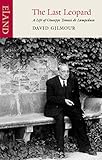
This is my review of The Last Leopard: A life of Giuseppe Tomasi di Lampedusa by David Gilmour.

If Lampedusa, who in due course became the Duke of Palma, comes across as rather dull, it was partly due to his intense introversion with strangers and also because his life seemed to revolve round consuming literature, history and cakes in prodigious quantities. The author succeeds in showing how Lampedusa's only published novel,"The Leopard", sadly rejected until just after his early death from cancer, was the fruit of decades of musing about his aristocratic family, the state of Sicily and the reading which must have developed his sense of style.

The most interestig part of the book are the final chapters on "The Leopard", which you need to have read beforehand, with an exploration of the extent to which the leading character Don Fabrizio was modelled on Lampedusa's great-grandfather Prince Giulio during the Risorgimento in the 1860s, which brought about the unification of Italy and the break up of the old feudal estates, or on the author himself. Like Don Fabrizio, Giulio was a keen astronomer, but he was probably less of an autocrat. As regards his "sceptical intelligence ….. long periods of abstract thought… and pessimistic view of Sicily and Italian unity….. Don Fabrizio is more autobiography than invention", but he is also "transformed into the person the writer would like to have been".

On the author's own admission, the charming Tancredi is based partly on his adopted son Gio, although "as for his morals….Gio is fortunately much better than him". Yet Tancredi also seems to be an amalgam of some of the young Sicilan aristocrats who joined Garibaldi, for excitement rather than out of conviction.

The huge, violent and mixed reaction to "The Leopard" also makes fascinating reading. Many who thought they knew Lampedusa were astonished that this polite, self-effacing man could hold such cynical and negative opinions. One of the strangest criticisms was that, in being readable with clear characters and conventional syntax, the book failed to achieve the kind of "avant-garde experimentalism" which was in vogue in 1950s Italy.

Another critic even attacked Lampedusa for writing about animals in a "silly" way when in fact the portrayal of the faithful hound Bendico is one of the most humorously touching aspects of the novel, revealing the love of dogs, above people, which Lampedusa displayed in real life.

His marriage is intriguing: he braved his possessive mother's wrath by marrying a formidable pyschoanalyst, who also happened to be a wealthy Latvian aristocrat, but soon settled into what seems to have been a largely intellectual relationship with her, choosing to live with his mother until her death rather than with his wife, since the two women could not get on. Gilmour comments that "flames for a year, ashes for thirty" seems to have been both Don Fabrizio's and Lampedusa's view of love for their wives.

I would have liked the final chapters to have been longer, and more on the socio-political events which formed a background to both Lampedusa's life and his famous novel. The photographs which I discovered at the end of my kindle version are well-chosen.

⭐⭐⭐⭐ 4 Stars

Tone curl

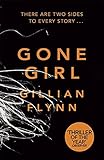
This is my review of Gone Girl by Gillian Flynn.

"Everyone knows it's always the husband": Nick is the obvious main suspect when his wife Amy disappears on their fifth wedding anniversary. Yet what kind of a mixed-up mess is she, after a lifetime of providing the model for her parents' money-spinning set of stories about "Amazing Amy", a modern Pollyanna designed to entrance both children and parents?

Gifted with a rampant imagination, Gillian Flynn has devised an intriguing situation with a labrynthine plot which hooked me because I sensed both that what I was being led to believe was false and that what I thought I was being clever in anticipating would prove a red herring as well. I like the gradual revelation of events in which truth and lies are hard to disentangle, the shifting relationships between the main characters, some sharp script-writerly dialogue, moments of real comedy in what seems to be mainly a black farce, and the continual parodying of the media-driven, hokey, faddish side of American culture. I liked it less when I started to suspect that the author herself might be too much part of this so that some of these parodies were imagined on my part.

Too often, the style lapses into a cheap magaziny tone, abetted by the author's love of creating adjectives ending in "y". I became irritated when the spate of quirky wit and imagination sank into slapdash banality. Are the false notes of trashiness unintentional or part of a plan to lure readers along with just enough but not too much violence and soft porn?

Although the commonly used device of alternating chapters between first person Nick and Amy works well, they both indulge in too much "telling" of their self-knowledge. Then, there is the continual underlying voice of the same caustic-tongued yet also often tweely sentimental female – incongruous for Nick in the midst of all his macho lingo and activities culled by the author from an obliging husband. I learned the latter in the acknowledgements at the end, which I mistook at first for Amy's play-acting of what an author's falsely modest, saccharine sign-off should be.

The nature of the final twist seems quite apt to me, but I was disappointed by its execution. I agree with reviewers who have found the final chapters too rushed and weakly developed – including some major flaws on the plausibility front.

Overall, I can see why this is a best-seller, probably one in a run of many. It is a page turner, good distraction for an economy airline flight, and a trigger for lively discussion at a book group if this does not cause an irrevocable rupture between the pulp fiction addicts and blue stocking readers, but with a little more care over style it could have been brilliant.

⭐⭐⭐ 3 Stars

Releasing truth

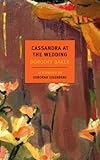
This is my review of Cassandra at the Wedding (New York Review Books Classics) by Dorothy Baker.

How do you react when your identical twin sister announces her intention to get married? Particularly if you have spent your entire childhood in the self-contained bubble of a rural backwater, with an academic philosopher for a father, encouraging you to dissect every thought, and a novelist mother to feed your preoccupation with words? What if your parents have laboured to make you different in superficial matters, overlooking the fact that you differ in the deep sense that one twin wishes to share the same life forever whilst the other wishes to break free into adulthood?

This recipe for high drama is a gripping page turner. I could not wait to get to the end, knowing that I would need to go back later to milk Baker's keen prose for the full sense of all her sharp and original observations. It often reads like the plays for which the author was well-known, with the advantage that a novel gives scope for the deeper introspection and exploration of the characters' inner thoughts.

The book is written from the alternating viewpoints of the two sisters: Cassandra and Judith, which gives you in time their very different takes on the same situations. Cassandra is neurotic, manipulative, a keen observer of others, with a biting wit, but an utterly unreliable narrator who lacks a sense of proportion, a source of huge irritation but also great sympathy to the reader. This is a tragi-comedy with many moments of great humour, and a light touch which adds to the pathos of the sadder events without making them too heavily dreary or depressing. Unlike some reviewers (including Lowri Turner in the introduction to my copy, which was a total spoiler so I am glad I did not read it beforehand), I did not find the ending disappointing – rather neat yet also satisfyingly ambiguous in some ways.

It is surprising that such a modern-seeming novel should have been written fifty years ago by someone born in 1907. It does not seek to shock, because it does not need to do so to stand out, with its subtle and distinctive approach. I am sure that, if written today, it would be on all the major prize shortlists.

⭐⭐⭐⭐⭐ 5 Stars

Warped insight

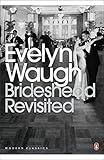
This is my review of Brideshead Revisited: The Sacred and Profane Memories of Captain Charles Ryder by Evelyn Waugh.

Vivid and original descriptions, sparkling streams of consciousness with perfect grammar and impeccable punctuation, telling observation of character, sharp dialogue, and high comedy mixed with bitter irony – all the evidence for Waugh's reputation as one of England's greatest novelists is here. I can appreciate his nostalgia for a no doubt rose-tinted view of a past way of feudal life and the novel also provides some intriguing social history of the lives of a privileged few between two World Wars, as when an Oxford undergraduate casually expects a friend's drunken vomit from the night before to be cleaned up by a servant.

On the other hand, the snobbishness, treatment of "the lower classes" as a lesser breed, and frequent racist and chauvinist comments which seem to be a product of his own prejudice prevent Waugh from seeming a great novelist in terms of vision.

The most interesting aspect of the novel for me is the parallels to be found with Waugh's own life, despite his attempts to deny them. The bored Captain Charles Ryder doing his war service is Waugh stuck in England on petty exercises rather than seeing real action. Ryder's infatuation with Brideshead and the Marchmain family is Waugh's with Madresfield and the Lygons. Sebastian Flyte is partly the captivating, alcoholic drifter Hugh, and Julia is modelled on his beautiful sister Maimie, denied the opportunity to marry royalty because of a family scandal. Julia's fiancé Mottram's comical attempts to convert to Catholicism at any price are reminiscent of Waugh's own rather bizarre exchanges with the priest he had to satisfy to achieve his own conversion. The flamboyantly gay, precociously effete Anthony Blanche is, on Waugh's own admission, two-thirds Brian Howard and one-third Harold Acton, reciting poetry through a megaphone.

A weakness in the plot seems to me to be the scandal of the Earl's flight to Venice with his mistress Carla – his offence does not seem "bad" enough to justify the blight on the Marchmains. In this, truth was more dramatic than fiction: Earl Beauchamp (William Lygon), a major Whig politician, was forced into exile to avoid an Oscar Wilde-type humiliating trial when his officious brother-in-law threatened to make public his rampant homosexuality.

The part I find hardest to understand is Waugh's treatment of Catholicism which he saw as crucial to the work. He suggests to me that Hugh and Julia are "screwed up" by a religion that tortures them with a sense of guilt over the "sins" they are too self-indulgent to deny themselves. Using Ryder as mouthpiece, Waugh does a pretty good job in sending up Catholicism, exposing the confusion and illogicality of its practice. Yet, he clearly implies that, like him, Ryder converts to this faith, but Waugh does not supply a clear explanation as to why and how this occurred.

Whilst being a compelling read, this is one of those novels which need to be revisited to appreciate it fully. It is also ideal for a book group, since there is so much to discuss about style, structure, plot, characters and aim, plus it is likely to divide opinion quite sharply.

⭐⭐⭐⭐ 4 Stars

Good yarn a little frayed

This is my review of The Flight Of The Falcon (Virago Modern Classics) by Daphne Du Maurier.

Armino Fabbio, a competent but jaded tour guide, feels responsible for the death of someone perhaps recognised from his childhood. This takes him back to Ruffano, the quaint Italian hill town of his birth, which revives memories not only of the destructive effects of World War 2 on his family but also of his domination by Aldo, the charismatic elder brother shot down as a pilot.

Despite a promising beginning and my huge admiration for gripping psychological dramas like "Rebecca" or "My Cousin Rachel", I was sufficiently unengaged by this novel to notice with disappointment the flaws: two-dimensional characters, stilted dialogues, unlikely coincidences, some rather tedious surfeit of detail. Yet many passages are brilliant, apparently effortless in their clarity and striking impact. I was also tantalised by my inability to grasp the geography of the place, and would have liked a streetmap.

Published in 1965, twenty-seven years after Rebecca, this novel may be a bit dated, the work of a popular novelist still spinning yarns in the style of earlier decades, without any further development as a writer. In spite of my reluctant reservations, although I guessed the key twists in advance, and some of the plot is a bit ludicrous, I was gripped eventually – I think by the idea of Fabbio being able to pass himself off as a stranger in familiar territory, even with people he once knew. This intriguing aspect of "false identity" is often employed by Du Maurier.

I found Fabbio an emotionally cold character, which could be attributed to his dysfunctional childhood, but was interested to read that Du Maurier herself often seemed rather chilly and remote.

⭐⭐⭐⭐ 4 Stars