“The Quiet American” by Graham Greene: mixed motives

Fed by fear of the draft which deterred young Brits from going to America, and a spate of excellent but harrowing films, my memories of the Vietnam War are limited to the doomed efforts of the American government to drive the Communists out of the north in the 1960s. In fact, this war lasted from 1955-75, and was preceded by the shorter first Indo-China about which my knowledge is very shaky. This is the period in which Graham Greene sets his classic, “The Quiet American”, to which I turned with a huge sense of relief after struggling through a few superficial, over-hyped modern novels.

The narrator is Fowler, a cynical British journalist, although we never quite learn what disappointments have driven him so far from his native land. He finds solace in opium and his beautiful young mistress Phuong – a relationship which may seem exploitative to readers seventy years on. He reports objectively on the attempts by the French to prevent the insurgency of the Communist Việt Minh into their Far Eastern colony, showing great foresight in observing that the increasing American involvement will come to nothing, and “in five hundred years there may be no New York or London, but they’ll be growing paddy in these fields, they’ll be carrying their produce to market on long poles wearing their pointed hats”.

Fowler is therefore irritated by what he sees as the naivety of Pyle, an idealistic young American, newly arrived in Vietnam to work for the Economic Aid Mission. It becomes apparent that he may even be a menace, through his desire to meddle in the situation via direct action, by promoting a “Third Force”, as advocated by a writer he much admires.

As Fowler tries to warn him, “We are the old colonial peoples, Pyle, but we’ve learned a bit of reality, we’ve learned not to play with matches. This Third Force – it comes out of a book, that’s all. General Thé’s only a bandit with a few thousand men, he’s not a national democracy”.

Fowler’s growing animosity is fuelled by Pyle’s infatuation with Phuong, whom he wishes to marry and save from what seems to him a sad fate if she stays with Fowler – too old and separated from a wife who refuses to divorce him.

It is not a spoiler to reveal Pyle’s murder, which is reported at the outset. The intrigue lies in the revelation of how this comes about, and the question of the extent of Fowler’s involvement in it, and of the degree to which an action can be justified if the motives are suspect. This psychological drama plays out against vivid images of life in Vietnam of the 1950s, from the cities to the tense encounters with the enemy in the countryside. As a reader, one can simply be absorbed in Fowler’s personal crisis, without always being entirely clear about the various power groups involved. On the other hand, the novel is an opportunity to understand a past conflict more clearly, and consider parallels with the present.

In around 180 pages of tight prose peppered with wry observation and convincing dialogue (except perhaps when Fowler is telling Pyle about love while the two men take refuge in a watch tower), Greene transports us into a different world. To absorb all this, the book needs to be read slowly, more than once. It is a masterpiece, perhaps in danger of being forgotten beneath piles of more recent mediocre undemanding fiction.

“The Gardener”: by Salley Vickers – Insight versus second sight?


A talented illustrator of children’s stories, the improbably named Halcyon aka Hassie Days finds that contracts have dried up following her decision to focus on caring for her dying father.  Together with her sister Margot, she agrees to share their joint inheritance from him on the purchase of a neglected old house in the Shropshire village of Hope Wenlock.  This is clearly not a good idea since the two have continued their childhood bickering into adult life, and have very different personalities and aspirations, Margot being smart, materialistic and employed in some form of high finance.  It gradually becomes apparent that Hassie is going through a mid-life crisis, triggered by a recent love affair.

At first, I was hooked by Hassie’s wry humour, and insightful observation of varied local characters, or Margot’s friends, despite the apparent inability to manage her own life. The influences which have made the two sisters so different are intriguing.  The descriptions of the scenery around Wenlock edge, and the garden which Hassie transforms with the help of the resourceful Albanian Murat, who may be lying low for reasons connected with immigration, are very vivid and compelling.

However, the last five chapters proved a growing disappointment: “So many things happened in quick succession around this time that I may have got the sequence confused”. I am inclined to speculate with other reviewers as to whether the author was pressed for time to finish, or even struggling to find a happy ending that would not seem too trite.  While some loose ends or last minute crises are tied up too neatly, other threads are brought to the fore without being adequately woven into the tale.  For instance, the accounts of the C7 abbess, St.Milburga, are rather tedious information dumps. As she reads the journals of Nelly East, the former occupant of the house who was so repressed by her husband, Hassie’s affinity with her seems too sudden and undeveloped. Several incidents appeared implausible, too rushed, or both.  Murat remains a two-dimensional character to a frustrating degree.

I could appreciate the process by which Hassie might come to terms with fate, develop a sense of proportion and renewed purpose in life. However, the hint of magic realism, “away with the fairies”, was a step too far.

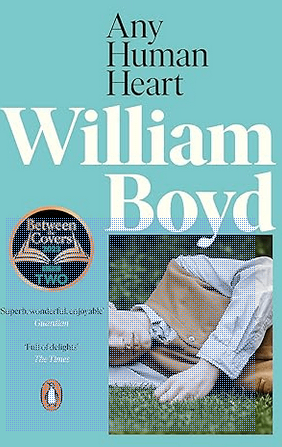
Any Human Heart by William Boyd

It is an achievement to concoct the diary of a man from fifteen-year-old schoolboy in the early 1920s to death six decades later aged 85. It must have involved a good deal of research to select the series of C20 events to form the backdrop, and the book is possibly more appealing to readers of retirement age who can recall or have heard a lot about them in the past.

Logan Mountstuart has a comfortable childhood since his father is manager of a meat company, producing corned beef in Uruguay. On his return to England, a master at his minor public school who has taken a fancy to him steers Logan into an Oxford College from which he emerges with a third class degree, which matters not since his ambition is to become a writer. He has modest success in getting published quite quickly, but feels trapped after making the mistake of marrying an earl’s shallow daughter, on the rebound from rejection by a more intriguing woman. And so he embarks on a chequered life, where in the attempt to make the journal more interesting, his imaginary acquaintances mix with a succession of the rich and famous, movers and shakers, the likes of Hemingway, Picasso, Ian Fleming, even the Duke of Windsor and Wallace Simpson. All of these seem taken with Logan, at least initially. Then there is the US painter Nat Tate, whom some critics have been fooled into thinking actually existed.

However, all the name-dropping quickly becomes tiresome, and I suspect the book may appeal more to men, since it is written very much from a male perspective. William Boyd has explained that Logan was inspired by the journals dating from the 1920s of writer and critic Cyril Connolly, whom he describes as “selfish, promiscuous, talented, hard up, lazy, an epicurean and a particular kind of English intellectual (his tastes were refined but narrow), and I found something about his flawed personality deeply beguiling”. As a female reader, I do not.

Particularly in early life, Logan is not a very likeable character. He can’t resist sleeping with his best friend’s fiancée, he drinks far too much, and lusts after countless women, most of whom conveniently seem to find him attractive. Yet he has odd flashes of integrity, as when he refuses to plant incriminating evidence on a man whom the Duke of Windsor wants “out of the way”, and so years later still bears a grudge against him – Wallace hissing the word “traitor” at a chance meeting.

Logan is at his best in times of adversity. When unjustly imprisoned in Switzerland, which at least ensures he survives World War ll, he distracts himself with a small farm of insects found in his room – woodlice, a cockroach and ants which he “herds together in a small packet” but they keep escaping, which gives him “a vicarious sense of freedom”. Sometimes he is so impoverished that he has to live on tins of dog food, for which he develops a taste, but always lands on his feet. His home may be sold because he is believed dead, but in another stage of life someone will bequeath him a house, admittedly in a rundown state.

He may have to flee the US since he is suspected of underage sex with a girl he didn’t realise was only sixteen, but ends up with a cushy teaching post in Nigeria, where he has a chance to show his decency in trying to free a servant who has been pressganged into an army during the Biafran war. Boyd’s own childhood experience of living in Nigeria may have contributed to this section’s authentic ring.

There is wry, even black humour, in the scenes when, especially in old age, he decides it is not too late to take up a cause like joining a Socialist Patients’ Collective, after experiencing the shortcomings of the NHS, or finding out who is defacing a plaque to a hero of the Resistance in the French village where he has taken up residence – this altruism invariably backfires.

The disadvantages of the diary format is that the entries are often quite short and fragmented. There are too many banal sections, involving lists and humdrum events: how many made to measure summer suits Logan bought, just how much he boozed one night, how he furnished his flat. This may be realistic in terms of what a diary is like, but is pretty tedious. While skimming through the duller patches, it is easy to overlook the names and professions of people in passing, so that when they turn up again three hundred pages later one cannot be bothered to check who they are.

What often feels inevitably unstructured, because it is representing the course of life, and also unbearably long – I felt better disposed to it as my Kindle recorded 80 per cent read – is actually full of many imaginative incidents which could have been developed more fully, and some expressive pieces of writing which one would not normally find in a diary. In other words, would a series of short stories on particular events in the stages of Logan’s life had been more satisfying? Still, this book was longlisted for the 2002 Booker Prize, has been adapted for a television series, and has sold well, so who am I to carp?

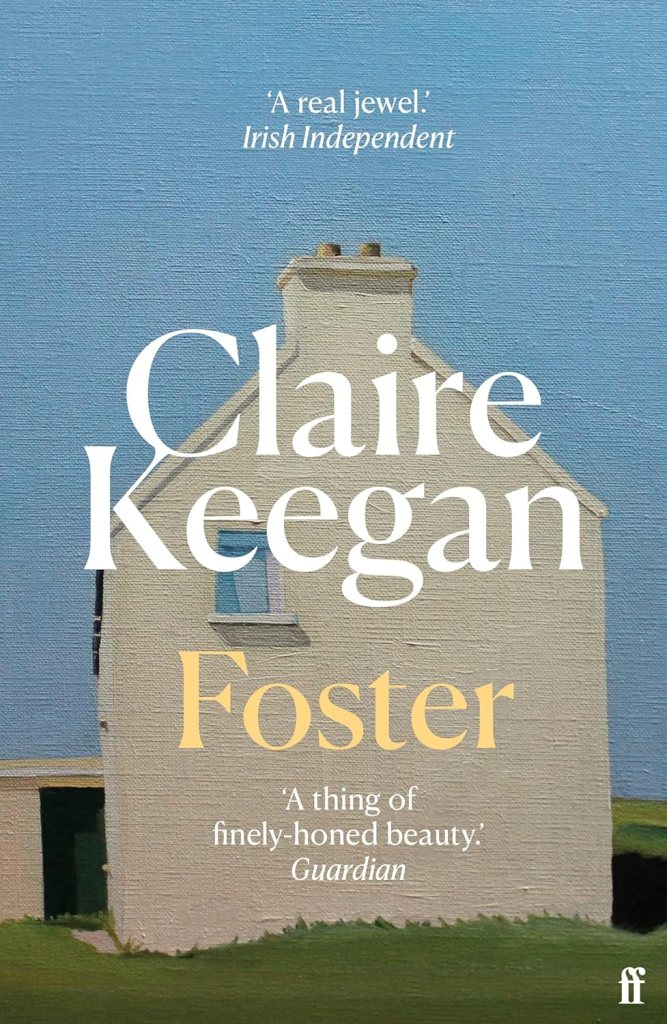
“Foster” by Claire Keegan: when less is more

“The wind is high and hoarse in the trees, tearing fretfully though the high boughs…..A big loose hound whose coat is littered with the shadows of the trees lets out a few rough, half-hearted barks…..The presence of a black and white cat moves on the window ledge.” This spare, poetical prose sometimes sounds incongruous, too mature in the thoughts of the young girl narrating this story, unusually observant as she is. But does this really matter? Recounted in the present tense to give a sense of immediacy, this is one of those simple tales which hang on the subtle way in which the facts are revealed.

In the rural Wexford of southeast Ireland during the early 1980s (as we glean from references to the IRA hunger strike in the Maze Prison), a girl – whose name we are never told – is fostered with a farming couple, the Kinsellas, to ease the burden on her heavily pregnant mother. Home life sounds chaotic, since her mother already has to care for at least four children, and do more than her fair share of running the farm, with a husband who clearly drinks away what money there is, leaving too little to pay for the hay to be cut, gambles away a red Shorthorn cow, and casually accepts handouts of potatoes, rhubarb and “the odd bob” sent to his wife. His callousness is revealed when he forgets to unload the girl’s luggage as he drives away, but never seems to make any move to remedy his error.

The Kinsellas could not be more different. Working hard in quiet cooperation, they are keeping at bay a suppressed grief which the girl only discovers after some weeks, from a neighbour’s gossip. Yet although the girl’s presence can only enhance their sense of loss, they still give her the care and attention which she has lacked, so that she blossoms and develops in the space of a few weeks. Suddenly, it becomes clear, as it would to a child with little sense of time passing over a long summer holiday, that the school year is about to start, her mother has given birth and she must return to her old life. The sense of belonging and the affection which have grown make the parting all the harder, on both sides. As is the case with Claire Keegan’s novellas, the ending is ambiguous, leaving the reader to reflect on what happens next. Yet it seems that the girl has gained some permanent benefit from the experience, as perhaps the Kinsellas have as well.

Much of the emotion in this book is implied, together with the way in which observations are used to reveal the characters’ lives and the rural setting, laced with the Irish turn of phrase in the dialogues. As John Kinsella observes, “You don’t have to say anything. Always remember that as a thing you need never do. Many’s a man lost much just because he missed a perfect opportunity to say nothing”.

This novella has been made into the film “The Quiet Girl” which has also been highly praised.

“Act of Oblivion” by Robert Harris: At what price?

Following the vacuum created by Cromwell’s death, encouraging the restoration of the monarchy in England, the “Act of Oblivion” issued a general pardon, with a few exceptions including the “regicides” who had signed Charles l’s death warrant.  Robert Harris makes two of these real men the central characters of his novel: Ned Whalley, turned loyal soldier prepared to be ruthless in the loyal support of his cousin Cromwell, and Ned’s son-in-law Will Goffe, a devout Puritan with a passion for preaching  and a streak of fanaticism, as indicated in his unshakeable belief that the Second Coming will take place in the year 1666, as foretold in the Book of Revelation. This delusion at least makes their trials more bearable, as they endure a precarious existence on the run in the New World, with their nemesis, the fictional but plausible Richard Nayler, in unrelenting pursuit long after others have lost the taste for it, driven less by his desire to avenge the king’s execution,  than by a deep personal grudge.

The author succeeds in maintaining a continuous sense of tension and menace, so that right to the end, one is unsure whether Whalley and Goffe will escape capture, let alone survive. If the narrative sometimes lacks pace, this perhaps serves to remind us  of the inevitable tedium of being forced to lie low, often in very uncomfortable conditions, always on the alert and rarely certain of whom one can trust.

Robert Harris never misses the chance to reveal characters’ strengths and flaws, so that, wherever one’s sympathies lie in the first place, they tend to keep shifting. We see how, when they were in a position of power serving a triumphant Cromwell,  the essentially decent Whalley and Goffe were capable of being as cruel as Nayler, who in turn sometimes has unexpected flashes of compassion.  Writing a memoir to pass the time, Whalley comes to question some of Cromwell’s motives and actions, while Goffe seems rigidly set in his religious certainties. While perhaps King Charles ll and his brother James are portrayed as unremittingly debauched to the point of caricature,  even they appear worthy as they trot round London on horseback, reassuring people in the aftermath of the Great Fire.

Having dragged somewhat in places, the narrative passes too rapidly through the events of the Plague and Great Fire of London which test the faith of Will’s long-suffering wife Frances. The unpredictable, nail-biting end is also quite abrupt. Yet overall, this novel is well-constructed, wears the detailed research on which it is based quite lightly, and certainly stimulates interest in a fascinating period of our history, which could have turned out very differently. It also raises the moral dilemma of how far to go in following one’s principles, at the price of losing almost everything else which one loves or enjoys.

Ceremony of Innocence by Madeleine Bunting: the costs of turning a blind eye.

Journalist Fauzia is appalled to learn that her friend Reem, a recent Cambridge graduate from Bahrain, has disappeared in Cairo a few days before she is due to present a paper on her PhD research. Fauzia’s fear is mixed with guilt, since she is responsible for having enabled Reem to make progress in her PhD by giving her a laptop of sensitive information which she lacked the courage to use herself. This provided evidence of the involvement of Fauzia’s ex-husband’s family, the Wilcox Smiths, in shady, very lucrative business deals with corrupt regimes in the Middle East.

The storyline then switches back to 1969, to trace the course by which Fauzia’s former father-in-law Martin made the transition from decent diplomat working for an Empire in decline to ruthless entrepreneur. Then, forty years on, we see the prosperous family through the eyes of Kate, a poor relative, as she makes ends meet by taking as a lodger Hussein, a doctor seeking asylum in the UK, having been tortured as a Shia in his native Bahrain.

The threads are gradually drawn together against the background of British “establishment” members who have lost political influence on the world stage, and seek to maintain status through the accumulation of wealth, regardless of the cost to others. It seems that a bad conscience can be quashed all too easily by conspicuous do-gooding and steering conversations through channels of vacuous politeness. Some bleak incidents are leavened for the reader with lengthy accounts of daily life in the Wilcox-Smiths idyllic country house, although at other times the incongruity of this makes the harsh realities appear more shocking.

This complacency explains the relevance of the title, which is taken from the famous line by Yeats: “The ceremony of innocence is drowned”. It seems more apt for this book than the earlier one in the same verse, “Things fall apart; the centre cannot hold”, which the African writer Chinua Achebe has used already for his novel exploring the tensions created by colonisation.

Despite an original approach to an interesting and important theme, at times this novel risks falling between the two stools of political thriller and critical study of upper class manners. Initially, I was so impressed by “Ceremony of Innocence” that I thought the favourable comparisons with John Le Carrés work, made by some reviewers, did not go far enough. The variety of characters, with a convincing mixture of redeeming features and flaws (apart from the ruthless misnamed Dotty), seem particularly well-developed and realistic. Then I began to notice a few somewhat unlikely or unclear plot twists, the uneven structure of the novel, or the point where old habits die hard, and former journalist Madeleine Bunting has Hussein recount the circumstances which have brought him to England in the kind of objective, articulate flow better suited to an article based on interviews with asylum seekers. The novel’s climax is rather abrupt, although perhaps this is deliberate to build up the tension. The inconclusive ending, still dragging a few loose ends, is arguably appropriate to the morally ambiguous events. Ensuring that everyone gets the justice they deserve would have been too far removed from real life.

Some reservations apart, this novel proves very readable and thought-provoking, a good way of inspiring us to find out more, or to be reminded about the Middle East, and Britain’s involvement and degree of culpability in recent crises and personal tragedies there.

Still Life by Sarah Winman: “rose-coloured spectacles”

This soap opera focuses on the friendships and loves of two on the face of it very different characters: upper class lesbian art historian Evelyn Skinner and East End maker of geographical globes, forty years her junior and improbably named Ulysses Temper. They are tenuously linked by a chance meeting in Italy near the end of the Second World War, where Evelyn is trying to save priceless paintings from the clutches of the Nazis, and Ulysses is a young soldier fighting the Fascists. In this, Evelyn heightens his budding appreciation of art, although this seems due more to the influence of his commanding officer Darnley, who takes him to visit old churches in odd moments between the shelling. Both harbouring nostalgic memories of their encounter, Ulysses and Evelyn are fated to meet again, but not for more than two decades.

Perhaps owing to her acting experience, Sarah Winman has an eye for comic scenes, even in the midst of tragedy, and an ear for slick, wisecracking dialogue, until it becomes serious in the mouths of say, Evelyn or  oddball autodidact Cress, and risks sounding pretentious. The lack of “speech marks” does not bother me, and in fact serves to aid the narrative flow. I was more irritated by the uneven style, which swings between the extremes of overblown prose and chatty sound bites very likely to start with ‘spect or s’pose  or simply omit any verbs. The intrusive narrator is all too fond of telling us what is, or is not, about to happen now, not just yet, or not at all.

I understand the escapist appeal of a tightknit group of characters who can rub along despite their differences in the community based on an East End pub, or Italian “pensione”, and the novel could certainly inspire a visit to Florence, or trigger an interest in its history, including the devastating flood of 1966, or in the city’s art, if one takes the trouble to look up the references to painters and particular masterpieces.

Yet  the tone is generally too sentimental for my taste, with a plot which relies far too often on coincidence, or implausible events like the dramatic rescue of a man on the point of suicide from a roof in Florence, or  the smuggling of anaesthetised parrot  Claude across the Channel in a suitcase,  although he survives to spout Shakespeare at his bemused audience.  The tendency to exaggeration and caricature often makes it hard to take the characters seriously, and seems to encourage a false “feel good” sensation over lives which are in many ways quite sad. The most likeable and  nuanced character is Ulysses, whose at times frustrating passivity masks a deep, unexpressed  grief  which goes beyond his love for a beautiful, damaged woman who is incapable of committing to him.  The novel is at least a hundred pages too long, and would have benefitted from a ruthless editing of some repetition and banal padding.

“Still Life” is a bestseller, which must have delighted many readers. If you are not one of these, I am not sure it is worth wading through every page, but having done so for a book group, at least it should provide plenty of meat for analysis of  social change in the second half of the C20,  whether the novel gives a truthful impression of life for gay people in that period,  and of the work as a piece of creative writing in general.

A Single Thread by Tracy Chevalier: “a tale of petit point”

My mother used to speak of her “maiden aunts” who were never able to marry because of the dearth of single men after the First World War. Violet Speedwell is such a “surplus woman”, her loneliness compounded by poverty. To gain independence from her widowed mother, embittered by the loss of her elder son, and constantly carping, Violet moves to nearby Salisbury, where after paying rent, her wages are insufficient to buy a hot meal every day and replace outworn clothes. She finds distraction in the unlikely company of broderers, women who have volunteered to decorate colourful kneelers and cushions for the Cathedral, and in the friendship of Arthur, a man old enough to be her father, with a passion for bell ringing, but also a wife who is yet another woman traumatised by her son’s death on a French battlefield.

Plots are often padded out with some specialism which readers are likely to know little about, but find interesting. In this case, the themes are embroidery and bell ringing, both of which the author has thoroughly researched. The former has the ring of truth, being based on the actual project undertaken in the 1930s, under the direction of the real-life Louise Pesel, who appears in the novel, using her striking designs for scenes from English history.

With painstaking attention to detail, Tracy Chevalier recreates the staid, dull, conventional world of the 1930s, as it appears to us now, bringing it alive with moments of poignancy and wry humour. It is a world where women are not supposed to have careers, nor hike round the countryside on their own, and their mere presence, if alone, seems to make others uncomfortable. If they fail to marry, they are expected to be carers when the need arises. Some may say that this state of affairs has far from disappeared.

This is an easy read which could promote discussion in a book group, but I found it rather dull, with the research too often shoehorned clunkily into wooden descriptions and stilted dialogues, stereotyped characters, and a somewhat thin plot relying on too many coincidences and contrived situations. I was also unconvinced that a woman like Violet would in the past have gone to bars to meet “sherry men” with whom to have brief sexual encounters, although I could understand why the tedium of living with her mother might drive her to drink.

My reservations may be unfair, since this novel seems to have been generally well-received.

“The Return of the Native”: flawed diamond by Thomas Hardy

From his opening sentence, Thomas Hardy portrays the hypnotic power of the bleakly beautiful, unchanging Egdon heath which influences so strongly the lives of those born and raised there, so that even the talented Clym Yeobright who has become a man of the world in Paris, is drawn back to it magnetically, with the desire to live a simpler life of greater social value. Outsiders forced to live on the heath feel more oppressed by it, like the capricious Eustacia Vye who would like nothing better than to be transported to Paris.

The heath forms the backdrop to the relations between the six main characters which, as we have come to expect from Hardy, prove fateful owing to the conflict between their natural inclinations, differing ambitions and the rigid social conventions which constrain the women in particular. A cast of local rustics provide the comedy in a structure which keeps closely to the classical framework of unity of time and place: events take place over the course of a single year, between two bonfire nights, and the drama never strays beyond the boundaries of Egdon Heath.

Having read all Hardy’s other “major” novels, I was at first disappointed by the tedium of overlong, wordy, initially leaden descriptions, punctuated by the disruption of pompous literary references of often doubtful relevance which obliged me to keep flipping to the notes at the back. Eventually, I was worn down or reeled into submission. Undeniably, many passages expanding in minute detail on the changing weather, the vegetation, the past history and present activities on the heath are brilliant, original and memorable. For instance, in Chapter VI, “The Figure against the Sky”, Hardy describes how the wind creates a kind of music with “the general ricochet….over pits and prominences” combined with “the baritone buzz of a holly tree” and “a worn whisper, dry and papery” from “the mummified heath-bells of the past summer, originally tender and purple, now washed colourless by Michaelmas rains, and dried to the dead skins by October suns”. And so on – Hardy was of course also a poet.

Hardy has a gift for conveying complex emotions and trains of thought in minute detail, arousing sympathy for all except perhaps the philanderer Wildeve. Bearing in mind how our assessment of the characters is likely to be very different from what even Hardy may have intended, writing a hundred and fifty years ago, he gives us the material to make up our own minds. Eustacia may seem to us an object of sympathy since she is not directed to any solid purpose in life – by default, her beauty leads men astray and she gets the blame for it. Clym may be found wanting in failing to consider enough the impact on others of his well-intentioned actions. Diggory Venn, the reddleman, bizarrely red from head to foot from the ochre he sells to farmers to dye their sheep, often seems meddlesome and manipulative, although Hardy apparently intended him to retain an “isolated and weird character” until obliged by the publisher to use him for a partially happy ending.

The plot is often implausible, relying on overheard conversations and coincidental meetings to feed the accumulation of misunderstandings. Scenes slip into melodrama, particularly the ludicrous final climax. One is left with a vague sense of dissatisfaction, but perhaps it mirrors real life when one feels this over the way matters often work out. Despite this, the quality of some of the writing is remarkable, so that certain images and reflections on these imagined lives, linger in the mind.

Required to read this in three days for a book group, I was left stunned by the welter of impressions received in a short space of time. I suspect that to read this slowly, savouring some of the best passages, is the most rewarding approach to this novel, which will take you out of the fast-paced world of sound bites, Twitter tweets, Snapchat and easy instant gratification, in which Eustacia would probably have revelled.

On Java Road by Lawrence Osborne – knowing where to draw the line

“If you want to know how you’ve done in life, tell your eighteen-year-old self in the mirror whether you have disappointed him or lived up to his expectations”.

For much of this novel, narrator Adrian Gyle clearly falls into the former category. After years spent in Hong Kong chasing trivial news stories, he appears cynical, unattached, often too hungover to pursue a lead as he drifts towards the inevitable point when his editor’s patience finally snaps.

It was not always so. In his youth, feeling socially out of place at Cambridge, he made an unlikely friendship with another outsider from a very different background: Jimmy Tang, son of a vastly wealthy Hong Kong business family, who inspired him to share the challenge of translating classical Chinese poetry into English.

Following the British handover of Hong Kong to the Chinese, life has changed abruptly, as the new authoritarian regime sets about dismantling democracy, sparking increasingly violent street battles as the police crack down on student demonstrators. One of these is Rebecca To, Jimmy Tang’s latest extra-marital lover, whose activities create the threat of reprisals from those in power against both her own wealthy family and his.

So this forms the basis for a topical thriller with a strong sense of place, Lawrence Osborne being a travel writer as well as a novelist. Yet it may disappoint those expecting suspense and action, since the most dramatic incidents tend to occur offstage, fail to materialise or leave the reader uncertain as to whether a particular crime has actually been committed at all. The author seems more interested in the dynamics of a long friendship between two very different men linked by a few common interests and shared memories. His aim is to explore the varied moral positions that individuals or groups take to particular issues and situations.

Having been very impressed by a recent reading of “The Forgiven”, I did not find the descriptions of Hong Kong as striking as those of Morocco, but maybe the latter simply lends itself to this. Perhaps years spent as a “nomad” observing people in different countries accounts for the distance which the author creates between us and his characters, so that one does not care too much about them. This mattered for me in the case of Jimmy Tang and Rebecca To who seem quite thinly developed. The “inverted” nature of this novel results in, for instance, Jimmy’s long-suffering wife and Rebecca’s father appearing more authentic despite being minor characters. The focus on a few exceptionally wealthy, good-looking people, with no opportunity missed to display a knowledge of fine wine gave the serious theme a shallow quality. Admittedly, the dilemma facing influential Hong Kong Chinese who have a lot to lose if they risk dissent needs to be understood.

Displaying the bones of an excellent novel, I was left disappointed when the plot slips away to a bland conclusion.