There but for fortune…

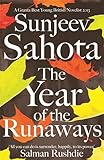
This is my review of The Year of the Runaways by Sunjeev Sahota.

Randeep, Avtar and Tochi are all economic migrants from India, crammed with others into a small terraced house in Sheffield where they work illegally on a building site, paid far below the minimum wage by an unscrupulous gang-master. It took a while for the author to establish their backstories, but eventually I became engrossed in their individual lives, and the different chains of misfortune which led them to obtain falsely or infringe the terms of their visas.

This is a fascinating insight into Indian culture: the continued level of violent prejudice against untouchables like Tochi, even amongst British Indians; the lack of a social security system in India to support Randeep’s upper caste family when his father falls ill, aggravated by his mother’s view that it is socially beneath her to work; the complex network amongst British Indians in which illegal migrants are both exploited and assisted, not least the gurdwara or places of Sikh worship where desperate followers of the faith can often get temporary bed and food. Randeep’s British “visa bride” Narinder also makes us think about the role of women in segregated communities who are repressed by fathers and brothers, denied the chance to gain any qualifications or the right to work, for whom breaking free means bringing shame on parents they may love too much to hurt.

Despite being a powerful and gripping story, strengthened by what seems to be authentic knowledge, it is weakened by a clunky structure and often incongruous style. There are almost too many characters to grasp, although you could say this gives a Dickensian touch, too much mundane or minute detail which saps the narrative drive, although this may also help one to visualise the scene, except, of course, where there are too many distracting Hindi (?)/Sikh terms making the confused and irritated reader long for a glossary.

My main problem is with the frequent odd turns of phrase: “earplugs emerged from her neckline to noodle about her chest”, “the writing desk too narrow for the three large oval doilies it was dressed in”, the urban stretch of rivers with “just the odd fishermen thickly hidden”, “she repaired to the outside toilets” (archaic in context). I cannot decide whether the approach is a daring attempt at poetical language which sometimes works as in “the sunlight squandered itself across the world”, or the errors of someone for whom English is a second language. I agree with other reviewers who have called for sharper editing, excising the indulgent wordiness and digressions, but since I have often complained about the formulaic effect of creative writing classes, perhaps this apparently spontaneous torrent of page-turning, thought-provoking flawed talent comes as a breath of fresh air.

The final Chapter 14 ends abruptly, leaving questions unanswered as to exactly how the main characters arrive at the “almost happy ending " of the i-dotting epilogue, a bland anticlimax after the unrelenting blows of the main text, although bitter ironies still lie just below the surface.

⭐⭐⭐⭐ 4 Stars

Facing the music

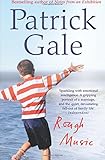
This is my review of Rough Music by Patrick Gale.

Why is forty-year-old, openly gay, successful bookshop owner Will considered by his “best friend” Harriet to need therapy sessions? We sense from the hook of the opening chapter that his glib talk of loving his parents and his “very, very happy” childhood masks some family trauma. This is gradually revealed to us in chapters which alternate between two time frames, the present and more than thirty years earlier, with most scenes set in blue house overlooking a Cornish beach which Will’s parents rented for a fateful holiday long ago when he was eight, and which his sister Poppy has hired again, inadvertently or perhaps not, as a fortieth birthday present, to which he agrees to take his now ageing parents for a break.

I enjoyed the wry humour of the innocent young Will, confusingly called Julian, being led astray, even to the extent of becoming an unwitting accomplice to serious crimes, by the misnamed “trusties”, old lags allowed to tend his prison governor father John’s gardens. Yet, despite some powerful dramatic moments – often coming with unexpected brutality out of the blue, the plot proves much less important than the characters.

In minutely-observed scenes Patrick Gale shows great insight as he takes us inside the heads of his three main characters: Julian/Will growing up as a sensitive little boy, trying to make sense of the adult world and his budding sense of being gay, seeking company in books; his musical, free-spirit of a mother Frances who has drifted into a restrictive marriage with a decent but uptight and hidebound man, and father John himself, who displays a more sympathetic personality beneath the surface, although unable to express the love he feels for his wife. His desire to “accumulate enough small, loving gestures to make something big enough for her to notice” is poignantly undermined by her development of early-onset Alzheimers – not a spoiler since this is clear from the beginning. Like mother, like son, Frances and Will share good intentions combined with a capacity to cause pain without meaning to.

The author has not extended his great skill in developing characters to the secondary roles played by, for instance, Harriet and Will’s gay lovers whom I did not find convincing. Also, the aftermath of the book’s dramatic climax seemed disjointed and underdeveloped, plus I found it hard to believe that such an observant and in some ways perceptive child as Will could apparently forget certain striking events from his childhood.

Overall, this is an absorbing, often moving tale with some astute comments on life and moments of comedy to ease the tragedy.

⭐⭐⭐⭐ 4 Stars

Hand of fate

This is my review of Signals of Distress by Jim Crace.

Original, imaginative and quirky, well-written with sharp irony and some striking descriptions – the storm of silvery pilchards making “the sea drenched in fish….as if the water had lost its liquidness and was turning to solder” – Jim Crace transports us to a remote Cornish fishing town in the winter of 1836.

The routine of life in Wherrytown is upset when “The Belle of Wilmington” with its American crew and unfortunate slave Otto shackled to the orlop deck runs aground on a sand bar, with much of its cargo washed ashore, including a herd of cattle which offer the locals the prospect of some illicit beef. This dramatic event coincides with the arrival of Aymer Smith: full of good intentions but pedantic, unworldly, socially inept with a gift only for causing trouble without meaning to and irritating everyone he meets. Aymer’s mission is to apologise in person to those dependent for their livelihoods on the collection of kelp from the beaches, who will suffer from his brother’s decision to switch from the use of kelp ash to sodium carbonate in the soap-making progress. Aymer is determined to compensate them – with bars of soap, coins, perhaps even a rash proposal of marriage.

This is a confined, prejudiced, harsh, every-man-for-himself world, typified by the ruthless local agent, wheeler-dealer Walter Howells. Yet in a varied cast of characters, some show flashes of kindness against the odds, and even Aymer eventually becomes an object of sympathy – a foolish yet essentially decent man.

The story may seem to meander along, at times too absorbed in minor detail, yet the author is forging a chain of cause and effect, working towards an end which, even if you guess it, is quite powerful and haunting. There is a vein of unremitting honesty, even visceral cruelty, a sense of fate, in Jim Crace’s writing which also gives it authenticity, and embeds an unusual tale in one’s memory.

⭐⭐⭐⭐⭐ 5 Stars

Mean Ends

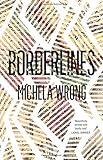
This is my review of Borderlines by Michela Wrong.

In the effort to erase her shock and regret over an intense love affair which has ended in tragedy, Paula is persuaded by the charismatic Winston Peabody III to assist him in preparing the case to be heard at the Hague for the recently war-torn state of North Darrar in its boundary dispute with its larger, more influential neighbour Darrar. Is this work as ethical as it sounds, is North Darrar a cause worth defending, and how will Paula be affected by this assignment?

Michela Wrong’s experience as an award-winning journalist explains why this deeply serious and intelligent novel often reads more like scripts for Radio 4’s “From our own correspondent” than creative writing. She combines her understanding of damaging colonial legacies, the corrupting effect of power on new regimes, however idealistic they may have been at the outset, and the cynical manipulation by self-interested Western states, to create a “North Darrar” with a very convincing sense of place, brought to life with vivid descriptions of landscapes in the Eritrea on which this novel is based. There are many insights and powerful moments, such as her sense of being trapped when prevented by a soldier from taking her customary evening run out into the plains, or the rendezvous at the “Tank Graveyard”, “a chilling indictment of superpower policy” where a local man explains the “geology” of the place, “like a quarry…our warmongering history caught in the sedimentary layers” of different weaponry from the days of the old Darrar Empire, the Italian conquest and British occupation to the latest civil war, with even some downed Soviet MiGs buried in there.

I agree that this often reads like a tense legal thriller, and even when it slackens off into scenes of office and expatriate social life it rings true. A slight problem for me is that all the characters – mostly Africans – have the same very articulate but somewhat stilted “voice” which seems to be that of the author contriving opportunities to give us information. I realise that Paula is intended to be a driven, prickly individual but her motives, for the action which got her arrested, for instance, seem insufficiently developed. The weakest part for me is her relationship with the impossibly wealthy and well-connected American Jake Wentworth. Recalled in disjointed flashbacks, the descriptions of their physical love often appear quite corny and clichéd, even hollow since it is unclear whether there really was anything more than sexual attraction. Is one meant to feel that Jake was a selfish man, a symbol of casual Western dominance, who “couldn’t” leave his wife, was attracted to clever, high-achieving women but unable to cope with their success, wanting a mistress in a cosy hideaway where he could rely on seeking comfort on his terms? The last chapter may focus too much on “tying up loose ends” in Paula’s life, although its sense of anticlimax may again be part of the book’s realism.

Overall, this is worth reading, and very timely in this period of widespread civil war outside the “developed world” and massive refugee problems. It is well-structured, but one is constantly reminded that it is a novel by an analytical, facts-driven non-fiction writer, lacking that elusive spark of creative imagination.

⭐⭐⭐⭐ 4 Stars

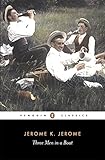
“Three Men in a Boat: To Say Nothing of the Dog” (Penguin Classics) by Jerome K. Jerome – Messing about on the river

This is my review of Three Men in a Boat: To Say Nothing of the Dog (Penguin Classics) by Jerome K. Jerome.

When I read this as quite a young child, it seemed hilarious. I’m referring, for instance, to George and Harris rushing round in search of the butter, until realising that one of them had sat in it. Struggling dutifully through it more recently for a book group, it seemed rather silly and very dated, although I could still laugh at the succession of locals claiming to have caught the ever weightier trout encased on a pub wall, only for it to turn out to be made of plaster, when one of the clumsy three accidentally knocked it down.

I found a bit of research on the story much more interesting. Publication in 1889 was earlier than I had imagined i.e. not Edwardian. After the passing of the 1870 Education Act, and the extension of cheap rail fares giving people ready access the Thames, there was a sharp increase in the demand for amusing, easily read books and in the appreciation of boating as a pastime. This was perhaps a comic novel ahead of its time, much Victorian reading matter still being a bit sententious and worthy. So, there was a sharp contrast between the popularity of the book (which has never been out of print), and the snooty response of critics, even in Punch.

The author himself came from a once prosperous middle-class family which had fallen on hard times. So, despite his grammar school education, he had to start work as a young teenager, which obviously gave him a wide experience of life and the ability to relate to ordinary people. His unusual name was partly due to his father Jerome Clapp adding another Jerome to make it sound more distinguished. The “Klapka” came from a Hungarian who lodged with the family for a while.

I can see that what is really a series of amusing anecdotes, observations on daily life and snippets of local history on the areas bordering the Thames is appealing to us now in its innocence and nostalgic portrayal of a lost age. This probably remains a classic which you should read, the younger the better, although I doubt if a tale of three gormless middle-aged men rowing up the Thames more than a century ago would appeal much to this audience.

⭐⭐⭐ 3 Stars

The unremarkable Whitshanks

This is my review of A Spool of Blue Thread by Anne Tyler.

Retired social worker Abby with her eccentric streak and strong sense of justice and her husband Red, owner of a small construction company in Baltimore, have raised four children and now welcome their grandchildren to the fine family house built by Red’s father Junior Whitshank, poor boy made good from the Appalachians, or thereabouts, who coveted it so much that he persuaded his wealthy clients to sell it to him, perhaps using some dubious means to achieve this end.

The opening seems promising, as Abby and Red conduct a Pinterish conversation over how to deal with wayward son Denny’s latest unsettling action: a nocturnal phone call to announce that he is gay. My enthusiasm cooled when nothing comes of this, and each chapter seems like a separate short story, or sequence of anecdotes, laden down with often tedious domestic detail, about what appear, apart from the prickly, often absent drifter Denny, to be an unremarkable middle—class American family with, frankly, no real problems. The twee, folksy style also grated on me, with the overuse of brackets and “house that Jack built” repetition. This may of course be intentional, to chime with the Whitshanks ordinary Americanness. Despite the humour which sets Anne Tyler apart from other celebrated modern writers like Marilynne Robinson and Alice Munro, there was just not enough to hold my interest.

But then, mid-way through Chapter 3 in which the children feel obliged to rally round as Abby develops worrying memory lapses and Red, recovering from a heart attack, is deemed unable to cope with her, Anne Tyler hooks my interest by beginning to let slip a chain of unexpected twists to indicate that all is not as it seems. I even stopped being annoyed by the style, although I swear it sharpens up as the story belatedly takes off. We begin to see how, for all her good intentions, inviting needy and sadly often ghastly people to share family meals without consulting her long-suffering family, she has unwittingly damaged both the child that she loves the most, and the one she has insisted with apparent great generosity on helping. At last, I was able to appreciate the subtle observation of the characters who begin to become more distinct, the irony and moments of sadness beneath the comedy and the telling dialogues.

Anne Tyler takes a risk, which pays off, in giving us the essential story in Part 1, ending Chapter 8, as is often the case, on a note of pathos, only to go back in time to show how Abby met Red, when she was going out with his friend Dane, and how Junior came to marry Linnie Mae, who proves to be much more than the homely, downtrodden figure portrayed at the outset. The author even manages to make us feel a flash or two of sympathy for Junior. In beginning and ending with Denny, the story has a satisfying arc.

⭐⭐⭐⭐ 4 Stars

Timshel – man’s freedom to choose

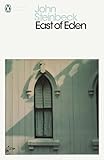
This is my review of East of Eden (Penguin Modern Classics) by John Steinbeck.

This epic masterpiece reminds me of aspects of Dickens and Hardy applied to God-fearing yet sinful turn of the century California. The opening chapter captures the beauty of the "Eden" of the Salinas Valley where Steinbeck was born. This forms much of the backdrop to the saga of two contrasting families whom Steinbeck uses to develop his ideas on the nature of good and evil, love and hate, beauty and ugliness.

The Hamiltons are close-knit and loving under the influence of their charismatic father Samuel, based on the author's own grandfather, who despite his silver tongue and inventiveness is doomed to poverty because he has only been able to afford a plot of poor land. The Trasks are introspective and repressed, generally unhappy despite their wealth because of their inability to find love. Steinbeck uses them to explore the theme which fascinated him: the story of Cain and Abel which he reinterprets over two generations, dedicating the book to his own two young sons.

The book seems dated in its use of an intrusive and omniscient narrator who tells the reader what to think about the characters, digresses into expounding his views on American society, and at times even lapses into the first person and enters the story as John, the grandson of Samuel Hamilton. These Escher-like shifts in point of view can be justified as part of Steinbeck’s emperimentation as a writer. From a critical angle, one can also find many of the author’s key characters quite implausible, in particular Cathy, introduced from the outset as a monster. She seems to represent the Devil in the novel, and the idea that evil is often an inexplicable force. In describing her manipulative nature, Steinbeck was sadly seeking some catharsis from the break with his second wife. Perhaps because he is intended to be a symbol of goodness, Lee, the impossibly competent and virtuous Chinese servant who saves the Trask family from total collapse and somehow learns to speak like a professor while talking pidgin English since that is what ignorant Americans expect, is also not entirely convincing. Yet he provides not only a good deal of wry humour but also serves, like Samuel, as a mouthpiece for Steinbeck’s philosophising, some of which is fine-sounding hokum.

Despite these reservations, it is easy to understand why East of Eden was an instant and longstanding bestseller. Beneath the gripping plot with all its twists of violence and emotion, made tolerable by comedy and the descriptions of American life a century ago, there are moving passages and some profound insights. A story which in the hands of a lesser writer might have sunk into sentimental soap becomes brilliant because of Steinbeck’s gift for words. Apart from the enjoyment of his dialogues and anecdotes, powerful passages come without warning to stop you in your tracks and demand to be reread: the descriptions of the different types of men who become hobos; even Samuel’s droll eulogy of his ancient horse Doxology “with his feet like flapjacks”; Dessie Hamilton’s musing over Samuel’s insistence on flouting the superstition that white doves bring “sadness and death” – she realises that they do, it is only a matter of time.

⭐⭐⭐⭐⭐ 5 Stars

Turkish Delight

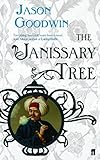
This is my review of The Janissary Tree (Yashim the Ottoman Detective) by Jason Goodwin.

Like many detectives, Yashim is a loner, but it is for the unusual reason that he is a eunuch and therefore somewhat set apart from others and so better-placed to observe events. This makes him invaluable to his employer, the Sultan in 1830s Istanbul, even if the ruler ironically does not fully appreciate his skills.

In the first of what has turned out to be a successful series, Yashim is called upon to solve the murder of a concubine in the closed, sinister world of the harem, but is under greater pressure to investigate the disappearance and bizarre sequential murders of four young army officers.

At first, I was drawn in by the vivid images of Istanbul, by the appealing personality of Yashim, understandably bitter over his state, yet maintaining a wry sense of humour combined with a penchant for cooking mouth-watering dishes. The snippets of history concerning past sultans, the fall of Istanbul to the Turks and the bloody demise of the once influential yet corrupt military Janissaries are quite interesting.

Yet I soon became irritated by the short sound-bite chapters (132 in 329 pages) which seemed to be a device to pad out with digressions a thin plot, often making it quite tortuous and hard to follow in the process. On page 164, I became so disengaged by a chain of implausible dramatic events that I gave up on the book for a while. No serious spoilers intended, but apart from the fact that the author’s descriptions are often quite complicated and unclear, I couldn’t accept the idea of Yashim stopping the advance of a fire by demolishing a house it would seem virtually single-handed – surely the flames would leap across the gap, or simply blast down the other side of the street? Neither could I accept his ability to chase an assassin through crowded alleys on the basis of “magic……..an unreasoned and unexamined knowledge”. While I’m at it, some of the dialogue grated on me in sounding far too modern – more suited to metrosexuals meeting in a London wine bar – not to mention describing a tanning yard as the size of a football field.

When I returned to the novel for the sake of a book group, I enjoyed the second half more, perhaps because the end was in sight. The denouement is quite neat, but some key points seem unduly rushed, and I feel the novel as a whole could have been developed better. I do not plan to spend more time reading other books in the series, yet it is clearly quite popular.

⭐⭐⭐ 3 Stars

St. Agnes’ Stand by Thomas Eidson: Desert yarn

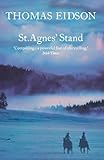
This is my review of St. Agnes’ Stand by Thomas Eidson.

This is not a typical western, even if at first handsome, tough and wily loner, Nat Swanson seems like standard material for the hero of one. As he rides through the desert wastes of New Mexico en route for a new life in California, on the run from a trio bent on avenging the death of a man he has just killed for reasons not fully explained, Swanson comes across two wagons ambushed by Apaches. Haunted by the face of a woman he has glimpsed at a window, he is drawn into offering help, only to find himself trapped in the apparently impossible task of saving a nun convinced he has been sent by God and the companions he has not bargained for, including several vulnerable children.

""The intense heat and wind were playing with the air, making it warp and shimmer over the land." What sets this novel apart from most westerns is the author’s skill not only in capturing a sense of the striking landscape but also in entering into the characters’ minds on both sides, so that we are half-able to identify even with the dilemma of the cunning, brutal Apache leader. Both Swanson and the nun are brought at times to question their actions and beliefs. Most of all, Eidson has a gift for creating a sense of tension, which is evident from the first pages as Swanson looks out for the slightest sign that he is being followed.

In his desire to hold the reader, Eidson does not shy away from images of gratuitous brutality which linger too long in one’s memory, nor from indulging in far-fetched plot twists. Suffering from multiple wounds and exhaustion, how on earth does Swanson manage to scale cliffs and hit targets with his crossbow, let alone carry packs containing blankets and even the luxury of coffee? Yet despite feeling disturbed or irritated by all this, combined with unease over the negative portrayal of the Indians and the dollops of sentimentality which are combined too casually with all the violence, this book is a page turner.

The author describes himself as inspired by a strong oral tradition of spinning yarns, and this tale reminds me of Norse legends, in which there is a thread of morality and spirituality beneath the thud, blunder and exaggeration.

⭐⭐⭐⭐ 4 Stars

Recalling Bellow’s Gift

This is my review of Humboldt’s Gift (Penguin Modern Classics) by Saul Bellow.

A prize-winning author whose creative life is stagnant while his personal life is in a mess, Charlie Citrine is haunted by memories of his former friend and mentor, the brilliant but manic poet Humboldt Fleischer. Humboldt is based on the real-life poet Delmore Schwartz, a one-time colleague of Saul Bellow, to whom Charlie himself bears quite a strong resemblance.

The rambling plot which switches back and forth in Charlie’s mind is mainly a framework for Saul Bellow’s astonishing prose, a mind-blowing stream of consciousness, with punctuation (minus commas between adjectives, an interesting technique). This is leavened by many very funny descriptions and dialogues, which may atone for any irritation over yet another novel by a writer about writers, and for Bellow’s casual cultural references which require everyone who is not an American with an encyclopaedic general knowledge to either break the rhythm of reading to look them up, or remain in ignorance.

The humour also serves as an antidote to Citrine’s philosophical musings about the state of the soul, the existence of an after-life and the decline of American society by the 1970s into consumerism and banality. Citrine’s monologues, which tend to be made more digestible for the reader by frequent mocking or teasing interruptions, generally from female lovers past and present, suggest that his ideas are underdeveloped, even confused. Yet this may be intentional, since Bellow himself seems to have changed his opinions substantially over his long life spent reflecting on the meaning of life.

You may regret that Bellow dissipated his extraordinary verbal talent on such a self-absorbed, self-indulgent, weak, lecherous man as Citrine, although he is redeemed by a self-deprecating sense of humour and a rather appealing ability to understand the viewpoint of those fleecing and manipulating him, and to find a sense of proportion when things get tough. Bellow might of course argue that Citrine is merely a parody of himself, a man whose flaws did not prevent him from producing brilliant prose. So, despite its verbosity, repetition, sometimes woolly thinking, and damp squib conclusion, this original, remarkable work with its stunning descriptions of places, notably Chicago, and people, its wit, interesting ideas, insights and ultimately entertaining plot is worth reading – although you have to take the novel slowly to get the most out of it.

⭐⭐⭐⭐⭐ 5 Stars