This site will share with you hundreds of book and film reviews written since 2009. Also a chance to discuss these reviews together with some of my creative writing to be added.
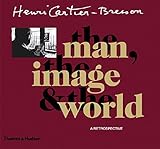
This large and heavy paperback may not fit easily on your shelves,but makes an enticing coffee table book with its large selection of Cartier-Bresson's celebrated black-and-white photos, usually with the black border showing that the original negative has not been cropped, and covering the span of his career (mainly 1930s – 1970s) spent travelling the world as a photojournalist, trying to capture "the decisive moment" or "fugitive instant" to represent the meaning of a scene or event. His gift for remaining unobtrusive, yet acting with feline speed when required, enabled him to obtain some striking but unposed and therefore more natural images.
The book includes a few biographical chapters and also interesting examples of his work as a small-scale film producer in the studio of Jean Renoir, plus the drawings and paintings to which he turned in old age, virtually abandoning the 35mm Leica which had made photography "his way of life".
You will find yourself poring for minutes on end over the spontaneous shots which preserve striking patterns of light and shade, geometric shapes made from the natural interplay of objects, insights into the lives of ordinary people captured in his "street photography" and impressions of landscapes, often resembling paintings in their composition.
If you have not read the previous novels in the Patrick Melrose series, in particular “Mother’s Milk”, embarking on this novel may feel like walking into a room full of mainly pretentious or snobbish strangers who talk across you about people and incidents you know nothing about.
The author tells you quite a bit about past events, but not enough to plug all the gaps.
Driven to drugs and drink in previous episodes, his marriage destroyed, the anti-hero Patrick’s neurosis is focused on the failings of his mother, Eleanor, like him to some extent the victim of a wealthy upper class but dysfunctional family background. Perhaps her greatest folly has been to insist on giving away her beautiful house in France and fortune to members of a spiritual, do-gooding cult who appear to be hypocritical rogues on the make. “At Last” begins with her cremation, a cue to bringing together previous characters in the series, and an opportunity to draw Patrick towards a sense of closure, perhaps a chance to draw a line and move on. Thus, “At Last” forms a suitable finale to the series.
In “At Last” you have to wade through too many highly condensed explanatory flashbacks to find any of the striking descriptions, sharp dialogues and amusing situations which carried me through “Mother’s Milk”. As with the latter, many characters are caricatures or rather two-dimensional, and the idea of a plot seems incidental. The opening monologue from the ghastly and unexplained upper-class bore Nicholas Pratt seems implausible during a cremation, a contrivance to recap on Patrick’s troubled family, and makes for an off-putting beginning. Then, the succession of digressive flashbacks about Patrick’s past addictions and relations with other characters, sit oddly in the middle of the ongoing scene of the funeral.
Overall, the structure seems too rambling. The many references to past events are likely to seem repetitive to those already familiar with them, but confusing and indigestible for newcomers. As a result of all this, the book is not as moving as it should be. It is as if St Aubyn has become addicted to the Melrose theme, and keeps dribbling it out, with a few details added, in successive books over several years, whereas perhaps from a literary viewpoint it would have been better digested and restructured into a different format.
So, I think you need to be a well-informed “Melrose addict” really to enjoy this book. Although St. Aubyn can prove a talented writer, “At Last” does not seem to be one of his best works.
“A non-fiction writer pursuing the literature of reality” – even before I came across the groundbreaking pioneer of “New Journalism, Gay Talese’s, description of himself, I had thought his accounts of meetings with celebrities read like novels, and his fly-on-the-wall presence so self-effacing that many of the episodes could have been fictionalised.
His writing reminds me of Alistair Cooke’s “Letters from America”, with the same artful trick of rambling for a purpose, gradually ensnaring you in topics you would not expect to enjoy. For instance, there are three articles centred on boxers, one on Frank Sinatra, another on life behind the scenes at Vogue magazine, none of which are subjects of any interest to me at all, but Talese’s sharp observation and fluid, unpretentious prose sucks you into a range of different and unfamiliar worlds.
As he explains in “Origins of a nonfiction writer” it was listening behind the counter in his mother’s dress shop that taught him the importance of listening without interruption, of asking “And what did you feel? ” to get at the “interior monologue” illustrated so effectively in the “loser” Floyd Patterson’s moving reliving of his humiliating defeat in a fight with Sonny Liston.
I particularly like Talese’s portrait of the actor Peter O’Toole at the height of his fame, yet clearly troubled from his childhood in Catholic Ireland. “I am a left-hander who was made to be right-handed,” he explains, displaying his right hand scarred and deformed from being constantly used as “a kind of violent weapon……smashing through glass, into concrete, against other people, whereas his left hand is “long and smooth as a lily”.
In the very different context of a Parkinson-afflicted Mohammed Ali on a goodwill trip to Cuba, Talese tells you a lot about Havana through his description of “a memory lane of old American automobiles chugging along….various vehicular collages created out of Cadillac grilles and Oldsmobile axles…patched with pieces of oil-drum…with kitchen utensils and pre-Batista lawn mowers …and other gadgets which have elevated the craft of tinkering in Cuba to a high art”.
My only reservation about this surprisingly gripping short selection of essays is that it is a bit dated, being set mainly in the `60s and involving characters likely to be outside the experience of most readers under 40. So, the pieces are a mixture of striking, wrily humorous or thought-provoking situations and dialogues, interspersed with mundane passages you may be tempted to skip – risky, since you may miss a gem.
⭐⭐⭐⭐ 4 Stars
Frank Sinatra Has a Cold: And Other Essays (Penguin Modern Classics)
How could I have left this book to languish on my shelf for years before reading it? At first, I was bowled over by the sharp, witty prose, striking descriptions and amusing dialogue. This short novel follows the trilogy "Never Mind, Bad News and Some Hope" about tensions within a dysfunctional upper middle class family, the Melroses. "Mother's Milk" can stand alone, but the books are probably best read in sequence, ending with the recently published "At Last".
Mother's Milk has an unusual opening, with a small boy (Robert) "remembering" the trauma of being born, the sense of insecurity in the "new world" outside the safety of his mother's womb. Or has the birth of his younger brother (Thomas) caused him to imagine all this? At any rate, it is interesting to be prompted to question just what a small child remembers from the beginning of life, before it is swamped by other impressions. Robert is, of course, ludicrously precocious and implausibly articulate. His cynical, upper middle class barrister father (Patrick) may have had a hand in this.
When the story moves on to the viewpoints of Robert's parents, my enjoyment wavered. All the characters begin to appear to be caricatures, so that you laugh often, but are rarely moved. The apparent reasons for Patrick's drunken mid-life crisis do not evoke huge sympathy. Although it must be frustrating that his do-gooding mother has disinherited him in favour of a half-baked "Transpersonal Foundation", Patrick still seems to be quite well off. His wife Mary's preoccupation with her new baby, possibly a reaction to her own mother's neglect, may get a bit wearing at times but does not really justify his infidelity with an old girlfriend. If you have read the earlier novels, the details of the story may make more sense. As it is, there is a little too much condensed "telling" of past events, rather than gradual "showing".
You may argue we are not meant to take it all too seriously but rather to enjoy the comical situations, laugh aloud at the humour and be stopped short by the occasional telling insight. Yet, there is an underlying sense of bleakness, so it came as no surprise to read in a review that Patrick is modelled, if loosely, on the author, who freely admits that he was raped by his father, rather as Patrick, it seems, was abused in the first novel, "Never Mind".
Yes, the attitude to old age in this book often seems cruel and lacking in empathy. Yes, the writing is rather crudely anti-American. You could also say it is truthful, if one-sided. My main criticism is that the plot is thin and developed rather carelessly, with missed opportunities to create to develop scenes.
Despite this, St Aubyn is clearly a very talented writer.
This is likely to divide opinion sharply since it rejects the convention of a clear plot, and flits back and forth in time with a variety of viewpoints and sheer number of characters which may prove confusing.
It is a series of short stories rather than a novel, focusing in turn on different members of an amorphous group who have in common only some kind of link to the music industry – they know, or know someone who knows, either Bennie the driven music manager, or Sasha, his light-fingered assistant whose kleptomania may have some deeper emotional cause.
I enjoyed the quirky incidents and offbeat humour of the first seven chapters, and the game of anticipating which character mentioned in passing would turn up as a key player in the next episode. I liked the way the author always managed to overcome my irritation at being dragged away from one group of characters, by skilfully hooking me in to the next one, only to be disappointed again at having to leave the new story with strands left unresolved, perhaps forever.
Some of the relationships are genuinely moving, such as the hard-bitten, selfish, corrupt Lou's love for his sweet, gentle son, whom he cannot help inadvertently damaging, just through being the bastard that he is. I was impressed by the study of Scotty, mentally ill but managing after a fashion, who convinces himself half the time that being a failure is as good as being a success.
My good opinion suffered a blow in Chapter 8, an over-farcical account of a disgraced PR manager trying to make ends meet by advising a genocidal dictator of some unnamed country, which was an annoyingly unconvincing mixture of Arab desert too close to lush African jungle. The there are two sections I grew too bored to read properly: an intentionally bad , I think, parody of a journalist's interview with a movie star, followed by an attempt to relate to an autistic boy, and to show his thought processes, through a PowerPoint presentation – a novel idea, but it goes on for 74 pages – has the author not heard of death by OHP? After that, the return of the final chapters to some of the original characters lacks the power to engage me, in a work which seems to have lost its way – perhaps because the subjects are essentially rather uninteresting and underdeveloped players in an artificial and shallow world.
On one hand, this book is unusual, often creative and original, with what you might call brave experiments (but shouldn't the author be clear-eyed enough to see where they may have fallen short?), yet there is too much that is contrived, gimmicky or glib for me to rate this as an indisputably worthy Pulitzer winner.
The cat's table is "the least privileged place" in the dining room aboard an ocean liner bound for Tilbury from Ceylon in 1954. The narrator, Michael , recalls how, as an eleven-year-old, this is where he meets not just two other unaccompanied boys, but a group of eccentric adults. In the accurate belief that they are invisible, at least until their mischief brings them to the captain's notice, these three racket around, experiencing the complex life of a ship, straying below deck and into first class, eavesdropping as they lie hidden in the lifeboats where they gorge the emergency chocolate rations, getting involved in bizarre events, hearing quirky, often unsuitable anecdotes, all of this related in short chapters which add to the fragmented, dreamlike quality of the voyage.
The "main plot" of the story, which revolves round a mysterious shackled prisoner who is brought out for exercise at night, proves rather thin and implausible with an unsatisfying ending, yet does not appear to be the author's main concern.
The novel seems to be mostly about the nature of memory and the way people relate to one another, so that fleeting impressions, brief incidents and passing friendships from early life may prove unexpectedly enduring and significant in adulthood.
I found the description of the voyage and numerous rambling into vignettes very evocative and absorbing. Less satisfactory are the frequent "flash forwards" to Michael's later life. His adult relationships with his cousin Emily and with his friend's sister Massi do not prove as convincing and moving as I think they are intended to be.
It is interesting to speculate to what extent the events of the voyage make Michael permanently mistrustful , someone who breaks too "easily away from intimacy", although having rather distant parents and uncaring relatives who think it in order to send him unaccompanied on a long voyage is probably the main reason.
Overall, this is an unusual novel which lingers in one's mind. It is brilliant in ways that will differ according to the reader's own cast of thought. An example of this for me is the description of the night-time sailing through the Suez canal, which years later Michael's friend Cassius captures in paintings which only Michael can appreciate have been drawn "from the exact angle of vision Cassius and I had that night". I like the humour in Michael's list of the irascible captain's "crimes committed (so far)" most of which are actually the children's fault. However, the tale is also flawed when some allusion or plot development misses the mark or falls flat.
The journalist John Kampfner examines in turn a wide range of modern states which have to varying degrees traded personal freedom for the promise of increased security, prosperity or both.
He opens with a fascinating chapter on Singapore, the self-styled "most successful state in the history of humanity" where Lee Kuan Yew has micro-managed his state to create a well-behaved, conformist population, in which extreme poverty has been eradicated, people are kept happy with shopping and recreational facilities, and alarm bells only begin to ring when you realise that free speech is trammelled, dissenters are harshly punished, and the rate of capital punishment is "regarded as secret" but said to be among the highest in the world. As a local sociologist observes, "Understanding the limits of freedom is what makes freedom possible". As Kampfner adds, "perhaps it depends on which freedoms and which limits."
Subsequent chapters cover China and Russia, where the West made the cardinal error of assuming that the encouragement of the free market after the collapse of communism would automatically lead to greater democracy. Then we move on to the "consumer excess" of the United Arab Emirates, supported by near-slave immigrant labour, the "functioning anarchy" of India, and Italy under Berlusconi.
The next section on Britain with a focus on the development of the "surveillance state" under Blair, seems the least successful, perhaps because the details are already familiar but too condensed and partial.
The "tainted dream" of the United States provides the final case study, with the Bush regime's sharp clampdown to minimise the terrorist threat after the shock of 9/11: in one case, a dragnet based on tip-offs which rounded up 80,000 people, mostly illegal immigrants, did not lead to a single conviction for terrorism.
All this shows that the "difference.. between countries roughly in.. the `authoritarian camp', and those who pride themselves on their `democratic' values may be one of degree".
The author notes in his interesting postscript how he has been attacked as "anti-capitalist" on one hand and an "apologist for dictators" on the other – a misreading of his argument on both counts. He simply presents the facts in a lively style, and leaves us to reflect on the nature of our freedom, and whether we have as much as we think, or need.
Offering ideas, but no easy solutions, he ends with the sad irony that many nations' freedom has been "bought off with a temporary blanket of security and what turned out to be illusory prosperity" after the economic crash which has affected Singapore, China and Dubai as well as the US and Europe.
For a readable book of this length, Kampfner has done a good job. My reservations are twofold. Firstly, he glosses over what freedom and democracy really are, tending to assume that readers will already know – unlikely if few of us really have them! Secondly, this book (which needs to be updated regularly) would benefit from a fuller and more realistic analysis of how countries facing economic collapse could take the opportunity to re-align the balance between wealth-creation, security and liberty.
This is an excellent history of modern China, very readable despite the small print and thin pages. Admittedly, it requires a good deal of time and dedication, but repays the effort. Clearly very knowledgeable but modest with it, Spence knows what points to select from a mass of detail to convey a clear understanding of how and why China evolved from a vast empire, which had turned its face inward against western-style development, to the world's largest communist state, now rapidly embracing economic growth.
He starts with the decline of the late Ming dynasty in the late C17, enough to capture the flavour of a highly centralised, bureaucratic, top-down society which has been the nature of China since the first unified Qin dynasty of 221BC, but he doesn't make the mistake of getting bogged down in detail that far back.
In the subsequent Qing dynasty, we see the first painful enforced contacts with the west, including the shameful role of the British, in flogging opium to save having to spend silver on purchasing Chinese goods. In addition to the usual problems of natural disasters and the difficulty of collecting taxes in such a vast area, the Qing had to contend with major rebellions but managed to survive for a surprisingly long time up to 1912, partly owing to the effectiveness of some impressive campaigns under remarkable Confucian-trained leaders, motivated by their loyalty to traditional Chinese values. Despite this, and a belated willingness to reform, the Qing eventually fell, leading to a prolonged period of chaotic civil war between a succession of warlords.
It is clear that the impetus for radical change came from men who, from the C19, had the opportunity to travel abroad where they could gain access to western political ideas of both liberal representative democracy – an alien concept in China – and Marxist-Leninism. Spence provides a clear analytical account of the rise to power of the Guomindang movement, inspired by Sun Yat-sen and led by Chiang Kai-shek until his exile to Taiwan. He traces the development of the communist People's Republic of China, by no means a foregone conclusion. The machinations of leaders like Mao Zedong as they tighten their grip on power, the Orwellian twists in accepted views make fascinating reading, even to those familiar with the basic facts. To quote Spence on the abrupt fall from favour of Lin Biao under Mao Zedong's regime: "The credulity of the Chinese people had been stretched beyond all possible boundaries as leader after leader had been first praised to the skies and then vilified."
Deng Xiaoping is an intriguing character, as he steers his vast nation towards economic development with periodic crackdowns on free speech, the most shocking and tragic being the killing or wounding of thousands in Tiananmen Square – worse violence perhaps than any single incident in the recent "Arab Spring".
Every section starts with a useful summary, and there is a full glossary at the end in the likely event of your finding it hard to retain the confusingly similar names of many people and places. Although there are many maps to describe the numerous military campaigns, I would have liked a brief section at the outset to highlight key aspects of the geography.
I am most interested in present-day China, but this book provides an essential foundation to understanding this country's complex mix of sophistication and barbarity – developing beautiful artefacts hundreds of years before say the UK, only to smash them wantonly in the misnamed Cultural Revolution of the 1970s. The historical approach enables us to appreciate how the protests of the Chinese who spoke out against repression in the 1970s and 1980s echo those of the past, not just the anti-Guomindang and the anti-Qing of the late C19, but even the Ming loyalists of the C17.
Last updated in 1999, this seminal work is now due for a brief update to cover recent developments as China invests in Africa and copes with the effects of global recession.
It is easy to understand why H.H.Munro, pen name Saki, is still regarded as one of the greatest writers of short stories. His elegant, ironic prose reminds me of P.G. Wodehouse with a sharp sting in the tale.
Although Saki mocked the snobbery and hypocrisy of upper class Edwardian England, he himself seems to have been limited by unexamined prejudice against the lower classes, women in general, and new social movements of his day like female suffrage and socialism.
Organised by date of collection, the tales show a clear progression. The early "Reginald" stories are remarkably short, often barely a page, very dated and a bit too precious in style for my taste. As the years pass, the stories gain in length and depth, culminating in works like "The Square Egg". This captures the muddiness of trench life in World War 1 – the streaming mud walls, the inches of soup-like mud at the entrance to the dug-out, the muddy biscuits eaten with mud-caked fingers. This story also shows Saki's talent for going off at an imaginative tangent, in this case based on a wily Frenchman's novel idea for using the idea of "square eggs" from specially bred hens to try to get some money out of the narrator.
I particularly enjoyed the stories which focus on real emotions and psychology which could be relevant to any age and society: "Peace Toys" in which an uncle tries to give his nephews toys which will discourage them from violent play; "Tobermory" which speculates on the practical disadvantages of having a cat which has learned to speak about all the compromising goings-on it has witnessed as it creeps around unnoticed; "The Lumber Room" in which a small boy takes advantage of a rare chance to have his revenge on a pious, bullying aunt – the many stories about children getting their own back on control-freak adults may stem from painful experiences in Saki's own motherless childhood. Then there is "The Story-teller" where a bachelor distracted by noisy children on a train ride subverts the normal rules about telling children only improving stories.
I have mixed feelings about Clovis, a favourite recurring character of Saki's, who acts as a mocking observer of the class to which he has been born, while sponging off it, and snobbishly maintaining many of its prejudices. Yet "Clovis on Parental Responsibilities" is amusing where, in a Pinterish talking at cross purposes with a Mrs Eggelby, bored by her endless prattle about her children's accomplishments, Clovis undermines all the accepted views on bringing up children.
I would have liked a brief introduction on Saki's life. It seems important to know that, enrolling as an ordinary private soldier when in his forties, he was killed by a sniper's bullet after vainly asking a colleague to put out the cigarette which was emitting a tell-tale trail of smoke.
It is easy to understand why H.H.Munro, pen name Saki, is still regarded as one of the greatest writers of short stories. His elegant, ironic prose reminds me of P.G. Wodehouse with a sharp sting in the tale.
Although Saki mocked the snobbery and hypocrisy of upper class Edwardian England, he himself seems to have been limited by unexamined prejudice against the lower classes, women in general, and new social movements of his day like female suffrage and socialism.
Organised by date of collection, the tales show a clear progression. The early "Reginald" stories are remarkably short, often barely a page, very dated and a bit too precious in style for my taste. As the years pass, the stories gain in length and depth, culminating in works like "The Square Egg". This captures the muddiness of trench life in World War 1 – the streaming mud walls, the inches of soup-like mud at the entrance to the dug-out, the muddy biscuits eaten with mud-caked fingers. This story also shows Saki's talent for going off at an imaginative tangent, in this case based on a wily Frenchman's novel idea for using the idea of "square eggs" from specially bred hens to try to get some money out of the narrator.
I particularly enjoyed the stories which focus on real emotions and psychology which could be relevant to any age and society: "Peace Toys" in which an uncle tries to give his nephews toys which will discourage them from violent play; "Tobermory" which speculates on the practical disadvantages of having a cat which has learned to speak about all the compromising goings-on it has witnessed as it creeps around unnoticed; "The Lumber Room" in which a small boy takes advantage of a rare chance to have his revenge on a pious, bullying aunt – the many stories about children getting their own back on control-freak adults may stem from painful experiences in Saki's own motherless childhood. Then there is "The Story-teller" where a bachelor distracted by noisy children on a train ride subverts the normal rules about telling children only improving stories.
I have mixed feelings about Clovis, a favourite recurring character of Saki's, who acts as a mocking observer of the class to which he has been born, while sponging off it, and snobbishly maintaining many of its prejudices. Yet "Clovis on Parental Responsibilities" is amusing where, in a Pinterish talking at cross purposes with a Mrs Eggelby, bored by her endless prattle about her children's accomplishments, Clovis undermines all the accepted views on bringing up children.
I would have liked a brief introduction on Saki's life. It seems important to know that, enrolling as an ordinary private soldier when in his forties, he was killed by a sniper's bullet after vainly asking a colleague to put out the cigarette which was emitting a tell-tale trail of smoke.



 Antenna Reviews