Cracking a pig’s egg

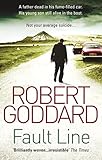
This is my review of Fault Line by Robert Goddard.

I have a weakness for Robert Goddard's novels which are notable for their highly convoluted intrigues and often original themes based on some historical or topical issue, in this case the china clay industry, in decline around St Austell in Cornwall but apparently expanding in South America, which the author manages to link with dastardly deeds in Naples and the beautiful island of Capri which he of course makes you want to visit.

Although I understand why some reviewers feel that his novels produced annually have become pot boilers in danger of burning dry, it seems to me that, following on the heels of "Blood Count", "Fault Line" confirms a return to form as regards plot, although I wish that Goddard would make the effort to edit some of the triteness out of his prose.

In Jonathan Kellaway we have a likeable and convincing character who displays integrity and presence of mind, the very qualities which encourage more devious people to make use of him, asking favours which ensnare him in precarious and even dangerous sitations in the process. The plot is quite well-structured and deftly revealed. I agree that some aspects of the denouement are implausible, but isn't that often the case with this type of thriller? With a main plot perhaps a little less extraordinary than is often the case with Goddard, I worked out fairly early on what the explanation must be, but was not left disappointed at the end since there was a thought-provoking final twist I had not foreseen.

This is a page turner and an enjoyable read, relying on suspense and tension rather than sex or violence.

⭐⭐⭐⭐ 4 Stars

A Striking Variation on “Death in Venice”

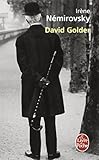
This is my review of David Golder (Le Livre de Poche) by Irene Nemirovsky.

In her spare prose, Irene Nemirovsky portrays in vivid and minute detail the thoughts and final acts of David Golder as he faces up to the death he has always feared. Having escaped as a youth from poverty in Russia, Golder has ruthlessly gained a vast fortune, but has nothing to spend it on, save the extravagances of his wife, who uses luxuries as a substitute for the love he cannot give her, their daughter Joyce who has been spoiled with material goods, and all the hangers on whom the rich attract.

On the surface, all the main characters are despicable, calculating, self-seeking and unlikeable. However, Irene contrives to evoke from us some pity for all of them, in particular Golder. Although this is to be honest a rather depressing book, there are some unexpectedly moving and beautiful scenes, evoking long-lost places and lifestyles of 1920s Europe and Russia. Nemirovsky is worth reading for the quality of her writing.

I have read reviews which attack Nemirovsky for her anti-semitic tone. Although Jewish herself, she converted to Catholicism and wrote for anti-Jewish publications, yet this could be excused as an attempt to escape persecution – one which failed since she was deported to Auschwitz where she died of typhus. I admit that at times, I find it hard to believe that she is not "a self-hating Jew" in the prejudiced and negative descriptions she often employs. Apart from the fact she may only be conveying the views of other characters, there is a subtle humanity in her writing – she seems to me to describe characters warts and all, with all their flaws and vulnerability, without a trace of sentimentality.

⭐⭐⭐⭐ 4 Stars

Caught in the current

This is my review of No Time Like the Present by Nadine Gordimer.

Having admired years ago Nadine Gordimer's anti-apartheid novels which won her the 1991 Nobel Prize for Literature, I was impressed to find that, approaching ninety, she is still writing, dissecting the state of "free" South Africa.

This is the tale of a mixed-race couple adjusting to a world in which they no longer need to conceal their relationship, but also find that the freedom to make choices and lead a "normal" life often highlights cultural differences they did not notice when plotting undercover dissidence, plus there is the growing realisation that their new black leaders succeeding Mandela are often deeply flawed and corrupt, to such an extent that it might even be preferable to emigrate, the supreme irony in view of what Steve and Jabu have sacrificed for their country.

Although I wanted to like this book, to learn from Gordimer's deep knowledge and insights into South Africa, the stream of consciousness style proved a barrier that soon became insuperable. When I managed to tune into the fragmented phrases alternating with garrulous paragraphs, I could see that I was being enabled to sense the characters' diverse, fleeting thoughts as directly as if they were my own. However, the reading process becomes an exhausting labour rather than a stimulating pleasure, with the too frequent distraction of phrases that are oddly convoluted to no purpose, and dizzy-making switches from one heavy subject allusion to another.

Gordimer's style seems to have evolved over the decades, so one has to assume the current phase is deliberate. The prose reads as if written or typed "as it comes" without any attempt at honing or editing. In the end, I decided with great reluctance to abandon the effort for the time being – a great pity since there is a need for thought-provoking novels on the new South Africa based on first hand observation and understanding.

⭐⭐⭐ 3 Stars

“The Lifeboat” by Charlotte Rogan – The Will to Survive

This is my review of The Lifeboat by Charlotte Rogan.

This opens with Grace Winter on trial for some unspecified crime on board a lifeboat after the sinking of a luxury liner en route from England to the States in 1914. We expect murder at least and possibly cannibalism. Since a plea of insanity may be the best option, Grace is asked by her lawyers to write a detailed account of events on Lifeboat 14. This is a good literary device, although it requires the reader to suspend disbelief that a recent survivor of a prolonged trauma would be capable of producing such a coherent and analytical record – Grace may of course be an unreliable narrator.

Charlotte Rogan is very ambitious in her decision to interweave Grace’s recollections of events on Lifeboat 14 with those of her earlier life, aboard the ship before it sank, and details of the trial afterwards. This courts the risk of defusing moments of high drama and the effects of the oppressive hardship on the lifeboat, day after day, as well as that of confusing the reader. In the event, I found the gradual revelation of events intriguing, even if it was disappointing to find some threads unresolved rather than somehow woven into the denouement.

I agree with reviewers who feel that the full horror of the experience is at times underplayed, but the author succeeds in showing the changing relationships between the passengers, the shifting power play, the way gossip morphs into facts which can be used to depose a failing leader. Although these issues could have been developed more fully, Rogan prompts us to reflect on what makes a survivor, the extent to which the normal codes by which we live are a veneer, the situations in which killing some people to save a large number overall could ever be justified.

I found this book a page turner, despite reservations that at the most dramatic points, or when discussing complex philosophical points, the prose, although clear and accessible, does not seem quite equal to the task, if you set the bar at a high level. I did not mind Grace’s rather pragmatic, analytical approach nor the lack of the kind of crazy, poetical fantasy one finds in the lifeboat of “Jamrach’s Menagerie” since Grace’s thinking represents that of a “born survivor”. This is intimated by her honest admission that, after the financial ruin of her husband, she planned the seduction of the wealthy Henry Winter away from his long-term fiancée to marry her instead.

I felt that the quality of the writing tails off a little in the final chapters which seem a little too disjointed. The book might have benefited from being longer to give more scope to develop its complex themes, or perhaps it would have been enough to work more on the prose in some key chapters.

As a first novel, this is very impressive. For plot and insight, this book scores highly and the prose is just adequate to sustain these.

⭐⭐⭐⭐ 4 Stars

Who caries?

This is my review of Sweet Tooth by Ian McEwan.

"My name is Serena Frome….and almost forty years ago I was sent on a secret mission for the British security service. I didn't return safely. Within eighteen months…I was sacked having disgraced myself and ruined my lover."

These opening sentences hooked me, although I might have preferred not to know all this information in advance. Then, I found myself trying to engage with Serena as I waded through page after page of dense description of the "telling" variety, in the voice of a sixty-something, upper middle-class woman looking back to her early life with a somewhat cold objectivity as if writing about someone else – a voice which I did not find quite convincing (an interesting point to debate when you have finished the book). Small things bothered me, such as the way Serena always referred to her father as "the Bishop", or did not bother to go to one of his services during a visit home at Christmas. Surely even an atheist daughter would make it to a carol service for old times' sake? Or her parents would have had something to say?

I kept reading only because the writer is the celebrated Ian McEwan, and being about the same age as him and Serena it was interesting to be reminded of the political and social ferment of the `70s which I did not fully appreciate at the time, so I wonder how much Serena's lists of events and comments on them mean to younger readers.

This novel seems to fall between three stools. Presented as some kind of spy thriller, it proves somewhat low key and unexciting. This could be realistic in that a young woman in the MI5 of the 70s was likely to be given only mundane tasks, but does not make for a great read. As a sometimes polemical take on the life and times of the 1970s, this novel might have made more impact as a series of Jonathan Raban type essays. It may succeed best as being in fact another sort of novel altogether about the art of writing. In this respect, Serena's analysis of her lover's ingenious short stories provides one of the most interesting aspects of the novel, although I felt no doubt unintentionally patronised by the suggestion that someone like Serena who loves reading but has never studied English may be impeded by not knowing how to "read" a challenging text.

The final twist may redeem the book a little, but I did not find "Sweet Tooth" as original as say "Enduring Love" nor as well-constructed as " The Innocent".

⭐⭐⭐ 3 Stars

A British Alice Munro?

This is my review of The Lighthouse (SALT MODERN FICTION) by Alison Moore.

In an attempt to take his mind off his failed marriage, the oddly named Futh (this appears to be both a German surname and urban slang) leaves England for a short walking holiday along the Rhine, but this only gives him too much time to brood on his sad childhood, dominated by his mother leaving home when he was about twelve. On his first evening at the ominous-sounding Hellhaus – literally "light house" – Hotel, Futh meets Ester with a parallel tale of an unhappy marriage and the price of passive acceptance of life.

In deceptively simple, plain and painstaking, unpretentious prose, Alison Moore dissects Futh's appearance, his thoughts, motivations, the events which have shaped him. All this is conveyed through his memories, behaviour, conversations with others, so we may come to different conclusions since the author never tells us what to think. Even the dramatic climax is ambiguous.

I believe the author has had success writing short stories, and this is very evident in the way that most incidents are like small, self-contained stories in their own right. In what is still a relatively short first novel, Moore has managed to produce what proves to be a tightly-structured overarching narrative, even if Futh seems to be bumbling around, often lost, much of the time.

Some readers have found Futh intolerably dull and the novel too mundane, but you could argue that the whole point is to make a very ordinary and in some ways unappealing man the subject of a story which may have all the pathos and ironical chain of cause and effect of a more flamboyant tragedy. Moore displays the power of an understated story, on a par with a first-rate minimalist painting or musical score.

There is perhaps a little too much symbolism e.g. the heavy use made of Muriel Spark's description of "the tall lighthouse sending out kindly beams which some took for welcome instead of warnings against the rocks" or the Venus flytraps. I admit this is not a page-turner, except towards the end when I knew that the "something bad" indicated at the beginning was about to occur. If you like action-packed thrillers or romance, this is not the book for you. It is also deeply sad, definitely not "feel-good", although Futh's continual failures – even the ducks don't want to eat his bread- is just about saved from becoming unendurable through the narrator's frequent flashes of wry humour. At times, I was reminded of Mr. Bean.

I agree that it is hard to believe that Angela would marry a man like Futh, but since she is seen through his eyes, we know he is too damaged himself to be capable of empathising with her or grasping the complexity of the emotions which drove her to marry him. In the same way, his perception of his relationship with Kenny is clouded by his own emotional stunting. All this may demonstrate the subtlety of Moore's writing, when you pause to think about it.

I admire this novel without much liking it, and suggest it as a good choice for a book group if you are interested in discussing the craft of writing, debating what makes a good ending, and understanding polarised viewpoints.

⭐⭐⭐⭐⭐ 5 Stars

A Dip at the Shallow End

This is my review of Swimming Home by Deborah Levy.

A beautiful, mentally sick young woman is caught swimming naked in the pool of a French villa rented by a famous poet, his dysfunctional little family, his wife's old school friend and her unappealing husband. Why is the young woman invited to stay when this is so clearly unwise? Just what form will the inevitable resultant tragedy take? Or will it simply prove to be a lightweight farce?

Although this may not be an entirely original scenario, there is plenty of scope for a compelling drama for which the author creates a cast of potentially interesting characters. The plot is revealed obliquely, in short chapters with continually changing viewpoints, disjointed scenes like fragments of glass which are often quite surreal. This approach may be what led to the Man Booker shortlisting, but combined with a style that flits in a sometimes jarring fashion between parody and caricature, psychological drama and even a touch of magic realism, the result left me feeling unengaged with and unmoved by the main characters, although I thought the adolescent Nina and the lonely old doctor observing them all from her balcony were well drawn.

At first, I was annoyed by the author's habit of telling the reader too soon and too baldly what is going to happen. I later realised that she is often setting red herrings in our path, which could be quite clever, except that the climax proves too abrupt and inadequately foreshadowed and explained. Then the final chapter seems too much of a sentimental footnote.

I think the book may improve on a second reading, but it was seriously marred for me by a lack of subtlety in the development and some surprisingly gauche prose, which read as if the author wrote what first came into her head without any reflection and redrafting. These factors would have caused me to give up midway if the novel had not been so short and Booker-listed. I believe that Deborah Levy has achieved success as a playwright and perhaps this story would work well on the stage, although it would be hard to create the sets for some of the locations which add flavour to the story.

⭐⭐⭐ 3 Stars

But still the heart doth need a language

This is my review of The Map of Love by Ahdaf Soueif.

Lonely and at a loose end after her return to Cairo, Amal assists the thirty-something American Isabel Parkman to translate some of the papers left by her great-grandmother Lady Anna Winterbourne who married an Egyptian nationalist a century before at a time of great political unrest when Egypt was still "under the yoke" of the British Empire. Fascinated by Anna, Amal begins to reconstruct her story, although it is often hard to know where fantasy ends and real scenes from the past begin. To a lesser extent, she applies the same approach to Isabel's meetings with Amal's suave elder brother with whom she is becoming infatuated.

The prospect of gaining a perspective on Egyptian history and politics seen through the eyes of an Egyptian woman, the author Ahdaf Soueif, is what drew me to this book, although I agree that the combination of somewhat soft-centred romance with serious historical and political comment may cause it to fall between two stools. The theme of examining love affairs between different cultures across generations against a complex political background is very ambitious, and perhaps the price paid is that the reader's attention is stretched over too many people, rather than engaged with a few fully developed central characters.

The author's style may be typically middle eastern and therefore all part of the experience to be gained, but I found my growing impatience with it a real barrier to reading the book. Despite my strong desire to like this novel, I felt smothered by its embroidered wordiness, the often banal dialogues and overdetailed descriptions as a substitute for dramatic action, the convoluted structure clanking back and forth in time. At one point Soueif goes off at a tangent on the nature of colour and the impossibility of defining the point at which, say, blue becomes green. Why not simply express this fascinating idea in a few pithy words on the lines of, "How strange that one cannot see exactly when blue turns into green"?

This is, as a reviewer described another of her books, an acquired taste. If you enjoy long, slow, rambling, gentle even in the midst of violence, reflective family sagas with frequent little digressions this may well appeal. Also, apart from its length, this could be a good choice for a book group as it provides scope for discussion of both plot and style, and is likely to divide opinion.

⭐⭐⭐ 3 Stars

Challenging the Extrovert Ideal

This is my review of Quiet: The power of introverts in a world that can’t stop talking by Susan Cain.

"Quiet" will strike a chord if, in an attempt to secure a job, you have ever claimed in a personality test to prefer going to a party to reading a good book, only to find that you still come out with an introvert's score.

Susan Cain makes an interesting comparison between the "Culture of Character", which valued those who were serious, disciplined, modest and honourable (think of a Jane Austen hero) and the "Culture of Personality" with its emphasis on impressing people and influencing them which developed Dale Carnegie style in C20 America to feed an economy based on mass production and sales. The latter obviously tended to encourage "charismatic leadership" and the desirability of employing extroverts. Cain produces a vivid description of Harvard Business School, where the young men "stride, full of forward momentum" and the women "parade like fashion models, except they are social and beaming". "Good luck finding an introvert round here," they quip.

Yet, there is growing evidence of how assertive people who are allowed to take decisions, often on the basis of inadequate knowledge, just because they sound confident, frequently make serious errors which they would have avoided if only they had listened to an introvert. The unwise investments made in the recent financial collapse, and the decision to fight the Iraq War come to mind. By contrast, introverts may make surprisingly effective leaders in organisations where there is a need to be receptive to the ideas of staff undertaking complex tasks.

Cain discusses how introverts may need to "act extrovert" to achieve their ends but also urges them to claim the acceptance to be themselves, not criticised for "working slowly and deliberately", liking to concentrate on one task at a time, and being "relatively immune to the lure of wealth and fame", often called "reward orientation". In a perhaps rather utopian section, she suggests how education could be adapted to meet the needs of introverts e.g. not so often forced to work in large noisy groups with continuous interaction.

I particularly enjoyed the introduction, which provides the gist of the book as is often the case, and the wonderfully entertaining Chapter 2 featuring the "hyperthymic…extroversion-on-steroids" guru Tony Robbins as he sets out to "unleash the power within" at a minimum of $895 a head. This book often seems to be more a dissection of American culture than about introversion.

Although I was initially very impressed with "Quiet", I soon found that the anecdotes seem rather long-winded and corny, the scientific theories a little oversimplified and some of the examples given of introversion appear subjective and open to question. To be fair, this is probably the reaction of an introverted Brit to a relatively over-chatty, populist American approach.I began to skim through, looking for the key observations which could in fact be summarised in a single colour supplement article. Yet, if Cain succeeds in stimulating more people to read about psychology, and induces a few extroverts to think more positively – even gain a little more awareness – about introversion, this book will have achieved a good deal.

⭐⭐⭐⭐ 4 Stars

A Modern Rival to Maupassant

This is my review of Concerto a la memoire d’un ange by Eric-Emmanuel Schmitt.

His ingenious plots on a wide variety of original themes, each ending with an unpredictable twist combine with his uncluttered prose to make the French-Belgian Eric-Emmanuel Schmitt's short stories gripping and memorable. His success as a dramatist assist him in creating tight structures and dramatic scenes with realistic dialogues.

For me, "The Poisoner" (L'Empoisonneuse) is a near perfect short story in its structure and style. Marie Maurestier, acquitted of the murder of three husbands and a young lover, is the object of speculation and some fear in the local community. The local butcher beckons her to the front of the queue to get her out of his shop as fast as possible. She arouses neither sympathy nor affection because of her sharp tongue, but is also valued as a local tourist attraction. Then, Gabriel, a handsome and dedicated young priest comes to take charge of the church, with dramatic results. Schmitt cleverly manipulates our changing attitudes to Marie and Gabriel. Examining motives and moral issues from every angle in his fluid prose, he builds up a sense of tension and compulsion to read quickly to the end to learn the outcome.

In the shortest tale, a tough seaman receives a message to the effect that one of his daughters has died – but which one is it? In a prize-winning novella which gives the book its title, an ambitious young pianist is driven almost mad with jealousy over the superior technique of an impossibly virtuous and unworldly violinist. In some ways this story is too contrived but still absorbing. Finally, we see the effects of a woman's decision to tolerate no longer the philandering of her corrupt husband who just happens to be the President of France. This last story seems most influenced by Schmitt's embracing of Catholicism in later life. Yet, although all the stories perhaps inevitably have a strong moral basis, he never preaches, and is often unflinching in subjecting his characters to fate, yet is essentially positive.

⭐⭐⭐⭐⭐ 5 Stars