Je tire ou je pointe?

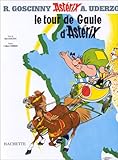
This is my review of Le Tour de Gaule d’Astérix by René Goscinny,Albert Uderzo.

As a mature student of French, I read this in an attempt to understand the addiction to "les bandes dessinées" which seems to persist into adulthood even for French literature lovers. I hesitate to repeat what must be widely known – since I had grasped it without reading a single Asterix in the past – that the revered Goscinny has created a "village gaulois" populated by "irréductibles gaulois" who manage to make mincemeat of the entrenched Roman garrisons surrounding them, and fools of the occasional representative of Caesar who comes along with the intention of bringing the villagers to heel. The secret of the locals' success lies in the magic potion prepared by the venerable druid Panoramix, and the exceptional strength of the menhir delivery man, Obelisk, who never needs to take the potion since he tumbled into the brew at berth.

The ensuing tale of the wager for Asterix and Obelisk to tour France without being captured, collecting local specialities on the way as evidence, is pretty silly although amusing, partly in showing one again the French preoccupation with food – all the items collected are edible and listed with gusto at the end: "saucisse de tolosa", "huîtres et vin de burdigala" and so on.

In trying to find an equivalent story embedded in English culture I came up first with Winnie the Pooh, then thought perhaps Dad's Army would be nearer the mark. You may need to be able to associate Asterix with the nostalgia of childhood, and also be a native of France to understand the puns fully. I have at least learned the French for "port" and "starboard" and that, "Je tire ou je pointe?" refers to the game of pétanque.

⭐⭐⭐⭐ 4 Stars

Knowing a true classic when you read it

This is my review of The Comedians by Graham Greene.

This harsh revelation of the "violence, injustice and torture" imposed on Haiti by the thuggish "Tontons Macoute" supporters of the sinister "Papa Doc" during the 1960s forms the background to a novel that is a mixture of tense thriller, sad love affair, and reflection on the meaning of life provided through the portrayal of a variety of characters. Sadly, this impoverished island escaped from Papa Doc's control only to suffer the ravages of AIDS in the 1970s.

Returning to the rundown hotel in Haiti which he cannot sell, Brown has to deal with the body of a dead government minister in his swimming pool. This must be concealed from his only two guests, an idealistic but naive American couple, the Smiths, who are resolved to transform Haiti with an ill-timed project to promote vegetarianism. Can Brown maintain his clandestine "semi-detached" affair with Martha, whom he resents having to share with her spoilt and all-too observant young son, while Brown is unsettled by the suspicion that Martha's ambassador husband knows about the relationship but appears to accept it. What has brought Captain Jones to Haiti – a congenital liar beneath his blustering charm?

Although Greene himself did not regard "The Comedians" as one of his best works, and he admitted his experience of Haiti was superficial, this book hooked me from the first few pages with his gift for storytelling, constructing a plot in which every incident and character counts, creating a strong sense of place and devising scenes which are by turns poignant, philosophical, menacing, exciting or hilarious – hence the idea that we are all to some extent playing the part of comedians.

The narrator Brown may be cold, cynical and self-centred, but his role as an outsider gives him the detachment to observe and analyse the people and situations he encounters. He may be forgiven a little bitterness since he has never known his father's identity, and his flamboyant mother abandoned him as a small boy in a Catholic boarding school where the monks could be relied upon not to throw him out when she failed to pay the fees.

For the first time, I have understood some of the Catholic angst which pervades so many of Greene's novels. Near the end, Brown refers to "the never quiet conscience injected into me without my knowledge, when I was too young to know, by the fathers of the Visitation." Brown seems to be the vehicle for Greene's introspection. "The rootless…. we are the faithless. We admire the dedicated….the Mr. Smiths for their courage and integrity……we find ourselves the only ones truly committed to the whole world of evil and good, to the wise and the foolish, to the indifferent and the mistaken. We have chosen nothing except to go on living."

⭐⭐⭐⭐⭐ 5 Stars

Better in French

This is my review of The Chalk Circle Man (Commissaire Adamsberg) by Fred Vargas.

Blue chalk circles begin to appear in the Paris suburbs, each ringing some everyday object. But Commissaire Adamsberg knows it is only a matter of time before a circle contains a murder victim. Unlike his sidekick Danglard, the pragmatic, cynical, stereotypical heavy-drinking inspector deserted by his wife, Adamsberg is not your usual senior police detective. Burdened by his acute intuition, "if only I could be wrong about someone once in a while", he wanders round with his shirt half hanging out, idles around in coffee shops too depressed to go into work, and is only tolerated by colleagues at his new post in Paris because of his astonishing success record in solving cases.

Some of the characters are entertaining, such as the beautiful Mathilde, a famous marine biologist, only really happy deep-sea diving, who spends her time when on dry ground following and observing strangers. I liked her glass table with a built-in aquarium. However, the main characters are all highly eccentric and somewhat unrealistic. I enjoyed some of the quirky dialogue and was prepared to go with the flow of the off-the-wall plot until it reverted abruptly to the kind of trite, contrived thriller overfull of coincidences with a hero who keeps presenting his bemused colleagues with the next piece in the jigsaw, obtained through his latest light-bulb moment.

Some of the English translation is a little oddly worded perhaps partly because the distinctive whimsical quality is hard to capture in English.

Not sure I'll read any more in the series……..

⭐⭐⭐ 3 Stars

Quirky and Whimsical

This is my review of L’Homme Aux Cercles Bleus by Fred Vargas.

Blue chalk circles begin to appear in the Paris suburbs, each ringing some everyday object. But Commissaire Adamsberg knows it is only a matter of time before a circle contains a murder victim. Unlike his sidekick Danglard, the pragmatic, cynical, stereotypical heavy-drinking inspector deserted by his wife, Adamsberg is not your usual senior police detective. Burdened by his acute intuition, "if only I could be wrong about someone once in a while" , he wanders round with his shirt half hanging out, idles around in coffee shops too depressed to go into work, and is only tolerated by colleagues at his new post in Paris because of his astonishing success record in solving cases.

Some of the characters are entertaining, such as the beautiful Mathilde, a famous marine biologist, only really happy deep-sea diving, who spends her time when on dry ground following and observing strangers. I liked her glass table with a built-in aquarium. However, the main characters are all highly eccentric and somewhat unrealistic. I enjoyed some of the quirky dialogue and was prepared to go with the flow of the off-the-wall plot until it reverted abruptly to the kind of trite, contrived thriller overfull of coincidences with a hero who keeps presenting his bemused colleagues with the next piece in the jigsaw, obtained through his latest light-bulb moment.

I recommend this in French for the practice, and the English version to help with some more obscure language points. Some of the English translation is a little oddly worded partly because the distinctive whimsical quality is hard to capture in English.

Not sure I'll read any more in the series……..

⭐⭐⭐ 3 Stars

Authors collect materials in the living of their lives

This is my review of Mad World: Evelyn Waugh and the Secrets of Brideshead by Paula Byrne.

This very readable biography of Evelyn Waugh focuses on his fascination with the aristocratic Lygon family and the ambiance of their ancestral home Madresfield, which inspired his famous novel "Brideshead Revisited". Paula Bryne recaptures the poignancy of the drama to rival a Shakespearean tragedy in which the cultivated and socially conscious Earl Beauchamp, one of the last Liberal grandees, was driven into exile because of his blatant homosexuality,a victim to the hypocrisy of the day and the jealousy of his brother-in-law, the Duke of Westminster. On the other hand, Beauchamp seems to have used his powerful position to prey upon attractive young servants, rather in the style of a modern celebrity disc jockey.

Paula Byrne paints a sympathetic portrait of Waugh, highlighting his wit, companionship and loyalty to those he liked or admired, his special gift for platonic friendships with women, his courage and cheerful resourcefulness under pressure, "for he liked things to go wrong". Admitting that he was snobbish and often sharp-tongued, she makes allowances for him continually: his outrageous comments were often "meant to be jokes", when in later life he played the part of the crusty lord of the manor "in love with the past" he became a parody of himself, but the knowledge that hosts he thought he was entertaining found him a bore "broke his spirit".

It is interesting how biographies differ. Perhaps wisely for the sake of the length and coherence of the book, the author glosses over his friendships with other writers like Grahame Greene, his unconventional conversion to Catholicism, his possibly neglectful or exploitative relationships with his second wife and children, and the details of the alcoholism and drug-taking which aged him prematurely, drove him into periods of temporary insanity and eventually killed him "before his time". She makes light of the selfishness as when, it must have been through lack of thought, he accidentally started a fire in his father's precious bookroom.

Whom is one to believe? Hugh Carpenter's biography claims that Waugh was not given men to command in World War 2 because he found it hard to relate to working class soldiers. Paula Byrne makes light of Waugh's insistence when in the Royal Marines on "etiquette and proper procedures" and his attempt "to convince the young men how much better the world was before the invention of electricity".

One of the most interesting aspects of the biography is speculation on the extent to which Waugh's writing drew on his own experiences, places he had visited but most particularly the people he knew, often amalgamated to create a character.

With only minor reservations over some repetition which suggests a lack of editing, this book sets Waugh in context and is an inspiration to read more of his work for the humour and quality of the writing, even if much of the social comment now seems very dated.

⭐⭐⭐⭐ 4 Stars

Flawed Genius

This is my review of The Yiddish Policemen’s Union by Michael Chabon.

What would have happened if a long-forgotten proposal in 1940 to give the Jews a temporary homeland in Alaska had come to pass? How will the Americans deal with the prospect of having to absorb millions of Jews who have failed to emigrate in time when the "Reversion of Sitka" occurs after the agreed sixty years are up?

In what first appears to be a Chandler-type cynical detective thriller, but which twists at times into a Bashevis Singer evocation of the culture of the Jewish shtetl, or a soft-centred rom-com-soap of family life, Chabron sets free his vivid imagination to create in some detail the world of "the Frozen Chosen" in an incongruous ambiance of halibut factories, cherry pie and vast pine forests.

The stereotypical antihero Detective Landsman, driven to drink through grief over his lost child and estranged wife, is still sufficiently professional to care about the death of a drug addict in what looks like a "cold-blooded execution". His often unauthorised investigations lead him into the archaic world of a "black hat rebbe" or rabbi who bears close resemblance to a mafia boss. The rather thin plot meanders to the denouement with the reader in my case mostly hooked by the sparkling pyrotechnics of Chabron's original prose, although at times his bold verbal experiments fall flat, or fizzle out, so that I can understand why this book has divided opinion quite sharply.

Many readers have complained about the frequent Yiddish words peppering the text. Although I found that they add a flavour and music to the prose, and you can usually guess what they mean, it was informative but too distracting to keep looking them up, so I agree that there is a case for brief footnotes. Similarly, the many references to Jewish culture could have been explained in an appendix e.g. the Tzadik ha-Dor or Messiah expected once in every generation, or the fascinating "boundary maven" whose job it is to define with lines of string the "eruvs" or areas which enable orthodox Jews "to get round the Sabbath ban on carrying in a public place, and walk to shul with a couple of Alka-Seltzers in your pocket, and it isn't a sin".

This book is riddled with wry humour of questionable taste, and is often very funny and clever, but also poignant. It is perhaps too long, and self-indulgent in its lack of editing. The author sidetracks too much into minor scenes and descriptions, loses the plot in the sinister wilderness of the Pearl Strait but glosses so quickly over some of the main facts that I had to reread bits to check I hadn't missed something.

⭐⭐⭐⭐ 4 Stars

Spinners Spun

This is my review of Live From Downing Street by Nick Robinson.

My admiration for Nick Robinson's great sense of humour, impressive intelligence and public speaking skills as displayed in a promotional talk led me to purchase this book. It provides an interesting explanation of the influences which moulded him and how he trained for his profession, set in the context of broadcasting in general, with a timely reminder of the BBC's contribution to free speech.

Although careful not to spill too many beans on members of the current government, he provides a store of anedotes on former key figures – a paranoid Wilson, on-a-mission Thatcher and not-as-stupid as people think Bush.

If you have followed the news closely since long before Robinson became a journalist in the 80s, you may be a little disappointed to find this is a rehashing of what you already know. The casual reference to names of current media figures may tend to make the book date fairly rapidly.

However, if you enjoy an entertaining if fairly superficial read, or have come to "the news" recently and would like to learn more of "the background", I recommend "Live from Downing Street".

⭐⭐⭐⭐ 4 Stars

In too deep

This is my review of J’AI Lu: Le Passager De La Pluie (Folio Policier) by Japrisot.

Unusual in being written as a novel after the script of what became a celebrated prize-winning film, this contains verbatim in the style of a play the dialogue used on screen. The descriptions are intensely visual – evoking the rocky coastline of southern France, the experience of driving in the rain, with a growing sense of menace as the heroine Mellie Mau, a lonely child bride addicted to dressing in white, becomes uncomfortably aware of the presence of a sinister stranger dropped off in her small home town. She finds herself involved in a crime which she may be able to conceal from her possessive husband, who perhaps did not appear to be such a chauvinist in the 1960s when the story was written, but then another shrewd stranger appears on the scene, with an almost telepathic ability to work out what she has done. It is just a question of forcing her to admit it….

This short novel is a page turner, full of twists and high tension and working towards a neat and convincing ending. The book just escapes being corny. Some of the violence seems a bit gratuitous, and at times I found it hard to take the male characters' tendency to resort to brute force with a casualness which was perhaps more acceptable when the film was made. There is a little character development as we learn about the troubled childhood which has perhaps stunted Mellie's maturity and fed her capacity to lie, about rhe uneasy relationship with her mother and the reason's for Mellie's submission to an older and domineering husband. At the same time, we gain respect for her stubborn courage.

An easy read – even for a foreigner reading it in the original French – a lightweight story on the surface, there is more to this than first meets the eye.

Comment Comment | Permalink

⭐⭐⭐⭐ 4 Stars

Too bogus

This is my review of Vile Bodies (Penguin Modern Classics) by Evelyn Waugh.

Does the classic which brought him fame and fortune show why Evelyn Waugh was described in his lifetime as the most important British writer of his day? Certainly, his style is very articulate and witty, although at times a little too silly and dated for modern tastes. This is a darker version of P.G. Wodehouse, with a failure driven to sudden suicide, and a young woman who implies sex by talking about the pain it gives her.

Readers will differ as to which passages they find the funniest. For me, apart from those I cannot give away, it was the exaggerated but telling description of the motor race to which the "hero" Adam and his friends are invited. "The real cars that become masters of men, those creations of metal who exist only for their own propulsion through space, for which the drivers clinging precariously at the steering wheel are as important as his stenographer to a stock-broker."

In the loosely structured plot which seems to be a staccato succession of incidents not necessarily "going anywhere" we are introduced to the "bright young things" of the 1920s. They are hedonistic, selfish, lacking in direction, engaged in a haze of party-going – "Masked parties, Savage parties, Victorian parties, Greek parties…parties where one had to dress as somebody else…..tea parties at school where one ate muffins and meringues and smoked crab, parties at Oxford where one drank brown sherry and smoked Turkish cigarettes, dull dances in London, and comic dances in Scotland and disgusting dances in Paris – all that succession and repetition of massed humanity.. Those vile bodies."

But beneath all the frivolity there is the sad undercurrent that these young people reject the values of the older generation who sent their children to die in the First World War, but have nothing in which to believe instead. Since this book was published in 1929, Waugh is quite prescient in foreseeing the next world war which is the "Bright young things'" fate. As the Jesuit Father Rothschild observes – the author never having met a Jesuit at the time – "…there is a radical instability in our world order, and soon we shall all be walking into the jaws of destruction again, protesting our pacific intentions."

Waugh was quite critical of the book, one cannot know how sincerely. The more sombre nature of the second half and Adam's brittle relationship with Nina may reflect the fact that Waugh's first wife, "She-Evelyn", left him for a so-called friend whilst he was writing "Vile Bodies", a blow from which he found it hard to recover. It is interesting to speculate just how autobiographical some of his books were, with many of the characters modelled on people he knew.

What troubles me a little about "Vile Bodies" is not being sure just how ironical Waugh intended to be. He was himself a heavy drinker, a socialite and a snob who looked down on "the masses". Perhaps he was a creature of his times, but one cannot help feeling that he was a clever man who, as in this case, frittered his talent on fairly lightweight themes.

⭐⭐⭐⭐ 4 Stars

“No part deformed out of mind..as is the inward, suspicious mind”

This is my review of The Watchers: A Secret History of the Reign of Elizabeth I by Stephen Alford.

In one of those histories that reads like a novel but is based on thorough research, "The Watchers" leaves us in no doubt that behind the swashbuckling exploits of Drake and Raleigh, the routing of the Armada and Shakespeare's vivid dramas, Elizabethan England was a violent and precarious world in which to live, operated like the forerunner of a police state. This was a response to very real threats: Elizabeth was regarded as an illegitimate, heretic queen not merely by the Pope but also the powerful Catholic rulers of Spain and France; the brutal 1572 St Bartholomew's Day massacre of French Huguenots was an ominous sign of what English Protestants could expect if Elizabeth was deposed in a foreign invasion. Many of the leading aristocratic families in England were Catholics prepared to support plots against Elizabeth. Her Catholic cousin Mary Queen of Scots was an ever-present threat ready to take her place.

As chanted from a book of common prayer, "Save us from the lions' mouth, and from the horns of the unicorns: lest they devour us and tear us in pieces."

With reference to surprisingly detailed records of intercepted letters, drafts thereof, and the various ciphers or codes used, Stephen Alford describes how most of the hundreds of Catholic priests who infiltrated England were mainly intercepted to be martyred, imprisoned or deported. He traces the careers of men like Thomas Phellipes, cryptographer, linguist and right-hand man of Sir Francis Walsingham who in turn worked for the Queen's leading minister, Lord Burleigh who wrote, "there is less danger in fearing too much than too little". Phellipes worked with a succession of agents, some "double", and helped to unmask a succession of intrigues, of which perhaps the most infamous was the "Babington Plot" which led to the controversial beheading of Mary Queen of Scots. With a fascinating regard to the rule of law, Walsingham was prepared to falsify evidence against Mary, but there was an insistence on a trial with reasonably convincing evidence, even though Elizabeth would have preferred a neat unofficial murder which would have left her clear of authorising the killing of another "crowned head".

The text is often repetitious, which pads it out unduly, but also helps to reinforce the main points, although some of the plot explanations are a bit long-winded. The list of "Principal Characters" and "Chronology" are useful for the general reader, with detailed notes for the academic.

⭐⭐⭐⭐ 4 Stars