Flawed Genius

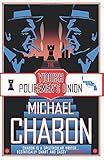
This is my review of The Yiddish Policemen’s Union by Michael Chabon.

What would have happened if a long-forgotten proposal in 1940 to give the Jews a temporary homeland in Alaska had come to pass? How will the Americans deal with the prospect of having to absorb millions of Jews who have failed to emigrate in time when the "Reversion of Sitka" occurs after the agreed sixty years are up?

In what first appears to be a Chandler-type cynical detective thriller, but which twists at times into a Bashevis Singer evocation of the culture of the Jewish shtetl, or a soft-centred rom-com-soap of family life, Chabron sets free his vivid imagination to create in some detail the world of "the Frozen Chosen" in an incongruous ambiance of halibut factories, cherry pie and vast pine forests.

The stereotypical antihero Detective Landsman, driven to drink through grief over his lost child and estranged wife, is still sufficiently professional to care about the death of a drug addict in what looks like a "cold-blooded execution". His often unauthorised investigations lead him into the archaic world of a "black hat rebbe" or rabbi who bears close resemblance to a mafia boss. The rather thin plot meanders to the denouement with the reader in my case mostly hooked by the sparkling pyrotechnics of Chabron's original prose, although at times his bold verbal experiments fall flat, or fizzle out, so that I can understand why this book has divided opinion quite sharply.

Many readers have complained about the frequent Yiddish words peppering the text. Although I found that they add a flavour and music to the prose, and you can usually guess what they mean, it was informative but too distracting to keep looking them up, so I agree that there is a case for brief footnotes. Similarly, the many references to Jewish culture could have been explained in an appendix e.g. the Tzadik ha-Dor or Messiah expected once in every generation, or the fascinating "boundary maven" whose job it is to define with lines of string the "eruvs" or areas which enable orthodox Jews "to get round the Sabbath ban on carrying in a public place, and walk to shul with a couple of Alka-Seltzers in your pocket, and it isn't a sin".

This book is riddled with wry humour of questionable taste, and is often very funny and clever, but also poignant. It is perhaps too long, and self-indulgent in its lack of editing. The author sidetracks too much into minor scenes and descriptions, loses the plot in the sinister wilderness of the Pearl Strait but glosses so quickly over some of the main facts that I had to reread bits to check I hadn't missed something.

⭐⭐⭐⭐ 4 Stars

Spinners Spun

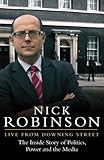
This is my review of Live From Downing Street by Nick Robinson.

My admiration for Nick Robinson's great sense of humour, impressive intelligence and public speaking skills as displayed in a promotional talk led me to purchase this book. It provides an interesting explanation of the influences which moulded him and how he trained for his profession, set in the context of broadcasting in general, with a timely reminder of the BBC's contribution to free speech.

Although careful not to spill too many beans on members of the current government, he provides a store of anedotes on former key figures – a paranoid Wilson, on-a-mission Thatcher and not-as-stupid as people think Bush.

If you have followed the news closely since long before Robinson became a journalist in the 80s, you may be a little disappointed to find this is a rehashing of what you already know. The casual reference to names of current media figures may tend to make the book date fairly rapidly.

However, if you enjoy an entertaining if fairly superficial read, or have come to "the news" recently and would like to learn more of "the background", I recommend "Live from Downing Street".

⭐⭐⭐⭐ 4 Stars

In too deep

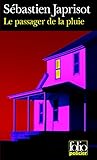
This is my review of J’AI Lu: Le Passager De La Pluie (Folio Policier) by Japrisot.

Unusual in being written as a novel after the script of what became a celebrated prize-winning film, this contains verbatim in the style of a play the dialogue used on screen. The descriptions are intensely visual – evoking the rocky coastline of southern France, the experience of driving in the rain, with a growing sense of menace as the heroine Mellie Mau, a lonely child bride addicted to dressing in white, becomes uncomfortably aware of the presence of a sinister stranger dropped off in her small home town. She finds herself involved in a crime which she may be able to conceal from her possessive husband, who perhaps did not appear to be such a chauvinist in the 1960s when the story was written, but then another shrewd stranger appears on the scene, with an almost telepathic ability to work out what she has done. It is just a question of forcing her to admit it….

This short novel is a page turner, full of twists and high tension and working towards a neat and convincing ending. The book just escapes being corny. Some of the violence seems a bit gratuitous, and at times I found it hard to take the male characters' tendency to resort to brute force with a casualness which was perhaps more acceptable when the film was made. There is a little character development as we learn about the troubled childhood which has perhaps stunted Mellie's maturity and fed her capacity to lie, about rhe uneasy relationship with her mother and the reason's for Mellie's submission to an older and domineering husband. At the same time, we gain respect for her stubborn courage.

An easy read – even for a foreigner reading it in the original French – a lightweight story on the surface, there is more to this than first meets the eye.

Comment Comment | Permalink

⭐⭐⭐⭐ 4 Stars

Too bogus

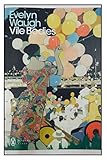
This is my review of Vile Bodies (Penguin Modern Classics) by Evelyn Waugh.

Does the classic which brought him fame and fortune show why Evelyn Waugh was described in his lifetime as the most important British writer of his day? Certainly, his style is very articulate and witty, although at times a little too silly and dated for modern tastes. This is a darker version of P.G. Wodehouse, with a failure driven to sudden suicide, and a young woman who implies sex by talking about the pain it gives her.

Readers will differ as to which passages they find the funniest. For me, apart from those I cannot give away, it was the exaggerated but telling description of the motor race to which the "hero" Adam and his friends are invited. "The real cars that become masters of men, those creations of metal who exist only for their own propulsion through space, for which the drivers clinging precariously at the steering wheel are as important as his stenographer to a stock-broker."

In the loosely structured plot which seems to be a staccato succession of incidents not necessarily "going anywhere" we are introduced to the "bright young things" of the 1920s. They are hedonistic, selfish, lacking in direction, engaged in a haze of party-going – "Masked parties, Savage parties, Victorian parties, Greek parties…parties where one had to dress as somebody else…..tea parties at school where one ate muffins and meringues and smoked crab, parties at Oxford where one drank brown sherry and smoked Turkish cigarettes, dull dances in London, and comic dances in Scotland and disgusting dances in Paris – all that succession and repetition of massed humanity.. Those vile bodies."

But beneath all the frivolity there is the sad undercurrent that these young people reject the values of the older generation who sent their children to die in the First World War, but have nothing in which to believe instead. Since this book was published in 1929, Waugh is quite prescient in foreseeing the next world war which is the "Bright young things'" fate. As the Jesuit Father Rothschild observes – the author never having met a Jesuit at the time – "…there is a radical instability in our world order, and soon we shall all be walking into the jaws of destruction again, protesting our pacific intentions."

Waugh was quite critical of the book, one cannot know how sincerely. The more sombre nature of the second half and Adam's brittle relationship with Nina may reflect the fact that Waugh's first wife, "She-Evelyn", left him for a so-called friend whilst he was writing "Vile Bodies", a blow from which he found it hard to recover. It is interesting to speculate just how autobiographical some of his books were, with many of the characters modelled on people he knew.

What troubles me a little about "Vile Bodies" is not being sure just how ironical Waugh intended to be. He was himself a heavy drinker, a socialite and a snob who looked down on "the masses". Perhaps he was a creature of his times, but one cannot help feeling that he was a clever man who, as in this case, frittered his talent on fairly lightweight themes.

⭐⭐⭐⭐ 4 Stars

“No part deformed out of mind..as is the inward, suspicious mind”

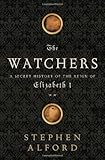
This is my review of The Watchers: A Secret History of the Reign of Elizabeth I by Stephen Alford.

In one of those histories that reads like a novel but is based on thorough research, "The Watchers" leaves us in no doubt that behind the swashbuckling exploits of Drake and Raleigh, the routing of the Armada and Shakespeare's vivid dramas, Elizabethan England was a violent and precarious world in which to live, operated like the forerunner of a police state. This was a response to very real threats: Elizabeth was regarded as an illegitimate, heretic queen not merely by the Pope but also the powerful Catholic rulers of Spain and France; the brutal 1572 St Bartholomew's Day massacre of French Huguenots was an ominous sign of what English Protestants could expect if Elizabeth was deposed in a foreign invasion. Many of the leading aristocratic families in England were Catholics prepared to support plots against Elizabeth. Her Catholic cousin Mary Queen of Scots was an ever-present threat ready to take her place.

As chanted from a book of common prayer, "Save us from the lions' mouth, and from the horns of the unicorns: lest they devour us and tear us in pieces."

With reference to surprisingly detailed records of intercepted letters, drafts thereof, and the various ciphers or codes used, Stephen Alford describes how most of the hundreds of Catholic priests who infiltrated England were mainly intercepted to be martyred, imprisoned or deported. He traces the careers of men like Thomas Phellipes, cryptographer, linguist and right-hand man of Sir Francis Walsingham who in turn worked for the Queen's leading minister, Lord Burleigh who wrote, "there is less danger in fearing too much than too little". Phellipes worked with a succession of agents, some "double", and helped to unmask a succession of intrigues, of which perhaps the most infamous was the "Babington Plot" which led to the controversial beheading of Mary Queen of Scots. With a fascinating regard to the rule of law, Walsingham was prepared to falsify evidence against Mary, but there was an insistence on a trial with reasonably convincing evidence, even though Elizabeth would have preferred a neat unofficial murder which would have left her clear of authorising the killing of another "crowned head".

The text is often repetitious, which pads it out unduly, but also helps to reinforce the main points, although some of the plot explanations are a bit long-winded. The list of "Principal Characters" and "Chronology" are useful for the general reader, with detailed notes for the academic.

⭐⭐⭐⭐ 4 Stars

Waughped talent

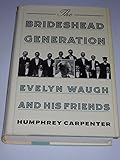
This is my review of Brideshead Generation: Evelyn Waugh and His Friends by Humphrey Carpenter.

This biography provides a vivid portrait of Waugh's personality and the factors which may have affected it, but falls short in the method used to include some of the author's influential acquaintances such as Harold Acton, Graham Greene and John Betjeman to name only a few. This involves frequent digressions which make for a read that is often rambling and baggy in structure, particularly in the early chapters. In a book that cries out for a good edit, I was put off by the opening chapter's lengthy imaginary conversation between two horribly precocious young Etonians which, although it may have satisfied Humphrey Carpenter's ambitions as a novelist, seems unnecessary when there is so much "real" information to cover.

Waugh comes across as a witty and articulate man with a keen sense of the ridiculous, but on the negative side also a bully, an appalling snob, irritable, often remarkably rude, which may have had something to do with being frequently drunk. We are told that in World War 2 he was judged unsuitable to command a company of soldiers because he could not relate to junior ranks. All this may have been in some way the result of a lack of affection as a child, a sense of exclusion from the "cosy friendship" his father apparently formed with Waugh's older brother and the humiliation of his first wife, "She-Evelyn" going off with another man.

He also revelled in gossip, exaggerating the misfortunes of others, including so-called friends. He could not resist the barbed repartee as when Graham Greene observed that it would be fun to write about politics rather than God. Waugh rejoined: "I wouldn't give up writing about God at this stage if I were you. It would be like P.G. Wodehouse dropping Jeeves halfway through the Wooster series."

There seems to be a strong autobiographical thread in much of his writing. "Vile Bodies" which established his reputation and began to earn the income which enabled him to live the life of a country squire, shows both the brittle gaiety of the endless parties of the "Bright Young Things" but also the cynicism of the generation reaching adulthood just after World War 1 and their rejection of the values of the fathers who had sent their sons to die.

It is sad to read that, only in his early sixties, prematurely aged by alcohol, cigarettes and "sodium amytal", he was longing for death and claiming to be so bored that he breathed on the library window to play "noughts and crosses with himself, drinking gin in the intervals between play". Even before that, suffering from hallucinations and an enhanced persecution mania triggered by large quantities of alcohol combined with medicinally prescribed drugs, Waugh heard voices accusing him of the actual charges that he probably found most cutting: that he was snobbish, had fascist sympathies, was guilty of "sentimental overwriting" at times, and may have been an "insincere" convert to Catholicism, together with the charge of homosexuality.

Although the final chapters of this book are the best, I was disappointed by the rather pat ending, suggesting that Evelyn Waugh's reactionary views had been proved justified by the turn of events evident in the 1980s – "the remarkable way in which ancient institutions seem to have outlived the egalitarian zeitgeist".

⭐⭐⭐ 3 Stars

Alter Ego B2 CD 4

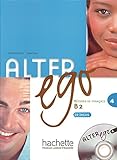
This is my review of Alter EGO B2 4 by Alter EGO.

Coming to this book with a good but very rusty A Level pass, I would say it is useful to revise and extend my knowledge – not sure how effective it would be for the systematic acquisistion of that knowledge in the first place.

This has some interesting extracts from articles on a range of social and cultural issues – "La vie au quotidien et points de vue sur" – mostly dating from 2005-6, which are sufficiently generalised not to date too quickly and provide stimulating discussion points for adults, although I wonder whether "grands adolescents" would find some of them a bit dry.

The CD of interviews and conversations spoken by a variety of voices at "normal" speed, with transcriptions at the back of the book, is very useful.

Grammar is woven quite neatly into the text with clear explanations again at the back of the book, but it is frustrating not to be able to refer to the answers and therefore learn from one's mistakes or gaps in knowledge. Also, some of the comprehension questions on the articles seem to me a bit pointless or unclear.

This is definitely a book best used with a teacher.

Although the pages are quite attractively designed to make you want to read them, the whole book seems somewhat bitty and arbitrary in what it covers.

⭐⭐⭐ 3 Stars

No one emerges with credit

This is my review of A Line in the Sand: Britain, France and the struggle that shaped the Middle East by James Barr.

James Barr blends academic research with journalistic flair to remind us of the shabby deals and ostrich-like expediency which led to the crises still bedevilling the Middle East. Using anecdotes and well-judged quotations, he brings alive the out-dated imperialistic wranglings of Britain and France, both scrambling to fill the vacuum left by the collapse of the Ottoman Empire.

The "line in the sand" refers to the infamous Sykes-Picot Line agreed secretly in 1916, which ran from Acre on the coast to Kirkuk near the then Persian frontier, with no regard for the Arab tribes inhabiting what appeared to be mostly useless desert. The British were interested in Palestine and Jordan south of the line mainly as a means of securing Suez and the route to India. To the north, the French demanded what is now the Lebanon and Syria to ensure they did not lose out to the British in a land which might yield rich oil reserves. Matters went awry from the outset with T.E. Lawrence's famous assault on Damascus in Syria – a blatant attempt to undermine the Sykes-Picot agreement by enabling the Arabs to gain territory in land coveted by the French.

Barr opens with his shock on discovering how, while British soldiers were fighting in World War 2 to save France, the French were supplying arms to the Haganah, the Jewish militia dedicated to creating a separate state of Israel. However, the British seem to have been equally perfidious at times – agreeing with a shameful vagueness over details to support Sharif Hussein of Mecca in his ambitions for an Arab Empire to include Syria which lay north of the fatal line. As someone observed "we are rather in the position of hunters who divided up the skin of the bear before they had killed it." The British desire to give Arabs independence in French-controlled Syria and Lebanon was always tempered by the reluctance to give Arabs in Palestine the same freedom – until it was too late.

Also, long before the French took the idea of a Jewish state seriously, the wily Lloyd George had come round to supporting Zionism in the hopes of encouraging American Jews to put pressure on the US to enter the First World War on the Allies' side, plus he thought the Jews might be of more assistance to the British in Palestine than the fragmented Arab tribes. Yet, by the 1940s, the situation was reversed with the British trying somewhat ineptly to protect the Arabs in Palestine and contain the violence of freedom fighters like the Irgun.

Barr does a mainly excellent job in steering us through the dramas of T.E. Lawrence, De Gaulle, the alarming Orde Wingate, plus a host of others who interfered in the Middle East, with varying degrees of understanding, cynicism, short-termism, and sadly often misplaced "vision". Concluding with the British evacuation of Jerusalem in 1948, Barr helps us to appreciate the complexity of the situation, all the different angles. Apart from the final quotation that "other people's countries…must be left to their own salvation," I do not recall that he suggests clearly the course that should have been taken, but this may be for the good reason that there was no clear solution.

Small improvements would have been the inclusion of a "timeline" of key events, a glossary of major players and groups involved, and perhaps a brief summary of the situation in Palestine in previous centuries, all designed to help anchor the "general reader".

⭐⭐⭐⭐⭐ 5 Stars

Cracking a pig’s egg

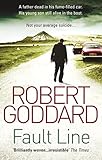
This is my review of Fault Line by Robert Goddard.

I have a weakness for Robert Goddard's novels which are notable for their highly convoluted intrigues and often original themes based on some historical or topical issue, in this case the china clay industry, in decline around St Austell in Cornwall but apparently expanding in South America, which the author manages to link with dastardly deeds in Naples and the beautiful island of Capri which he of course makes you want to visit.

Although I understand why some reviewers feel that his novels produced annually have become pot boilers in danger of burning dry, it seems to me that, following on the heels of "Blood Count", "Fault Line" confirms a return to form as regards plot, although I wish that Goddard would make the effort to edit some of the triteness out of his prose.

In Jonathan Kellaway we have a likeable and convincing character who displays integrity and presence of mind, the very qualities which encourage more devious people to make use of him, asking favours which ensnare him in precarious and even dangerous sitations in the process. The plot is quite well-structured and deftly revealed. I agree that some aspects of the denouement are implausible, but isn't that often the case with this type of thriller? With a main plot perhaps a little less extraordinary than is often the case with Goddard, I worked out fairly early on what the explanation must be, but was not left disappointed at the end since there was a thought-provoking final twist I had not foreseen.

This is a page turner and an enjoyable read, relying on suspense and tension rather than sex or violence.

⭐⭐⭐⭐ 4 Stars

A Striking Variation on “Death in Venice”

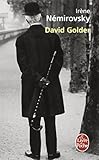
This is my review of David Golder (Le Livre de Poche) by Irene Nemirovsky.

In her spare prose, Irene Nemirovsky portrays in vivid and minute detail the thoughts and final acts of David Golder as he faces up to the death he has always feared. Having escaped as a youth from poverty in Russia, Golder has ruthlessly gained a vast fortune, but has nothing to spend it on, save the extravagances of his wife, who uses luxuries as a substitute for the love he cannot give her, their daughter Joyce who has been spoiled with material goods, and all the hangers on whom the rich attract.

On the surface, all the main characters are despicable, calculating, self-seeking and unlikeable. However, Irene contrives to evoke from us some pity for all of them, in particular Golder. Although this is to be honest a rather depressing book, there are some unexpectedly moving and beautiful scenes, evoking long-lost places and lifestyles of 1920s Europe and Russia. Nemirovsky is worth reading for the quality of her writing.

I have read reviews which attack Nemirovsky for her anti-semitic tone. Although Jewish herself, she converted to Catholicism and wrote for anti-Jewish publications, yet this could be excused as an attempt to escape persecution – one which failed since she was deported to Auschwitz where she died of typhus. I admit that at times, I find it hard to believe that she is not "a self-hating Jew" in the prejudiced and negative descriptions she often employs. Apart from the fact she may only be conveying the views of other characters, there is a subtle humanity in her writing – she seems to me to describe characters warts and all, with all their flaws and vulnerability, without a trace of sentimentality.

⭐⭐⭐⭐ 4 Stars