“Teaching people not to think”

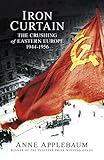
This is my review of Iron Curtain: The Crushing of Eastern Europe 1944-56 by Anne Applebaum.

Would Eisenhower have allowed the Russians to take Berlin in order to spare his troops if he had foreseen that the Soviets would go on to impose Communism on Eastern Europe for almost half a century? With a focus on Poland, Hungary and East Germany, Anne Applebaum draws on the memoirs of people who lived through the period, to dissect the evidence for how the USSR managed to crush opposition: mass deportations to fit nationalities within the "correct" boundaries, promotion of "Moscow men" into key positions, indoctrination of the young, suppression of the Catholic church, control of the media, to name a few aspects. Repression grew under the "High Stalinism" of the early 50s once the complacent belief that east Europeans would vote for communism was seen to be a delusion.

The chapters take a thematic approach, working logically from such topics as communists and policemen through politics and economics to issues of "socialist realism", "ideal" planned cities, and reluctant collaborators. So, you can pick out what catches your interest, although it is most valuable to follow the author's train of thought. With the clear aspiration to be taken seriously as an academic work, this may contain too much detail for the general reader to retain, and the unpronounceable Polish names do not help, but Anne Applebaum is always cogent and relevant.

I was particularly interested in the exploration of how "the need to conform to a mendacious political reality left many people haunted by the sense that they were leading double lives". Freudian psychoanalysis was taboo in the USSR, and therefore in due course banned in, for instance, Hungary as well, because it was "too focused on the individual", eventually dismissed in the chillingly humourless jargon of the regime as "the domestic psychology of imperialism". We read of a boy's terror when his father angrily pointed out that the arrest of a general in a show trial did not mean that he was guilty. This "banal truth" felt "like an earthquake" for if his father was right, the authorities must be arresting innocent citizens, but surely, only an enemy could think this was the case……

The helpful glossary of abbreviations and acronyms of the often suppressed political parties and of the notorious secret police organisations could have been supplemented with a reference list of the main individuals mentioned, and a timeline of events. The chapter on the abortive revolutions of the mid-fifties could have been expanded, although perhaps they are dealt with briefly since already well-covered elsewhere. Yet these are minor criticisms of a fascinating analysis which merits being kept on one's shelf as an ongoing reminder of the folly of the attempts to develop a "perfect" society through the exercise of unquestioned, unbending authority, not to mention the dangerous cult of the "supreme leader" in a society which ironically suppresses individuality.

⭐⭐⭐⭐⭐ 5 Stars

Solving the riddle and unwrapping the mystery

This is my review of Among The Russians by Colin Thubron.

At first I wondered if it was worth spending time on a travelogue of 1980s Soviet Russia written before "perestroika" and "glasnost" triggered the fall of communism. Was the book only of interest to those who could relate with nostalgia to, say, being pestered for jeans, instructed to take hands out of pockets when filing past Lenin's coffin, intrigued by the job creation scheme of a middle-aged lady seated on every hotel corridor, and depressed by the lack of goods for sale in the gloomy grandeur of the GUM state department store?

Relevance seemed unimportant as I became ensnared by the novel-like quality of Thubron's writing, so that I was not surprised to note that he has in fact written a good deal of fiction.

Also, the book proves of value, in its vivid and perceptive analysis of Russia as a basis for understanding how it reached its current state – apparently materialistic, corrupt and increasingly unequal.

Thubron asks whether "the easy Russian submissiveness to God and tyranny….the unwieldy immensity of Russian bureaucracy" is the result of a people crushed by the vastness and impersonal isolation of their country. Yet, some of them like nothing better than picking mushrooms in the birch woods.

An extreme example of conditioned thinking is the woman who insists a statue is holding a torch. "The torch should be there, so it was there. It was an emotional fact". Yet in complete contrast a man falters, "Not to be subjected to a laid-down principle, only to be governed by what you find is so. It's harder but right."

Thubron introduces us to unexpectedly beautiful towns off the tourists' beaten track, like Suzdal, with its dozens of paired medieval churches set in a landscape of streams, meadows and chickens squawking along unpaved streets. I have resolved to visit Armenia after reading of Echmiadzin, with the oldest state-built Christian church in the world, and Garni, with its "perfect and solitary" Greek temple on the edge of a steep bluff.

There are some funny anecdotes: when a Lada saloon drove up alongside Thubron's car to reclaim a drunken girl he had befriended, "in the back seat a formidable pair of grandmothers added their Gorgon stare to the barrage of accusation, until the whole car resembled some livid and scandalized hydra, which said not a word."

On the negative side, claiming to speak "only hesitant Russian", how did Thubron manage to conduct such complex exchanges with the locals he encountered? How genuine are his records of conversations? I would have liked a larger, clearer map, an index and some photographs, although Google has shots of many of the places and buildings mentioned. Some of Thubron's descriptions seem too studied, and my interest flagged on the way to the Caucasus but he brings the book to an effective conclusion with a reminder of the underlying menace of continual surveillance.

⭐⭐⭐⭐⭐ 5 Stars

Not much beyond the punchline.

This is my review of Nouvelles a chute by Collectif.

All the short stories in this little book meet the requirement to have an unexpected or surprising ending, as promised by the title. I assume from the annotations to explain less familiar vocabulary and the questions at the end that this is designed for French school students who have to learn how to analyse a text. I feel a bit sorry for them as regards how this could destroy one's simple enjoyment of a story.

I imagine the book could be useful for "A Level" class discussion in England, and the stories went down quite well in my French group for British adults. The tales by various successful modern writers are on diverse themes, but tend to have in common the approach of developing a particular situation in depth, such as a man enjoying the habit of taking a girl out for a meal, or the plight of a small boy bullied by his playmates. They also share the trick of leading the reader into some kind of misconception, which is abruptly shattered at the end.

I cannot say more without introducing spoilers, but it is perhaps a limitation of these tales that, if you remove the "surprise factor" at the end, there is not much left to consider.

⭐⭐⭐⭐ 4 Stars

Ring of uncomfortable truth

This is my review of A Dangerous Delusion: Why the West Is Wrong About Nuclear Iran by Peter Oborne,David Morrison.

It surprised me that this hard-hitting attack on US and UK policy towards Iran is the work not of a John Pilger-type polemicist, but of two journalists, one of whom has worked for the Daily Telegraph.

This short book makes uncomfortable reading as it hammers out arguments backed by apparently valid sources: the US overthrew a democratically elected President Mossadeq in the `50s, replacing him with the puppet Shah who was allowed to acquire nuclear reactors with a view to generating electricity. When he was in turn ousted for a regime "that wasn't to the west's taste", although Iran had signed the Nuclear Non-Proliferation Treaty (NPT), offered to "abide by the rules" in producing enriched uranium for civilian purposes and even assisted the US after 9/11, the US has persisted in misrepresenting Iran as an aggressive power hell-bent on acquiring a nuclear bomb, using this as justification for harsh sanctions which have caused ordinary Iranians considerable hardship. Meanwhile, the US has practised double standards in permitting its allies Israel and India to obtain nuclear weapons after refusing to sign the NPT.

I appreciate the viewpoint of the reviewer who felt that this book does not address sufficiently the reasons why the US may justifiably fear the nuclear arming of a powerful Islamic state, but one could argue that, in trying to redress the balance of misinformation fed through the western media, and to reduce the ignorance of the general public, the authors must focus on the "dangerous delusion" of the title, since if "the west is wrong about nuclear Iran" the price is the counterproductive provocation of the very hostility and negative action that is feared.

⭐⭐⭐⭐ 4 Stars

Come-tragedy

This is my review of Fifty Words by Michael Weller.

Very much in the vein of "Who's afraid of Virginia Woolf" and Yasmina Reza's "The God of Carnage", also featuring a son with a hamster, this intense dialogue of a play is a portrayal of a marriage on the rocks.

Their son's first "sleepover" gives architect Adam and his wife Jan a rare evening alone together. This starts off in a bantering tone leading perhaps to a night of love, but there is a lack of communication and hints of darker problems from the outset and at times the bitternesss turns to violence. I found the frequent sudden shifts of mood or topic somewhat artificial and they weakened any sense I might have had of being moved by the plight of this couple who seem both self-destructive and ill-matched. The quickfire wit also prevented me from feeling very sorry for either of them, but it is very entertaining.

I concluded that this is really a set of observations on the nature of a variety of marriages, say where women play the game and turn a blind eye to their husbands' shortcomings and infidelities, or where women have children to please and keep their husbands and then hate their partners for this. Although Adam may be technically more "in the wrong", his wife Jan certainly comes across as more neurotic and manipulative. This may be the unintentional effect of a male writer identifying more with the man in the marriage. There are too many insightful comments to retain on first viewing of a performance; probably each person will come away with some different perceptions triggered by the play.

⭐⭐⭐⭐ 4 Stars

Insights into the rural soul

This is my review of Marie DES Brebis by Christian Signol.

This is the true story written by Signol in the first person to capture the oral memories of Marie, shared with him in her old age. Found abandoned as a baby and brought up by a kindly shepherd in the remote Causse region of Quercy, Marie's life as a shepherdess, mother and husband of a quarryman spans the two World Wars and the technical advances which first disrupted and then destroyed her peaceful existence.

In a vivid account of life in a French village from the early 1900s, we see Marie taking her bread to the communal oven to be baked, her linen by cart to the washhouse twice a year, and the vital social contact she gained from all this, as from the round of traditional festivals in a community where everyone is expected to take part and support each other.

At first, I found the narrative rather sentimental and banal, as when Marie marries, when she is old enough, the farmhand sent to assist her guardians, as Signol informs us in advance as soon as Florentin makes his first appearance as a young boy, just as we are told on the birth of Marie's daughter that she will have a mind of her own and leave home at the age of eighteen.

Then, as harsher blows strike her, I began to realise that Marie's simplicity, acceptance of fate and positive attitude to adversity are not just a somewhat mawkish saintliness, but the result of her closeness to nature, of the long periods spent alone, almost meditating, observing subtle changes in the landscape and weather and the insignificance of mankind in the universe. When, in late middle age, she visits Paris, Marie is appalled by the lack of community spirit, as people pass each other in the street without any greeting, devoting themselves to acquiring material possessions. Initially, she criticises the young rioters of May '68 for protesting when they have so much, but then she realises that their "inner souls" are seeking something other than the pursuit of money, possessions and wealth.

This is a good way of practising French as the language is crystal clear (apart from the patois), with a smattering of useful idioms. It's not "great literature" but provides an insight into the mind of a good-hearted woman experiencing the undervalued pleasures and vicissitudes of rural life as it gradually crumbles away under inevitable forces of change.

⭐⭐⭐ 3 Stars

Promising much but delivering less

This is my review of When the Money Runs Out: The End of Western Affluence by Stephen D. King.

Frustrated by politicians' refusal to admit that western economies may be in permanent decline, and their wrangling over austerity versus stimulus as the key to restoring growth which may be a chimera, I leapt eagerly on King's topical book.

I like King's rejection of economists' recent preoccupation with obscure models, and his concern to take historical, political and social factors into account, although I think some of his analyses would make academics in these disciplines wince.

The most original aspects seem to be his comparisons between the current situation and previous events, such as the decline after a period of promising growth of both Argentina and Japan, the bubble of "subprime" investment in the original American railroads, or the crises of the 1990s from which "Tiger economies" like South Korea or Malaysia, recovered quickly owing to their lack of a sense of entitlement, or so the author claims.

His examination of the recent financial crisis is clear, but has already been well-covered elsewhere. Yet his approach to economic terms seems inconsistent: the "loss aversion" which occurs in periods of stagnation is defined at some length, but I am not aware that he explains at any point how bond yields work, or the difference between monetary and fiscal policies, all crucial to an understanding of the economy. A glossary of economic terms would have been useful.

There is a good deal of space-taking repetition and some of his observations seem unduly subjective and perhaps a little confused, such as frequent references to the guilty role of "baby boomers" who are "having their cake and eating it". Does he expect this group to opt for early euthanasia so they can hand their ill-gotten share of resources on to the next generation?

I was disappointed by his recommended policies, which are presented in a rather rushed and woolly fashion in the final chapter. Some, too complex to explain fully here, on say, rating creditors for the quality of their decisions, or setting up "fiscal clubs" or encouraging more mobility of labour seem too theoretical, taking little account of the realities of nationalism, democracy or the implications for local services. Other policies seem based on flimsy arguments: I am unconvinced that banks have been forced to pursue risky ventures promising higher profits by the need to subsidise such "social commitments" as ATMs, or telephone and internet banking services for small savers.

⭐⭐⭐ 3 Stars

Half-cooked

This is my review of The Golden Door: Letters to America by Adrian Gill.

Just as Alistair Cooke's deceptively laid back, meandering "Letters from America" used to draw me in by some subtle magic even when I was a teenager, so A.A.Gill's mirror images of these hooked me from the outset, before disillusion set in. Since I have always thought of Gill as unable to resist an acerbic barb at someone else's expense, I was surprised by the lyrical style of the opening pages in which he begins by describing his fading family ties with the States to which some of his ancestors emigrated, including "the Yorkshire cowboys".

Like Cooke, he often commences a topic in an oddly intriguing place, as for "Guns" where he describes how Civil War guns used by the slave-owning South were sold to the French, captured by the Prussians, sent for use by African troops in German colonies, fell into British hands and ended up displayed in the Imperial War museum. The chapter on "Speeches" begins: `The last word Abraham Lincoln ever heard was "sockdologising", this being from a line in the play he was watching when assassinated.

Although most of the topics interested me – skyscrapers, philanthropy, evolution i.e. creationism, to name a few, I was frustrated by Gill's frequent wandering into successive marginally relevant fact-laden digressions. So, I could only cope with this book in small doses, returning to pan for a bit more gold in the perhaps self-indulgent muddle of his thoughts.

Whereas Cooke apparently always saw himself as a journalist, Gill comes across to me as an essayist, which means that perhaps he is generally more concerned with form than substance. So, he can end the chapter on guns with a clever fantasy in which guns acquire a power and personality of their own : "The guns want us aware, they want us fearful, they want us to want them" – which is of course entertaining but nonsense. Yet the development of Americans' attachment to their guns is not explored very fully.

Cooke's aim was "to explain in the most vivid terms the passions, the manners and the flavour of another nation's way of life". By contrast, Gill's ideas often seem half-formed, even when stated emphatically, since an unusual take on topics tends to seep away into subjective rambling. A final question is whether Gill's letters' would come across better if read aloud, like Cooke's.

⭐⭐⭐ 3 Stars

The wrongdoing of others

This is my review of The Aftermath by Rhidian Brook.

Promoted to Colonel's rank for an act of courage, Lewis Morgan is posted to the British Zone in Hamburg, devastated by the force of Allied bombing, to supervise the "denazification" and restoration of civilian life in the aftermath of World War 2. It seems clear that his dislike of bureaucracy and evident sympathy for ordinary Germans will land him in hot water. Sadly, his empathy does not extend to his wife Rachael: prolonged separation and a family tragedy have driven a wedge between the two. Tensions are compounded by Lewis's unconventional, perhaps naïve decision (inspired by a similar real event in the author's family history) to share the impressive dwelling in which his family has been billeted with its defeated German owners, the cultured, spontaneous architect Lubert and his stroppy teenage daughter Frieda.

From the outset, I felt in the hands of a writer confident in his skilful plot and complex, well-drawn characters. He makes it all look deceptively easy, and slips in evidence of detailed period research quite subtly. Although you can guess some of the main plot developments, the denouement is always in doubt so that the tension builds strongly to an unpredictable ending.

Some reviewers have found the character development weak, and I admit to never quite believing in the unpleasant Major Burnham whose eyes both men and women seemed to find "pretty", whilst the half-crazed dissident Berti did not quite work for me either. Some of the minor characters, like the officers' wives, seem like caricatures, although may sadly be an accurate portrayal of the prejudice and snobbery rife at the time in their society. Despite this, the main players come across quite strongly. I particularly liked the character of Lewis's son Edmund, an appealing mixture of innocence and guile, as he earnestly attempts to read the codes of the adult world, frequently "getting it wrong". Rachael's shifting emotions in the course of the tale also appear both convincing and moving.

Others have spotted the odd anachronism, or grating, even misued word, and I was a little disappointed to learn that the book was written with a film in mind, so that some descriptions are guidelines for props departments rather than how a character might have perceived a situation. Yet all these are minor quibbles over a page turner which brings alive a neglected aspect of World War 2.

⭐⭐⭐⭐⭐ 5 Stars

Shaped by other forces

This is my review of The Siege Of Krishnapur by J. G. Farrell.

At first, this 1973 Booker winner seems too much of a conventionally structured "good yarn", a kind of Somerset Maugham with humour, to gain the prize today, but as the plot darkens and becomes more bizarre, I revised this initial view.

Inspired by the 1857 Indian Mutiny, the novel covers the siege of the "Residency" of "the Collector", a senior representative of the East India Company at the fictional although authentic-sounding Krishnapur. The Collector is the only person to foresee the rebellion, but his insistence on constructing security walls is dismissed as evidence of eccentricity, even madness. Meanwhile, we are introduced to a range of distinctive characters, members of the British expatriate community, in the main complacent, ignorant and contemptuous of Indian religion and culture, casually exploiting the locals as a source of cheap labour to support a luxurious lifestyle. There are moments of droll comedy, as when Lieutenant Cutter gallops on horseback onto a friend's verandah, spearing feather cushions to alarm and delight the ladies. Similarly, the culture clash is shown with amusing irony when the self-absorbed Fleury, obsessed with poetry, fails to grasp the bitter sarcasm of the local Maharajah's son, who finds himself frustrated in the attempt to discuss technical inventions with a westerner. Throughout this scene-setting, the reader anticipates that the peace is about to be brutally shattered.

With the siege in progress, I felt the book started to lose its way. A major flaw is that it seems utterly implausible that such an inexperienced and inadequate bunch of defenders could possibly hold out against a band of determined sepoys for more than a day. Also, the callous, facetious tone used to describe brutality begins to grate after a while, and certainly inures one to shocking and poignant events. I was unconvinced by the contrived nature of some of the philosophical debates which Fleury, or the doctors, or the padre are prone to launch into despite the pressing ongoing need to fight off the enemy.

The story begins to rally, ironically, as we see the characters reduced to starving skeletons, stripped of many of their former prejudices and worldly preoccupations. This is one of those books peppered with arresting insights as applicable to us today as to the Victorians, and with striking descriptions, such as the Collector's admiration for vultures for which he had grown fond: "by their diligent eating of carcases they had probably spared the garrison an epidemic" whilst, in flight "they ascended into limitless blue until they became lost to sight…. They more resembled fish than birds, sliding in gentle circles in a clear pool of infinite depth".

Tension is aroused in the final pages, since the eventual outcome is unclear. One senses Farrell is all too capable of wiping out at the end every character who has survived against the odds. He was a daring risktaker of a writer. Some passages are brilliantly original and quirky, others miss the mark with an element of Boys' Own fantasy. And underlying all the thud and blunder, there are perceptive comments on the meaning of life.

⭐⭐⭐⭐ 4 Stars