Impact by Olivier Norek: jury out on un thriller écolo

A bestselling French author of crime fiction, Olivier Norek was also a scriptwriter for the addictive television series “Engrenages” or “Spiral” in English. In “Impact”, he has chosen to use a thriller as a vehicle for confronting us with the extreme consequences of climatic change, particularly in parts of the world little known to those most responsible for aggravating the problem. His serious purpose, perhaps fed by years spent as an aid worker, is indicated by the references supplied at the end to support every adverse effect described.

His opening chapter sets the tone with a graphic description of the Niger delta, where leaking oil pipes have polluted the land, forcing the evacuation of the local population to a coastal “bidonville” shanty town. The bodies of the many who have already died are burned, presumably to prevent a greater pollution at the price of a lesser one, not to mention the lack of humanity involved. Subsequent digressions transport us to a range of far-flung places under pressure, like northern Siberia, where hungry polar bears forced southwards by the melting of ice caps terrorise the residents.


Already shaken by his experiences in Nigeria, soldier Virgil Solal is devastated by the loss of his infant daughter, only a few moments after her birth. Doctors assure him that despite living in the attractive district of Bercy Village, the foetus must have been fatally damaged by the effects of air pollution from the nearby ring road and cement works. This is the trigger for Solal to assume the role of an ecowarrior, heading up a direct action group, “Greenwar”.


This novel may well stir the emotions, prick the conscience and alter the mindset of readers. It may also prompt discussions which the writer did not intend.

The wildfires raging through the Hollywood Hills as I write, leaving a landscape reminiscent of Gaza, may prove to some that the scale of potential global catastrophe cannot be exaggerated. However, such scenes as the Indian family taking refuge on their kitchen work tops not just from the rising water but the snapping jaws of the crocodile lurking in it appear too far-fetched. Likewise, the rapid rise of a global cult, supporting Solal with his assistants dressed in panda suits with distinctive mock red facial scars seem improbable. We are assured of the effort to minimise the impact on the environment of printing this novel, but what about that of the mass production of the panda suits?

Solal’s murder of a kidnapped oil executive whose company predictably refuses to pay a vast ransom with major concessions is justified by him and legal defence as being nothing compared with the deaths due to climate change caused by fossil fuels. The suggestion that Solal’s actions will be sufficient to arouse mass movements to force change is unconvincing. The issues are oversimplified by the failure to present and adequately demolish where possible the counterarguments. Do the ends justify the means? Are the ends actually achieved sufficient? What about the complicating effects of overpopulation, or the understandable wish of less developed countries to “catch up”?

Do the somewhat two-dimensional, stereotyped characters, neatly divided into “good” and “bad” detract from the novel, together with the excessive contrast between moments of gimmicky horror and sentimentality?

It was good practice to read this in the original French, and although by turns irritating, disjointed and a little tedious in its repetition of calamities, Impact is thought-provoking. However, I would prefer to have read a John Pilger-style set of articles exposing the untrammelled capitalism, short-term approach, greed and lack of vision and strategy, to name only a few of the complex factors driving climate change.

“In a Summer Season” by Elizabeth Taylor: Caught on a cultural watershed

Although still in print, the novelist Elizabeth Taylor seems to be generally overlooked, and perhaps on the brink of being forgotten unless some director is inspired to make a film of one of her books, as was the late Dan Ireland for “Mrs Palfrey at the Claremont” in 2006, establishing this as perhaps her best-known work. Taylor was probably resigned to be eclipsed from the outset by the coincidence of sharing her name with the film star who shot to fame in “National Velvet” in 1944, shortly before the publication of the first of the author’s twelve novels, “At Mrs. Lippincote’s”.

Despite having been described as “her most sex-infused work”, Taylor’s eighth novel, “In a Summer Season”, published in 1961, reminds me of Jane Austen as she might have written if living in the 1930s-1950s. Although the tale switches between arguably too many points of view, Taylor’s heroine is wealthy forty-something Kate Heron, recently widowed after a happy marriage, who has set tongues wagging in the local community by marrying Dermot, handsome and charming, but ten years her junior, and unable to hold down a job.

The main characters are not quite as aristocratic as Austen’s, although some casually count the odd titled friend, and Kate’s former father-in-law, the crusty Sir Alfred, has been knighted for his rags-to-riches success as a factory owner. They tend to fall into two groups: well-heeled and living on unearned income on one hand, on the other, like retired teacher Aunt Ethel, or Kate’s new husband Dermot, ruefully or resentfully aware of being obliged to trade on the good will of richer relatives.

While Austen’s focus is on young women’s attempts to find suitable husbands in the confined world of country houses and the Bath Assembly Rooms, Kate occupies a spacious house with a telescope providing a view of Windsor Castle, a live-in cook, daughter at boarding school and son moodily learning the ropes in the factory he is expected to inherit. The main issue is whether everyone is correct in assuming that her marriage to Dermot is doomed to fail, the question being when and how. Combined with sub-plots, this may all sound too trivial and dated to be worth reading. Yet, as with Austen, what raises this novel above unendurable banality is Taylor’s skill in combining comedy, acerbic wit and poignancy, although her acute observations are expressed through the thoughts and dialogues of her characters rather than the explanations of an older-style, sometimes intrusive narrator.

Another difference is that Taylor is more experimental in deliberately playing down plot narration , preferring to focus on particular scenes. So it is that, for instance, the two major events in the plot are only referred to, or inferred – in fact never fully explained – after they occur. Instead, the detail lies in apparently minor scenes, like Kate’s visits to the hairdresser “Elbaire”, the uncharitable atmosphere at the sorting of clothes for the village church jumble sale, or the accepted ritual of “seeing off” the children at Waterloo Station for the autumn term return to boarding school, with the firmly repressed fleeting doubts as to the justification for sending one’s offspring away in this fashion.

From this approach, we learn a good deal about the characters’ thoughts, the degree of self-delusion, and their views on each other – generally, they are more clear-sighted about the latter than themselves. Taylor also conveys the behaviour and outlook of people living in the 1950s very vividly, although she confines herself to a narrow and privileged section of society. Of course, the world has changed so much since then, that it may be difficult for readers under say forty to feel engaged.

I am particularly intrigued by the fact that this book was published in 1961 at a time of sea change, when the author could have gone either way between a “genteel” novel which formed a natural progression on from Jane Austen, and the “kitchen sink realism” of working class drama, with the abandonment of conventions. Elizabeth Taylor chose to “play safe” and stay “in line” with writers like Barbara Pym, rather than join the ranks of the “ground-breaking” works like John Osborne’s “Look Back in Anger” (1956), Shelagh Delaney’s “A Taste of Honey”, or Lynne Reid Banks’ “The L-shaped Room” (1960). Admittedly, the acute sexual desire which is what attracts Kate to Dermot is described, but she remains essentially conformist, expecting to live as an appendage to a husband, accommodating his wants, rather than seeking independent self-fulfilment. The only somewhat caricatured “modern” touch is provided by Araminta, a neighbour’s uninhibited daughter who is training to be a model in London.

Although she lived into the 1970s, perhaps “The Swinging Sixties”, the pill and certainly the Sexual Discrimination Act, to name a few changes, came a little too late for Taylor to make the adjustment to an edgier style. However, it seems that in fact she was quietly radical in her thinking. It comes as a surprise to learn that, as a young woman, she belonged to the Communist Party, and she remained an atheist and a Labour voter in later life. So, it must have been a conscious choice to omit any evidence of this from the novel, apart from Kate’s atheism which did not prevent her from making wedding “vows before the God she does not believe in, without the slightest hesitation”, to quote Aunt Ethel.

It is a fair observation that a psychological study of privileged people can be as moving and insightful as one about those struggling in poverty, and Taylor does not shy away from displaying a capacity for ruthlessness when it comes to achieving her chosen (if somewhat abrupt and contrived) ending.

What is certain is that, if alive today, Elizabeth Taylor could have written some gripping soap operas.

“After Leaving Mr. Mackenzie” by Jean Rhys: a talent to give consideration to an apparently wasted life

Jean Rhys is best known for “The Wide Sargasso Sea”, which reimagines and brings to the fore a sympathetic portrayal of the a character who plays a minor but menacing part in “Jane Eyre”: “the mad woman in the attic”, Mr Rochester’s wife “Bertha”. I was unaware that this was written when Rhys was in her seventies, bringing a fame and much-needed income which she felt had come too late. Lack of money and being “let down” by men in her early adult life, together with the experience of being an outsider, as a woman brought up in the West Indies, but moving to England and Paris, must all have provided material for her early novels, such as “After Leaving Mr. Mackenzie”, published in 1931 when Rhys was about forty.

In 1920s Paris and London, in a world recovering form the First World War but drifting into recession, women had limited opportunities, being expected to follow the conventional path of marriage and children. Although we have to piece together the backstory of the anti-heroine Julia Martin, it is clear that she has chosen not to conform, marrying a man with whom she can drift round Europe, but not rely upon to provide for her. Since leaving him, she has resorted to scrounging off a succession of former and new, casual lovers. When the latest of these, a certain Mr. Mackenzie decides he has salved his conscience and paid her off with a sufficient number of weekly allowances, she turns to her increasingly unsupportive relatives: the dutiful sister embittered through caring for their dying mother, and a sanctimonious uncle.

The previous death of Julia’s young child may be seen as an excuse for her behaviour, although Jean Rhys does not explicitly suggest this, post-natal depression and concern over “mental health” not featuring much in the 1920s. From our C21 stance, Julia’s apathy, failure to manage her affairs, and the blunting of her sadness with wine and brandy may test our patience. I am not sure at what point Jean Rhys became the impoverished alcoholic with the personal experience to convey both Julia’s weakness and vulnerability, and the reactions it evokes in others.

Yet, although it is undeniably bleak, and if it had been much more than a novella in length, I would have been unlikely to finish it, I was carried along by the authentic ring of the author’s clear, spare prose, touched with wry humour. Despite the radical change in life styles, the novel seems modern in its directness. It enables you to visualise and sense interwar Paris and London, and to enter the shifting thoughts of all the flawed characters involved. Jean Rhys has the skill and humanity to enable us to empathise with them all to varying degrees, although her focus is on Julia, who observes her surroundings acutely, but blanks out the bigger picture, rather than face up to the practicalities of improving her situation. In a society in which a woman’s looks count for too much, the inevitable fading of Julia’s youthful appeal is for her the last straw.

“Continuer” by Laurent Mauvignier: “Travel not to escape life, but for life not to escape us”

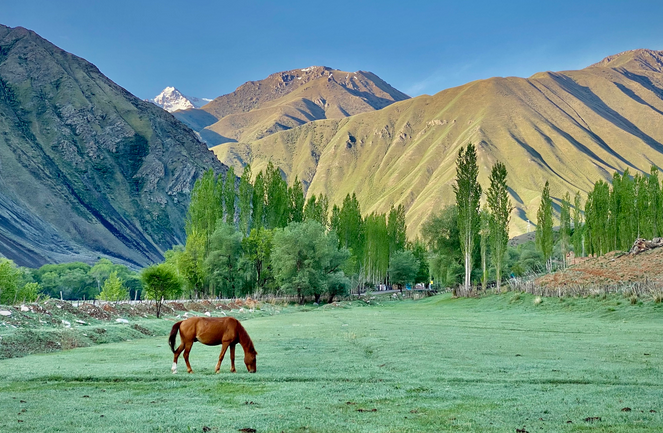
Confronted by her teenage son Samuel’s delinquency, Sibylle decides on a drastic solution which she may well have been considering for herself: to uproot him from Bordeaux to a different culture, closer to nature, where he can learn “true” values, by trekking on horseback through the mountains of Kirghizistan. Selling with apparent ease a conveniently inherited house, she is able to finance this scheme, and set off, despite her ex-husband Benoît’s strong objections, and Samuel’ sullen resentment.

The novel proceeds in a series of dramatic incidents, some quite improbable, covered in great detail, often in a “stream of consciousness” style which can become oppressive in its repetition and intensity. Events are punctuated with flashbacks including the rather hackneyed use of dreams, to reveal the past events of Sibylle’s life.

“Continuer” has been made into a film which apparently focuses on the relationship between mother and son, and the striking landscapes through which they travel, perhaps because these are the strongest aspects of the novel (despite the author reportedly not having set foot in Kirghizistan before writing it). But Mauvignier has sapped his theme with continual references to Sibylle’s underdeveloped backstory, some details of which have to be shoehorned into the somewhat rushed anti-climax of the ending.

“Continuer” seems to have been well-received in France, although I preferred Mauvignier’s earlier novel “Des Hommes” (“The Wound” in translation) which deals with the problems of coming to terms with the past faced by Frenchmen forced to fight in the Algerian war of independence. Both novels share what may be the hallmarks of his writing: distinctive style, unusual structure and inconclusive ending. Both novels convey a strong sense of place with minute descriptions of physical sensations, some of which can be absorbing, but in this case did not engage me fully.

Remembering Babylon by David Malouf: Living in a world where a sense of the presence of those who have gone before is lacking

Written by the internationally admired novelist and poet David Malouf, this is an unusual take on the interactions between the European colonists and the native Aborigines in C19 Queensland.

The central character, Gemmy Fairley, is based on the life of James Morrill, a sailor who was shipwrecked and washed up on the Queensland coast where he lived for sixteen years with the Aborigines, before returning to the settlers’ “civilisation”. Both men announce themselves with the same words, “Don’t shoot! I am a British object!”, but the Gemmy of Malouf’s imagination seems to be a more poignant and touching character who seems to have adapted quite easily to Aborigine life, after an even harder childhood as an orphan exploited by a London rat-catcher.

At first, Gemmy is a source of curiosity and amusement, but in an isolated, insecure white immigrant community, he soon arouses suspicion mingled with a repulsion which is heightened by the nature of his difference – physically damaged by adversity, he is between two cultures, a white man who looks and behaves like a native. In a community which lives in a constant sense of fear of the unknown, uneasily aware of the presence of elusive, possibly menacing strangers, they dare not trust him, particularly when he is reported to have received a visit from a couple of Aborigines.

In this subtle psychological drama, Malouf tends to portray the Aborigines in a more sympathetic light, as more sensitive and empathic than the white settlers, although they remain more two-dimensional than the latter. The Aborigine couple “were concerned that in coming here, among these ghostly white creatures, he might have slipped back into the thinner world of wraiths and demons he had escaped, though never completely in his days with them. They had come to reclaim him; but lightly, bringing what would feed his spirit”. As tensions rise in the colonial village, those who have supported Gemmy feel rejected by the community, but disillusioned with their former friends in return.

The Minister, Mr Frazer, makes use of Gemmy’s local knowledge and labour to dig up the unfamiliar local plants he wishes to study. This gives him the idea of developing a market for local fruit and vegetables, but the plan is bound to wither in the face of a Governor who thinks only of imposing his own British culture.

By turns disturbing and beautiful, carefully crafted, Malouf’s prose needs to be read slowly, like a poem, to appreciate more fully the vivid pictures created of Queensland, to note the small details which may prove relevant later and to understand fully the thoughts he wishes to convey.

From the outset, I felt that the novel which focuses on small insights was building up slowly to a powerful climax but this drifted away in the last three chapters which seem disjointed, rushed and too disconnected from what has gone before, featuring insufficiently developed relationships, or characters who have not even appeared previously. Perhaps the author is simply most interested in showing how , for instance, a single incident may have particular significance in one’s memory; a person may have a lasting influence which may be hard to grasp, perhaps only when it is too late.

This novel is worth reading for the quality of the writing and observation, and the issues it addresses, although I would rate “The Conversations at Curlew Creek” more highly from the viewpoint of structure. ”Remembering Babylon” could be a good choice for a book group, since it could spark discussion over the experience of being a colonial settler, the relationships with indigenous groups, and the psychology of individuals in groups under pressure, or living in a world where they need, but do not have, “a sense of the presence of those who have gone before”.

Cakes and Ale by W. Somerset Maugham – Fickle fame

Said to be the most highly paid novelist in the world in the 1930s, W. Somerset Maugham’s popularity has withered to the extent that he seems on the verge of being forgotten. Judging by “Cakes and Ale”, this would not have surprised him, for the novel is a satire on his literary world as he saw it, in which an author’s success depended, not on the merit of his books, but rather the arbitrary support, or rejection, of influential sponsors and critics. The reputation of the most highly regarded writer was likely sink into oblivion on his death.

Published in 1930, when Maugham was in his fifties, “Cakes and Ale” came to be his favourite book, perhaps because of its strong autobiographical element, since he draws on his own experience as an orphan brought up by stuffy relatives in Whitstable, and later as a medical student until his success as a writer enabled him to give this up.

The book caused an uproar when published since it seemed to be a thinly disguised  parody of Thomas Hardy and his relations with his first wife, used to portray the fictional Edward Driffield, who comes from humble origins, burdened by an unfortunate marriage to Rosie, a “common” and none too faithful barmaid. For this, he was accused of “trampling on Thomas Hardy’s grave”.  He was also condemned for too obviously using the writer Hugh Walpole, supposedly a close friend, as the model for the self-serving writer Alroy Kear, who agrees to write a sanitised version of Hardy’s first marriage for his widow Frances to get published.

Maugham denied that any of this was the case, claiming that Driffield was inspired by an obscure writer whose name he couldn’t recall who came to live in Whitstable.  Alroy Kear was a pastiche of several writers while Rosie was a character who developed in his mind over many years, perhaps triggered by the “obscure writer’s” wife, shunned in the prim world of Whitstable, although Rosie seems to have had more of the nature of Maugham’s one-time lover, the actress Ethelwyn or “Sue” Jones, whom he loved mainly because “she was beautiful and honest”.

So the criticism that Maugham was “quite unable to work with someone actual to work upon” seems justified, although the models used may not have been correctly identified.

I found the descriptions of class-ridden, gossipy, judgemental late C19 Whitstable, where everyone knew each other’s business, quite evocative, particularly as Maugham shows how it has evolved over time when he revisits it decades later.  Life as a poor medical student in London is also well-drawn. The dialogues reveal Maugham’s sharp, sardonic humour and talent as a playwright, although it is never quite clear to what extent he shares the snobbery and prejudices of most of his characters, apart from Rosie.

By contrast, the lengthy analysis of the literary world seems more like a tedious essay, with Maugham over-grinding an axe in an often pompous and stilted style. Very little happens in a book which would have made more of an impact as a novella, once Maugham decided it could not be contained in his original plan for a short story.  Styles have clearly changed, but the plot lacks structure, as Maugham’s creator rambles through his reminiscences.

Yet every now and again, one is struck by some insight into the past: on a visit to Whitstable after decades of absence, “Knowing English inns, I ordered a fried sole and grilled chop”. In a chance meeting with the local doctor with whom he had gone to school, Maugham reveals how the status of the medical profession has changed as he observes: “I judged from the look of him that he had lived, with incessant toil and penury. He had the peculiar manner of a country doctor, bluff, hearty and unctuous. His life was over. I had plans…I was full of schemes for the future…Yet to others I must seem the elderly man that he seemed to me. I was so shaken that I had not the presence of mind to ask about his brothers whom as a child I played with….”

Then there is the crux of the tale in which Maugham “begins to meditate upon the writer’s life”, which in fact he has been doing quite a lot throughout the book. “It is full of tribulation. First he must endure poverty and the world’s indifference, then having achieved a measure of success, he must submit with good grace to its hazards. He depends on a fickle public”. And so on…. “But he has one compensation. Whenever he has anything on his mind…..in short any emotion or any perplexing thought, he has only to put it down in black and white, using it as the theme of a story, or the decoration of an essay, to forget all about it. He is the only free man”.   

If Maugham had developed this conclusion more fully, yet concisely, I would have found it more deserving to be regarded as a classic.

“My Friends” by Hisham Matar: ambitious and moving, but with something missing which is perhaps the point

Hisham Matar has drawn much of the material for his novels from his Libyan heritage: a childhood experience of exile, with the need to conceal even his own identity, at times his very name, because of his father’s criticisms of Colonel Gaddafi’s dictatorship, or his father’s sudden arrest and abduction to Libya, never to be seen again.

The story revolves round three rather different men, thrown together by chance and linked by the sense of being cast adrift as exiles. It begins at what proves to be the end, as the narrator Khaled has an emotional parting from his old friend Hosam Zowa, about to start yet another new life in California where his father had acquired a house. As Khaled wanders back from King’s Cross Station to the small flat he has rented for decades, the subsequent chapters form a series of flashbacks and reminiscences, set against the background of a people ground down by a repressive regime, energised by the Arab Spring to rise up in rebellion, only to become embroiled in a new round of “coups, counter-coups, chaos and confusion”.

Surprisingly few very dramatic events are recorded, notably the demonstration in London outside the Libyan Embassy in 1984, when policewoman Yvonne Fletcher was shot and died. Now studying in Edinburgh, Khaled is persuaded by his friend Mustafa to take part in the event, but the balaclavas they purchase to conceal their identities are no protection against the unexpected volley of bullets from an Embassy window. Although badly injured, both survive, but with lives irrevocably changed: doomed to be branded disloyal troublemakers. With the real risk of physical arrest and torture combined with the psychological games set up by the Gaddafi regime, the two young men are unsure whether their close relatives in Libya are aware of their plight but are afraid to contact them in case they suffer reprisals as a result. Khaled’s caution proves justified when he eventually risks phoning his parents: while his father goes away for a minute, the inevitable eavesdropper on the line coughs twice, just to make his presence known.

The novel conveys well the surreal aspect of crises, and the continual fear involved in exile. There is the constant need to be on guard, even against fellow students thought to be “spies” being paid to inform on Khaled and Mustafa. To protect himself from the long arm of Gaddafi’s regime, Khaled sacrifices much to keep a low profile. This involves becoming a habitual liar, even to his closest relatives back home. So incredibly, for years, he maintains the fiction that he is still studying at university and having a great time, when in fact he is living in poverty in London, doing dead-end jobs when he can.

Some of the most engaging passages are the dialogues involving conversations too detailed to be memories, as when Khaled, as a boy, hears his liberal-minded parents discussing the daring story read on the radio, written by Hosam, whom he has yet to meet. Or, years later there is a domestic scene set in Libya, which has to be relayed to Khaled in the form of a letter, in which Hosam describes his growing attraction to a much younger relative called Malak, who is goaded by Hosam’s brother into describing the kind of man she would choose to marry – it’s like being a fly on the wall observing another culture and adjusting one’s view of it in a positive way.

At other times, the author digresses into some topic which interests him and could easily be an essay in its own right: as in “a survey of London’s inherent instability” which involves Khaled and Hosam in visiting the houses where a range of famous writers lived in passing. Another example is a discussion of Arab words which have no English counterpart, like “heart” in the metaphysical sense: “How can the English language do without such a word?” Malak asks.

For the most part, the novel is slow-paced, and probably a hundred pages or more too long. Not much happens in Khaled’s life, restricted partly by his exiled status, partly the limits he imposes on himself, the implied inability to commit to a permanent relationship which may be the result of trauma. The author’s focus on small incidents and passing impressions, could become very tedious. Matar largely succeeds in avoiding this with the acute observations and insights which he weaves into Khaled’s stream of consciousness. Matar is interested in psychology, why people behave as they do, rather than in tight plotting and the power of a “less is more” style. He portrays Khaled as being in the middle of the trio : behaving like the impulsive Mustafa when he is with Hosam, or the cautious Hosam when with Mustafa.

Inevitably, the urge to return to Libya to fight for an end to tyranny proves irresistible for two of the trio, with Khaled apparently stuck in the safe inertia of his constrained haven in London – but this enables the dynamics of the relationship between the three to change again. On one level, the situation is often painfully poignant or sad, but on another it is simply a realistic portrayal of how life turns out.

The reliance on memories leads to fragmented, disjointed impressions, particularly in the final chapters which felt like a condensed bolt-on to reach a rather limp ending. Yet overall, the novel increased my awareness and understanding of Libya and the trauma of exile, although I felt that there was something in Khaled’s personality which made his life more constrained and limited than perhaps was necessary, and that humans being by their nature capable of adapting, he was in his own way oddly content.

“Three Hours” by Rosamund Upton: Missing the Mark

Based on the 1999 Columbine High School massacre in 1999, the location is a private school in rural Somerset. Perhaps because the author is a former scriptwriter, this novel has a visual, filmic quality, being presented in mostly short scenes, continually switching into flashbacks to fill in the details of various characters. This became overdone at points where the book degenerates into notes – such as a list of newspaper headlines likely to stir up prejudice against Muslims in Britain, or of Trump’s inflammatory tweets.

The novel opens dramatically following the shooting of the headmaster. We are given his increasingly confused thoughts, interspersed with those of the pupils who frantically try to save him, and other staff members taking refuge in various parts of the site, too scared to move. However, I was disappointed that the psychology of the two perpetrators of the crime is never developed and explored sufficently.

In focusing in a period of just three hours in the school morning, the author builds up the tension, as the killer’s footsteps can be heard pacing up and down the corridor, pausing outside the door which cannot keep him (or her) out for very long.

The geography of the site is described in painstaking but hard to visualise detail. It is clearly complicated, with buildings like the junior school or the pottery room set apart – as proves necessary for the plot, but I could have done with the map which the authors of many such novels tend to provide.

The idea of confining the story to a timespan of three hours is interesting, and it is quite tightly plotted, but I found the style too sentimental at times, even “soft-centred”, and so incongruous for such a grim situation, although I did not think it was deliberately intended to create a jarring contrast.

One’s view of a book is always partly a matter of taste, and this one is very popular. However, I was put off by the bleak theme, some overly contrived scenes, not least some admittedly ingenious aspects of the climax, and too shallow treatment of what motivated the villains of the piece.

“A Rising Man” by Abir Mukherjee – a cut above.

Having survived the shelling of the World War 1 trenches and lost his wife to Spanish flu, there is little to keep Captain Sam Wyndham in England. Invited to join the Imperial Police Force in Bengal, only a week after his arrival in Calcutta, he has to deal with the perplexing murder of a senior British official outside a brothel in the native quarter.

At times, Wyndham may seem like yet another of the cynical, somewhat dysfunctional detectives who encounter a succession of red herrings, blind alleys and setbacks, but with the occasional far-fetched act of derring-do or flash of insight manage to solve the mystery – or at least have it explained by the arch villain, possibly in some tense cliff-hanger.

For a first novel, this is quite impressive. What sets it apart is that the author, brought up in the UK as the child of Indian immigrants, succeeds in getting inside the mind of an Englishman of a century ago. Sometimes the dialogue and Wyndham’s view of his world seem too modern, but the setting is an interesting one – Calcutta in 1919, with a population beginning to question British rule, and Wyndham’s investigation disrupted by the unrest following the Amritsar massacre.

The author’s in-depth research of the buildings, ambience and history of Calcutta creates a strong sense of place. His identification with the native people does not deter him from showing them honestly, as well as how they are viewed by the British expats, whose unconscious prejudice, sense of superiority and general tendency to underestimate them is often shown.

Sergeant Bannerjee Surrender-not, who puts up with being known by this name since British people cannot be bothered to learn it accurately, appears to do most of the legwork as regards the investigation. Although the ending seems a little rushed, some of the scenes on the way seem rather long and repetitive, but perhaps that reflects the nature of detective work. There is realism in the way that essentially honest people, like Wyndham, may be sucked into a system of compromise, even acceptance of corruption on the basis of “the end justifies the means”.

Some “loose ends” of unfinished business point to a sequel, or series as it has turned out, so I shall probably read the next novel in due course – it being no doubt advisable to do this in the right order.

The House of Doors by Tan Twan Eng- when each door opens into a different theme………..

It is common practice for a successful writer to fictionalise the life of some celebrated author from the past. In this case, Malaysian novelist Tan Twan Eng, three times long- or shortlisted for the Booker Prize, has focused on Somerset Maugham, the acerbic, acute observer of human failings, who became a bestselling novelist and famous playwright in the first half of the C20, but is now in the process of being forgotten – unless “The House of Doors” revives interest in him, especially if it is made into a film.

Born in Penang, qualified in law in London, Tan Twan Eng is well-placed  to recreate the meeting of east and west in early C20 Malaya, against the backdrop of the Chinese mainland in turmoil. The focus is on a fortnight in 1921, when Maugham and his secretary/lover, the flamboyant Gerald Haxton, are the house guests of  expat barrister Robert Hamlyn and his wife Lesley, who is unusual in having been brought up in Penang. Initially underestimating Lesley, Willie Maugham finds her to be the source of intriguing local stories, like the scandalous murder trial from the recent past, which will provide the material for him to restore his finances after a disastrous investment, and hopefully retain Gerald’s affections in the process.

This bald summary does not do justice to a complex tale with perhaps too many threads, quite skilfully interwoven, although the reader may find it hard to categorise.  On the face of it, this is a book in which not much happens: at a deeper level, there are continual dramas at an international to personal level.

Lesley’s friendship with the visiting exiled political leader Sun Yat-Sen sometimes reads like a potted history of China on the brink of a Communist revolution, but at least I was made aware of his significance for the first time.

With his sham marriage, Willie portrays the stress of leading a double life, behind a mask, forever fearful of being exposed and disgraced like Oscar Wilde. Lesley represents the other side of the coin: a women who has to find a way of coming to terms with her husband’s infidelity with another man, in an era when divorce was not an option socially. Ironically, this situation leads to her discovering a greater degree of personal fulfilment than might otherwise have been possible.

Apart from the meticulous plotting, with the habit of dropping clues which only become clear much later on, so one has to keep concentrating, it is the written style which sets this novel apart.  I sense that the author has aimed to write in the style of Maugham, inevitably using the type of incident which he would have found intriguing and likely to appeal to his readers.

The  unusual choice of verbs, original metaphors and similes, although occasionally overdone,  are generally very effective, particularly in creating through the mind’s eye scenes of places one has never visited. Even small incidents are described with care. Take the simple action of unwrapping a book: “I cut the twine with my fruit knife, inserted its tip into a fold of the wrapping and with two or three brisk strokes filleted the package open”…. “The blackened kettle was brooding on a charcoal stove, steam whispering from its spout”.

When “Willie pressed his palm to the hard, crocodilian bark” of the  three hundred years old raintree in Robert’s garden,  “the intricate filigree of branches and leaves reminded him of the network of bronchiole and alveoli in a set of lungs”, a clear reference to his previous career as a doctor.

Tan Twan Eng’s own legal training gives the cross-examination in the murder trial an authentic ring, and may also account for  his close attention to detail, for example when introducing us to Malaysian cultures. The precision of his descriptions of the traditional c18 shophouses in Penang with their distinctive “five foot way” paved with brightly patterned terracotta tiles at ground level,  and the timber louvred shutters above can be confirmed by countless photos on the internet.  The ink and watercolour drawings of particular streets, also viewable online, are a model for the paintings Lesley drew in her youth. Even the “kerongsang”, set of three brooches used to fasten the “kebaya” is described fully, when Lesley’s new mood of assertiveness leads her to wear traditional dress.

It may have been a combination of deep reflection over the “the right word” and the structure of the story, not to mention the need for a suitably rich and  inspiring theme that have led Tan Twan Eng to produce “only” three novels in a span of sixteen years. Yet the resulting combination of quality of writing, insights into human nature and thought-provoking themes makes “The House of Doors” worth reading.