Normal People by Sally Rooney – What does it mean to be “normal?

This is an in-depth portrayal of the evolving relationship in the four life-changing years from leaving school to starting on a career of two young people in present-day Ireland. It is perhaps inspired by George Eliot’s observation, quoted at the outset,  and no doubted garbled here into plain English, on the profound  and unexpected way in which one personality may influence another.

The bright but troubled product of a well-off yet dysfunctional family, Marianne is a loner and misfit at secondary school, continually provoking rejection and bullying by her peers. The one exception is Connell whom she can meet in a neutral setting outside school because his mother cleans for Marianne’s family. Supported by his poor but well-balanced and tolerant single mother Lorraine, the charming, athletic and academic high-flier Connell is the complete opposite of Marianne in being very popular, a situation he is afraid of sacrificing by the admission that he not only likes her but they are in a sexual relationship.  In his immaturity he behaves callously, despite the sensitivity which feeds his love of English and leads Marianne to encourage him to apply to study literature at Trinity, her university choice.

Once at somewhat exclusive middle-class Trinity, the tables are turned: with the chance of a clean slate, it is Marianne’s turn to become accepted and sought after, whereas the working-class Connell feels out of his depth, judged by his thick regional accent and cheap, unfashionable clothes. Yet through indications of her lack of self-esteem and sexual masochism in her relations with men, the degree to which Marianne has been physically and mentally abused is revealed: although details remain sketchy as to her dead father, they are painfully clear as regards her cold mother, and brutal, manipulative brother, both themselves the victims of abuse, but not portrayed with any sympathy like Marianne. Throughout, she and Connell may no longer be lovers but share some deep bond, yet not always with complete openness and self-knowledge. Though highly intelligent and perceptive, immaturity and lack of experience inevitably plunge them into frequent uncertainty and confusion, unable to express their complex, shifting emotions.

This is an insightful and often moving page turner, with the tension of knowing that matters could end in tragedy. Born in 1991, Sally Rooney has the advantage of being close enough to her school years to write with authenticity about the pressure to conform and bullying aggravated by social media. She gets inside the head of the two main characters to create a convincing stream of the changing and conflicting emotions of being on the cusp of adolescence and adulthood.

It may well be that this novel has been over-hyped, although I would not criticise the simple style which is probably  harder to write than it seems and serves to convey  the characters’ thoughts more effectively than  many a self-regarding literary turn of phrase.  I agree that apart from Marianne and Connell, the characters are mostly two-dimensional caricatures, with no indication of their inner motivations and thoughts. The main flaw for me is that periods of mental illness, which figure strongly in the book, seem to be slipped into, or recovered from rather too abruptly, with insufficient development of the situation. However, I was satisfied by the ending which seemed a well-chosen point for conclusion, leaving it open to the reader to decide what happens next in their lives. This is not a depressing read for there are moments of humour despite the emotional intensity.
“Olive Kitteridge” by Elizabeth Strout – Baffling World

This collection of short stories about the inhabitants of the fictional coastal town of Crosby in Maine remind me of the work of the Canadian novelist Alice Munro,  also of “Lake Wobegon Days”.  The opening tale, introduces us to Henry Kitteridge, the decent, kindly pharmacist who falls for his tragically widowed young assistant Denise. It is easy to understand why he dreams of leaving his brusque, sharp-tongued wife Olive who “had a darkness that seemed to stand beside her like an acquaintance that would not go away”, so hard to grasp why “to leave Olive was as unthinkable as sawing off a leg”.  Olive’s appearances in the stories vary from a brief mention to a pivotal role, to the extent of justifying the use of her name as the overarching title. She embodies three key themes of Elizabeth Strout’s work: ordinary people are flawed and complex; many of us are damaged by “messed-up childhoods”, inevitably screwing up our own offspring in turn; we cling to relationships for fear of  being left alone.

The most successful stories for me were those focused on a clear situation, such as Olive’s thoughts during the wedding reception of her only son Chris, who has married an assertive Californian. Filled with love for the son she may have mentally abused, Olive tries to overcome her “panicky, dismal feeling” and convince herself that this marriage is all for the best until, overhearing a conversation between the bride and a friend, in which Olive is criticised,  she gives vent to her suppressed jealousy and resentment through an original and comical act of revenge. I was also impressed by the subtlety of the final story “River” in which Olive, feeling bereft as a widow who had “day after day unconsciously squandered” the time spent with Henry whom she should have valued more, begins to form an unlikely relationship with a man she has always disliked, who is similarly suffering from the loss of his wife, because even “lumpy, aged, wrinkled bodies were as needy as..young, firm ones”.

Other stories, although interesting, seem too rambling and baggy, probably better developed into novellas. An example of this is the middle-aged man, who unexpectedly finds himself suffering from “empty nest syndrome” after the departure of his four sons, has an affair with a sympathetic single woman, and gets involved in trying to help a young girl afflicted with anorexia.

I found least satisfactory the shorter stories with no connection to Olive, which almost seemed included to pad out the collection to a suitable length, such as the tale of the pianist who drinks too much to drown her emotional pain and lack of confidence, or the self-deluding wife  who is painfully reminded of her husband’s infidelity.

As the above examples suggest, too many of the characters seem to suffer from deep, even suicidal depression, insanity, illness and premature death. The stories are saved from unbearable grimness by the wry humour, and some blackly comical absurdity, as when, caught short on the way home from an evening out, Olive insists on using the hospital toilet, only to find herself and Henry embroiled in a hold-up by two masked men bent on stealing drugs.

The style is for the most part direct and insightful, apart from the odd excess, as when a suicidal psychiatrist who has been “messed up” by his mother shooting herself recalls, her “need to devour her life had been so huge and urgent a to spray remnants of corporeality across the kitchen cupboards”.

A good choice for a book group, these Pullitzer prize-winning stories will provoke a good deal of discussion, and no doubt divide opinion.

“Tombland” by C.J.Sansom – Trusting to see a new day.


Tombland (The Shardlake series Book 7) by [Sansom, C. J.]

It is 1549, with the boy-king Edward VI on the throne and his ambitious uncle Edward Duke of Somerset the virtual ruler in his role of Lord Protector. People are already beginning to voice regret over the passing of Henry VIII and England is ripe for rebellion with the grim imposition of fanatical Protestantism and acute poverty aggravated by the cost of on-going wars and the debased currency, but in particular by the accelerating pace of enclosure by wealthier landowners of the common land  vital for the survival of their poorer neighbours.

In the seventh novel in this series, courageous, persistent, incorruptible, liberal-minded lawyer Matthew Shardlake is asked to investigate discreetly a murder charge against John Boleyn, a relative of the king’s sister, the young Princess Elizabeth. Since the Boleyns are out of favour, he may have been framed.

This plot-line is side-lined by the eruption of Kent’s Rebellion on the fringes of  Norwich. Workers who have been subservient all their lives gain confidence and determination in the new-found freedom of the camp on the sandy heath above the city, where they are trained to fight in the event of the Protector failing to accept their demands for reform.  Tension builds with the news of the approaching the army sent to quell their resistance. As the prospect of failure and reprisals grows, some begin to question the decisions of their charismatic leader Robert Kett.

Although sometimes bearing too close a resemblance to a schools’ history documentary, this theme is quite gripping with a range of well-developed characters and certainly raised my interest in a significant happening of which I was unaware, despite having studied A Level History. The lengthy essay at the end shows the book to be remarkably faithful to known events, as well as indicating what some have criticised as the author’s obsession with the theme. One caveat: would the shrewd and cautious Shardlake really have agreed to act as Kett’s legal advisor with so little apparent internal doubt and fear?

I found the details and handling of the Boleyn murder mystery less satisfactory, with an over-reliance on coincidence and a somewhat implausible denouement. Too many of the characters seem to be caricatures, or two-dimensional, the villains ludicrously villainous. The two threads of murder mystery and rebellion are welded too crudely together.  The novel is hard going by reason of its unnecessary length, padded out with repetition or superfluity of detail, or simply verbosity. However, it seems that famous, successful authors are no longer required to spend time editing, and no one else bothers if it is a “guaranteed” best seller.


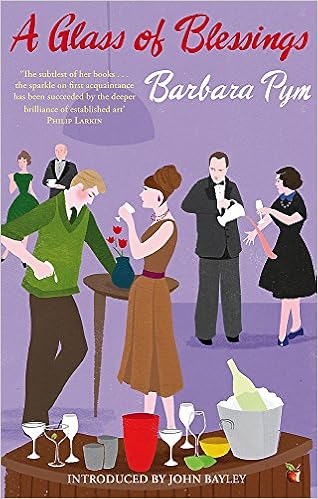
“A Glass of Blessings” by Barbara Pym – No need to call a spade a spade when armed with a scalpel of wit.


This is my review of “A Glass of Blessings” by Barbara Pym.

With her coolly  ironic appraisal of well-heeled middle-class life in 1950s London, Wilmet Forsyth could be a reincarnation of Jane Austen.  Married to Rodney, a conventional civil servant slipping prematurely into a dull rut of middle age, who feels that it reflects badly on a man if his wife works,  Wilmet has no children, plenty of domestic help,  and so has too much time on her hands.  A situation which was commonplace amongst young middle-class women fifty years ago sounds dated and odd now, indicating how much life has changed.

Wilmet is made to seem more appealing by her humorous self-deprecation: imagining the two local clergymen in need of home help attempting to boil eggs she concludes, “I wondered if they would know what to do if they cracked. I never did myself”. Wilmet is a mass of contradictions. Her religious piety seems like a social habit acquired alongside her elegant dress-sense, her liking for good food and wine, and her disapproval of men in duffel coats and women wearing nail varnish. She seems untroubled over having a husband and mother-in-law who are “non-believers”, and shows a broad-minded tolerance to acquaintances who turn out to be kleptomaniac, or living in a gay relationship at a time when this was still illegal. Her religion does not prevent her from basking in the admiration of her best friend Rowena’s  husband,  and playing potentially dangerous games  with  the intriguing Piers Longridge, Rowena’s  possibly disreputable brother with a hint of the ne’er-do-well.

On the surface, this is an entertaining read if one can avoid feeling irritated or in the case of younger readers even offended by the total lack of political correctness: the snobbish class-consciousness with its sense of entitlement and privilege; the stereotyping of working class characters; sexism and intimations of racism- although no one belongs to an ethnic minority to put this to the test. I am fascinated by this type of novel which recreates the sense of a past way of life, to some extent parodying it, but with the writer herself a product of the period, unconsciously voicing accepted prejudices of her society.

Barbara Pym was an Oxford graduate, who never married, despite many close relationships with men, and who earned her own living apart from writing novels. Although she is too subtle to make it explicit, she portrays Wilmet as an intelligent woman who does not fulfil her potential because of the attitudes of the society in which she has been raised. Publishers were apparently reluctant to print Pym’s novels which even at the time were considered old-fashioned.  Yet in her lifetime, she was considered underestimated as an author, who remains worth reading not merely for her clear, pithy style and wit, but also for the poignancy and depth of observation of human nature which lie beneath the surface.

“Sombre Dimanche” – a real life in Budapest


This is my review of “Sombre Dimanche”  by Alice Zeniter.

Although not explained by the author, the title “Sombre Dimanche” is inspired by the famous Hungarian song of that name, written in the 1930s with lyrics at first despairing over war, later portraying a man considering killing himself following his lover’s suicide. This song was widely banned in Hungarian jazz clubs for fear of driving people to copycat deaths, and later censored in its English version by the BBC, as likely to depress people too much in wartime.

Alice Zeniter’s novel is unlikely to have quite such a drastic effect, since the chapter of accidents which befall the main characters often seems too ludicrous to be taken seriously. Had this been written consistently as a social satire, or black family comedy, it might have been more effective. In fact, it is a hotpotch of “genres”, in addition to the above: part historical novel covering the period from World War 2, through the imposition of Soviet communism, abortive Hungarian uprising of 1956, collapse of Russian domination in 1989, and resultant messy embrace of western capitalism and “democracy”; part family saga; part “coming-of-age” novel from boy to manhood – interesting challenge for an ambitious young female writer; part literary tragedy.

The limitations of this novel disappointed me after having been so impressed by the author’s subsequent novel “L’Art de Perdre” or “Art of Losing”. This saga of a “Harki” Algerian family forced to take refuge in France after Algeria gained its independence because the head of the family had fought briefly for the French in WW2, gave me a more vivid grasp of the history of this traumatic period than I had gleaned from other sources.

“Sombre Dimanche” is by contrast quite disjointed. With the fundamental shortcoming of “telling” rather than “showing”, it flits confusingly between time periods and characters, lacking a clear narrative drive. Political events form a fragmented, unclear background. The overwhelming impression is of the passivity and what seems like spineless resignation to their fate of the main characters: Imre Mandy, his sister Ági and disconnected father Pál, offset by the cantankerous grandfather, who loathes the Russians, but the Germans marginally more. It could be that their wooden house, more suited to a rural setting and so incongruous in its triangle of garden in central Budapest, surrounded by rail tracks from which thoughtless train passengers hurl their empty plastic bottles, is a metaphor for a landlocked Hungary subject to waves of marauding invaders. However, one is mostly irritated by Imre’s lack of maturity and Ági’s lack of resilience, and left with the sense that they find a kind of contentment and security in their self-imposed isolation and narrowness of vision and life.

There are a few striking or insightful passages, as when the pubescent Imre becomes fascinated by a woman at the public baths, even when he realises that she is in fact quite old. Years later, the profound gulf between him and his German wife is indicated by her delight in having found the “real” Hungary in the vigorous men performing traditional dances in their native costume, whereas Imre can see the dangerous right-wing nationalism akin to Nazism in their behaviour. However, what may be intended as the climax of the book in the form of a self-exculpatory letter written by the grandfather fails to convince. Having been rendered speechless by a stroke, how could he write so lucidly at such length, and how can he show such empathy and humility after years of ranting, boorish tyranny?

Whereas Alice Zeniter’s Algerian heritage gave “L’Art de Perdre its authenticity, living and working in Budapest for a few years has given her the ideas for an interesting novel, but promising ingredients seem half-whipped into a flat soufflé.

Vernon Subutex by Virginie Despentes – “If it’s crude, it must be good!”


This is my review of  Vernon Subutex Tome or Volume 1  by Virginie Despentes – read in French, but also available translated into English.

Vernon’s odd surname Subutex is also a medication used for treatment of drug addiction, which indicates the tone of this novel. The former manager of a popular Parisian record store in the heyday of punk, forty-something Vernon has fallen on hard times in the face of competition from digital streaming. On hearing of the suicide of singer Alex Bleach, who has paid his rent for the last couple of years, Vernon’s first reaction is to wonder how he will manage when the bailiffs arrive. His only solution is to sponge off a succession of former friends and lovers, sinking rapidly into life on the street. Self-centred and weak-willed, he retains much of his old charm and power of attraction, appears quite perceptive and resourceful when sober and drug-free, but seems to be going through a kind of mid-life crisis. What may save him in the end is that news has spread of his possession of recorded monologues produced by Alex Bleach, which have gained extra commercial value from his recent death.

The first in a trilogy, this book has won many awards in France, been shortlisted for the Man Booker International Prize and made into a television series. It has been praised in glowing terms by critics as a “formidable” portrayal of “contemporary French society”. I cannot agree, since it seems to be mired in a narrow, sordid urban world of foul-mouthed promiscuity, cocaine-addiction, drunkenness, materialism, fascism and violence. A strong thread of prostitution and topical transgender sex runs through it, hardly surprising in view of the author’s previous life as a sex-worker and the themes of her early writing triggered by the experience of rape.

The flimsy plot serves as a vehicle for a series of disjointed portraits of mainly dysfunctional or unorthodox individuals, some of whom seem to play only a passing role, although they may reappear in Parts 2 or 3. Perhaps because the end was in sight, I found some of the later characters more authentic and well-drawn, even to the extent of evoking sympathy: Patrice, the wife-beater who can neither control his emotions nor express true remorse for the violence which has driven away the woman and two children he loves; Sophie, who has been driven a little mad by the death through an overdose of her elder son, a long-term addict for reasons she cannot comprehend.

There is a good deal of stereotyping and cliché in this novel, and I often found the female characters less fully developed and convincing, not counting their ludicrous names (La Hyène, Lydia Bazooka, Vodka Satana, and so on). I found it hard to credit that ex-porn star Deborah would decide, it would seem on a whim, to transition into Daniel, with so little effort or distress, and then be so successful in “mixing with the boys” and having heterosexual girlfriends.

I struggled through this for my French book group, by turns depressed, irritated and bored. The characters have a tendency to indulge in quite entertaining, exaggerated rants, there are some useful idioms buried in all the oppressive obscenity, but having reached the rushed and unresolved ending, clearly intended to make one read Part 2, I do not feel inclined to find out what happens to Vernon.

Privileged with their musical, poetical language, the French seem to delight in “slumming it” with over-rated imitations of the truly great, boundary-crossing, no holds barred novels which somehow “work” much better in English. I happen to be reading Philip Roth’s “The Human Stain” at the same time, which really is “magistral et fulgurant, Une œuvre d’art. Une formidable cartographie de la société américaine” des 1990

The Woman on the Stairs: never too late to learn


This is my review of  The Woman on the Stairs  by Bernard Schlink.

A lawyer by training, most famous for his novel “The Reader”, Bernard Schlink has a direct, analytical approach to fiction which sometimes seems dry, but can be moving and insightful in its precise, pared style. This novel is apparently inspired by Gerhard Richter’s blurred painting, “Ema” (Nude on a Staircase), based on a photograph of his wife.

A successful German lawyer in late middle-age, the anonymous narrator describes how he came across a familiar painting in a Sydney art gallery: “Woman on Staircase” is the nude portrait made years ago by the now famous Karl Schwind of Irene, when married to the wealthy entrepreneur, Peter Gundlach. The lawyer recalls how, years before, he became embroiled in a bizarre legal dispute, in which the manipulative Gundlach ensnares Schwind in a kind of groundhog day situation, in which he damages the painting in order to summon Schwind to repair it. This is part of a tortuous plan to persuade Schwind to exchange the painting he is desperate to regain for Irene who has left her husband for him.

This intriguing scenario gradually shifts into the serious themes Schlink is perpetually drawn to exploring. It seems he cannot relinquish the troubling question of how, having inherited the moral burden of collective guilt, suffered the pressures of a divided country, Germans should now live. Has the narrator followed false values in pursuing a well-paid career and material comforts? Irene’s desire to break away from being a trophy wife or an ambitious painter’s muse, limited to exploiting her sexual attractiveness, has led her to spend years caring for troubled children, but has she also at one time been caught up in a Baader-Meinhof type terrorist movement? This aspect of the book seems somewhat unsatisfactory because it is underdeveloped.

Schlink also explores at length how with age, we reflect on the past, imagining what might have been, regretting past actions or gaps in our recollection, with belated understanding or self-delusion in distorted memories. The narrator appears to have fallen in love with the idea of Irene rather than the woman himself, whom he does not really know, yet when he at last meets up with her in later years their relationship becomes a vehicle to reveal the price he has paid for his highly controlled and repressed emotions, the product of his upbringing.

I read this novel in a single day, initially finding it a page-turner, but was disappointed that it seems to lose dramatic drive, with the final “Part Three” rather tedious in its lengthy portrayal of the narrator in the, for him, unfamiliar role of caring for Irene in her illness, although I can see that it is probably very realistic. The book builds up to a satisfactory conclusion, but I was left with the sense that a potentially unusual and thought-provoking story has somehow misfired, either through a weakness in the translation, which seemed good at first, or through an uneven development of the wide range of ideas touched upon.

Himself by Jess Kidd: if Dylan Thomas had written detective fiction.

This is my review of Himself  by Jess Kidd

In the late spring of 1976, roguish Dublin charmer Mahony saunters into off-the-beaten track Irish coastal town of Mulderrig, “a benign little speck of a place…pretending to be harmless”, “his trousers…ridiculous…wide enough at the bottom to mop the main road”. After years spent in a bleak orphanage, he has discovered his true name and identity, and comes in search of his mother, or at least to find out more about her, the bewitching, wayward teenager Orla Sweeney. So begins a tale of detection with a difference.

Since Mahony has inherited Orla’s powers of clairvoyance, and sees ghosts at every turn, he is likely to glean more information from them than the sly locals with much to hide. Yet it seems that having the second sight does not enable Mahony to see straight away the truth which is partly revealed to us in the brutal hook of the prologue, in which a young girl is savagely murdered by an assailant, but her baby son is mysteriously spirited away while his back is turned.

Usually, I would avoid like the plague a book run through with so much ghostly magic realism. Yet in this first novel, Jess Kidd proves to be a kind of female, Irish Dylan Thomas, sustaining such a vivid imagination, and spinning her blarney with such easy skill, mixing humour with poignancy, that I was won over. This novel is not merely a page-turner to see how it will all end, but a joy to read for the sheer language: when the unpleasant local priest is punished for his worldly cynicism by the appearance of a spring in his library, he tries to look “rigidly unperturbed” as “near the fireplace…a thick layer of frogs seethe in heathen ecstasy where the hearthrug used to be”.

Since the story is “off the wall” from the outset, although managing to convey a good deal about tight-knit, isolated rural communities given to superstition, I found the build-up to the denouement a tad too ludicrous. References to some of the ghosts, like the eccentric ageing actress Mrs Cauley’s long-dead lover Johnnie become a bit repetitive, and phrases including “arse” too tediously frequent, but overall it is a surprisingly good read.

Although somewhat flawed in certain respects, this is a remarkably talented work, more entertaining, humorous and moving by turns, and in fact better written than many a more hyped and “literary” novel.

“Ghost Wall” – warped time


This is my review of  Ghost Wall  by Sarah Moss

This novella packs a more powerful punch than many a longer novel, with never a word wasted as it grips us with the sense of menace building beneath its wry humour, the strong sense of place on the moors and beach below Hadrian’s Wall in Northumberland, the characters and situations revealed through the observation of the narrator Sylvie, named by her father Bill after Sulevia, the Ancient British goddess of springs and pools.

A bus driver to earn a living, Bill is a self-taught expert on Iron Age life and survival skills. He is also a working-class racist, male chauvinist bigot, a control freak who dominates his downtrodden wife and teenage daughter with verbal sarcasm which tips into physical abuse, often as a means of releasing his own frustration when he feels criticised or undervalued by other people. “He didn’t always like it when people laughed”.

This and more becomes slowly apparent as Sylvie describes their family “holiday” taking part in an exercise to re-enact Iron Age life, alongside three students of the ebullient Professor Slade who drops by each day to see how they are getting on as self-sufficient hunter-gatherers, spending hours foraging for bilberries, burdock root, garlic “greens” and mussels at low tide, skinning rabbits for “mum” to stew in a cauldron over an open fire, when not washing a student’s filthy smock after he has slipped into a bog.

Dressed in a coarse, shapeless tunic and thin skin moccasins rather than what would seem like essential hiking boots, Sylvie can “feel the texture, the warmth, of different kinds of reed and grass in your muscles and your skin. The edges of the wooden steps over the stile touch your bones, an unseen pebble catches your breath. You can imagine how a person might learn a landscape with her feet”.

Having delegated the drudgery, the Professor and Bill have time to turn their minds from mundane to mystical matters, and get carried away planning the Iron Age-style “ghost wall” of the title, a palisade of willow lattice and skins, decorated with animals’ skulls in the absence of human ones. When dusk falls, the desire to drum on the skins and chant proves irresistible, and from this it may be only a short step to the “play-acting” of some darker ritual.
Silvie is shrewd enough to recognise that her father is “a show-off given to brutality” and has not had too much spirit beaten out of her to argue. Yet she seems tied to him in their appreciation of a natural world free from the false pressures and values of modern commercialisation. She appears trapped in childhood, frightened of venturing out into independence – even her attraction to the student Molly seems like a kind of adolescent crush, perhaps the dawning of an awareness of how she might become a liberated young woman, perhaps a rejection of the maleness which has so far crushed her, rather than an indication of lesbianism.

Apart from the sheer enjoyment of reading this book for the quality of the writing and the tight, entertaining plot, many issues arise for consideration: prevailing class differences, the north-south divide, male versus female relationships, how we have lost touch with nature, how values have changed over time in some ways, and in others perhaps essentially remarkably little.
My only slight reservations are over the formulaic, over-used device of a prologue with a dramatic, violent hook to catch the reader and the very abrupt, anti-climactic ending. Yet I can see that there is strength in leaving matters open for the reader to decide what happens next.

“The Human Stain” by Philip Roth – How accidentally a destiny is made.


This is my review of The Human Stain  by Philip Roth

Original and astonishingly articulate, “The Human Stain” forms the third part of Philip Roth’s trilogy of novels exploring major social issues in late 1990s USA.

After a distinguished career as a former Dean and Classics Professor who has chosen to return to classroom teaching at small-town New England Athena College, Coleman Silk falls foul of “political correctness” by describing two black students as “spooks”. He is referring to their ghost-like nature in appearing on his class register but never in person: the powers that be construe his words as racist. The irony of this situation, and the reasons for Coleman’s furious reaction to the charge are gradually revealed.

Proud and impulsive, he storms out rather than wait for the outrage to die down. His anger and isolation only fed by the sudden death of his wife Iris, which he attributes to stress over his treatment, he further scandalises the community by taking up with Faunia, an uneducated college cleaner and farm worker less than half his age. Their common bond seems to be that she too has been society’s victim, although in a very different way.

The narrator is Nathan Zuckerman, Roth’s favourite alter ego who reappears in other novels, but Roth makes the maximum play with artistic licence, digressing into events and inner thoughts (as when Faunia thinks about why she likes crows so much) which Zuckerman could not possibly know. The device for getting round this is that Silk’s story inspires Zuckerman to go on to research, expand upon and dramatise his whole life in the “The Human Stain” which we are actually reading. This goes far beyond Coleman’s emotional demand that, as a professional writer, Zuckerman should write about the monumental injustice which has been done to him.

Roth makes much of the parallel between Coleman’s plight and what he sees as the inordinate and hypocritical uproar over Clinton’s dalliance with Monika Lewinsky. An additional apparent inspiration was the experience of an academic friend, Melvin Tumin, who was subject to a “witch hunt” but was ultimately found blameless for the alleged use of racial language as regards two African American students. The plot is also a vehicle for exploring practical difficulties of gaining racial equality. An ambitious individual bent on achieving “The American Dream” may choose the controversial path of “passing himself off” as white, but this may be at the price of cutting oneself off from blood relatives and denying one’s children a sense of their true heritage.

Meanwhile, Faunia’s violent, vengeful stalker ex-husband Les Farley serves to reveal the problem of the traumatised veterans unable to adapt to “normal” life after the living nightmare of Vietnam. Roth shows his skill in arousing a sense of sympathy for almost everyone in this book, even the French academic troublemaker Delphine Roux who pays lip service to what Coleman (and probably Roth) sees as phoney literary “deconstructionism”. Perhaps, though, there is just a tinge of the flaw of subjective anti-feminism and academic conservatism in Roth when it comes to writing about Delphine.

Roth’s writing sometimes reaches such a peak of broiling intensity, that one has to take a pause to recover, and his tendency to examine causes and motives from every conceivable angle sometimes seems obsessive. Some of the quieter passages have the deepest impact, as when Zuckermann, who has taken refuge from the “entanglement” with his “turbulent” past life in a two-room cabin by a small pond with a patient blue heron in the Madamska mountains, meditates on how hard it has proved to adapt to “radical seclusion” and how easily he has made a friend of Coleman and let “all the world’s malice” come back “rushing in”.

Sadly, watching the film of the book years ago deterred me from reading it, because I could not get over the problem that actor Anthony Hopkins did not “look the part” of Coleman Silk. Having at last read it for a book group, I shall now make a point of going back to the first two parts of the trilogy involving a different set of characters and dilemmas: American Pastoral (1997) and I Married a Communist (1998).