The Shepherd’s Tale by James Rebanks: hefted to the land

This is titled both to link it to and distinguish it from W.H. Hudson’s 1910 classic “A Shepherd’s Life”, relating the tales of Caleb Bawcombe in C19 Wiltshire. Obliged to read this modern take as a book group choice, I was expecting a bland memoir, overhyped by a publisher as a sentimental portrayal of an arduous, largely vanished occupation.

In fact, it provides a fascinating explanation of why successful modern sheepfarming iin upland areas involves a mixture of hard labour and decisions which are in their way at least as complex as aspects of the history degree at Oxford which the author eventually obtained as a mature student.

A Herdwick ram

For instance, to breed sheep best-suited to the harsh Lake District environment requires ongoing study of the features of the rams or “tups” best suited to mate with specific ewes. The value of one’s stock is raised by winning prizes at local shows in a tightknit community where there is a high demand for tups which will increase the quality of one’s lambs.

The degree of cooperation and equality which has existed in the rural community for centuries is impressive. The common land on the upland fell is shared by a system of grazing rights based on “stints”, pieces of land which can be bought or rented between “commoners”. The sheep are herded up there in the summer, to enable the grass on the lower land to grow sufficiently to produce the hay needed for the winter feed. When it’s necessary to drive them back down to be dipped, all the commoners involved are expected to lend a hand, with the vital assistance of their generally very skilful sheep dogs.

James Rebanks has also altered my perception of the Lake District as simply a unique area of great beauty to be protected but also enjoyed as much as possible by visitors from other regions. Poets like Wordsworth and writers of acclaimed travel guides like Wainwright discovered the Lake District for themselves, as an idyll in which to escape, and promoted this limited view. Rebanks has made me aware how this disregards the existence and therefore the needs of the local rural population, and their contribution to preserving the landscape.

This matters, if teenagers, particularly boys already involved in working the land with their families, are obliged to pass exams which they regard as irrelevant to their expected future, by teachers who through their own form of ignorance seem to disparage their way of life.

So bright boys like Rebanks wasted their time at school – he only gained GCSEs in woodwork and RE, leading to the family joke that he could become a coffinmaker! None of his teachers respected the role of being a farmworker enough to convince him of the need for a certain level of education just to have more choice to do what one wants in later life. In Rebanks’ case, this was to earn money from professional employment, ultimately perhaps unexpectedly, success as a bestselling author, in order to earn the money to establish himself more firmly as a farmer..

Having found this much more gripping and thought-provoking than expected (if a bit repetitive in places), I recommend this as a read that is both informative and by turns humorous and moving in portraying a generally unfamiliar way of life. This also provides the evidence to question modern values and too ready acceptance of the way we live now. I shall definitely read the sequel to this, “An English Pastoral”.

Gainsborough – A Portrait by James Hamilton

“I’m sick of Portraits and wish very much to take my Viol da Gamba and walk off to some sweet Village where I can paint Landskips and enjoy the very End of Life in quietness and ease.”

Thomas Gainsborough claimed to prefer painting landscapes, but is best known as a leading and very prolific C18 portrait painter. After moving to London in later life, and famous enough to be invited to paint George III and Queen Charlotte, he became quite well off.

Hamilton’s opening chapter portrays Gainsborough as sociable, charming and generous, but also subject to mood swings, and bursts of rage, as when he slashed a canvas which a client had rejected. His friend the actor Garrick’s description of his mind as like a “steam engine overcharged” with genius implies a manic quality. As a young man, he was more harshly criticised as “very dissolute…inordinately fond of women”, which eventually seems to have led to an attack of venereal disease which nearly killed him. He was also often in debt, despite his high work rate, painting “upon his feet….during five or six hours every day”, and a wife who came with a useful annual annuity, the result of being the illegitimate daughter of a prince. Hamilton suggests that the cost of keeping his wife and daughters as well-dressed “advertisements” for his work was initially more than he could afford!

In later life, Gainsborough could chat informally to the king with ease, but was too unorthodox to “play the game” as a member of The Royal Academy, to the extent that when he complained about the way his pictures were being hung at the 1784 Academy Exhibition, he was simply ordered to take them down!

Although at pains to write a biography, Hamilton’s expertise as an art historian has led him to analyse in some detail the painter’s work, with coloured plates usefully provided for many of the examples, but often too small in the paperback edition to appreciate sufficiently. So it is worth looking up images of them online. Gainsborough’s portraits of the gentry and aristocrats are often rather stiff, and the backgrounds may be of greater interest, as in the famous painting of Mr. and Mrs Andrews crammed one side of arable fields clearly depicted the husband’s new farming methods. Beautiful, elaborate dresses, displaying skill in painting silks and velvets, were often added afterwards, neither belonging to or ever worn by the sitters. Some of the most striking portraits, with a photographic quality of realism, focus on the faces of friends, who often had to wait months to receive them as gifts, since they were painted in between more lucrative commissions.

One of the most fascinating aspects, although we have to wait to Chapter 25 to discover it, is Gainsborough’s unusual approach to painting. He liked to work in darkened rooms, lit only by flickering candlelight, with a large canvas tied loosely to a frame so that it billowed slightly like a sail, while the sitter’s head was positioned only inches away from the painting of it. Gainsborough worked with great physical energy, continually stepping backwards and forwards. Most extraordinary of all, he is reputed to have painted at times with long-handled, six foot brushes, which must have been larger, ordinary brushes tied to flexible handles of say, willow or hazel.

Another intriguing fact is that, whereas from boyhood, growing up in Suffolk he painted landscapes from observation of nature, later on he would construct landscapes to copy, using heads of brocolli for trees. Endlessly experimental, he would use his fingers, bits of sponge, even on an impulse sugar-tongs to apply paint.

Hamilton creates a strong sense of place as regards where Gainsborough spent most of his life. As a boy, it was Sudbury in Suffolk, where the once prosperous wool and cloth weaving trade had declined, leaving a politically corrupt sytem and discontented population. It was only the small inheritance from an uncle who had made money from property ownership in the depressed town which enabled Gainsborough, aged only 13, to escape to London as an apprenticed engraver – “some light, handy craft trade”.

The descriptions of Bath are fascinating, particularly if one happens to live there. There is the irony of the unhealthy nature of a spa town with the smoke from coal fires trapped in the valley, “set so deep …air was apt to stagnate”. In summer, “the air was thick with the chalk and dust thrown up by traffic….which in the wet and cold of winter became a deep mire”. Those who came to take the waters would have been better off staying at home in view of the sedan chairs used to transport the gouty and rheumatic, which were reduced to boxes of sodden leather in the frequent rainy days.

Apart from the sensitive, appealing portraits of his two daughters when little girls, and one of his wife as an older woman, with a direct, quizzical gaze, Gainsborough’s immediate family members remain two-dimensional. He is described as hen-pecked, but perhaps his wife had good reason to control his income from portraits. It is unclear why Hamilton calls the daughters “troublesome”. The elder daughter may have inherited a more extreme form of the painter’s possibly somewhat manic personality. For her to be considered “mad” may have led to her short-lived marriage being a failure, with her younger sister being forced into the role of a spinster carer. Probably, there is simply a lack of information to explore these family dynamics further. Yet there is a vivid image of Thomas wondering how best to dispose of his deceased brother Humphey’s invention of a by then rotting steam engine. Clearly, they were talented members of an “ordinary” family.

Similarly, I would have liked Gainsborugh’s uneasy relationship with Joshua Reynolds to have been presented more fully and clearly. Was it more than the case of an orthodox President of the Royal Academy criticising Gainsborough, even after his death, for “a want of precision and finishing” which Hamilton sees as “brave, flamboyant exuberance”?

Overall, the biography is meticulously researched and a mine of information. Yet reading it proves a laborious task at times, largely through a lack of rigorous editing to remove the frequent repetition, tedious lists of, say, lients or paintings, and long-winded digressions. I found Gainsborough’s chequered relationship with The Royal Academy too fragmented and hard to follow. The tendency to speculate in the absence of evidence or impossibilty of knowing how Gainsborough could have reacted to the present could also be quite irritating.

Despite these reservations, I recommend this biography, having gleaned a great deal from it.

Eileen – The Making of George Orwell by Sylvia Topp

This systematic, thoroughly researched biography of George Orwell’s first wife Eileen Blair has been overshadowed by Anna Funder’s more recent, subjective and at times dramatised account, “Wifedom”. The latter’s damming portrayal of Orwell, as an appallingly selfish man whose clumsy advances would nowadays trigger the wrath of the #MeToo Movement, induced me to turn to Sylvia Topp’s work for a second opinion.

It is true that Orwell pursued his interests with a single-minded obsession, whether it was to rush off to Spain to fight Franco’s fascist forces, or to lead an arduous life of self-sufficiency in a rundown cottage in an isolated village, rearing goats and selling eggs to make ends meet. He also seems to have made frequent passes at women,  apparently regarding fidelity in marriage as  unimportant, yet still deviously concealing an attempted fling with one of his wife’s so-called best friends. The fact that a fascination with young Arab girls prompted him to ask  Eileen for permission to visit a Moroccan brothel is particularly disturbing. He seems callous in his lack of concern over her ill health, but perhaps because he was frequently so unwell himself, he underestimated the risks of her final operation, leaving her to die alone while he went abroad. The empathy which prompted him to comfort a traumatised stranger he came across during the London blitz did not seem to extend to his wife.

Yet Sylvia Topp makes it repeatedly clear that Eileen willingly chose to devote her life to supporting Orwell for the decade of their marriage. This was despite being sufficiently ambitious to be very disappointed not to get a First at Oxford, and eventually finding an interest which could have given her a fulfilling, independent career – she was working on a Masters in the psychology of education when she met Orwell. She was conventional enough to think that, approaching thirty, “it was time” for her to get married. She also seemed to have a leaning towards achieving success vicariously through others, not only Orwell but also her high-flying brother Eric whose medical articles and books she typed and edited long before she took on the same role for Orwell.

By modern standards, Eileen was not a feminist. Yet since Oxford University only started awarding women degrees in 1920, four years before she began to study there, while women only gained the right to vote in 1918, and then had to wait a decade to have the voting age reduced from 30 to 21, she possibly felt that this was sufficient clear evidence of advances in achieving equality. She was clearly not a victim but prepared to speak out,  and show initiative when she really wanted to do so.  Admittedly, Orwell’s frequent bouts of illness as his TB developed cramped her style, but she seems to have been an innately kind person who could not have done otherwise than care for him. 

The couple somehow found time for a very active social life, entertaining friends in their often uncomfortable homes, and there is a pattern in their guests’ comments on Eileen: energetic, lively and attractive. She had no shortage of admirers: while Orwell was fighting in Catalonia, she had an enjoyable social life in Barcelona, forming a close relationship with a man called George Kopp, who may have wanted to marry her. Yet when Orwell was shot, she helped to ensure he received the best possible treatment, and later saved him from arrest as a suspected communist, by contriving to give him advance warning.

With her belief in Orwell’s talent, Eileen seems to have enjoyed being closely involved in his creative writing.  There is evidence that her feedback led to a marked improvement in his style, which colleagues noticed without identifying the reason.  The couple were intellectually very compatible, able to discuss issues on equal terms, and Orwell valued her opinion and trusted her enough to tell his publishers to deal with her, and accept her decisions in his frequent absences. There is even a suggestion that aspects of “1984”, an certainly the title of the classic, were derived from a poem which she wrote before even meeting Orwell: “End of the Century, 1984”.

The couple were also bound by a rejection of materialism, concern for social justice, and perhaps a sense of there being some virtue in a life of struggle, although Sylvia Topp notes tartly how they frequently took advantage of the good will and home comforts of wealthier relatives.  Ironically, by the time of Eileen’s tragically early death, Orwell’s writing was beginning to bring in a good income, although he too only lived for a further five years.  They paid a high price for a shared addiction to strong black tobacco.

Despite a tendency to be overdetailed and to speculate too long over minor points, to the extent that in order to get “hooked” quickly, it might be advisable to skim-read the first three chapters, and later through Eileen’s final employment at the BBC, this biography proves in the main very absorbing and revealing, not only about Eileen and Orwell, but also the times in which they lived.             

Free – Coming of Age at the End of History by Lea Ypi

Lea Ypi’s early life was spent in the last years of a Communist Albanian regime  even more ideologically  extreme than the USSR. Her charismatic teacher Nora indoctrinated her to revere Stalin as a source of inspiration for people round the world, a kindly man who loved children. Following the death of “Uncle Enver”, the anti-revisionist dictator who dominated Albania for forty years, Lea pestered her parents  to show due respect by displaying a large photograph of him. Perhaps this was to compensate for her awareness of never being able to “fit in”, because her parents were what Nora dismissively called “intellectuals”, with the wrong “Biography”.

Her father called himself Zafo, to avoid the need to apologise for having the same name as “Xhaferr”, the Axis-supporting “quisling” politician during WW2, while her maternal grandmother had lived abroad in luxury in her youth, and aroused suspicion by speaking French. It was a bizarre society in which people knew each other’s business, helped each other out with loans, but were not above informing on neighbours as reactionaries who failed to do their stint of street cleaning on Sundays or made jokes about the Party. Life revolved around queues for scarce goods, with the ritual of honouring a can or stone left to mark one’s place in the line.

If  anecdotes of daily life, details of family history and explanation of the political background all seem disjointed and at times unclear, this serves to convey Lea’s sense of confusion, which was compounded when the Communist system broke down and many who had been ardent supporters of the old regime suddenly discarded their principles, and denied they had ever believed in the Party line  Even Lia’s parents were found to have been concealing their past – Xhaferr really had been a relative –  leaving Lea  to wonder whom to believe or trust.

“Communism, the society we aspired to create, where class conflict would disappear and the free abilities of each would be fully developed was gone too. It was gone not only as an ideal, not only as a system of rule, but as a category of thought.  Only one word was left: freedom”.

The freedom to travel abroad on borrowed money revealed that life in the West was not superior in every way – Lea discovered that teenagers in Athens could not identify Ulysses, but knew all about some cartoon mouse called Mickey of which she was unaware!

Lea’s family were clearly not typical in that her father eventually obtained a senior post which brought him into contact with the Prime Minister, while her mother made political speeches campaigning successfully for her husband, whom she had decided had a better chance of being elected as an MP. They appear oddly unworldly at times, hiding their money in an old coat rather than using a bank, although this proved a better option than the loss of their savings in an unwise investment.   

However, the new democracy turning out to be possibly even more corrupt and inefficient than its predecessor, the country lapsed into civil war, which Lea covers with scrappy extracts from her  teenage diary – perhaps because she was running out of time after the weeks spent writing her memoir in a Berlin cupboard during the pandemic, when she should have been home-schooling her children.

Although uneven in quality, this is a fascinating insight into a country now very topical with the focus on thousands of Albanian men, economic migrants paying smugglers to cross illegally to the UK. Ironically, Lea’s disenchantment with “freedom” may have led to her breaking a promise to her father when having insisted on studying philosophy abroad, she ended up as an academic teaching and researching Marxism – for which she makes a somewhat woolly case in the final rushed pages. One clear explanation stands out: “My family equated socialism with denial: the denial of who they wanted to be, of the right to make mistakes and learn from the, to explore the world on one’s own terms. I equated liberalism with broken promises, the destruction of solidarity, the right to inherit privilege, turning a blind eye to injustice”.

Red Shelley by Paul Foot: radical before his time

Performance poet Benjamin Zephaniah tells the anecdote of how, as a punishment at school, he was given Shelley’s famous poem, “The Mask of Anarchy”, to analyse. When he informed the teacher of his inability to understand it, she cruelly branded him “stupid”. This should have put him Shelley for life, except that years later he came across a copy of Paul Foot’s biography “Red Shelley”, which made him a great admirer of the poet overnight.

This book makes it clear that the poem was inspired by the Peterloo Massacre of 1819 in which hundreds were injured, a few even killed, as sabre-wielding mounted soldiers tried to break up a crowd of many thousands demonstrating to demand parliamentary reform, which did not commence until twenty years after Shelley’s death. As the member of a wealthy and privileged family, who had developed a keen sense of the injustice of inequality and the need to redistribute wealth from the “idle rich” to those who actually work to produce goods, Paul Foot probably felt an affinity with Shelley.

With no particular love for C19 Romantic poetry, I had failed to appreciate the serious ideas behind it in Shelley’s case, although I have to admit that his rational arguments impress me most in his written prose. Expelled from Oxford for writing a pamphlet on atheism, he wrote, “Supposing twelve men were to make an affidavit…. that they had seen in Africa a vast snake three miles long… that…eat nothing but Elephants, & that you knew from all the laws of nature, that enough Elephants cd. not exist to sustain the snake – wd. you believe them?”

Growing up against the background of the French Revolution, and coming from a wealthy Whig, anti-Tory, anti-government family probably exposed him to liberal ideas from an early age. His support for “the unfriended poor”, was based on his observation of the suffering caused by the enclosure of farmland and the squalid working conditions of the Industrial Revolution. His ideas went beyond a verbal attack on the arbitrary power of kings, and the cynical use of the Established Church as a tool of social control. He saw before many others that giving people the vote would not in itself solve the injustice of major inequality. This required “the levelling of inordinate wealth, and an agrarian distribution of the rich, uncultivated districts of the country”. Many of his ideas still seem surprisingly, and depressingly, relevant (and unachieved) today.

Shelley’s advocacy of free love also heaped opprobrium on his head. Paul Foot possibly lets him off too lightly, in underestimating the extent to which this argument was used by men as an excuse for “free sex” and treat women badly or disregard the pain that it can cause. Although Shelley genuinely seems to have supported “feminist” views, to believe in equality for women and to respect their intellects, as in the case of his second wife Mary Shelley, his abandonment of his first wife Harriet, who ultimately took her own life, is troubling.

Paul Foot admits to a certain inconsistency in Shelley. For all this radical poetry, “Let the axe/Strike at the root, the poison-tree will fall”, he was terrified by the physical violence of an angry mob. His attempts at being a political agitator in Ireland, or an agent raising money for the Tremadoc dam projects, which he imagined leading to a “perfect, idealistic society” for the workers, came to nothing. Since the latter provoked an unsuccessful assassination attempt on him (only his dressing gown was shot through with bullet holes), Shelley’s fear seems justified. At least Shelley’s “bitter satires” were read most widely amongst working class readers.

He ended up in Italy, furious over the 1819 ban on his political writing, although at least he escaped imprisonment for it, unlike some of those prepared to print his work. Isolated and often depressed, spending more time with Byron who had no interest in interfering with property and rank, than with any oppressed Italians, Shelley continued to write, producing his most famous “Ode to the West Wind” shortly before his accidental drowning.

There may be some small excuses for my previous neglect of Shelley. The late C19 saw what Paul Foot calls “an orgy of cultured Shelley-worship”, which stressed his “belief in freedom” and “lyric” poetry, censoring out all the controversial atheism, feminism and extreme views. In the 1930s, Shelley was savaged by the influential critic F.R. Leavis, for his “sloppy metaphors”, for plagiarising Shakespeare, and for his inability “to grasp something real” resulting in poetry which had “little to do with thinking”. But from what I have just seen of Shelley’s poetry, it is full of ideas and beliefs which make it worth reading, even if the language used tends to be excessive or lacking in discipline by some critical standards.

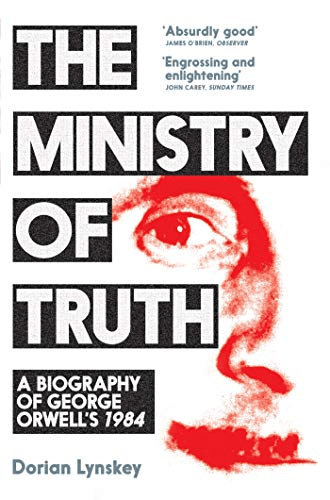
Ministry of Truth – a biography of George Orwell’s 1984 by Dorian Lynskey: “Don’t let it happen. It depends on you”.

This very readable and informative biography of George Orwell focuses on his adult life, culminating in his last novel, “ Nineteen Eighty-four” ( referred to here as“1984”).

In the year 1984, the long-deceased author was criticised for failing to foresee how technical advances would benefit ordinary people, and being unduly pessimistic about the threat of political leaders crushing freedom. Forty years on, the book seems more relevant now with even “democratically” elected populist leaders like Trump using “alternative facts” and “fake news” to achieve their ends, while the Chinese Communist Party “moulds model citizens” by means of technical surveillance combined with a system of rewards and punishments, reminiscent of the telescreens used to indoctrinate and spy on the inhabitants of Airstrip 1 in “1984”.

Dorian Lynskey makes us aware of the many writers engaged from the late c19 century in attempts to imagine the future, notably H.G.Wells with his “social fantasies” , and the Russian Zamyatin with a ringside view of tyranny, author of “We”. Although they clearly infuenced Orwell, to the extent that he was accused of plagiarising the latter in “1984”, the main point seems to be that important ideas were being explored.

In his development of the manipulative leader “Big Brother”, Orwell’s main motivation was not to predict what he defined as a “pessimistic utopia” (i.e. non-existent place, the word “dystopia”, not being in common use until a decade after his death in 1950). He did not seek to be a prophet of doom, nor did he turn against socialism in later life as some of his opponents liked to think. “1984” was simply intended as a warning against governments which suppress freedom by gaining excessive control over people’s lives, and stifling opposition. As he dictated just before his death from TB in early 1950, “Don’t let it happen. It depends on you”.

Orwell saw the effects of distorting the truth first-hand when fighting against Franco in the Spanish Civil War, where he naively joined an anarchist brigade, following rejection by the better-equipped Communist forces because he was thought “unreliable”, for being one of the first to question the Moscow “show trials”. In a chaotic Barcelona, he met a Russian called “Charlie Chan”, thought to be an agent of Stalin’s secret police, who tried to stir up an already unstable situation by claiming that anti-Franco anarchists were really trying to aid the dictator!

Orwell obtained much useful material from those who wrote about their experiences of totalitarian regimes. He probably came across formula “2+2=5” in the work of Eugene Lyons, who turned against Communism when he witnessed “the propaganda, persecution and industrial-scale dishonesty” during a visit to the USSR to interview Stalin. Ironically, several publishers initially declined to print “Animal Farm”, for fear of offending Stalin, a Second World War ally at the time. Needless to say, “1984” was fiercely attacked by readers from the far left, and delighted those from the right, who failed to grasp that Orwell was attacking repression of all political types.

The coining of the term “Orwellian” by Mary McCarthy, together with the adoption of such terms as “Newspeak”, “doublethink”, “thoughtcrime”, “unperson” and “Big Brother” have become embedded in our culture, but I had not appreciated the extent of the writer’s influence since his death on a surprising variety of people, as covered here in somewhat rushed and indigestible detail. Margaret Atwood’s “The Handmaid’s Tale” was inspired by “1984”. Artists like David Bowie made abortive plans to produce a musical version of “1984”. In the run-up to the year 1984, commercial products from Macintosh computers to sisal-look wool carpets were promoted via references to Big Brother – that is, a book warning against controlling people was used to manipulate them.

Orwell’s complex personality is revealed through numerous anecdotes and quotations. He once wrote to a friend, “I find that anything outrageously strange ends up by fascinating me even when I abominate it”. He was a remarkably hard-working journalist and writer which he somehow combined with a very active social life. “His conversation was like his writing, unaffected, lucid, witty and humane”. He loved to argue, and was surprised when a writer, whether a friend or a celebrity like H.G.Wells, was upset by a barbed comment in one of his reviews. He gave 1984 ’s Winston Smith his own pathological fear of rats, which once led him to fire his rifle at the wrong moment, alerting the enemy Spanish who destroyed his side’s cookhouse. He was married twice and had close women friends, but created a wooden character lacking an inner emotional life in the form of Julia in “1984”. This could of course have served to indicate the damaging effects of being brought up under Big Brother’s domination. Orwell chose to write “1984” on the bleakly beautiful Scottish island of Jura, well out of reach of the hospitals where he needed treatment. With nostalgia for an idealised pre-1914 past, he detested every aspect of modern American culture.

He wrote just after the Second World War, “No thoughtful person whom I know has any hopeful picture of the future”. Ill health may have depressed his spirits – but what would he have made of the world today – not least virtual reality machines?

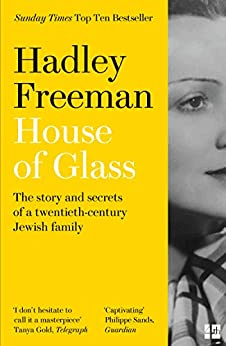
“House of Glass”, The story and secrets of a twentieth century Jewish family by Hadley Freeman – Knowing the past…..

Growing up in the US, Hadley Freeman noticed that her glamorous grandmother Sala was often sad, but she was only prompted to investigate the reason for this by the discovery, after her death, of a shoebox containing a motley collection of mementos: photos of Sala ripped into quarters partly taped together, or in the company of an unknown man whose face had been erased; a metal POW tag from 1940; a drawing on a “scrappy piece of paper” signed “Avec amitié, Picasso”.

Hadley Freeman’s often poignant account of what turned out to be her father’s family history from the turn of the C19 will strike a chord with many Jewish readers: poverty in a Polish shtetl (Jewish village), driven to emigrate by a pogrom in the aftermath of World War 1, finding opportunities in Paris, but feeling the bitter sense of rejection when forced into hiding, or to move on yet again in order to survive when France was overrun by the Nazis.

In fact, the Glass family suffered less as a result of the second World War than most ordinary Jewish families. What sets the Glass family apart is the remarkable success and wealth ultimately gained by two of the author’s great uncles. Handsome, self-effacing Henri invented the Omniphot, a machine capable of copying a variety of documents at different scales, including the reproduction of blueprints on microfilm – clearly in demand during wartime. Pugnacious, volatile Alex possessed an unlikely artistic streak which enabled him to become a successful producer of “high fashion” and later a collector and dealer in art to celebrities, who cultivated the friendship of people in high places, including Christian Dior and Picasso.

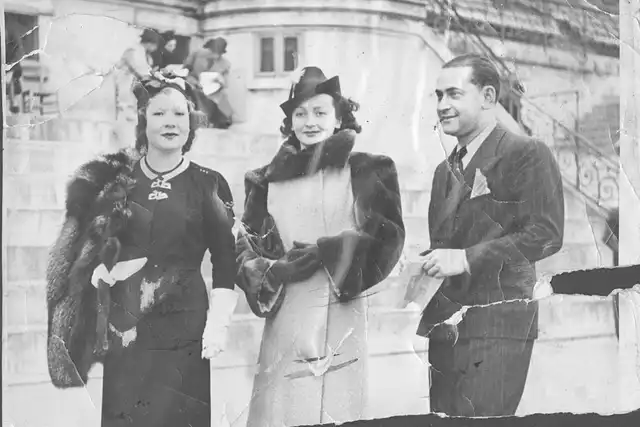
Sala (centre) and Alex (right)

This biography has been hyped by readers who seem undeterred by the way it is padded out with repetition, a fair amount of trivia, and some rather superficial and subjective analysis. The space given to speculation is perhaps inevitable since the narrative often seems to revolve round Alex, who proved an inveterate “myth-maker”, concealing and rewriting his past to suit his purposes. Did he really escape from a moving train bound for the death camps, by trading on the good will of a tall companion (whom he left to perish) to lift him up to a convenient hole in the carriage roof? Did he find a safe hiding place by exploiting a connection with a comrade-in-arms from his days in the Foreign Legion, who ironically was engaged simultaneously in deporting Jewish people from France to Germany? Is it an exaggeration to claim that post-war, “despite the surface fabulousness of Alex’s life, his business was crippled by debts, and he would go for days without eating in order to pay his staff of 150”? Particularly in the light of Alex’s unreasonable detestation of his sister-in-law’s fluency in German, which she had acquired long before the rise of the Nazis, the author takes an indulgent view of his willingness to work with suspected wartime collaborators, designing costumes for a Parisian ballet director “for the career-saving sum of 500,000 francs”. Such details are hard to follow and “square up” at times, and frankly somewhat wearisome.

It is a pity that, in the paperback version, the numerous family photos embedded in the text are generally too small and dark to see the details clearly. The focus on a particular family may help readers to empathise with their situation, but if the underlying aim was really “to know the past in order to understand the present and plan properly for the future”, to paraphrase Chaim Potok’s observation which Hadley Freeman cites, there are too many important broader aspects e.g. political aspects concerning Israel, which this overlong story omits to explore.

“Travels with a Donkey” by Robert Louis Stevenson – modern reevaluation of a classic

TRAVELS WITH A DONKEY IN THE CÈVENNES (Taylor & Guild Annotated Classics) by [Robert Louis Stevenson]

When I was a child, a dark red leatherbound copy of “Travels with a Donkey” lay unopened on a shelf for years as a classic I knew I ought to read. When recently I finally got round to downloading it on my Kindle, I was put off by hearing on the radio that Stevenson’s donkey Modestine had in fact been judged unfit for travel, so that the author had to include the last leg of his journey through the French Cévennes by stage coach. This, I discovered, was after only twelve days in which the poor animal, “not much bigger than a dog”, weighed down under a “monstrous deck-cargo”, was goaded, often by means of a whip or spiked stick, to trot some hundred and twenty miles up and down a succession of steep slopes.

Stevenson’s admission of feeling horror over his cruelty makes his persistence in this seem even worse – as when he rearranges his own load to free an arm with which to “thrash” Modestine, “two emphatic blows” needed for every “decent step” which the poor animal takes. Combined with his failure to plan in advance how best to reduce the load to manageable proportions, I set about reading this somewhat prejudiced against the famous author. To be fair, in the 1870s, lightweight synthetic materials were not available. But does it excuse the author that a local peasant insisted on making him a spiked goad as the only way of managing a donkey?

At first I was also impatient with Stevenson for undertaking the journey in late September, where he was likely to find “cold…grey, windy, wintry” weather four thousand feet above sea level. However, the weather seemed to improve as he travelled south, and I suppose it might have been too hot to walk earlier in the summer.

With overnight stops at a Trappist monastery “Our Lady of the Snows” where his admission of being an atheist prompted two visitors to combine in trying to convert him, at a number of remote inns or with a villager prepared to offer him hospitality for a small fee, Stevenson was able to portray the lives and attitudes of the local inhabitants. He was clearly impressed by a historical struggle which has deeply affected the area: the doomed uprising of the Protestant Camisards against the oppression of the Catholic majority in the early 1700s.

What finally won me over at least to the extent of appreciating why this novel was so famous for more than a century, is Stevenson’s ability, as he passed through the regions of Velay, Gévaudan, Mont Lozère and Cévennes to describe the landscape, and his wanderlust, in such vivid and precise terms.

“I lay….studying the colour of the sky, as we call the void of space, from where it showed a reddish grey behind the pines to where it showed a glossy blue-black between the stars. …I wear a silver ring. This I could see faintly shining as I raised or lowered the cigarette; and at each whiff the inside of my hand was illuminated, and became for a second the highest light in the landscape…..The outer world, from which we cower into our houses, seemed after all a habitable space…. I thought I had rediscovered one of those truths which are revealed to savages and hid from political economists: at the least, I had discovered a new pleasure in myself”.

In the valley of the Tarn, where Spanish chestnut trees have been so important to the economy, his portrayal makes it possible to visualise them without ever having visited the area.

“Some, trusting to their own roots , found strength to grow and prosper and be straight and large upon the rapid slopes of the valley; others, where there was a margin to the river, stood marshalled in a line and mighty like the cedars of Lebanon. Yet even where they grew most thickly they were not to be thought of as a wood, but as a herd of stalwart individuals; and the dome of each tree stood forth separate and large, and as it were a little hill, from among the domes of its companions…..autumn had put tints of gold and tarnish in the green; and the sun so shone through and kindled the broad foliage, that each chestnut was relieved against another, not in shadow but in light. A humble sketcher here had laid down his pencil in despair”.

It is probably an advantage at least to have passed through the area, stopping off at places like Florac or St. Jean-de-Gard, but the names of the the remoter points he passed are intriguing, prompting one to search the web for maps and images: Cheylard-L’Évèque, Chasseradès, Cassagnas, or Le Pont-de-Montvert.

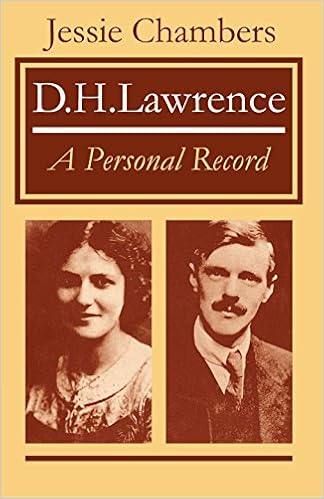
“D H Lawrence, A Personal Record by ’ET’ – Jessie Chambers” – a vivid memoir which everyone interested in Lawrence’s life and times should read

Jessie Chambers was the second daughter of the smallholder of Haggs Farm where the teenage D H Lawrence became a welcome visitor because of his “exuberance, his gaiety, his powers of mimicry, his resourcefulness….his readiness to help” causing even Mr Chambers to exclaim “Work goes like fun when Bert’s here: it’s no trouble to keep them going”.

Jessie and Lawrence became close friends, paying weekly visits to the library where they took out more books than were strictly allowed, read and discussed them earnestly. For about a decade, Jessie was the sounding board for Lawrence’s musing over, say, the obligation to use one’s talents to do good, the nature of love, or his need to be free to travel abroad, without a fixed home which was a foretelling of the course his life would take.

Sadly, this intellectual closeness aroused the jealousy of his over possessive mother, who forced them to consider the emotional aspect of their relationship. With the callousness he was to show so often in the future, Lawrence told Jessie, “I’ve looked into my heart and I cannot find that I love you as a husband should love his wife”. Yet since he could not bear to give up her company, he suggested they could marry if she wanted, but he would need to seek physical fulfilment elsewhere, or if he managed to find a woman to satifsy him physically, he and Jessie could continue a clandestine intellectual relationship. Clearly this marred their friendship, obliging Jessie to conceal the love she felt for him, until his elopement with the married mother-of-three Frieda Weekley put an end to any further relationship.
In the meantime, her distress did not prevent Jessie from copying out some of Lawrence’s poems and sending them to a publisher, when he was all for giving up the attempt to get his work accepted after several rejections. Years later, he wrote to thank “the girl (who) had launched me, so easily on my literary career, like a princess cutting a thread, launching a ship”.

D. H. Lawrence A Personal Record by E.T. (Illustrated) by [Jessie Chambers, Marciano Guerrero]

Jessie was also among the first victims of his habit of including people he knew in his books without any attempt to disguise them, although in making Jessie his model for Miriam in “Sons and Lovers”, what really upset her were the distortions in the portrayal of her relationship with Lawrence. This was despite his assertion “It isn’t meant for the truth. It’s an adaptation from life, as all art must be”.

This memoir was written after Lawrence’s early death from tuberculosis in 1930. Written with great clarity, this impresses the reader as utterly authentic, insightful and moving. Along with her inner suffering over his overt insensitive agonising, she notes his love of nature, acute powers of observation, and gift for putting sensations into words.

The memoir is also a vivid evocation of life in the early C20 in the rural and mining communities of Nottinghamshire. In a world devoid of television and social media, Jessie’s father read magazine instalments of Tess of the D’Urbervilles aloud to his enthralled wife, and the family acted out Macbeth under Lawrence’s direction, “half-amused, half-vexed” when Mr. Chambers , horrified by what he had to say as McDuff, was driven to exclaim, “Oh dear, oh dear! How awful!” Yet ironically, in the awful social class divide, Lawrence’s first publisher Hueffer was uncertain how to talk to working men, clearly unaware that they could be sensitive and self-educated.

Even the comments included in inverted commas in the memoir could be precisely what was said, because Jessie first began writing an account of her friendship with Lawrence under the title “The Rathe Primrose” as early as 1911. After her final break with Lawrence in 1913, she destroyed this manuscript, and it is interesting to speculate whether she was the victim of the sexism of the day when a publisher rejected it earlier as “unlikely to be a commercial success”.

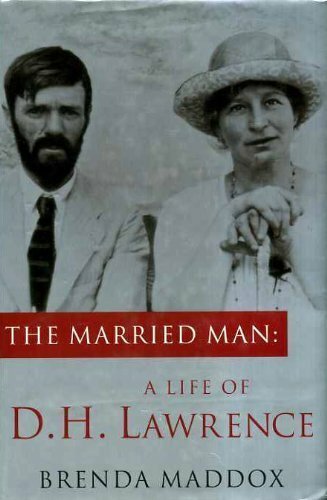
“The Married Man” by Brenda Maddox: tortured and flawed genius

The Married Man: Life of D.H. Lawrence by Maddox, Brenda Hardback Book The Cheap

This engrossing doorstep of a biography focuses on the eighteen years of D.H. Lawrence’s relationship with Frieda, his former tutor’s striking, ebullient, promiscuous German wife. Lawrence was probably attracted by her lack of inhibition and belief in free expression which she had picked up via a previous lover from continental thinkers like Nietzsche and Freud, in such sharp contrast to the narrow, Congregational chapel world of the Nottinghamshire mining community in which he had grown up.
In turn, Frieda believed herself to be nurturing and inspiring his genius as a writer, arguing after his death that, if he had married his first girlfriend Jessie Chambers, he would never have been more than “a little local poet, a watered down Thomas Hardy”.

For those who admired Frieda, there seem to have been more who regarded her as a very damaging influence on him, even to the point of contributing to his death by failing to use common sense and insisting on obtaining proper treatment for the tuberculosis which he denied for years, almost to the end. Admittedly, he could only tolerate life in a sanatorium for a fortnight when he eventually admitted defeat. Apart from her frequent infidelities which Lawrence seemed to tolerate, her worst fault seems to have been provoking him quite knowingly into the savage bursts of anger in which he beat her, even in front of visitors and friends. This, together with the undeniable misogyny in some of his later writing, plus his preoccupation with male dominance in marriage, triggered the condemnation of the 1970s feminist movement, as represented by Kate Millett.

As a result, Lawrence now remains well-known, but not particularly revered, so it is interesting to learn how quickly and easily he gained initial recognition, although his growing fame was fed by the notoriety of his later work, culminating in “Lady Chatterley’s Lover”, banned in both England and America, which it is disappointing to learn was written simply to earn as much as possible quickly when he knew he was dying. Apart from his main rival James Joyce, Lawrence was admired by famous writers like E.M. Forster and Aldous Huxley, although many were offended by his habit of including them undisguised, but often caricatured in his novels. They were repelled by the too frequent violent outbursts which made even friends doubt his sanity at times.

This could of course be attributed to his frequent ill health, and the suppressed knowledge that he had a disease which caused him considerable pain, and would kill him prematurely. When he was a child, his mother’s possessiveness, heightened by the need to nurse him through a long illness, and generally to protect him from infection, must have affected his emotional development. Her bitter contempt for her husband, which she encouraged her children to share, must also have damaged Lawrence’s ability to form stable relationships, but author Brenda Maddox does not explore these aspects much.

Lawrence is fascinating in his dual personality. Many found him charismatic, charming and entertaining, although his skilful mimicry must have been insensitive at times. He was industrious, with many practical skills, often generous with his time and money, when he had it, to help others. Yet he could also be cruel, abusive, sharp-tongued, dogmatic and opinionated to the degree that one might question how “good” a writer he really was when he committed some of his bizarre, often confused, ideas to print.

A restless wanderer to Italy, Ceylon, Australia or the high plains of the US state of New Mexico and Mexico itself in search of the pure air at high altitudes to ease his lungs, Lawrence gained the material for his memorable travel writing. His keen observation of nature and animals (which did not prevent his vicious beating of a pet dog) produced some striking poetry: “A snake came to my water-trough….” . “Sons and Lovers” is an enduring classic, although a clear example of the degree to which he drew on his own experience, in the process misrepresenting his relationship with Jessie Chambers, which he would justify by arguing that “art is not life”, even if it draws on real people for inspiration.

His later work, as summarised and quoted from in this book, often appears too farcical, perhaps intentionally, produced too quickly, with a loss of his earlier more subtle and considered style. But whatever one’s view of his work, Lawrence and Frieda remain an intriguing couple, rattling through their world of evocative places and famous names from the past.