There but for fortune…

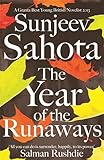
This is my review of The Year of the Runaways by Sunjeev Sahota.

Randeep, Avtar and Tochi are all economic migrants from India, crammed with others into a small terraced house in Sheffield where they work illegally on a building site, paid far below the minimum wage by an unscrupulous gang-master. It took a while for the author to establish their backstories, but eventually I became engrossed in their individual lives, and the different chains of misfortune which led them to obtain falsely or infringe the terms of their visas.

This is a fascinating insight into Indian culture: the continued level of violent prejudice against untouchables like Tochi, even amongst British Indians; the lack of a social security system in India to support Randeep’s upper caste family when his father falls ill, aggravated by his mother’s view that it is socially beneath her to work; the complex network amongst British Indians in which illegal migrants are both exploited and assisted, not least the gurdwara or places of Sikh worship where desperate followers of the faith can often get temporary bed and food. Randeep’s British “visa bride” Narinder also makes us think about the role of women in segregated communities who are repressed by fathers and brothers, denied the chance to gain any qualifications or the right to work, for whom breaking free means bringing shame on parents they may love too much to hurt.

Despite being a powerful and gripping story, strengthened by what seems to be authentic knowledge, it is weakened by a clunky structure and often incongruous style. There are almost too many characters to grasp, although you could say this gives a Dickensian touch, too much mundane or minute detail which saps the narrative drive, although this may also help one to visualise the scene, except, of course, where there are too many distracting Hindi (?)/Sikh terms making the confused and irritated reader long for a glossary.

My main problem is with the frequent odd turns of phrase: “earplugs emerged from her neckline to noodle about her chest”, “the writing desk too narrow for the three large oval doilies it was dressed in”, the urban stretch of rivers with “just the odd fishermen thickly hidden”, “she repaired to the outside toilets” (archaic in context). I cannot decide whether the approach is a daring attempt at poetical language which sometimes works as in “the sunlight squandered itself across the world”, or the errors of someone for whom English is a second language. I agree with other reviewers who have called for sharper editing, excising the indulgent wordiness and digressions, but since I have often complained about the formulaic effect of creative writing classes, perhaps this apparently spontaneous torrent of page-turning, thought-provoking flawed talent comes as a breath of fresh air.

The final Chapter 14 ends abruptly, leaving questions unanswered as to exactly how the main characters arrive at the “almost happy ending " of the i-dotting epilogue, a bland anticlimax after the unrelenting blows of the main text, although bitter ironies still lie just below the surface.

⭐⭐⭐⭐ 4 Stars

When women rebel like men

This is my review of Suffragette [DVD] [2015].

This film adopts a somewhat unusual take on the suffragette movement by focusing on Maud, a twenty-four year old Cockney who has suffered the unhealthy fumes and gross sexual harassment from the supervisor at a laundry where she has been employed since childhood, having been taken along to work as a baby when her mother worked there before her. Married to a fellow-worker with a young son to whom she is devoted, Maud initially wishes to keep out of trouble, but is drawn inadvertently into the campaign, and radicalised by the excessive police brutality she suffers and a growing realisation of the injustice and limitations of her life. This highlights the fact that the wealthy women who led the suffragette movement, often to some extent “playing” at it because they could opt out at any time, stood to lose less than their working-class supporters who risked destitution through being thrown out of their jobs and the isolation of being rejected by family and neighbours for their “subversive” beliefs.

Well-acted with some strong character development and a good script, I was particularly struck by the interesting evolving relationship between Maud and the cynical Irishman bent on infiltrating the suffragette movement, excellently played by Carey Mulligan and Brendan Gleeson respectively. Yet despite this, together with some moving moments and impressive recreations of 1912 street scenes with horse-drawn buses, I often felt myself to be viewing the drama in dark settings through a kind of fog , which may be intentional to imitate the graininess of old film footage of demonstrations. Also many shots seem to be with a camera held too close to the characters to see clearly what is going on – as in the case of Mrs. Pankhurst’s escape from arrest.

I would have preferred a good documentary of this fascinating theme, but since every generation needs to be reminded of how recently women gained the vote which many now do not bother to exercise, and how badly they were treated “as a matter of course”, this may for many be a more effective way of making the point.

⭐⭐⭐⭐ 4 Stars

Quirky rompol

This is my review of Pars vite et reviens tard by Fred Vargas.

Like “L’Homme au Cercles Bleus”, the first in the series about the eccentric Inspector Adamsberg, suspicions are first aroused by the drawing around Paris of symbols with possibly criminal connotations, in this case a mirror image of a number “4” on apartment doors. Fred Vargas draws on her knowledge as a medieval archaeologist to develop what was for me one of the most intriguing aspects of the plot – that a criminal mind could exploit an enduring fear of the plague to cause havoc in a city. In fact, this proves not to be the main purpose of the exercise. I was also interested to learn how the plague has recurred over the years in France, although this was concealed by the French government as recently as the early C20, when the outbreak was referred to in internal correspondence as“No.9”.

Adamsberg’s quirkiness is often amusing, as when he is too busy to replace his lost shoes, so goes round in sandals to the dismay of an underling, who is reduced to blurting out, “But you’re the boss!” when questioned by Adamsberg as to why it matters.

Otherwise, the plot seems rather feeble to me, relying too much on Adamsberg’s implausible “light-bulb” intuitions, or the murderer obligingly writing a long letter at the end to explain the crime. In fact, the plot seems less important than the characters, although ironically those who prove to be responsible for the crimes are not as fully developed as they might have been.

Although the characters are often interesting I do not find them particularly convincing. Adamsberg would surely not have lasted long as a detective in real life. His girlfriend Camille may merely be passing through the novel to make more impact on another occasion, but is too thinly drawn , as an incongruous mixture of “free spirit” and supplier of Adamsberg’s sexual needs who runs away when she catches the selfish man “in flagrante” rather than give him a well-earned earful. I did not entirely believe in trawlerman turned “crier” of messages Le Guern either, but liked the storm of nautical references surrounding him: even the box for receiving messages was decorated to resemble a boat.

This was useful to read for the quality of the French – hence the choice of the text in French schools and helpful footnotes to define trickier words. The “argot” in the dialogue was also a challenge at times. But if I had read this in English, I think it would have left me underwhelmed.

⭐⭐⭐ 3 Stars

The devil-and-all to pay

This is my review of 99 Homes [DVD].

During the recent US subprime prime mortgage crisis, young single father Dennis Nash suffers a double blow: he loses his employment as a construction worker, and is evicted from his family home. The film captures vividly how disbelief and anger turn to shock and pain – the outrage of having one’s home invaded without warning, the inability to think clearly when given only a few minutes to seize “essential” possessions before being ordered to “step to the kerb” in full view of neighbours.

Understandably yet regrettably, Dennis is sucked into working for the aptly named Carver, the diabolic wheeler-dealer who is exploiting the situation and who spotted his potential in the process of evicting him. This seems the only way Dennis can earn enough to regain his home for his young son and mother, gradually selling his soul in the process at what seems likely to prove great cost. Inevitably, making a good living by such dubious means begins to drive a wedge between him and former colleagues, ultimately even his own mother. At first, Dennis rejects Carver’s offer of a gun for protection against those driven to violence, but the fact that he changes his mind, much to Carver’s knowing amusement, is a sign of his steady sinking into corruption.

The relationship between Nash and Carver is quite subtly developed. The older man forms a liking for his protégé, taking him into his confidence, even doing him a favour by his warped standards. Nash’s initial hatred and contempt are eroded somewhat by the logic of Carver’s cynical powers of persuasion. What good has working hard done? America is the land of winners, not losers.

My only criticism in an otherwise powerful and gripping morality tale is that for a non-American (and perhaps for Americans too!) the details of the US legal system and various scams to exploit it are hard to follow, particularly when delivered in a side-of- the-mouth drawl which in the opening scenes made me long for sub-titles. So, my 4 star rating is a little shaky.

⭐⭐⭐⭐ 4 Stars

Facing the music

This is my review of Rough Music by Patrick Gale.

Why is forty-year-old, openly gay, successful bookshop owner Will considered by his “best friend” Harriet to need therapy sessions? We sense from the hook of the opening chapter that his glib talk of loving his parents and his “very, very happy” childhood masks some family trauma. This is gradually revealed to us in chapters which alternate between two time frames, the present and more than thirty years earlier, with most scenes set in blue house overlooking a Cornish beach which Will’s parents rented for a fateful holiday long ago when he was eight, and which his sister Poppy has hired again, inadvertently or perhaps not, as a fortieth birthday present, to which he agrees to take his now ageing parents for a break.

I enjoyed the wry humour of the innocent young Will, confusingly called Julian, being led astray, even to the extent of becoming an unwitting accomplice to serious crimes, by the misnamed “trusties”, old lags allowed to tend his prison governor father John’s gardens. Yet, despite some powerful dramatic moments – often coming with unexpected brutality out of the blue, the plot proves much less important than the characters.

In minutely-observed scenes Patrick Gale shows great insight as he takes us inside the heads of his three main characters: Julian/Will growing up as a sensitive little boy, trying to make sense of the adult world and his budding sense of being gay, seeking company in books; his musical, free-spirit of a mother Frances who has drifted into a restrictive marriage with a decent but uptight and hidebound man, and father John himself, who displays a more sympathetic personality beneath the surface, although unable to express the love he feels for his wife. His desire to “accumulate enough small, loving gestures to make something big enough for her to notice” is poignantly undermined by her development of early-onset Alzheimers – not a spoiler since this is clear from the beginning. Like mother, like son, Frances and Will share good intentions combined with a capacity to cause pain without meaning to.

The author has not extended his great skill in developing characters to the secondary roles played by, for instance, Harriet and Will’s gay lovers whom I did not find convincing. Also, the aftermath of the book’s dramatic climax seemed disjointed and underdeveloped, plus I found it hard to believe that such an observant and in some ways perceptive child as Will could apparently forget certain striking events from his childhood.

Overall, this is an absorbing, often moving tale with some astute comments on life and moments of comedy to ease the tragedy.

⭐⭐⭐⭐ 4 Stars

Hell hath no fury like a woman scorned

This is my review of Doctor Foster Series 1 [DVD] [2015].

Doctor Gemma Foster has a successful career as senior partner in a general practice, a handsome and seemingly loving husband Simon, appealing son and stylish house with friendly neighbours opposite. When she discovers a long blonde hair on her husband’s clothing, her suspicions seem somewhat easily aroused, and she reveals her concerns rather too readily for a confident, professional woman. Yet, as becomes clear, she is insecure beneath the surface, and prone to make enemies with her driven personality and an intensity which often leads her to “step over the mark”, manipulating others and using dubious means to achieve justifiable ends.

In this gripping, twisty and unpredictable tale one’s sympathies should be with Gemma as she tries to deal with a husband who will not admit to his infidelity and friends who continually prove duplicitous, but her increasingly extreme behaviour, although understandable, often seems to make things worse.

Some of the scenes in the surgery may not be very realistic, but can be accepted as “dramatic licence”. I thought the plot was in danger of losing its way and slipping into mere soap in the middle, but it all comes together in a dramatic final part, in particular a powerful dinner party scene.

This is an above-average drama, not merely owing to the excellent acting, well-developed characters and intriguing plot, but because it is thought-provoking over the sad and thorny issue of infidelity.

⭐⭐⭐⭐ 4 Stars

Reality and Fake

This is my review of Mia Madre DVD.

In the course of shooting a Ken Loach-type film on fraught industrial relations in a factory, Margherita tries to make time for hospital visits to her mother, separation from a lover who seems reluctant to accept that their relationship is over, and a daughter who needs to resit her school exams. Unlike her brother Giovanni, played by the director Nanni Moretti, Margherita finds it hard to face up to the fact that her mother is dying, and is by turns impatient, frustrated by her sense of being unable to be any use as a carer, or hides behind assurances to her mother that there is nothing amiss. Yet in his quiet way, Giovanni may see his mother’s death as the cue for a major change in the course of his life. Nanni Moretti must have been inspired to direct this film by the recent death of his own mother, although this may have made him “too close” to the event to portray it with a sufficient sense of perspective.

Some viewers will be moved by the situation, and be brought to reflect on how they will deal with the inevitable death of a parent, or have already done so. However, for me the film was a set of disjointed scenes which did not coalesce into a whole which “worked”. I was unconvinced by the surrealistic episodes which I assume occurred in Margherita’s imagination.

The comedy supplied by Margherita’s nightmare of an Italian-American leading man Barry Huggins, demanding, narcissistic and maddening in his inability to remember lines, is a welcome antidote to the protracted, realistic but depressing bedside scenes. Yet the mixture of poignant loss and farce often appear incongruous. Margherita Buy seems too emotional and capricious to have made it as a director, and as she slips into what seems like a nervous breakdown, it is half-painful, half-amusing to see her unnecessarily large retinue tip-toe in the wake of her tantrums like clueless sheep, but where is the producer or worried financial backer who in the real world would step in and send her off on indefinite leave?

One of the strongest scenes for me is where rejected lover Vittorio blasts Margherita with a hard-hitting analysis of all her shortcomings.

⭐⭐⭐⭐ 4 Stars

Hand of fate

This is my review of Signals of Distress by Jim Crace.

Original, imaginative and quirky, well-written with sharp irony and some striking descriptions – the storm of silvery pilchards making “the sea drenched in fish….as if the water had lost its liquidness and was turning to solder” – Jim Crace transports us to a remote Cornish fishing town in the winter of 1836.

The routine of life in Wherrytown is upset when “The Belle of Wilmington” with its American crew and unfortunate slave Otto shackled to the orlop deck runs aground on a sand bar, with much of its cargo washed ashore, including a herd of cattle which offer the locals the prospect of some illicit beef. This dramatic event coincides with the arrival of Aymer Smith: full of good intentions but pedantic, unworldly, socially inept with a gift only for causing trouble without meaning to and irritating everyone he meets. Aymer’s mission is to apologise in person to those dependent for their livelihoods on the collection of kelp from the beaches, who will suffer from his brother’s decision to switch from the use of kelp ash to sodium carbonate in the soap-making progress. Aymer is determined to compensate them – with bars of soap, coins, perhaps even a rash proposal of marriage.

This is a confined, prejudiced, harsh, every-man-for-himself world, typified by the ruthless local agent, wheeler-dealer Walter Howells. Yet in a varied cast of characters, some show flashes of kindness against the odds, and even Aymer eventually becomes an object of sympathy – a foolish yet essentially decent man.

The story may seem to meander along, at times too absorbed in minor detail, yet the author is forging a chain of cause and effect, working towards an end which, even if you guess it, is quite powerful and haunting. There is a vein of unremitting honesty, even visceral cruelty, a sense of fate, in Jim Crace’s writing which also gives it authenticity, and embeds an unusual tale in one’s memory.

⭐⭐⭐⭐⭐ 5 Stars

Mean Ends

This is my review of Borderlines by Michela Wrong.

In the effort to erase her shock and regret over an intense love affair which has ended in tragedy, Paula is persuaded by the charismatic Winston Peabody III to assist him in preparing the case to be heard at the Hague for the recently war-torn state of North Darrar in its boundary dispute with its larger, more influential neighbour Darrar. Is this work as ethical as it sounds, is North Darrar a cause worth defending, and how will Paula be affected by this assignment?

Michela Wrong’s experience as an award-winning journalist explains why this deeply serious and intelligent novel often reads more like scripts for Radio 4’s “From our own correspondent” than creative writing. She combines her understanding of damaging colonial legacies, the corrupting effect of power on new regimes, however idealistic they may have been at the outset, and the cynical manipulation by self-interested Western states, to create a “North Darrar” with a very convincing sense of place, brought to life with vivid descriptions of landscapes in the Eritrea on which this novel is based. There are many insights and powerful moments, such as her sense of being trapped when prevented by a soldier from taking her customary evening run out into the plains, or the rendezvous at the “Tank Graveyard”, “a chilling indictment of superpower policy” where a local man explains the “geology” of the place, “like a quarry…our warmongering history caught in the sedimentary layers” of different weaponry from the days of the old Darrar Empire, the Italian conquest and British occupation to the latest civil war, with even some downed Soviet MiGs buried in there.

I agree that this often reads like a tense legal thriller, and even when it slackens off into scenes of office and expatriate social life it rings true. A slight problem for me is that all the characters – mostly Africans – have the same very articulate but somewhat stilted “voice” which seems to be that of the author contriving opportunities to give us information. I realise that Paula is intended to be a driven, prickly individual but her motives, for the action which got her arrested, for instance, seem insufficiently developed. The weakest part for me is her relationship with the impossibly wealthy and well-connected American Jake Wentworth. Recalled in disjointed flashbacks, the descriptions of their physical love often appear quite corny and clichéd, even hollow since it is unclear whether there really was anything more than sexual attraction. Is one meant to feel that Jake was a selfish man, a symbol of casual Western dominance, who “couldn’t” leave his wife, was attracted to clever, high-achieving women but unable to cope with their success, wanting a mistress in a cosy hideaway where he could rely on seeking comfort on his terms? The last chapter may focus too much on “tying up loose ends” in Paula’s life, although its sense of anticlimax may again be part of the book’s realism.

Overall, this is worth reading, and very timely in this period of widespread civil war outside the “developed world” and massive refugee problems. It is well-structured, but one is constantly reminded that it is a novel by an analytical, facts-driven non-fiction writer, lacking that elusive spark of creative imagination.

⭐⭐⭐⭐ 4 Stars

“Three Men in a Boat: To Say Nothing of the Dog” (Penguin Classics) by Jerome K. Jerome – Messing about on the river

This is my review of Three Men in a Boat: To Say Nothing of the Dog (Penguin Classics) by Jerome K. Jerome.

When I read this as quite a young child, it seemed hilarious. I’m referring, for instance, to George and Harris rushing round in search of the butter, until realising that one of them had sat in it. Struggling dutifully through it more recently for a book group, it seemed rather silly and very dated, although I could still laugh at the succession of locals claiming to have caught the ever weightier trout encased on a pub wall, only for it to turn out to be made of plaster, when one of the clumsy three accidentally knocked it down.

I found a bit of research on the story much more interesting. Publication in 1889 was earlier than I had imagined i.e. not Edwardian. After the passing of the 1870 Education Act, and the extension of cheap rail fares giving people ready access the Thames, there was a sharp increase in the demand for amusing, easily read books and in the appreciation of boating as a pastime. This was perhaps a comic novel ahead of its time, much Victorian reading matter still being a bit sententious and worthy. So, there was a sharp contrast between the popularity of the book (which has never been out of print), and the snooty response of critics, even in Punch.

The author himself came from a once prosperous middle-class family which had fallen on hard times. So, despite his grammar school education, he had to start work as a young teenager, which obviously gave him a wide experience of life and the ability to relate to ordinary people. His unusual name was partly due to his father Jerome Clapp adding another Jerome to make it sound more distinguished. The “Klapka” came from a Hungarian who lodged with the family for a while.

I can see that what is really a series of amusing anecdotes, observations on daily life and snippets of local history on the areas bordering the Thames is appealing to us now in its innocence and nostalgic portrayal of a lost age. This probably remains a classic which you should read, the younger the better, although I doubt if a tale of three gormless middle-aged men rowing up the Thames more than a century ago would appeal much to this audience.

⭐⭐⭐ 3 Stars