“Leviathan” [DVD] – A modern Job

This is my review of Leviathan [DVD].

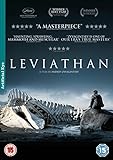
One of the most striking scenes in this visually beautiful film is the skeleton of a huge whale cast up on the north Russian beach. “Leviathan”, whether defined as a sea monster or Hobbesian autocratic state, serves as a metaphor for a deeply corrupt Russia where bribes oil the wheels of exchange and “might is right”.

Kolya, a hard-drinking, chauvinistic rough diamond, but at heart a decent man, tries to buck the trend by using the law to foil the crooked local mayor Vadim’s designs on the property built by his family on the shore of the bleakly beautiful coastline. Kolya enlists the support of Dimitri, a suave former army friend turned Moscow lawyer, but unused to the ways of the wild north, where legal procedures can be all too easily subverted, and brute force is always the default position, Dimitri proves no match for Vadim, who when sober proves wily and ruthless.

In an unrelenting succession of trials and tribulations, Kolya is all too obviously a modern-day Job. At 141 minutes the film is far too long, but is worth watching on a number of counts. In addition to some humorous moments to leaven the anguish, the acting is strong and realistic, giving what feels like an authentic impression of life in off-the-beaten-track, rural small-town Russia where hardship takes many forms: coping with harsh weather, limited opportunities – the only source of employment for Kolya’s incongruously beautiful young second wife being the fish factory -, oppressive bureaucracy, the lack of democracy, since Communism has been replaced by an authoritarian capitalism, and the all-pervasive corruption, permeating even the law courts where justice is a mockery and the recently revived Orthodox Church. Ironically, Vadim is deeply devout when sober, fraternising with the cynical self-serving local bishop Grishko.

It is hardly surprising that everyone seems to resort to vodka on the smallest pretext, be it to relax with friends, or to drown one’s sorrows alone. Stoical acceptance or resignation are the usual reaction to setbacks, punctuated with occasional bursts of destructive anger.

Perhaps the most intriguing twist is that the film did not baulk at making a harsh attack on the Russian regime, despite receiving a hefty subsidy from the Ministry of Culture. If it is the case that the director Zvyagintsev was forced to make some changes, I cannot imagine how hard-hitting the initial version was. Yet, having noted its success at Cannes, the Russian powers that be went on to nominate if as their foreign-language Oscar submission

⭐⭐⭐⭐ 4 Stars

“Fences” [DVD + Digital Copy] [2017] – Fenced in

This is my review of Fences [DVD + Digital Copy] [2017].

Retaining the script and staged quality of the original theatre play, but capturing in its street scenes and domestic interiors the atmosphere of 1950s suburban Pittsburgh, this film revolves around Troy, the garbage collector with some understandable but mighty chips on his shoulder: only white men are allowed to drive the vans which he has to ride hanging on to the open back, and his glory days as a baseball player occurred when the teams were segregated. One may admire his rash persistence in claiming the right to work as a driver, but will he be satisfied if he obtains it? Is his harsh treatment of his younger son the result of a brutal upbringing which denied him a good role model of how to be a father, or has he fallen prey to jealousy of the boy’s easier path to becoming a successful footballer? He clearly loves his wife, willingly handing over his pay cheque each week, but can he resist the temptation to betray her, and will he acknowledge and take responsibility for his weakness? At times, he shows great compassion for the pathetic brother injured in battle, but has he taken financial advantage of him?

The garden fence which Troy never quite gets round to completing is the metaphor for the barriers he erects in his life. Troy is clearly a complex, flawed man, so is he fated to sink into self-destructive failure or achieve some ultimate positive resolution?

Although I understand why Denzel Washington hoped for an Oscar in his demanding part, dominating the screen in virtually every scene, I found it hard to catch all the meaning of his passionate rants. By contrast, most of the strong supporting actors were very clear, notably the elder son who had suffered his father’s neglect, and the long-suffering wife, played by the brilliant Viola Davis.

I agree with reviewers who feel that, although well-directed and acted with realism, the play itself, the intense, emotionally draining work of August Wilson, a kind of black Arthur Miller, leaves one feeling a little disappointed, I think because it makes its points early on, promises much in the build up, but tails off, losing its dramatic punch at the end.

⭐⭐⭐⭐ 4 Stars

The imponderable bloom of life and relationships

This is my review of At The Existentialist Café: Freedom, Being, and Apricot Cocktails by Sarah Bakewell.

I read this popular philosophy in search of enlightenment on a fundamental but elusive theme: “the nature of being”.

Sarah Bakewell is strong on anecdotal biography, linked to a vivid sense of time and place. Sartre with his “down-turned grouper lips.. and eyes pointing in different directions..but if you forced yourself to stick with the left eye, you would invariably find it watching you with warm intelligence”. When held as a POW by the Germans, “his eyes gave him his escape route”, in the improbable form of a medical pass to leave the camp for treatment. Yet he missed the comradeship of being forced into close quarters with other prisoners. It filled him with fear to enter a Parisian café to observe “the few drinkers… more distant than the stars…each entitled to a huge section of bench…these men shimmering… within their tubes of rarefied light seem inaccessible to me”. Then he enraged his soul-mate Simone de Beauvoir by criticising her for having given in to the practicalities of life under Occupation, by buying tea on the black market, and signing a paper to certify that “she was not a Jew or a Freemason”.

I liked the illustrations which, being untitled, are open to one’s own interpretation: the influential Heidegger and Husserl, his former mentor and the “father of phenomenology” (definable as “the ways we experience things”), standing on a sunny slope against a background of wooded hills. Are the two men arguing over their different viewpoints, or exchanging polite banalities to mask how far they have grown apart?

The author ends the first chapter with useful if partial definitions of what existentialists do, in their concern with “individual, concrete human existence”. Individuals are responsible for all their actions, in a world where, as Sartre realised to his initial horror, everything is “contingent” and “it could all have happened a different way”, if individuals had taken alternative courses of action.

The author sheds light on some difficult ideas like Sartre’s “specific nothingness” with the example that when one has made an appointment in a café to meet a friend, the most important factor is the absence of that person. She is good on analysing the importance of Simone de Beauvoir’s arguably undervalued “The Second Sex” and the theories of the polymath philosopher-cum-psychologist Merleau-Ponty, also underestimated. His ideas may seem more accessible than most since they are underpinned with a scientific knowledge of neurology. It is easy to relate with a sense of relief to his views that an understanding of child psychology is essential to sound philosophy, that we need to study perception scientifically to make sense of the connection between our consciousness and the world around us. We have to connect socially with other people to exist in a meaningful way ourselves, rather than speculate about the reality of existence external to our own, as many philosophers have done.

Sarah Bakewell refers frequently to the opaqueness, and radical shifts in thinking of Sartre, Heidegger and Levinas. Sometimes, this seems like an excuse for the inability to present a coherent explanation of the essence of their ideas. With what often seems like the prime aim of entertaining us, complex theories are fragmented into bite-sized chunks, with explanations descending into a kind of woolly gimmickry which falls apart under close scrutiny: “If you had to sum up Heidegger’s opening sally in ‘Being and Time’ in one word, that word might be ‘wow!’..As a fresh starting point for philosophy, this ‘wow!’ is itself a kind of Big Bang. It’s also a big snub for Husserl… and his followers…..They have forgotten the brute reality on which all of us ought to be constantly stubbing our toes….Wake up, phenomenologists! Remember being – out there, in here, under you, above you, pressing in on you. Remember the things themselves, and remember your own being!”

Although I found parts of this book very interesting and felt the need to reread it, I also doubted whether this would actually add to my understanding. Apart from the fact that a chapter or two pulling together the essential theories would have been useful, I cannot escape the sense that much of the philosophy covered is highly arbitrary and subjective. It may appeal to one’s emotions, like Heidegger’s “notions of humans as a clearing into which Being emerges into the light”, but such ideas merge into each other in a muddled morass.

⭐⭐⭐⭐ 4 Stars

Becoming the people we should always have been

This is my review of The Gustav Sonata by Rose Tremain.

In the aftermath of World War 2, young Gustav Perle grows up in a quiet Swiss town, stoically trying to make sense of adult behaviour, win the love of his widowed mother Emilie, and live up to her exhortation to “master himself….be courageous, stay separate and strong…. like Switzerland”. Emilie is understandably depressed as she struggles to make ends meeting, making cheese and cleaning the Church, but is clearly ambivalent as regards her husband Erich, whose untimely death remains a mystery to Gustav. Although acknowledging Erich’s moral stance in saving Jews from the Nazis, she clearly resents the financial hardship and loss of status which this inflicted on his family, and she cannot warm to Anton, the Jewish boy who becomes Gustav’s best friend, despite the marked differences in their lifestyles and personalities. Anton is sensitive, a gifted pianist with wealthy, indulgent parents, but he proves unable to overcome his nerves sufficiently to achieve his ambition to become an internationally acclaimed soloist.

This moving and well-constructed books has three sections, like musical movements. For me the most powerful is the first part, the skilful and touching portrayal of childhood, and how we are influenced by our relationships. The second section takes us back in time to learn the truth about Emilie's and Erich's marriage, and the last leaps on half a century to the late’90s when Gustav and Anton are having to face up to the paths they have followed in life, and decide whether and how to change before it is too late.

Rose Tremain is an accomplished storyteller, capable of weaving an evocative, thought-provoking drama with a cast of complex characters out of a few strands of plot. Only occasionally in the middle chapters did the tone teeter on the brink of sentimentality, or the dialogue appear a little stilted as if translated from the German. A few plot details grated on me as unconvincing, such as the manner and timing of Erich’s death, or the two young boys’ game in the ruined sanatorium.

This is literary fiction with an eye to commercial success i.e. well-written, nuanced and thought-provoking combined with tragedy tempered by a feel-good soft centre and a few passages of raunchy sex – a page turner which is also worth reading.

⭐⭐⭐⭐ 4 Stars

History repeating itself

This is my review of Viceroy’s House [DVD] [2017].

In the false calm before the carnage, we see the hundreds of servants in their immaculate “native” uniforms performing the symbolic pageantry of a declining Empire bent on withdrawing from a colony with dignity. I have no idea how faithful this film is to history, but when the world is still riven by fighting between religious factions, this film is a timely reminder of historical bungling from seventy years ago. Yet unlike many humanitarian disasters, it is unclear what actions could have been taken to avoid it.

Hugh Bonneville is well-cast as Lord Mountbatten, the affable, unflappable negotiator brought in to pour oil on the tense meetings between the two adversaries Nehru and Jinnah, the one seeking liberty in the form of a united India, the other set on partition to permit the emergence of Pakistan as a Muslim state.

As British administrators indulge in heated debates as how best to stem the growing tide of unrest, they fail to notice the Indians in attendance hanging on on evey word, to pass on in whispers, only feeding the climate of prejudice and intolerance. The apparently illicit and futile love affair between a young Hindu and his longterm Muslim friend is a perhaps slightly sentimental metaphor for the problem of finding a solution.

In the film, the alleys of Delhi and the poor who throng them are impossibly clean and well-fed, and it must be hard to follow the arguments without prior knowledge of situation, as convincing lookalikes for the Oxbridge-educated Nehru, Jinnar and giggling, barefoot Gandhi make their appearances. Yet this is a visually impressive, well-acted, compelling film reminding us of a tragedy which time has eroded too quickly from memory: the massace of millions during the enforced displacement of 14 million Indians, and the terrible dilemma of having to choose quickly which country to join. There is also the twist at the end when we learn how Mountbatten himself may have been a mere pawn in a cynical exercise.

⭐⭐⭐⭐ 4 Stars

No longer knowing where the real points are

This is my review of A Book of Common Prayer by Joan Didion.

Cynical and hard-boiled Grace Strasser-Mendana is the widow of the former President of the coconut palm Central American Republic of Boca Grande. Having married into one of the island’s “three or four solvent families”, she stays on to manage affairs for her seemingly weak and incompetent relatives, instead of returning to her native North America. Perhaps because she is an anthropologist by training, she becomes fascinated by the Charlotte Douglas, a “norteamericana” like herself who has come to Boca Grande as a tourist, as part of the abortive search for her daughter Marin, who has unaccountably rejected her privileged background to become an anti-capitalist terrorist. Charlotte seems neurotic, at times even crazy, by turns either aimlessly drifting through life via casual affairs or throwing herself with bursts of frenetic energy into do-gooding missions.

At first, I expected this to be a Graham Greene style political-cum-psychological drama. I may have missed something, but for me it turned out to be an endless portrayal of Charlotte’s intense and troubled relationship with two dominating husbands: needy, abusive even violent when drunk, Warren, who perhaps uses alcohol to blank out mental pain and sickness, and the suave, wise-cracking, control-freak lawyer Leonard.

I was initially entertained by the spiky dialogues at cross-purposes, which read like a bizarre mixture of Coward and Pinter, mini playscripts in the series of short chapters. However, once I “had the measure” of the mainly quite unappealing characters, their flaws exaggerated to the point of caricature, there seemed to be no further development and I began to find the novel tedious. In the sketchy plot, many questions remain unanswered, but perhaps "what happens" isn't the point.

I have read that Joan Didion took great pains to hone her work, but although distinctive and original with some passages of remarkably expressive clarity, the overall effect is so contrived, with a mantra-like (prayer book-book like?) repetition of staccato phrases, often included more for rhythmic sound than sense, that it forms a barrier preventing real engagement with the characters. “Charlotte’s breakfasts at the Caribe. Charlotte went to the Caribe for breakfast every morning for a while. She went to the Caribe for breakfast because….” Or another paragraph hypnotically repeating the words “Porter” and “Pontchartrain”.

There is the additional niggling problem with the point of view, since writing in the first person, it is quite implausible that the narrator Grace can reproduce so precisely Charlotte's thoughts, experiences and intimate conversations with others – or perhaps we are meant to think that much of the story is in Grace's imagination.

I agree with those who have found the characters too superficial and cut off from normal “real life” for one to care about them, the only emotion being irritation over their self-absorption. It seems that Joan Didion herself led a somewhat artificial life staying and partying in the houses of Hollywood celebrities, drinking heavily, all of which may have led her to create scenes to which most readers find it hard to relate. We are sucked into anticipating the gradual revelation of plot fragments for us to piece together, but the tendency to tell us what is going to befall Charlotte is the death knell to dramatic tension.

I am left uncertain as to what the author was trying to say about the world through the medium of this unprepossessing cast with their entertaining if stylised, sterile conversations. Although she may have chosen to write novels because of the scope they gave her to be inventive, her sardonic, detached style seems to lend itself more to biting journalism.

While continually sensing her talent, I became impatient with the brittle, shallow use to which it is put.

⭐⭐⭐ 3 Stars

“His Bloody Project” by Graeme Macrae Burnet”: A pitted grindstone

This is my review of His Bloody Project by Graeme Macrae Burnet.

In 1869, Scottish Highlands crofter’s son Roderick Macrae freely confesses to the murder of three members of a neighbouring family, including “Lachlan Broad” who has bullied his father and driven him further into poverty. What could be unbearably bleak proves to be an absorbing and intriguing literary thriller, a form of “whydunnit.

We are given a number of differing viewpoint: the statements by residents of the remote coastal hamlet of Culdie; the lengthy and surprisingly articulate written account of Roderick Macrae himself, making it clear why his schoolteacher was so keen to for him to continue his studies; medical reports with an extract from “Travels in the Border-Lands of Lunacy, by an “acknowledged authority in the then nascent discipline of Criminal Anthropology”, chilling in its unconscious disdain for the “lower classes”; the drama of the courtroom trial and final epilogue on its aftermath.

All this provides a vivid impression of the harsh life in the remotely beautiful setting “with its magnificent vista of the isles of Raasay and Skye”. To an outsider, the houses of Culdie could be mistaken for “byres or pig-sties”, their rough thatch reeking with peat smoke, giving them the appearance of “gently smouldering”. We see the rigid class divide between the landowners and the crofters, with middle men like Lachlan Broad used to extract rents and dues, no questions asked as to methods. So, Lachlan can arbitrarily insist that Roderick and his father return to the water the seaweed they have spent a laborious morning cutting from the rocks to fertiliser their meagre plot.

With its relentless chain of cause and effect, this tale raises interesting questions of how matters might have turned out differently. What if Roderick’s father had possessed the flexibility and imagination to let him travel to Glasgow to be educated? What if Roderick’s two uncles had not been killed in a fishing accident years ago, thus reducing the family’s earning power? Is Roderick mad, bad, or a victim of circumstance? Should he have been judged sane or insane at the time, the latter being his only means of escaping the gallows, for a living fate which could well prove worse? How would we judge him now, with our supposedly more enlightened understanding of human psychology?

The focus on Roderick contrasts with the sketchy development of his sister Jetta’s personality and her parallel fate. Perhaps this is intentional, showing the casual sexism of their society.

My sole minor criticism is that virtually all the characters seem to communicate in a similar style with an unlikely degree of fluency. Yet I agree that the author was wise not to attempt to write dialogues in a Scottish dialect, which would have been distracting. A useful glossary is provided for the small number of local words e.g. “flaughter” meaning spade, but would have been better placed clearly at the beginning.

This well-written, skilfully constructed, subtle and thought-provoking novel deserves its shortlisting for the 2016 Man Booker Prize.

⭐⭐⭐⭐⭐ 5 Stars

Interesting idea but missed the mark for me

This is my review of Toni Erdmann [DVD] [2017].

In this offbeat farce with a serious message, artistic prankster Winfried Conradi is appalled to see how his daughter Ines has become a high-flying workaholic, driven to succeed in a ruthless, corporate world. This is a far cry from his own idealism and lack of materialism, born in a time when Germany was redefining its values after WW2. Ines is by turns embarrassed and furious when he gatecrashes her working life in Bucharest, where she is trying to negotiate a delicate contract which will involve handling the redundancies which will inevitably result from the reorganisation of Romanian oil production on efficient modern lines.

Winfried has been likened in appearance to Dame Edna Everage’s counterpart Les Patterson, but I have to confess being irritated by his trademark fake goofy teeth and mop-like wig. He struck me as the kind of attention-seeking unfunny would-be comic I would avoid like the plague in real life, making it hard to be convinced that there is supposed to be a wise, perceptive, right-thinking character underneath.

The acting is good, particularly the role of the tense Ines, whose sense of the ridiculous, which is perhaps inevitable in the child of such a father, nevertheless breaks through, even at inopportune moments.

This film has been highly praised by the critics, and certainly had many people roaring continually with laughter when I watched the film with a live audience. Yet for me, the film does not really “work”.

It is at least 45 minutes too long with some scenes so protracted, possibly in an attempt to immerse the audience in realism, that their initial dramatic impact is allowed to evaporate. Since the director apparently produced about 100 hours of footage, I appreciate that cutting it down to barely 3 hours must have been a challenge, but the lack of editing seriously weakens the film.

I admit that there are some moving moments, and that the main aim may be to explore the relationship between father and daughter, a serious theme leavened by a comic framework, but I am not sure that the film added much insight over the three hours. Although perhaps too different from her father ever to give up her career and become genuinely laid back, Ines shows from the outset that, despite her uptight exterior, she cannot help laughing at, even joining in, some of her father’s pranks, and is remarkably tolerant towards his excesses.

⭐⭐⭐ 3 Stars

Good service – suitable for use by elderly, if someone else available to iron them on

This is my review of 100 Printed iron-on School Name Tapes Name Tags Labels for Children.

Very rapid, in my case, next-day service and not too expensive. Perhaps a little small and faint for school use where need to identify items quickly. Seem particularly good for elderly people in care, because inobtrusive and so less "humiliating" for those who have been forced to give up their independence.

Too soon to judge how long-lasting these are and whether will retain their adhesiveness. I had to press quite long and hard with a hot iron to ensure each label is stuck on securely, and being so small they are fiddly to manage, particularly since one has to iron through a protective cloth when attaching to synthetic materials. Still, better than sewing on each as in the old days!

⭐⭐⭐⭐ 4 Stars