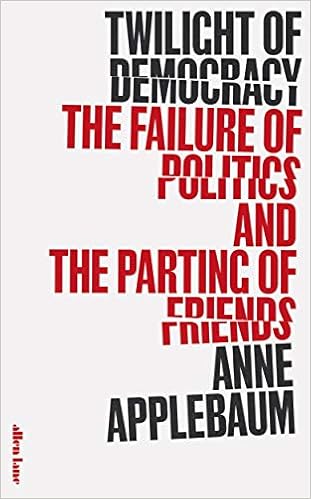
Twilight of Democracy – The Failure of Politics and the parting of Friends by Anne Applebaum: “Uncertainty has always been there”

On the surface, this is a timely and readable assessment of the disturbing situation in which many Europeans and Americans now find themselves as the solid ground of democracy, rule of law and free press they had come to take for granted begins to give way, and prove disappointingly short-lived in countries like Poland and Hungary which had the chance to regain it after the collapse of Communism.

Readers with draw different insights. I was struck by the ominous  parallels between the Polish Law and Justice Party  and the Tories under Boris Johnson since 2019: the former has undermined the independence of the judiciary, forced out experienced civil servants in favour of loyal party stooges, and appointed as director of state television a crony of the President who proceeded to fire respected journalists, replace them with those supporting the far right,  and soon abandoned “any pretence of objectivity and neutrality” in news broadcasts. One thinks inevitably of the attempt in the UK to prorogue Parliament in order to force through the Government’s will on Brexit, the criticism of judges who tried to take a stand, the replacement of experienced, moderate senior civil servants and ministers, and the rumours (at the time of writing) of government pressure to appoint a right-wing Director of the BBC to muzzle justifiable criticism which is seen as too “woke” and left-wing.

Anne Applebaum describes how democracy may be undermined by the “authoritarian predisposition”  of some leaders,  “that favours homogeneity and order”  and the way it may appeal to people who are “suspicious of those with different ideas”,  and who latch on to simple messages because they cannot cope with complexity. She made me aware of the different types of nostalgia, the more common “reflective” kind,  for those who miss the past but don’t really want it back because they know it wasn’t perfect, and the “restorative nostalgia” of those who set out to recreate the past in  “nationalist political projects” based on a simplified “cartoon version of history”,  in which they may either believe, or see cynically as a means of control.

In what I found one of the most interesting chapters, “Cascades of Falsehood”,  she reminds us forcefully how the Internet has created an uncontrolled “information sphere” with no easy way to know what is true: “People have always had different opinions. Now they have different facts…People click on  the news they want to hear”, and social media uses algorithms to feed them yet more of what they may have been conditioned to want. “Make America Great” and fake news obviously comes to mind.

As the wife of a former leading Polish politician,  with her own experience as a high-flying journalist and respected academic, the author should be well-equipped to analyse the situation.  I was prepared to accept that an outlook likely to be to the right of mine would at least give understanding of a different viewpoint.  I was therefore disillusioned to find so much of the book quite superficial (as reflected in the lack of an index), and anecdotal,  periodically digressing into an overly gossipy focus on some former friend or acquaintance who has become too extreme, like the US television presenter Laura McGraham.

With an analysis which could have been covered in an extended article, this works less well when padded out to a possibly hastily written book. The name-dropping, the glamorous boozy parties with former friends who have now swung even further right than they were before becomes somewhat tedious. I began to feel her analysis was limited by her apparent membership of a bubble of elitist privilege, such that she was out of touch with some of the real reasons why ordinary people might vote for right-wing autocrats against their best interests.

Suggesting at one point that people in the Western world feel themselves deprived if they lack air conditioning or WiFi, she overlooks the widening inequality indicated by the rise in  UK food banks, the large number of families two pay cheques removed from poverty. Perhaps because, living in the UK, I have a good understanding of the Brexit saga,  her coverage of this seemed particularly weak, partly since her reasons for the Leave vote seemed based on conversations with a small number of fogeyish, highly conservative former friends.

She herself shows continual flashes of bias, condemning Jeremy Corbyn’s brand of socialism out of hand without justification, condoning Israel with never a flash of criticism and no sympathy for the Palestinians. A self-confessed rightwinger, she does not show any awareness of how this might be distorting her own arguments.

Her conclusion that “uncertainty has always been there” but  we should live in hope, “picking our way through the darkness”  seems true, yet too lame.

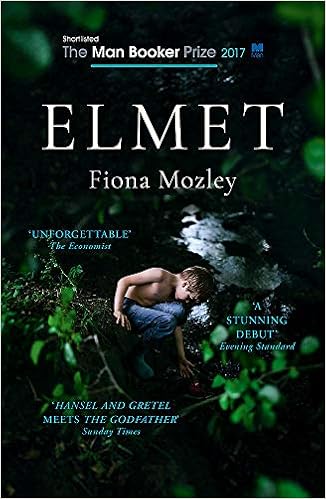
“Elmet” by Fiona Mozley: an inevitable descent?

Teenagers Daniel and his elder sister Cathy help their father to construct the isolated house in a hill-top copse which he does not own within earshot of the East Coast Main Line through Yorkshire, an odd choice for a rural retreat. Apart from a period attending school, where they found it hard to fit in, the pair have spent their childhoods as outsiders, dominated by their “Daddy” John, throwback to a former, simpler age, who wishes to have no truck with modern life, although to earn the money to make this possible, he engages at times with the sleazier parts of it, using his remarkable strength and skill as a bare-knuckle fighter (the name alone makes one wince in pain) in bouts arranged by gypsies and crooks. Portrayed as a kind of latter-day Robin Hood, he often channels his violence to settle scores against villains on behalf of those too physically weak to do so. Narrator Daniel describes how humanely “Daddy” traps and kills animals for food, but is he really a good man?

Daddy’s unconventional views are demonstrated in his attitude to land. “It’s idea a person can write summat on a bit of paper about a piece of land that lives and breathes, and changes and quakes and floods and dries, and that that person can used it as he will, or not at all, and that he can keep others off it, all because of a piece of paper. That’s part which means nowt to me.”

Unsurprisingly, owner of the land in question, Mr Price, takes issue with him over this, although there turn out to be other reasons for a long-term grievance between the two men. Can Daddy really hope to win against a wealthy wily, unscrupulous landowner? Brought up to defend themselves, how well will Daniel and Cathy be able to support their father when it comes to the crunch?

The location “Elmet” is inspired by the poetry of Ted Hughes, “The Remains of Elmet”, which he described as, “The Calder valley, west of Halifax, was the last ditch of Elmet, the last British Celtic kingdom to fall to the Angles. For centuries it was considered a more or less uninhabitable wilderness, a notorious refuge for criminals, a hide-out for refugees”. The novel also has hints of a latterday “Wuthering Heights”.

Author Fiona Mozley succeeds in creating a vivid sense of place, as regards both the natural landscape and the local community, impoverished by mine closures, where people struggle on zero hours contracts at the mercy of dishonest local employers. There is a convincing portrayal of the complex bond between the father and his children: caring and protective on one hand, he is unintentionally neglectful and damaging on the other. The children’s roles are a reversal of the norm, with Cathy strong and aggressive and Daniel gentle and domesticated.

I understand why many readers have praised this book, even how it came to be short-listed for the Man Booker Prize. Yet, although an original debut novel, it falls short for me in some fundamental ways. Perhaps the author wanted to portray Daniel as both immature and perceptive for his age, but his “voice” is inconsistent, switching between that of a naïve, inexperienced boy to observations and insights beyond his years. Poetic passages often sit oddly in the text, by turns overly sophisticated or grating:

“He was a human, and the gamut upon which his inner life trilled ranged from the translucent surface to beyond the deepest crevice of any sea. His music pitched above the hearing of hounds and below the trembling of trees.”
Since the author grew up in Yorkshire, I have to assume she has “captured” the local dialect, but many of the longer dialogues contain too much exposition. Some characters, like the children’s absent mother, or their neighbour Vivien, are underdeveloped. The violence of the climax surpasses everything which precedes it, but becomes quite implausible in the process. Also, the novel gains little from what has become the formulaic prologue trying to hook the reader by “giving away” some of the ultimate violent outcome, nor from the “flash forward” passages also in italics which show Daniel in the aftermath of events.

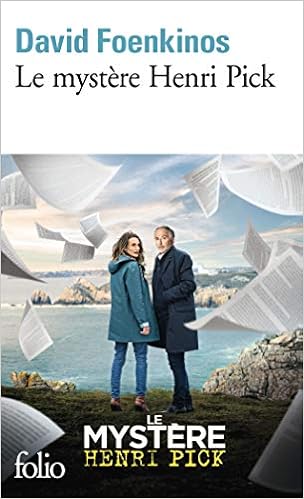
Le Mystère Henri Pick (The Mystery of Henri Pick) by David Foenkinos: picking over the traces

Ambitious young Parisian book editor Delphine Despero falls for moody young writer Frédéric Koskas, but despite her efforts in getting his first novel published quickly amid much hype, it proves a flop. On a visit to her parents in Brittany, the couple are intrigued by the local bookstore to which writers bring novels rejected for publication, where they discover a literary masterpiece written by one “Henri Pick”, who turns out improbably to be the recently deceased manager of the local pizza restaurant, recalled by his wife and daughter as neither a great reader nor known to write more than an occasional shopping list. The publicity storm created by this threatens to blow off course if not capsize the lives of all concerned.

At first, I found this book lightweight and contrived, and was motivated to read on only by the fact it was my book group choice, which at least served to improve my French. I was mildly irritated by the unnecessary footnotes which interrupted the flow, but more so by the pretentious tendency to write knowingly about the world of publishing, the pain of the writing process, and to name-drop shamelessly writers and books which a reader needs to be excessively “well-read” to appreciate. I suppose some of the Wikipedia-swallowing digressions are interesting, as in the poignant description of the real-life photographer Vivian Maier who worked for a year as a New York nanny, producing and storing thousands of Cartier-Bresson type photographs, sometimes without even developing the film, which remained undiscovered and unrecognised in her lifetime.

I am also uneasy about authors who, far from denying that characters bear any resemblance to living persons, actually include very much alive celebrities in their books – including in this case Jean-Paul Enthoven who by chance ironically figured in the press over his rejection of his Raphael’s overly autobiographical novel the day before I encountered him in this quirky novel.

Although my initial reaction has not fundamentally changed, at some point the whimsical humour did strike a chord with me – I think at the point when a character is dumped by his lover for scraping her Volvo car not once but twice, and thereafter is obsessed with Volvo cars, which he discovers are all without exception scratched. Foenkinos also succeeded in arousing my curiosity as to who really wrote the masterpiece.

I realised eventually that it is unimportant that “The Last Hours of a Love Story” somehow linked to the death of Pushkin sounds pretty unlikely to become a bestseller, and is probably intended to parody the publishing world’s hyping of often mediocre books. “The Mystery of Henry Pick” is really a series of psychological studies: the vitriolic book critic who finds himself friendless when he loses his job and comes to realise that he has been venting his own frustration over his inability get published; the woman whose impulsive affair with a stranger helps her to see how she has allowed her life to go awry. It is all about how and why people manipulate situations, fail to communicate with each other, or at some point come to take stock of how they have lived, all this conveyed through often humorous insights.

With talk at one point of “making a Biopick”, this novel lends itself to be made into an entertaining film, as has been the case. The setting in Crozon on the west coast of Brittany must also have boosted its tourist trade.

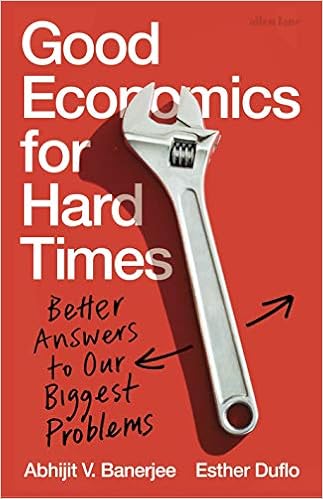
“Good Economics for Hard Times” by Abhijit V. Bannerjee & Esther Duflo: rambling too widely?

I had high expectations of what promised to be an accessible book on post-financial crisis economics by a couple of Nobel Prize winning academics.

Themed by a range of interesting topics like migration, trade, growth rates, climatic change, or artificial intelligence, although it is often hard to work out from the chapter headings what they are likely to be about, I was soon disappointed by what seems an overly superficial, disjointed, anecdotal approach, by turn tending to labour over stating the obvious, or failing to develop important ideas sufficiently. I understand an attempt to avoid putting general readers off with too many diagrams and tables, but used in moderation these can be more effective than wordy paragraphs.

Ideas too often seem presented in a rather one-sided way. For instance, the benefits of migration are cited, but not the complex problems it can create. I was surprised that the situation in Europe was not used as a major example of this.

At times, the tone appears a little patronising. The “better answers” in the title prove in short supply and in the main quite woolly.

A shorter, more carefully considered book expanding on any one chapter would have been more useful. But perhaps this book is not meant for mature readers already armed with a basic knowledge of economics who have also developed a good understanding of social and political issues. Ancillary to a rather dry basic economics course for students, this might be useful in stimulating questioning debate.

“History of Wolves” by Emily Fridlund: “The false belief that anything could ever end”.

Narrator Madeline, called Linda at school, recalls her childhood in the backwoods of northern Minnesota, where her lapsed hippie parents scrape a living after the failure of their commune. A teenage loner with no real friends, she lives in a kind of emotional vacuum between her strong, silent father “who always made it seem a great kindness… not to ask too many questions” and self-absorbed, insensitive mother with her half-finished projects, of which Linda is one. Expected to undertake adult tasks from an early age – chopping wood, feeding and exercising the dogs, walking miles in the dark after school to fetch drain unblocker – yet also given total freedom to roam, Linda observes people with the same forensic eye she applies to the natural world, but is often unable to interact “normally”, to the point of seeming autistic. She tends to become obsessed with other “outsiders”, like teacher with a shady past, Mr Grierson, who may have seduced pliant Lily, mocked for being part-Indian, which she never denies.

When the Gardners occupy a lakeside house in the area, Linda is paid to childmind their precocious four-year-old son Paul, and is surprised by the unfamiliar sensation of bonding with the little boy, also perhaps developing a crush on his mother Patra, who seems at times like an older sister. Linda notices Patra’s moments of “breathtaking tenderness” for her son, only to neglect him in her abject need to please dominant husband Leo. He turns out to be a third generation Christian Scientist which sits oddly with his profession as an academic astronomer. Members of this religion will not be pleased with the portrayal of their beliefs in this book, as troubling signs of something amiss in the Gardner family gradually builds up to a tragedy in which Linda is implicated.

This highly original, quirky novel is marked by a string of striking descriptions which enable one to visualise or sense situations even if entirely outside one’s experience: the changing colours in the sky above a lake as the night draws in; the behaviour of dogs; the pleasure of watching a child’s absorption in doing a jigsaw; a mother’s fruitless efforts to induce her teenage daughter to talk to her.

There are sharp insights, and bitter ironies as in the case of Mr Grierson who may have been punished for actions he only thought of committing – a twist of the Christian Scientist belief that “it’s not what you do but what you think that matters”.

Yet the critical incident, which arguably haunts and defines the rest of Linda’s life, remains unclear in some key respects and insufficiently explored. This may be deliberate since the author is more interested in capturing an individual’s thought processes together with the fragmented, even inaccurate impressions she may draw from a situation.

What may seem like a weakness in what I found to be the artificial, unconvincing conversations involving Leo and later Linda’s lover Rom may also be intentional, in that Linda either does not understand what the former is saying or resents the latter’s attempt to pin her down.

Perhaps a novel such as this can only have an ambiguous ending, but I was somewhat disappointed by what seemed a creative writer’s damp squib of a final twist which provides a somewhat weak conclusion. It left me with a sense of sadness over a life which seems needlessly blighted, since Linda is portrayed for much of the book as a bright, resilient person with a wry take on the world.

Overall, deservedly shortlisted for the Man Booker Prize, this novel probably needs to be read more than once to appreciate it fully.

“Désorientale” (Desoriental) by Négar Djavadi – Culture shock

Disoriental by [Négar Djavadi, Tina Kover]Born into an Iranian family of intellectuals who opposed the regimes of both the Shah and Khomeini, author Négar Djavidi arrived in France aged 11 after crossing the mountains of Kurdistan on horseback with her mother and sister. This gives an authentic ring  and some autobiographical elements to her acclaimed first novel.
It is a family saga covering four generations of an Iranian family  over more than a century of dramatic political and cultural change from exotically named feudal lord  Montazemolmolk living in the northern region of Mazandaran, with his harem of more than fifty bickering wives to grandson Darius, a dissident intellectual whose writing against first the Shah and then Ayatollah Khomeini forces him into exile in Paris with his family, including daughter Kimiâ, the narrator.

Much of the story is related in the form of flashbacks or imagined reconstructions of anecdotes Kimiâ has heard about her relatives, recalled as she sits, clutching a tube of sperm, in the waiting room of a Paris fertility clinic. This rather clunky plot device adds to the reader’s frequent confusion over the large number of often thinly sketched characters, like the brothers of Darius who are referred to by numbers 1 to 6 (there is a list of key family members at the back which you could miss until too late) and continual lengthy digressions.  The approach is deliberate in that the author has explained when interviewed her aim to portray the fragmented, kaleidoscopic nature of memory. Although this has received critical praise, I found the abrupt switches in her thoughts, usually expressed in dense exposition, quite hard to take. A stream of consciousness  can be very powerful, but in this case the continual change of subject is further disrupted when Kimiâ becomes an intrusive narrator,  justifying or apologising for an abrupt switch of topic:  “Allow me before it’s too late, before the storm of the Revolution rises and invades my story, to return to my resemblance to Grandmother”.  Dramatic events are undermined by a lack of subtlety,  even giving them an incongruous pantomime quality, as in the continual foreshadowing of  “L’ÉVÉNEMENT” (“THE EVENT”).

Continually being told what to think, trying to keep track of the characters as they flit in and out, mentioned in passing, I rarely engaged with any of them. The author is  by profession a script writer, so I am surprised that she did not make more use of scenes with dialogues which would have enabled the characters to reveal themselves, open to interpretation as we do in real life. The details of the occasional footnotes to provide a condensed history of events could have been woven into the story, or included as an introduction at the outset.

Kimiâ is “disoriented” in more than one sense: not only the abrupt cultural change from Teheran to Paris via an arduous trek led by people smugglers, but also confusion over her sexuality. Predicted by her tealeaf reading grandmother to be a boy, she acts and feels like one, imagining herself growing up to be a man. Her period of extreme teenage rebellion in Paris, dressing as a punk, drinking and smoking joints in shared squats after her perplexed mother has thrown her out is therefore a way of taking refuge in a world where her background is of no interest and she is not judged. She ends up in a relationship with a woman, but desperate to have children fathered by a man who will take an interest in his children, and able to provide the kind of cultural context she has lost in exile.

Although I think a heavily pruned version of the story with fewer characters would have been much more effective and allowed more space to develop some interesting ideas, perhaps the style is in the tradition of Iranian storytelling, so that an oppressively large cast of relatives bound in a love-hate relationship, and strong ties of mutual support and obligation, somehow co-existing with harsh judgement and rejection e.g. of homosexuality (to the extent of denying its existence), serve to provide the necessary insight into Iranian life.  By contrast, Kimiâ’s  adult world of punk and pop groups and artificial insemination for lesbians using sperm from an HIV positive man,  is not really typical of the West, and is a rather extreme example of the contrast between the freedom of the West and the conservatism of Iran.

There are some interesting comparisons e.g. whereas the Paris clinic is tense and silent, in Iran people would be so engaged in chatting that they would not notice when their turn to be seen arrived!  When the mother of Kimiâ’s partner  confuses Iran with Saddam Hussein’s Iraq, Kimiâ sees this as the result of living in Belgium, a reassuring, peaceful place where everyone’s the same, after living for generations free of problems without any immigration or mixing: “no need to concern oneself with other people,  nor to be afraid of them, nor question their presence”.  This of course shows a lack of knowledge and understanding on both sides!

Although I read this in the original French, I believe the English translation is very faithful to it.

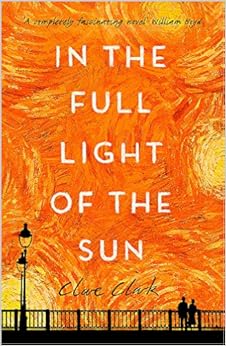
“In the Full Light of the Sun” by Clare Clark – fascinating theme but confused plot

Against a backdrop of rampant inflation and corruption, “madness spreading like gas”, in 1920s Berlin, famous art critic Julius Köhler-Schultz is in the throes of a bitter divorce from his much younger wife, who has decamped with their small son and “the only painting in the world” Julius “could not bear to live without”, a self-portrait of Van Gogh. In this vulnerable state he falls under the spell of a charismatic young art dealer, Matthias Rachman, but is he quite what he seems? Julius also supports the artistic ambitions of talented but troubled teenager Emmeline Eberhardt.
This novel was inspired by the long-forgotten but once famous case of Otto Wacker, the German dancer who was eventually tried for knowingly selling fake Van Gogh paintings, always after compromising the reputation of some expert by gaining his authentication. Initially I was impressed by the novel’s very strong sense of time and place, and the slow-burning build-up of suspense. It was therefore a shock to be plummeted into Part 2 with an abrupt switch to the viewpoint of Emmeline whose drunken agonising over unrequited lesbian love becomes somewhat tedious, although no doubt a true reflection of one aspect of inter-war Berlin. By the time I reached Part 3 in the form of the diary of lawyer Frank Berzacki, forced to face up to the Nazi regime’s inexorable crushing of Jewish rights, I realised that the author has deliberately inverted what one expects of a plot. Instead of setting an art crime at the forefront, this is obliquely referred to throughout the book, generally secondary to the inner thoughts and concerns of the three main characters in turn.

Can one ever be sure a painting is not a fake? Are the eye-watering sums paid for some art justified? Such questions woven into a historical thriller about possible fraud should make an absorbing read, so why did I find it frustrating, the middle section in particular such heavy going? I could forgive the frequently overblown or mawkish style whenever the author touches on passionate feelings, because this is offset by the many striking, poetical images, particularly in Emmeline’s section which I suppose is a way of portraying her artistic eye. She describes a flock of starlings: “ a vast rippling cape…surging and wheeling, stretching into swooping curves, twisting in helixes, rising in streamers on the wind, the whisper-roar of their wings like the sea or the thrumming of a thousand fingers on a thousand paper drums”.

The three sections are welded together in an unwieldy structure. Too many mostly thinly sketched and often unnecessary characters, and minor incidents which pad the novel up to over four hundred pages, tend to overwhelm or drive out the plot, in which key events take place “off stage” and so remain confused or unclear and left for the reader to surmise. I would have preferred the author’s painstaking research applied to a factual portrayal of art in interwar Germany.

Hiver à Sokcho or Winter in Sokcho by Elsa Shua Dusapin – “When the rain-hammered sea rises like spikes on the spine of a sea urchin”

I did not expect to be so gripped by this choice for a French book group, which has also been highly praised in its English translation.
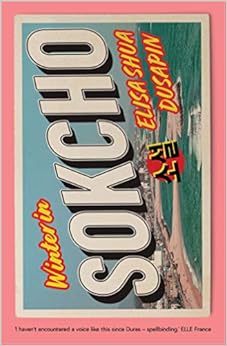
A twenty-five-year-old narrator whose name we never learn, so I shall call her “N”, returns from studies in Seoul to her home town of Sokcho, a seaside resort more dead than alive in the winter snows near the grimly surreal border zone with North Korea. N seems to feel a perpetual “outsider”, through being only half Korean, her father a French engineer “passing through” of whom she has no memories. Since the author is also half-Korean and half-French, one has to hope that this is not too autobiographical.

Into the rundown hotel where she skivvies for the grumpy Park, there appears Kerrand, a successful creator of graphic novels, with the added attraction of being French, who immediately uses N to help him buy art materials and guide him around. From the outset they are drawn to each other: both introverted, troubled and unfulfilled, which drives Kerrand to drift round the world seeking a purpose for the cartoon hero who may be his “alter ego”, while N tries to avoid facing up to her feelings by burying herself in routine tasks and clinging to the mantra that “her mother needs her”. Although on the same wavelength when discussing Kerrand’s art, they find it impossible to express, perhaps even acknowledge their emotions, as they keep making tentative advances and then withdrawing, always out of phase.

I admire the deceptive simplicity with which the author subtly conveys so much in such a short novel, with chapters rarely more than two pages, written in a clear style, switching between minute description and a kind of poetry to create vivid pictures. It is necessary to read every word to avoid missing some vital point.
Unable to predict the ending, I was not surprised that it proved ambiguous and in some respects sad, yet still somehow the right outcome of this skilfully crafted novel.

READ ON FOR MORE COMMENT

Reading between the lines, N’s incongruous engagement to the self-absorbed male model Jun-Oh, seems most likely to be a failed attempt to ward off her mother’s continual badgering for her to get married. Repressing her frustration, N’s at times almost bulimic stuffing of food to please her mother indicates her mental distress. Portrayed as a robust character less in need of help than her daughter, her mother runs a fish stall and takes pride in her cuisine, including her licence to remove the poison-filled liver from the puffer-fish, a Korean delicacy. Food, particularly of a fishy nature, plays an important role in this book as it does in Korean life.

We are given an intriguing insight into Korean life outside the westernised bubble of Seoul: the celebration of Seollal, the Korean New Year; the social life round the jjjmjilbang, or segregated Korean bathhouse; the “haenyeo”, hardy female divers with the unfamiliar (to us) range of edible creatures they cull from the sea.

Since Kerrand is keen to be driven to the border with North Korea, N visits it for the first time, because “only the tourists come here”. “Forbidden to leave the marked track, forbidden to raise one’s voice, forbidden to laugh” they pass through no man’s land “beige and grey as far as the eye can see”, where N can only tell that the grey-uniformed figure behind the souvenir counter is alive from the blink of her eyelids. The threat from the North even extends to the beach where a summer tourist who strays over the border risks being shot by an enemy machine gun.

N guides Kerrand round the Buddhist temple at Naksan, prompted by the stone statues to relate the folktale of the serpent which the dragon, guardian of the spring, must find to make the tortoise, guardian of the winter, cede his place.

Many phrases stick in the mind: “Pavane of dead leaves in the wind” or a striking description of fishermen preparing to catch squid: the slow rhythm of their boats on the swell, the switching on of bulbs attached to cables stretched from poop to prow to attract the molluscs, the pagoda at the end of the jetty from which N can watch their “light traps part towards the open waters, a slow and proud procession, the Milky Way of the sea” – all much more beautiful in the original French.

The Pianist of Yarmouk by Aehem Ahmad: “There’s always hope”

This is the revealing and moving memoir of a young musician who captured media attention in the west during the earlier part of the civil war in Syria, by dragging a beaten-up piano into the rubble of Yarmouk, the besieged suburb on the outskirts of Damascus, originally a large camp for refugees from Palestine in the 1940s. With help from foreigners, but at considerable personal risk, he succeeded in making the dangerous journey to Germany in 2015, where he was eventually reunited with his immediate family, and now continues to perform music about Syria to inform and remind us of the ongoing crisis there.

Ghosted by a couple of writers, the book is not particularly well-written and some details are unclear and at times hard to credit, but that is outweighed by the vivid first-hand account of life in Syria plus his resilience and flashes of humour even in adversity.

His father’s blindness and frequent need of him as a guide created a stronger bond than is usual between Syrian fathers and sons. A regular violinist at weddings, the father had greater ambitions for Aeham to become a classical pianist, going to extraordinary lengths to help him, against the odds, to gain a place at the prestigious music school dominated by children of the wealthy, going on to cajole, even bribe him, to continue practising through his rebellious teenage years. This gave him the skill which would one day save him from the hell of the civil war.

Initially impoverished, the family manages to achieve a brief level of prosperity through manufacturing and selling musical instruments, until the war forces the boarding up of the shop which is eventually blown to smithereens. Ironically, it seems to be the reluctance to abandon their instruments which keeps them in Yarmouk until they are caught up in the deadly siege.

I particularly liked the continual insights into life in Syria before it was disrupted by the war: the continual violent arguments between Aeham’s normally rational mother and her sister-in-law in the house they shared as an extended family. Despite skiving off high school to play popular music and compose in the shop (why wasn’t it open?), and insisting on marrying when his parents consider he is too young, Aeham still follows the custom of asking them to find him a suitable wife, and keeps to the tradition of not seeing their choice Tahini prior to their engagement – until curiosity brings her to their music shop to check him out, after which they arrange clandestine meetings.

From the outset there is pressure not to step out of line: Aeham is good at creating a sense of fear, as when he can tell from his father’s body language that the man whose piano they are tuning is dangerous – he turns out to be the ruthless and corrupt secretary of defence and close confidant of Assad’s father.

The tone darkens dramatically with the onset of war: the risk of arrest or a beating at one of the arbitrary checkpoints set up by rival military groups; the sniper fire which punctuates Aeham’s music as he accompanies a band of children singing; the piano, defiantly painted the colours of the Palestinian flag, set alight by a bigoted ISIS soldier because “ owning musical instruments is an unforgivable sin”. All this has to be endured on a diet of red lentil falafel and clover.

Although the dramatic account of Aeham’s eventual escape, involving exploitation by people smugglers and chains of middle men both sides of the political divide, has become an all too familiar theme, there is an authentic ring to his frequently breaking down in tears en route, or believing that he was about to meet his end, because of the surreal, inhuman stress of it all, together with his subsequent sense of guilt over having escaped and mourning for a past life, despite being in the safety of Germany.

This book is important reading for those unaware of the tragedy of Syria and Palestine. It is also worth viewing on YouTube some of the videos of Aeham playing.

“On Chapel Sands” by Laura Cumming: How everything turns away quite leisurely from disaster”

In 1929, on the long golden Lincolnshire beach of Chapel Sands, three-year-old Betty Elston was abducted when her mother wasn’t looking, but found safe and well in a house nearby a few days later. Why did Betty so readily accept being kidnapped and why were no demands for money involved? Perhaps understandably, her parents did not reveal that she had been adopted until an incident ten years later but why was she kept so isolated from local people? Why did the kind-hearted Betty come to reject her adoptive father to the extent of not going to his funeral? And why did the baker’s boy deliver bread to the neighbouring households, but not hers?

Although this reads at times like fiction, it is art critic Laura Cumming’s biographical “homage” to her mother in which “all the characters and events are real” with “only one name… changed, in the final chapter”. Skilled in interpreting what lies behind a painting, the author deftly drip-feeds the intriguing details of her mother’s life, some not discovered until years after the event.

Betty’s adoptive mother Veda seems sweet and submissive, perhaps worn down by two decades of infertility in a community where being a wife and mother was the main point of one’s existence, not to mention dealing with George, allegedly an “extremely intelligent but domineering and somewhat like a character from Dickens.”. Adoptive father George seemed cast as villain of the piece but I felt that the author was rather too hard on him, only softening in the revelation saved for the final chapter. In the kind of life where much of the excitement comes early on, in his case with a valiant role in the Boer War, ending up as a travelling salesmen during the years of Depression and World War Two must have been an anti-climax. Yet his skill in making elaborate models and using a simple Box Brownie character to produce some evocative photos suggests he may have been a frustrated artist, whereas Betty and Laura, born later, had the chance to develop their artistic talents.

Perhaps a little too thin at times, leading to repetition and reliance on speculation, the facts are fleshed out with descriptions of local celebrities like Tennyson who wrote of Chapel Sands as “a sand-built ridge….the spine-bone of the world”, together with vivid accounts of social life in rural Lincolnshire in the last century. Here were tightknit, inward-looking local communities where everyone knew each other’s business, but no one said a word to Betty about her origins. We are reminded of a lost world of self-sufficiency: in the 1920s the village of Hogsthorpe “numbered not quite five hundred people” with “a surprising range of shops – a butcher, a baker, not one but two shoemakers, a pair of blacksmiths….– a confectioner, three separate grocers, a bricklayer, plumber and wheelwright.… you could have your hair cut, have bicycles and baskets custom-made…the elementary school had room for more than a hundred pupils” – all this long gone.

Linking her mother’s life to the pictures she collected, Laura Cumming provides a detailed analysis of Breughel’s “Landscape with the Fall of Icarus”: the sturdy farmer ploughing improbably close to the cliff edge seems oblivious to Icarus drowning in the sea, just as the locals ignored the Elston family drama, while George is likened to Icarus in his hubris. It is a pity my Kindle could do justice neither to George’s photographs nor the paintings cited , so I advise reading a paper copy of the book if possible.

This book follows the same forensic technique as Laura Cumming’s “The Vanishing Man”, interpreting and speculating on the works of the great painter Velasquez. I was more impressed by the latter, but it may be a matter of taste whether one prefers the smaller-scale, more domestic canvas of the life of an ordinary girl who escaped a narrow world to find fulfilment as a painter and weaver, against the odds.