In 509 BCE, two and a half centuries after the foundation of Rome, King Tarquin was ousted and a republic established. Published in 2003, Tom Holland’s acclaimed account of its triumphs and ultimate chaotic decline focuses on the final century, ending with the death in old age of Augustus Caesar in 14 CE. Clearly based on deep research, although relying on a vivid imagination to cover the inevitable gaps in written records after two thousand or more years, the narrative often reads like a novel or lively colour supplement article.
The republic operated a form of democracy, with male plebeians, ordinary men allowed to vote and gain power over time, although women and slaves played no part in this. An interesting idea from the outset was that the country should be led by two consuls, elected annually, so that in theory they would constrain each other’s ambitions, and not have time to embed a dictatorship.
The Romans had to raise legions to extend the area controlled in order to defeat brilliant, ambitious rivals like the Carthaginian Hannibal from North Africa or Mithridates, King of Pontus to the east in modern Turkey. Land gained was a vital source of slaves, whose labour kept Rome going, and also of gold and tax revenue. Roman expansion triggered resistance, with barbaric cruelty on both sides. Mithridates punished an official who had levied tax too harshly by ordering liquid gold to be poured down his throat.
Despite developing a complex system, in which better off plebeians could gain office, over time Roman government became corrupted by bribery and wheeler-dealing, both flamboyant and covert. It grows increasingly hard to keep track of the key players, whose names too often start with a “C” (Crassus, Codius, Cato, Cicero, Catullus, Curio and so on), because of their shifting allegiances and unpredictable, mercurial temperaments, not to mention the continual battles and brutal reprisals.
Insights into Roman life are fascinating: fathers showed their children little affection, in the belief that this would “toughen them up”, yet the wealthy elite grew effete, scandalising the people with fads like fish farming which involved tunnelling through mountains to obtain salt water for bearded mullet kept as pets rather than for consumption. When the mania for eating exotic foods extended to dormice, this was banned. Despite being continually appalled by the excesses of the patricians, the plebs could still be seduced by displays of fights to the death, be it of enslaved gladiators, panthers, or elephants (which did reduce onlookers to tears).
The narrative is peppered with some pithy quotations, which often sound quite modern in translation. For once, I would have preferred footnotes to show the authors at the bottom of the page, rather than listed at the back, featuring in particular such names as Plutarch, Horace and the great orator Cicero.
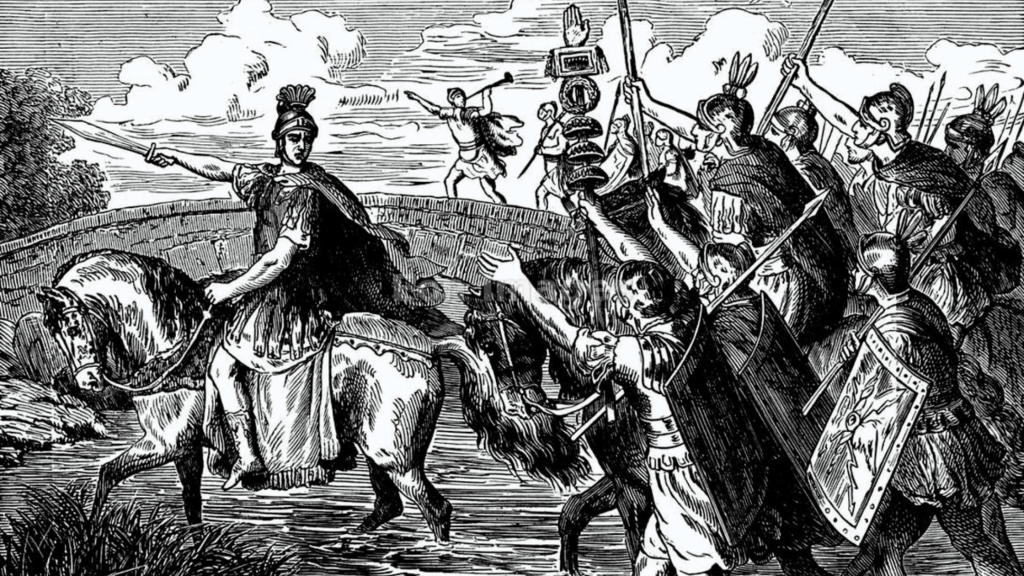
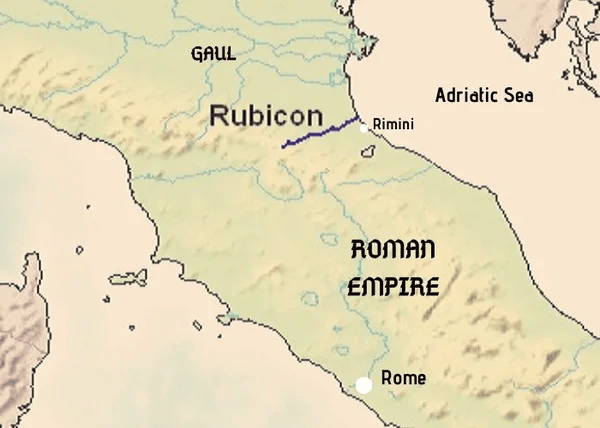
The pace of events quickens as the Republic lapses into civil war, when Julius Caesar, of Ides of March infamy, furious at not being accepted as Consul after great success fighting in the east, crosses the Rubicon (in fact an insignificant river) to capture Rome. Not for the first time, the narrative assumes farcical proportions, as he takes time off to canoodle with Cleopatra on a Nile cruise, but eventually defeats his enemies on home ground and makes himself dictator for life. This proved a step too far, prompting his assassination, as immortalised in Shakespeare’s play. It was left to his great-nephew, Augustus Caesar, to restore a semblance of the old democracy, although his control of the military maintained his autocratic power in reality.
Overall, this is a fascinating but at times mentally exhausting read, since it covers so much. It is immersive, but at times carries one along too fast to absorb the digressive flow of facts and analysis. I would have liked at least a résumé of the final Sack of Rome by the Visigoths, to round the drama off. Probably over-detailed and verbose in places, this history is informative and thought-provoking, not least in the parallels to be drawn with the modern world, such as Trump’s second term in the US in the mid 2020s.
History repeats itself, plus ça change, and do we ever learn?

