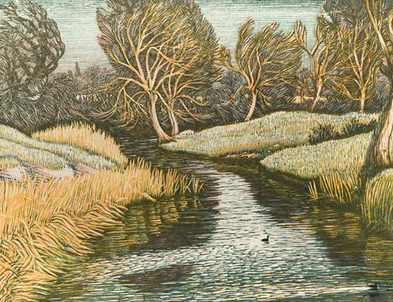
Born in 1885, Gwen Raverat was a granddaughter of Charles Darwin and also related to the Wedgwood family of pottery fame. Although her closest relatives were scientific rather than artistic, apart from her American mother who (I believe) gave up amateur painting when she became a wife and mother, Gwen was the first female to study at the Slade School of Fine Art and became a leading wood engraver.
Gwen’s childhood was spent in Cambridge where her father was a don, and in her sixties she began to write a memoir which, apart from being very funny in places, enhanced by her line drawings, also succeeds in combining a child’s take on her world with an astute analysis from a later adult viewpoint. Published in 1952, it was an instant bestseller, and remains fascinating because of the insight it gives into a past way of life, aided by use of family correspondence going even further back to previous generations.
Coloured wood engraving “Winter Morning”. (above)
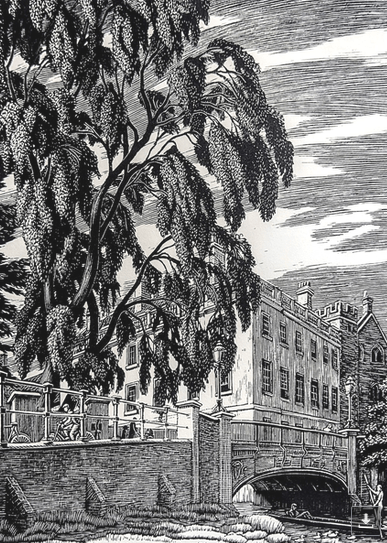
Old Silver Street Bridge Cambridge (below)
Since Fellows of colleges were only allowed to marry from 1878, Gwen belonged to the “first hatchings” of their children, and there was no social contact with other families in the town, outside this circle, with a particular fear of “the Poor”. This made her life quite privileged and exclusive, although not particularly rich in terms of material possessions, despite often being assertive on home ground, as an adolescent she was “shy and a bad mixer”, much to the despair of her sociable mother.
The chapters are themed rather than chronological, intended to be like “the spokes of a wheel from the hub” so that they can be read in any order. The downside of this is that it can be hard to keep track of Gwen’s age, as she changes from a child scared of ghosts in the dark, or engaged in wild games beside and sometimes in the river, to a bored teenager desperate to be allowed to go to boarding school like her brother, only to find that she doesn’t fit in with her frumpy appearance and shocking opinions (like not believing in Adam and Eve or the Flood).
From an early age, Gwen could see the illogicality in the system of values by which they were supposed to live. “Propriety” provided enough examples of this to justify a whole chapter: an aunt would not offer a friend a bed for a night after checking that he had lived with his wife before marrying her. A young couple could not be left alone in a room or out in public, but it was fine to deploy a child to act as a “chaperone”, a role which Gwen bitterly resented. Young boys could leap around naked at certain points in the river, but ladies and girls in passing boats had to bury their faces in parasols. Gwen, of course, managed to steal a look, and captured the scene years later in an wood engraving.
Very restricted in some ways, the children were allowed to play dangerous games, like running along nine foot walls or tying younger sister Margaret to a small cart roped to four bicycles with disastrous results when the riders decided to go different ways – but Margaret was always “only terrified but never badly hurt”. They were forced to wear what would now seem very heavy clothing, which of course maids were on hand to wash, not daring to complain when they got caked in mud. As she grew older, Gwen found it hard to manage tweed “walking skirts” which kept catching round her knees. After sewing yards of “brush braid” on the hem to collect the mud which spattered up from the roads, she had to spend hours removing it since she lacked a personal maid to do this
The most interesting chapters turned out to be those on specific issues like theories (of child rearing), education, ladies, religion, sport, clothes and society.
The chapters I enjoyed least were in the middle section (V11-X). “Ghosts and horrors” became quite tedious, although it must have inspired some of the scenes in wood engravings years later. Otherwise, these chapters focused on family members: “Aunt Etty” and some of the female relatives encountered at Charles Darwin’s Down (now Downe) House seemed either excessively eccentric or silly, perhaps as a result of having been denied the education or opportunity to achieve their potential alongside their brothers. “The Five Uncles”, hard to tell apart in a group, were clever in their fields of interest but rather bland, having grown up in their father Darwin’s shadow, in a prosperous, tolerant household where ill health, possibly fed by an encouragement of hypochondria , was the only problem. The only jarring note was struck by Uncle Lenny, President of a Eugenics Society, with his personal take on the survival of the fittest: “A man who can earn and keep money shows that he has the qualities essential to survival”, making money the only possible criterion for describing who “should be encouraged to breed”. Dull in places, this chapter arguably provides a good insight into upper middle class life at the turn of the C19.
There are few references to Gwen’s later life, which is worth looking up on line, together with examples of her work.

