Gainsborough – A Portrait by James Hamilton

“I’m sick of Portraits and wish very much to take my Viol da Gamba and walk off to some sweet Village where I can paint Landskips and enjoy the very End of Life in quietness and ease.”

Thomas Gainsborough claimed to prefer painting landscapes, but is best known as a leading and very prolific C18 portrait painter. After moving to London in later life, and famous enough to be invited to paint George III and Queen Charlotte, he became quite well off.

Hamilton’s opening chapter portrays Gainsborough as sociable, charming and generous, but also subject to mood swings, and bursts of rage, as when he slashed a canvas which a client had rejected. His friend the actor Garrick’s description of his mind as like a “steam engine overcharged” with genius implies a manic quality. As a young man, he was more harshly criticised as “very dissolute…inordinately fond of women”, which eventually seems to have led to an attack of venereal disease which nearly killed him. He was also often in debt, despite his high work rate, painting “upon his feet….during five or six hours every day”, and a wife who came with a useful annual annuity, the result of being the illegitimate daughter of a prince. Hamilton suggests that the cost of keeping his wife and daughters as well-dressed “advertisements” for his work was initially more than he could afford!

In later life, Gainsborough could chat informally to the king with ease, but was too unorthodox to “play the game” as a member of The Royal Academy, to the extent that when he complained about the way his pictures were being hung at the 1784 Academy Exhibition, he was simply ordered to take them down!

Although at pains to write a biography, Hamilton’s expertise as an art historian has led him to analyse in some detail the painter’s work, with coloured plates usefully provided for many of the examples, but often too small in the paperback edition to appreciate sufficiently. So it is worth looking up images of them online. Gainsborough’s portraits of the gentry and aristocrats are often rather stiff, and the backgrounds may be of greater interest, as in the famous painting of Mr. and Mrs Andrews crammed one side of arable fields clearly depicted the husband’s new farming methods. Beautiful, elaborate dresses, displaying skill in painting silks and velvets, were often added afterwards, neither belonging to or ever worn by the sitters. Some of the most striking portraits, with a photographic quality of realism, focus on the faces of friends, who often had to wait months to receive them as gifts, since they were painted in between more lucrative commissions.

One of the most fascinating aspects, although we have to wait to Chapter 25 to discover it, is Gainsborough’s unusual approach to painting. He liked to work in darkened rooms, lit only by flickering candlelight, with a large canvas tied loosely to a frame so that it billowed slightly like a sail, while the sitter’s head was positioned only inches away from the painting of it. Gainsborough worked with great physical energy, continually stepping backwards and forwards. Most extraordinary of all, he is reputed to have painted at times with long-handled, six foot brushes, which must have been larger, ordinary brushes tied to flexible handles of say, willow or hazel.

Another intriguing fact is that, whereas from boyhood, growing up in Suffolk he painted landscapes from observation of nature, later on he would construct landscapes to copy, using heads of brocolli for trees. Endlessly experimental, he would use his fingers, bits of sponge, even on an impulse sugar-tongs to apply paint.

Hamilton creates a strong sense of place as regards where Gainsborough spent most of his life. As a boy, it was Sudbury in Suffolk, where the once prosperous wool and cloth weaving trade had declined, leaving a politically corrupt sytem and discontented population. It was only the small inheritance from an uncle who had made money from property ownership in the depressed town which enabled Gainsborough, aged only 13, to escape to London as an apprenticed engraver – “some light, handy craft trade”.

The descriptions of Bath are fascinating, particularly if one happens to live there. There is the irony of the unhealthy nature of a spa town with the smoke from coal fires trapped in the valley, “set so deep …air was apt to stagnate”. In summer, “the air was thick with the chalk and dust thrown up by traffic….which in the wet and cold of winter became a deep mire”. Those who came to take the waters would have been better off staying at home in view of the sedan chairs used to transport the gouty and rheumatic, which were reduced to boxes of sodden leather in the frequent rainy days.

Apart from the sensitive, appealing portraits of his two daughters when little girls, and one of his wife as an older woman, with a direct, quizzical gaze, Gainsborough’s immediate family members remain two-dimensional. He is described as hen-pecked, but perhaps his wife had good reason to control his income from portraits. It is unclear why Hamilton calls the daughters “troublesome”. The elder daughter may have inherited a more extreme form of the painter’s possibly somewhat manic personality. For her to be considered “mad” may have led to her short-lived marriage being a failure, with her younger sister being forced into the role of a spinster carer. Probably, there is simply a lack of information to explore these family dynamics further. Yet there is a vivid image of Thomas wondering how best to dispose of his deceased brother Humphey’s invention of a by then rotting steam engine. Clearly, they were talented members of an “ordinary” family.

Similarly, I would have liked Gainsborugh’s uneasy relationship with Joshua Reynolds to have been presented more fully and clearly. Was it more than the case of an orthodox President of the Royal Academy criticising Gainsborough, even after his death, for “a want of precision and finishing” which Hamilton sees as “brave, flamboyant exuberance”?

Overall, the biography is meticulously researched and a mine of information. Yet reading it proves a laborious task at times, largely through a lack of rigorous editing to remove the frequent repetition, tedious lists of, say, lients or paintings, and long-winded digressions. I found Gainsborough’s chequered relationship with The Royal Academy too fragmented and hard to follow. The tendency to speculate in the absence of evidence or impossibilty of knowing how Gainsborough could have reacted to the present could also be quite irritating.

Despite these reservations, I recommend this biography, having gleaned a great deal from it.
This Thing of Darkness by Harry Thompson – A Masterpiece Overlooked as was Fitzroy.

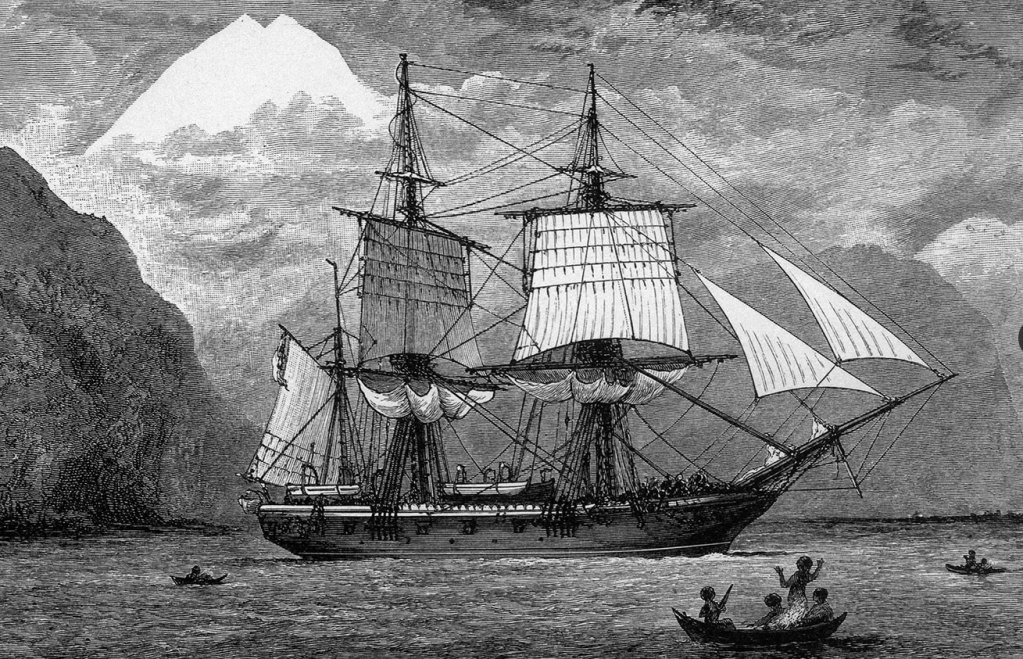
At 750 pages, this is a megatherium of a historical novel, to cite the name of the giant fossilised sloth which Darwin comes across during his five- year exploration of South America while employed as a naturalist aboard the survey ship, HMS Beagle. In the span of almost four decades from 1828, it is hard to keep track of the vast cast of characters, many of whom only appear briefly from time to time. Women play a minor role, and tend to be passive stereotypes, but that reflects life at the time.

Although Darwin is the most famous, the focus is on Robert Fitzroy, appointed Captain of the Beagle at the age of twenty-three, not only for his aristocratic connections, but also his brilliant performance as a student at the Royal Naval College. His first task is to complete the survey of the complex coast of Patagonia, with the harsh climate which drove his predecessor mad. The novel brings home the enormity of the task of mapping a continent with the limited equipment available, the cultural gulf between the Europeans and the various tribes they encounter, and the human cost of the well-intentioned desire to achieve “progress” complicated by the innate human drives of competition, domination and greed.

A central theme is the relationship between Fitzroy and Darwin, forced into close companionship for months on end in the cramped confines of a sailing ship. A bone of contention between them is the explanation of the variations in the creatures observed on their travels, whether alive or preserved in layers of exposed rock. Initially destined to be a clergyman, and troubled by his conclusions, Darwin finds it increasingly hard to deny the existence of some kind of evolution, as we now call it. Fitzroy, despite his analytical mind, cannot give up his belief that surviving species remain as they were first created by God, with only limited changes through adaptation to different environments.

Frustrated by the government’s refusal to fund further voyages of the Beagle, he resolves to finance them himself, running up excessive debts in the process. Constantly dealing with dramatic changes in the weather, he begins to see patterns, and while employed in later life at the Board of Trade sets up a weather forecasting system to issue storm warnings which save lives. Pressure from the owners of fishing fleets, concerned by the loss of earnings when forecasts keep their boats in port, lead to abandonment of then daily weather reports. This proves the last straw for a man who has suffered throughout his adult life from periods of depression.

At times of stress, Fitzroy suffers brief but severe manic episodes, which put both him and his men at risk. At a time of such prejudice against madness, it is surprising that he is not demoted for that reason. The extreme loyalty he arouses in his crew may partly explain this. The practice of sending little boys, as young as ten (or twelve in his case) off to sea to learn the ropes may have aggravated his instability.

Darwin is more balanced, and ultimately more successful. Yet he is presented in an unflattering light. His fellow officers on The Beagle generously bring him examples of unusual creatures they have found, but when these are shipped off to England, it is Darwin who receives all the credit, never acknowledging their contribution.

This novel is based on such detailed research on sailing 19th century ships in often atrocious weather conditions, and on every aspect of the varied landscapes and society of South America at the time, as well as the contrasting vivid portrayal of London and the rural south of England, that I imagined the author must be some nerdish eccentric. In fact, Harry Thompson was a highly successful television producer and comedy writer, who produced, for example, “Have I Got News for You”. His sense of farce pervades this book with flashes of irony and dark humour which lighten the theme.

By the age of 45, he had also found time to write a string of books, including biographies and this debut novel, “This Thing of Darkness”, which arguably deserved to win the Booker Prize rather than merely be longlisted. Ironically, the winner was John Banville’s “The Sea”, so different that the two novels seem to defy comparison in the same contest.

What might Harry Thompson have gone on to achieve, had he not died prematurely of lung cancer, never having been a smoker? It is a pity that many people will lack the time to embark on this book, or be deterred by its length. Reading it proves an absorbing, immersive experience, creating a powerful sense of many different places, and enabling us to identify with characters despite the accepted attitudes, value and knowledge of their day. Admittedly , in some dramatic scenes of near-death experiences, the derring-do may seem overdone; otherwise, the tedium and hardship of long days at sea, or struggling over unfamiliar, harsh terrain feels oppressive, but authentic. The political corruption of the period is all too similar to that of today – plus ça change!

Thompson really succeeds in bringing a fascinating period of history alive. This novel is a remarkable achievement, moving and informative, that will linger in the mind.

Border- a journey to the edge of Europe by Kapka Kassabova

Border: A Journey to the Edge of Europe

The border area west of the Black Sea between Bulgaria, where the author Kapka Kassabova grew up under a communist regime, with Turkey and Greece to the south, is a mystery to most people. Situated on the edge of Europe, it has been fated to lie on the edge of a succession of empires: Greek, Ottoman and Soviet, suffering continual invasion and domination, with enforced transfers of Greeks into Turkey and vice versa, now replaced by the stream of refugees from ravaged areas like Syria, trying to reach Germany or the UK by a backdoor remote mountainous route. Since her own family was forced out as economic migrants, I think during the messy collapse of communism, travelling as far afield as New Zealand, she displays a strong empathy for migrants of all kinds.
As a child, the author resented the restrictions which prevented her from crossing the border near her Black Sea holiday resort into nearby Turkey. She was intrigued by the East Germans known by the locals as “sandals”, who crept off into the forested granite hills of Strandja in the hope of finding a way round the electrified barbed wire border fence, only to be betrayed by shepherds or shot by border guards.

Thirty years later, nostalgia for the countryside brought her back, to stay in a succession of places, starting with the “The Village in the Valley”, presumably unnamed to preserve people’s privacy, now decimated by the mass population exit “in the brutal freefall of 1990s post-Communism”, completing the effects of an earlier flight of Greek-speaking people in exchange for Bulgarian refugees from Turkey in what the author calls “the merry-go-round of exchange of population”. Although this is fascinating, I was frequently left unclear about the sequence of events.

The lack of clarity, combined with frequent digression into anecdotes and folktales, and a picaresque map which omits most place-names to focus on specific features of her stories such as “The Spring of the White-Legged Maiden” or “Felix’s Cliff”, create an avoidable confusion which is my main criticism of the book.

The compensation, is the creation of a kind of magical, haunting quality in which we learn say, about “agiasma”, Greek for the holy springs, at one of which the author was taken to watch the fire-walkers, still keeping alive the tradition of fire worship.

Sometimes the supernatural “goes over the top” for my taste, as in the convoluted tale of the “Tomb of Basket”, the excavation of which was thwarted by terrifying night-time visions of “three-dimensional spectral projections” coming out of the rock to approach the terrified observers “who got the hell out of there”.

More prosaic is the anecdote of the Turkish “chesma” or roadside fountain where she meets a shady character, whom she realises too late must have developed his secluded rural “gangster-baroque” hideaway on the proceeds of spying and wheeler-dealing for the former Stasi-like State Security.

I was intrigued by the C6 rock monastery of Saint Nicholas, protected from further vandalism by a self-appointed, unpaid guard who turns out to be not only a despised gypsy but a Muslim, who observes, “Church or mosque, it’s all the same. A place of God and silence. You have to treat it with respect”. We are reminded that the reason for persecuting the gypsies over the centuries was that, in roaming around with their horses, they avoided paying tax. Hence the failed decree to ban gypsy acrobats from having horses.

Then there was her stay in “The Village where you lived for ever” in the Rhodope Mountains inhabited by the Pomaks. Descendants of long-ago converts to Islam and therefore persecuted as a kind of “fifth column” in Bulgaria, despite their Slavic or ethnic Bulgar origin, at various times having both Christianity and name changes forced upon them. Near here is “The Judgement” border cliff from which “inconvenient people have been pushed into the mist since the beginning of people”. I was moved by the tale of the Czechs trying to escape from Communism who left some money for the lunch they stole from a shepherd. His dilemma was whether to turn a blind eye and risk being punished for failing a test of his loyalty, or to report the theft and be commended. Having chosen the latter, he was haunted for the rest of a life. Or did the Czechs arrive in Greece safely, if hungry?
Kapka Kassabova has an appealing honesty, even if sometimes verging on neurosis. When it was time to move on from “the Village in the Valley” she writes: “I had worried that I was at heart a deracinated, drifting person, despite my delusion or being at home everywhere. That although I no longer belonged here, in the broken country of my youth, it was where I secretly belonged the most. That I fancied myself as an observer, but even after twenty years away, I was still a participant and always would be. That I had no distance from anything and cared too much about the doomed. That the Village in the Valley felt like paradise but might be purgatory. That I couldn’t tell the difference. That I felt tainted , yet full of love for this plundered place”.

In selecting points for this review, I appreciate once again the book’s strong sense of place and social history. This is made all the more poignant by the fact that, if inspired to visit this area, we would lack the knowledge and access to local guides to experience it as the author has. Also, how long can its character survive as people die out in the “villages of dingy, inscrutable beauty” while the current Turkish regime attacks the southern slopes of Strandja “like a wrecking ball” with gigantic quarries and cement works, and a coastal nuclear plant, all in the name of progress.

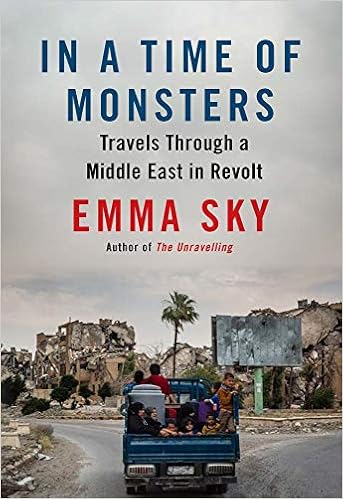
In a time of monsters – Travels through a Middle East in Revolt by Emma Sky

Encouraged to read this by Emma Sky’s sharp analysis in BBC radio interviews of the unintended consequences of the Iraq War, I realised too late that to find out more about her role as political advisor to the American commander General Ray Odierno in its aftermath, enabling her to give damning evidence at the Chilcot Enquiry, I should have started with her book “The Unravelling”.

“In a Time of Monsters” proves as is often the case with travel books to be very anecdotal and episodic, often revealing some telling insights through a chance encounter, but also frustrating, even confusing at times, in what it omits or glosses over. The background history of the Shias versus Sunni is a little too fragmented, while the explanation of the Caliphates from the death of Mohammed up to the recent attempts of Daesh to create a single Islamic state probably comes too late in the book, some two-thirds of the way through.

“Bored, bitter and twisted”, with an acute sense of anticlimax and loss of purpose after her return to London in 2010, perhaps even a little traumatised by her experience in Iraq as she suggests most westerners are, she resolves to make sense of events by visiting countries affected by the Arab Spring: Egypt, Tunisia, Syria, Iraq, Turkey, Saudi Arabia, Oman, Kurdistan and so on.

Making use of what seems like an inexhaustible network of obliging high level political contacts prepared to engage in boozy debates, Emma Sky has no difficulty in striking up conversations with strangers prepared to chat at length . Perhaps her childhood as the matron’s daughter at a boys’ boarding school gave her the confidence to act with such ease in “a man’s world” and also to embark on risky, physically tough journeys, solo or with a male guide for the reward of seeing beautiful, remote areas, like the mountains of Kyrgyzstan. Skimming along the river on a jet ski, white-water rafting, swimming into caves to scale waterfalls: sometimes, the socialising and exciting activities, seem too much of a digression from the lives of ordinary Arabs.

It is no surprise that Emma Sky criticises the US for allowing Daesh (or ISIS) to gain a foothold in Iraq in the anger over government corruption and discrimination against Sunnis following the fall of Saddam Hussein. She also condemns the failure to take early action against Assad in Syria to force him to negotiate. It is perhaps more of a surprise that she is so harsh on Obama, described as “leading from behind” and being too passive. However, she does not really provide convincing evidence that continued use of direct force by the West would have yielded the desired results without unacceptable levels of bloodshed, not to mention resentment over apparent attempts to dominate . She is also very critical of Iran as a somewhat malign and destabilising force, reaching tentacles even to the borders of Israel, but was perhaps unable to make the visit to the country which would assist a clear and more objective analysis.

There is a logical progression, in that, being in date order, the visits reflect the passage of events, so that by 2014 Emma Sky is at the refugee camp of Zaatari, close to the border in Jordan, which has become the fourth largest city in the country owing to the flood of refugees from Syria. By 2016 she is in Greece and Eastern Europe tracing the destabilising pressure of Arab refugees pushed out by the devastation in parts of the Middle East. She even visits London to suggest, perhaps too simplistically, that the Brexit vote itself was largely the result of concerns over migration triggered partly by the instability of the Middle East.

The Epilogue finds her on the pilgrim trail to Santiago de Compostela in Spain, a time of acceptance of her past naïve over-optimism, but clinging to the belief that “this is not a time for cynicism or despair” in the hope that her students will manage to leave the world a better place than they found it.

Lonely Planet New Zealand’s South Island Road Trips (Travel Guide) by Lonely Planet,Brett Atkinson,Sarah Bennett,Peter Dragicevich,Lee Slater -Skimpy and limited use as a sole guide

This is my review of Lonely Planet New Zealand’s South Island Road Trips (Travel Guide) by Lonely Planet,Brett Atkinson,Sarah Bennett,Peter Dragicevich,Lee Slater.

Designed to whet the appetite with plentiful photos in colour and clear maps to provide some easily-grasped “on a plate” itineraries for those who for whatever reason want a trip planned for them, this contrasts with the “usual formula” for “Lonely Planet” guides: tremendously detailed, largely black-and-white with few illustrations, for serious-minded independent travellers who probably already have a plan of where they want to go.

The breezy style is mildly irritating: Queenstown is introduced as “a small town with a big attitude” which “goes for gold with an utterly sublime setting” on Lake Wakatipu, “ripe for rubbernecking, so keep your eyes on the road and your hands on the wheel”. There are some useful street maps (once you get there!) of, for instance Te Anau or Central Nelson, snippets of good advice e.g. on leaving Te Anau by 8.00 to avoid heavy coach traffic to Milford Sound.. Yet the structure seems quite repetitive and therefore wasteful of space: introducing the four road trips, featuring main South Island highlights (Milford Sound, Kaikoura for whale-watching and Queenstown, then main cities, Queenstown again and Christchurch), then outlining each trip, finally covering each one in more detail but still quite skimpy as regards suggested activities and places to stay.

I question the rationale for the choice of road trips:

1. Sunshine Coast 4-7 day circular drive in vicinity of Picton, Nelson and Abel Tasman National Park on north coast

2. Kaikoura Coast 3-4 days linear route between Picton and Christchurch

3. Southern Alps Circuit 12-14 days circular drive from Christchurch via Arthur’s Pass, Fox Glacier, Queenstown with detour to Mount Cook

4. Milford Sound Majesty 3 – 4 days linear return trip from Christchurch via Te Anau to Milford Sound for boat trip

I do not recall reading this in the book, but starting from Christchurch, these four trips could be combined into a grand 4 week tour of the South Island.

I don’t understand why a few more features were not flagged up with a fuller index, and the inclusion of more itineraries e.g. to cover Dunedin and the Catlins Conservation Area in the south, or the Punakaiki Pancake Rocks on the west coast.

The guide in general seems over-simplified, fragmented and less informative than it could have been in the space provided.

⭐⭐ 2 Stars

“A long journey out of the self”

This is my review of Driving Home: An American Scrapbook: An Emigrants Reflections Pb by Jonathan Raban.

I discovered Jonathan Raban through “Arabia”, confirmed his brilliance in “Bad Land” and read “Driving Home” in the hope of rekindling some of the old magic. This is a collection of essays published in magazines and newspapers in the period 1991-2009, following his decision, as a middle-aged “Brit” to move to Seattle.

For me, Raban is at his best as a travel writer, the observant rolling stone who combines descriptions of landscapes and people met in passing with history, politics and culture to create a vivid sense of place. This is typified by the essay used for the book title, in which Raban drives a round trip from Seattle “a western city built in the wilderness and designed to dazzle” , over the Coastal Range and the Cascades, across various river valleys to the dead level plateau of the Christian Right where it is “a big thing to raise a tree”, since only stunted sagebrush grows there naturally. To give us background, he weaves in anecdotes about the explorers Lewis and Clarke, and introduced me to two neglected literary talents, the poet Roethke and the novelist Bernard Malamud, whose writing captured the spirit of the north-western states.

Raban’s political articles on the aftermath of 9/11, the newly elected Obama and characters like Sarah Palin are entertaining, informative but perhaps not as “striking” as some of his other work since so much has already been written on them by others, plus this material will date quite fast.

His essays on famous literary figures probably require some prior knowledge of their work. For instance, I enjoyed the article on the in many ways rather unpleasant Philip Larkin, and was interested to learn how much he feared death and pleased to be taught to appreciate his poem “Aubade”. However, the piece on William Gaddis left me cold and caused me to begin to skip in search of essays with more immediate appeal.

In the main, Raban can make watching paint dry interesting, but the occasional piece requires too much effort to be worth the trouble. The least successful category seems to me to cover those on a specific theme like “On the waterfront” which appears too much of a contrived exercise in writing.

If these essays were thrown together in a single book to earn a few bucks, I don’t blame Raban. His tendency to write articles based on his daughter, or to name-drop holidays with “the Therouxes” detracts somewhat from his writing.

Despite a few reservations, there are sufficient excellent passages in this book to make it worth reading and keeping on one’s shelf to revisit later.

⭐⭐⭐⭐⭐ 5 Stars