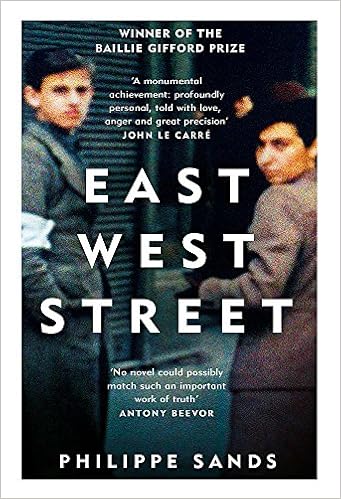
“East west street” by Philippe Sands: piecing together family history and human rights

This book made me reflect for the first time how in the early C20 when long-established stable empires were beginning to crumble, “Each country, old or new, was free to treat those who lived within its borders as it wished. International law offered few constraints on the majority’s treatment of minorities, and no rights for individuals”. The European Convention on Human Rights was not signed until 1950.

A few years before writing this book, lawyer Philippe Sands received an unexpected invitation to lecture in the Ukrainian city of Lviv on the human rights cases in which he had been involved,  his academic work on the Nuremberg trials and their consequences for the modern world. The location of Lviv proved a remarkable coincidence on several counts. Being in the “Bloodlands” of Eastern Europe, it represents a microcosm of a succession of human rights abuses, not least the Holocaust. In three decades from 1914, the city changed hands eight times, passing from the collapsed Austro-Hungarian Empire between Russians, Poles and Germans before ending up in Ukraine, by turns named Lemberg, Lviv, Lvov and Lwów. It  also happened to be the home town of the author’s Jewish grandfather Leon, who  ended up living in Paris with his wife, never speaking of events which had destroyed most of their relatives.

The initial letter “L” appears again in the names of the two Jewish lawyers, Lauterpacht and Lemkin who played a significant role in the development of international human rights legislation, and happened to study in Lviv, being taught by the same lecturers in some cases but apparently not meeting each other in person at the time.  The final coincidence lies in the fact that Hans Frank, one of the key Nazis tried at Nuremberg, committed or turned a blind eye to  his atrocities when he was appointed Governor General of Nazi-occupied Poland  which included Lemberg, as it was then called.

Lauterpacht argued that “the well-being of the individual is the ultimate object of all law”, while Lemkin coined the term “genocide” to describe the destruction of groups. At first, Lauterpacht’s argument that a focus on the protection of groups would undermine that of individuals seemed to me like academic hair-splitting. It seems undeniable that people may be persecuted both as individuals or as distinct groups, from the Jews to the Palestinians and the Rohinjas of Burma in the present day.

However, I was swayed in the end by the author’s argument that, “the need to prove the intent to destroy a group in whole or in part, as the Genocide Convention requires can have unhappy….. consequences. ….The crime of genocide has distorted the prosecution of war crimes and crimes against humanity, because it stirs up national outrage rather than the sort of ruthless examination of the record the country needs (as in the case of Armenians massacred in Turkey)….. People feel compelled to belong to groups and …… are killed because they happen to be members of a certain group…..The recognition of this fact in law tends to make more likely the possibility of conflict between groups by reinforcing the sense of group identity….  Defining the crime of genocide will end up giving rise to the very conditions it seeks to ameliorate”.

With its focus on this theme, the book is saved from unbearable bleakness by the author’s vivid evocation of life in Lviv, when Jewish communities lived with others on stable, reasonably amicable terms. Perhaps inevitably pursuing a forensic approach, Philippe Sands sometimes indulges in too much detail, as when he deploys a pair of law students to help him trawl through records from 1915-1919 to piece together Lauterpacht’s precise course of study, subjects, tutors and dates. The purpose is to understand what ideas may have influenced him, in common with Lemkin, but the inclusion of the details in the main text rather than an Appendix seems a bit excessive. On the other hand, I was fascinated by the photographs of the Nuremberg courtroom for which Sands  identifies individuals.

There is an unexpected human touch in the evident friendship formed between the author and Niklas, remorseful son of the unrepentant Hans Frank, eventually hanged at Nuremberg. The gentle Niklas keeps a photograph of his father’s body after the hanging, “To remind me, to make sure, that he is dead”.

Although overlong, also a little dry and repetitious in places, this distinctive book, hard to categorise by reason of being part detective story, part painstakingly discovered family history, but also a reflection on the impact of crimes against humanity,  is  certainly worth reading and lingers in one’s mind.
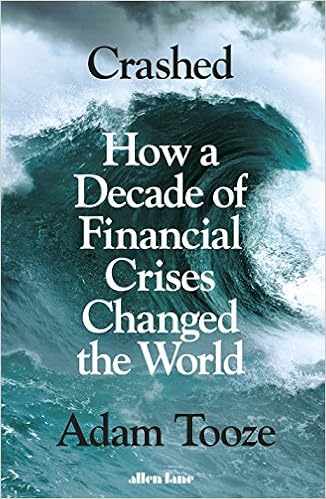
Crashed – How a Decade of Financial Crises Changed the World

A decade on, there is a case for a reassessment of the financial crash of 2008 which first became evident in the US, together with its aftermath on a global scale. Apart from the risk of producing a work that is simultaneously both overly superficial by reason of being so wide-ranging, and too confusing when it comes to referring to complex investment procedures, there is the question of whether a book is directed narrowly as academics or intended to enlighten reasonably well-informed general readers. There are many examples of books which manage to straddle both stools, page turners backed up with impressive bibliographies. I have the impression that this is what “Crashed” is meant to be, but for me it does not succeed in this.

One problem here is that the book requires such a good grasp of economics, financial speculation and politics that anyone possessing it would be unlikely to need to read it in the first place. Adam Tooze makes a promising start, explaining mortgage-backed securities (dodgy if based on loans issued to buyers who may not be able to repay them) or the “repo” system” – a risky form of speculation involving paying for a purchase of securities by reselling them. However, in describing how the crisis developed not only in the States but also the UK and the Eurozone, the author gets on a roll of journalese and no longer troubles to explain obscure acronyms and jargon of the trade. If one is only grasping the gist of the argument, of which one was already aware, is there any point in continuing?

There are also too many distracting digressions such as at the outset in Chapter 1, where the author goes on about the “The Hamilton Project” commenced on Obama’s watch, without clearly stating what it was.

The book contains a number of interesting insights on, for instance, the role of China in financing rampant speculation with its bloated trade surplus, or on the economic and political role of Germany , but I found that digging these out of the verbiage was hard work.

I recommend finding more systematic and focused studies of this fascinating subject, before perhaps returning to this book, which is perhaps better dipped into for reference , or read with the selection of specific chapters of interest, forearmed, of course, with a proper understanding of the working of government bonds, exchange and interest rates and so on.

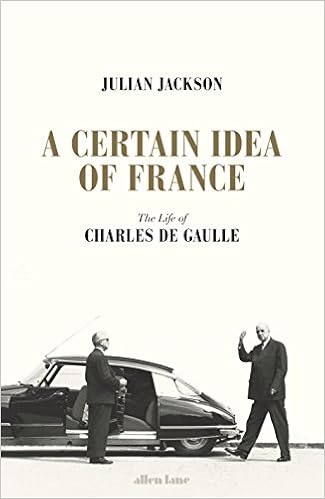
“A Certain Idea of France” – a biography of Charles de Gaulle by Julian Jackson- Using his wits to survive “like Tintin”.

This engrossing biography should delay the inevitable forgetting of what made De Gaulle so famous, with a clear socio-political summary of the past century to set the France of today in context. I enjoyed the frequent use of vivid quotations to show the reactions of De Gaulle’s contemporaries to this eccentric, complex man whose flaws both undermined and contributed to his often controversial achievements.

Deeply influenced by his conservative, nationalistic, intellectual Catholic upbringing, it is unsurprising that De Gaulle found the rapid French surrender at the outset of World War Two and subsequent collaboration intolerably dishonourable. His broadcasts to France from exile in London via the BBC, notably the famous call to arms in June 1940, had the same kind of morale-boosting impact as Churchill’s speeches. By the time De Gaulle was able to walk down the Champs-Elysées of a liberated Paris, an estimated “two million souls” gathered to greet him, yet few had any idea what he looked like in that pre-television age.

To gain recognition as the leader of the Free French and ensure that France should have some role both in the liberation and the subsequent negotiations required vast self-belief amounting to arrogance, combined with unrelenting persistence. Speaking of himself as “De Gaulle”, even “France”, a kind of latter-day male Joan of Arc, he threw chairs during tantrums with world leaders, machinated to get rid of rivals, tried Churchill’s patience to the limit, and aroused the implacable hostility of the American President Roosevelt. Forever “biting the hand that fed him”, he showed scant gratitude to the Allies or the Resistance groups on whom he was at times utterly dependent.

Perhaps he was simply applying the reading which had convinced him of a leader’s need to “cultivate mystery and keep his distance” with “a large dose of egoism, of pride, or hardness and ruse …Leadership is solitary exercise of the will”. Although he was a showman in his oratory, delivering carefully honed speeches from memory in several languages and, with his undeniable courage, loved to disappear into large adulatory crowds, private meetings with De Gaulle were often disappointing. There is a pattern in descriptions of him pontificating at length, looking through people rather than at them, sometimes unexpectedly proving later to have noted and even been influenced by remarks they had managed to make.

“Granting” Algerian independence has been cited as one of De Gaulle’s main achievements, but Julian Jackson points out that it was in fact “wrested from him” after France had come close to mainland civil war, and he showed a callous disregard for the suffering of pieds noirs and Harkis who “lost out” in the process.

It was a shock to realise that De Gaulle’s return to power as President in 1958 was undemocratic, a coup “legalised” because “France’s elites had lost confidence in the existing regime to resolve the Algerian crisis”. This gave him “full powers to govern by decree for six months with the suspension of parliament during that period”. His subsequent manipulation of the constitution under the new Fifth Republic to get himself elected directly by the public, thus cementing his personal power, was also questionable – he was recreating the role of a monarch within the republican system which had aimed to destroy it. His delight in “upsetting the applecart” was evident to the end, as in his rash speech, climaxing in the infamous slogan “Vive le Québec libre!”on a visit to Canada.

De Gaulle often seems like a throwback to a previous age, with his frugal personal lifestyle, rejection of the telephone even when holding high office. and his musing on the damaging effect on society of mass production. Yet he encouraged others to pursue the technology, including nuclear warheads, which would “make France great” and was fortunate, probably owing some of his popularity to, the fact that his “reign” coincided with the “Trente Glorieuses” – the three decades of post-war relative economic prosperity and cultural achievement in France.

Although forced to resign ultimately as an old man who had become out of touch, as indicated by the riots of 1968, De Gaulle often proved quite insightful: he foresaw the collapse of Soviet communism, the folly of the American involvement in the Vietnam War which could not be won, ironically even prophesied for the Common Market that “if England enters into the Community, it will collapse because England will divide us”.

Clearly intended to be a major academic work, this requires a significant investment of time. At more than 800 pages, including notes and bibliography, it is too thick and cumbersome to read comfortably in paper format. I found the Kindle version more convenient, with the downside of it being much harder to flick back quickly to check on a point. The sheer number of names of politicians or acronyms of organisations and parties often becomes too much to absorb. Yet it definitely extended my knowledge and understanding considerably – probably one of the best books I have made the effort to read.

The Romantic Poets and Their Circle (National Portrait Gallery Insights) by Richard Holmes – Captured creativity

This is my review of The Romantic Poets and Their Circle (National Portrait Gallery Insights) by Richard Holmes.

The National Portrait Gallery’s Insights series uses paintings and sketches from its collections to illustrate themes, in this case the “Romantic Poets” and members of their circle: the artist Haydon; razor-witted critic Hazlitt; courageous all-rounder Leigh Hunt, prepared to face imprisonment for his “seditious libel” of “this fat Adonis”, the Prince Regent, and to publicise the talents of rising stars like Shelley; the astronomer of “supernatural intelligence” Herschel who inspired Coleridge, Byron, Keats and Shelley; the great scientist Davy who linked seamlessly the “two cultures” of art and science, to name a few. It is interesting how, after achieving so much, many of them came to a somewhat sad end.

Most of the images, a full page for each character, are striking in their realism, surprisingly “modern” faces of people we can readily imagine meeting today or passing in the street : Haydon’s vigorous and lifelike head and shoulders’ sketch of Wordsworth; a bluff Sir Walter Scott, churning out pot boilers at this desk to pay off the debts of a bankrupt publishing house; Blake glancing up, pencil in hand, to capture some fresh vision or Amelie Opie staring with direct candour at her husband as he painted her, and therefore of course at us as well,

With his profound knowledge of the period, the biographer Richard Holmes is an excellent choice to provide supporting commentaries. “The dazzling Lord Byron” gets pride of place, “young…brooding, beautiful and damned”. We can be in no doubt about his charisma, combined with understandable, at times absurd vanity, in part perhaps a compensation for his club foot.

Allotted only a page or two for the rest, Richard Holmes manages to make every individual a distinct character, striking the right balance between a brief explanation of each person’s role, and finding a few revealing details or anecdotes. So we grasp Mary Shelley’s intellectual brilliance, precocious writing talent, and concern to create a “normal”, conventional life for her son after the traumatic loss of her other children, and Shelley’s drowning. The country boy John Clare’s sense of insecurity, of being an outsider in London society despite the ready recognition of his talent, is very apparent.

The author takes care not to omit women from the collection, although all too often they have been forgotten, like Felicia Hemans, “the most successful parlour poet of her age” famous for such lines as “The boy stood on the burning deck when all but he had fled”. How many, like the working-class poetess Isabella Lickworth “like the wild flowers on the mountain, unknown, unheeded lie”.

These details can only whet one’s appetite to discover more, and enhance the fascinating pictures for which they provide a context.

⭐⭐⭐⭐⭐ 5 Stars

“A long journey out of the self”

This is my review of Driving Home: An American Scrapbook: An Emigrants Reflections Pb by Jonathan Raban.

I discovered Jonathan Raban through “Arabia”, confirmed his brilliance in “Bad Land” and read “Driving Home” in the hope of rekindling some of the old magic. This is a collection of essays published in magazines and newspapers in the period 1991-2009, following his decision, as a middle-aged “Brit” to move to Seattle.

For me, Raban is at his best as a travel writer, the observant rolling stone who combines descriptions of landscapes and people met in passing with history, politics and culture to create a vivid sense of place. This is typified by the essay used for the book title, in which Raban drives a round trip from Seattle “a western city built in the wilderness and designed to dazzle” , over the Coastal Range and the Cascades, across various river valleys to the dead level plateau of the Christian Right where it is “a big thing to raise a tree”, since only stunted sagebrush grows there naturally. To give us background, he weaves in anecdotes about the explorers Lewis and Clarke, and introduced me to two neglected literary talents, the poet Roethke and the novelist Bernard Malamud, whose writing captured the spirit of the north-western states.

Raban’s political articles on the aftermath of 9/11, the newly elected Obama and characters like Sarah Palin are entertaining, informative but perhaps not as “striking” as some of his other work since so much has already been written on them by others, plus this material will date quite fast.

His essays on famous literary figures probably require some prior knowledge of their work. For instance, I enjoyed the article on the in many ways rather unpleasant Philip Larkin, and was interested to learn how much he feared death and pleased to be taught to appreciate his poem “Aubade”. However, the piece on William Gaddis left me cold and caused me to begin to skip in search of essays with more immediate appeal.

In the main, Raban can make watching paint dry interesting, but the occasional piece requires too much effort to be worth the trouble. The least successful category seems to me to cover those on a specific theme like “On the waterfront” which appears too much of a contrived exercise in writing.

If these essays were thrown together in a single book to earn a few bucks, I don’t blame Raban. His tendency to write articles based on his daughter, or to name-drop holidays with “the Therouxes” detracts somewhat from his writing.

Despite a few reservations, there are sufficient excellent passages in this book to make it worth reading and keeping on one’s shelf to revisit later.

⭐⭐⭐⭐⭐ 5 Stars