Every picture tells a story.

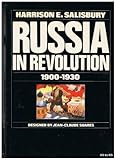
This is my review of Russia in Revolution, 1900-30 by Harrison E. Salisbury.

This provides an engrossing photographic record of the period from the disintegration of the last Tsar Nicholas ll's rule, through the often farcical chaos of revolution, and Lenin's inability to practise what he had preached, to Stalin's ruthless establishment of dictatorship and the collectivisation of agriculture on a huge scale. The mainly black-and-white prints, many still of great clarity show not merely the leading political players and artists but the life of the peasants, and a sense of the gulf between the wealth of the few and the muddy vastness of the countryside. We see the range from Rasputin posing with a prince and a colonel, to an unnervingly handsome and harmless-looking youthful Stalin. The faces are often startling in their modernity: members of the revolutionary "Women's Battalion" with heads shaved as stark protection against lice, an impassive-faced commissar noting details of dealers in human flesh during the famines of the 1920s (this is not really explained in the text), Russian woman doctor conducting stress and fatigue studies on a resigned young female worker.

At first, I found the supporting text very informative, including one of the most concise and effective explanations I have read of the various political parties in 1905: the uncompromisng Socialist Revolutionaries who saw violent terror in support of the peasants as the only path, the Marxist Social Democrats split in three groups with Lenin's Bolsheviks forming the largest party, the idealistic if impractical Anarchists and Constitutional Democrats or Kadets. Although there is only enough space for a fairly superficial coverage, the tragic if understandable confusion and ineptitude of the revolutionaries in their efforts to achieve a daunting radical change are made very clear – including the irony that after only four years Lenin was practising the kind of repressive rule which had led him to call for the Tsar's removal.

Apart from many telling quotations from letters and the comments of observers, the author also finds space for the role of art: Malevich's Futurist painting "The Knifegrinder" and the widespread application of "constructivist", machine-like art to propaganda posters like "Beat the Whites with the Red Wedge", the latter depicted piercing a white cirle, labelled "red" and "white" respectively. It was even applied to plain, angular clothing displayed in the 1920s.

The lack of an index is frustrating at times, the point being perhaps that most of the pictures defy classification in what they reveal. Poring over these photographs gives more insight than many a text on this fascinating if depressing period of history.

⭐⭐⭐⭐⭐ 5 Stars

“Replacing an identitarian object with a real presentation of generic power”

This is my review of The Rebirth of History: Times of Riots and Uprisings by Alain Badiou.

Attracted by the apparent brevity of "The rebirth of history" (119 pages), I was interested in reading an analysis of recent uprisings such as the Arab Spring by the famous French political philosopher Badiou. I understand his desire to adopt an academic approach, and was prepared to rise to the intellectual challenge of grasping his ideas. This was made harder by what I found to be a very tortuous style, although this may have suffered in translation.

Badiou cannot be blamed for wishing to be one of the first in the field to comment on the Egyptian uprising which triggered such optimism in the early days of Tahrir Square and the fall of Mubarak. His conviction that this is a clear example of the rebirth of history has suffered a setback from the re-establishment of a repressive military regime, but it is still too early to judge the longer term outcome of the Arab Spring. However, I came to the conclusion that the essence of Badiou's thoughts on riots as such could have been summarised in an essay. He also complicates his case by straying into the vast and complex topics of nation states, communism and liberalism, citing the books he has already written on these.

He makes some interesting observations, such as that contemporary capitalism has all the features of traditional capitalism as described by Marx although he did not live to see it: concentration of capital in the hands of the global "gangsters of finance"; government leaders of all persuasions reduced to the role of "capital executives". Another example is Badiou's definition of "intervallic periods" following the collapse of a significant new "Idea" e.g. 1980-2011 when classic capitalism revived because communism had failed which he compares with 1815-50 when dissatisfaction with the French Revolution led to a revival of monarchism.

In essence, I understood him to say is that a mass uprising of a diverse group of people, although they may only be a numerical minority, occupying a clear site, may generate the enthusiasm and energy necessary to force change, improving the lot of those neglected or oppressed by the state. He remains an idealist, arguing that, in such a riot, it is enough "to want to want" subordinating "the results of action to the value of the intellectual activity itself".

My basic problem with Badiou is that I find him over-theoretical and unrealistic. He enabled me to understand better what is meant by "the withering of the state" and the rejection of representative democracy as a form of exploitation. However, his thesis that a viable, peaceful society could emerge through the power of the "Idea" taking root – his language is quasi-religious at times – seems woolly and Utopian, a luxury for an academic in his Parisian ivory tower.

⭐⭐⭐ 3 Stars

Where is the enemy?

This is my review of Homage to Catalonia (Penguin Modern Classics) by George Orwell.

This vivid account of a few months spent fighting the Fascists in the Spanish Civil War reminded me that Orwell was a talented journalist as well as a writer of satirical fiction. He pulls no punches in describing the chaos and lack of resources in periods of mainly uncomfortable inaction punctuated with occasional hairy sorties.

My respect for his judgement was shaken a little by some of his observations – for instance, that he should find it “rather fun….in a boy-scoutish” kind of way to crawl about trying to take pot shots at the enemy without being hit himself, or the unconscious elitism of “Any public school OTC in England is far more like a modern army than we were.” He admits to longing for a powerful gun with which to pulverise the other side, but redeems himself with an admission of real fear when he has to expose himself to enemy fire. Similarly, his account of the experience of being wounded is interesting, together with such insights as the camaraderie between soldiers who know they would be shooting at each other in a different situation. His description of Barcelona as a briefly classless society in which there was no rank or status, and people treated each other as equals, is thought-provoking as regards “what might have been”, but clearly seemed too utopian to last, particularly since the bourgeoisie was simply lying low.

It is revealing that the chronic shortage of weapons may have been part of a deliberate government plan to prevent groups of anarchists or pro-revolutionary Marxists from gaining influence in the struggle. However, Orwell’s self-confessed lack of interest in the political side of the war is both surprising and disappointing, since it is clearly crucial to an understanding of what was going on in this complex struggle, and the outcome of events. Thus, the dramatic chapters on the counterproductive riots between anti-fascist groups in Barcelona – perhaps akin to fights between different revolutionary sects in modern-day Syria – are quite hard to understand. Orwell goes some way to redress this in the two Appendices, which were chapters integrated into the original text, but the result is needlessly disjointed and still somewhat unclear.

Although he produced this book in 1938, too early to judge the tragic outcome, at least Orwell had the prescience to predict that Franco would win, thus setting Spain back for decades.

⭐⭐⭐⭐ 4 Stars

A Divided Nation

This is my review of The Man on Devil’s Island: Alfred Dreyfus and the Affair that Divided France by Ruth Harris.

It is hard to identify a modern event which has had as much impact on society as the trials and imprisonment of Alfred Dreyfus on what we now believe to be a trumped up espionage charge of relative insignificance. Having read recently Piers Paul Read's very detailed yet clear and moving account of this, from the arrest of Dreyfus in 1894 to his pardon and reinstatement in the army in 1906, I turned to Ruth Harris for a wider analysis of Dreyfusards versus anti-Dreyfusards.

In the promising introduction, Harris emphasises how families were divided by the Dreyfus affair, with people on both sides often holding contradictory and conflicting views about everything except the innocence or guilt of the man at the heart of it all, or at least his right to a retrial or declaration of innocence. The author presents "two Frances" fighting "for the nation's soul": on one hand, the Dreyfusards, mainly republicans, Protestants, or socialists, upholding Truth and Justice in their demands for a retrial versus the anti-Dreyfusards, often Catholic, anti-semitic, with monarchist sympathies, champions of Tradition and Honour, either convinced of the guilt of Dreyfus or prepared to sacrifice him rather than overthrow the ruling of a military court when they were concerned to support and build up the army after the humiliation of defeat in the Franco-Prussian War.

I do not mind that only brief sections of this book are devoted to Dreyfus himself. I admire the author's depth of research and evident deep knowledge, and perhaps, with 137 pages of notes and bibliography, this is not intended for a general reader. Much as I wanted to get absorbed, I found the reading of this excessively hard going. There is a surfeit of detail in an indigestible form, made worse by a fragmentation of information e.g. on the anti-Dreyfusard Maurice Barrès, and the inclusion of specialist terms with inadequate explanation for a non-expert e.g. page 137 (paperback version) references to revolutionary Blanquists and revanchists from the Ligue de la patrie française. In short, there is a failure to distinguish clear, major points from a morass of over-condensed detail on too many characters and attitudes.

I would like to find another book on this of period of French history, but was forced to the disappointed conclusion that it was not worth the expenditure of time to plough through this, referring to other sources for clarification on the way.

⭐⭐⭐ 3 Stars

Grasshopping

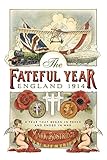
This is my review of The Fateful Year: England 1914 by Mark Bostridge.

Clearly written to tie in with the centenary of the outbreak of World War 1, “The Fateful Year England 1914” reminds me as regards format of Bill Bryson’s “One Summer: America 1927”. The “helicopter” approach may surprise you with all the events that were occurring simultaneously, although the author’s selection is inevitably somewhat arbitrary. Everyone is likely to learn something different from the book: in my case, about the “strike schools” where, influenced by the high level of industrial unrest, pupils protested against dogmatic and repressive school boards or about the slashing of “The Rokeby Venus” along with other works of art by militant suffragettes. The photographs of the period are also interesting.

On the other hand, I found the coverage too fragmented and superficial. The decision to devote an early chapter to a highly publicised murder of the day struck me as a rather crude and unnecessary hook (Bryson does the same), whereas the complex but less exciting topic of resistance to Irish Home Rule was so condensed as to be hard to follow. The chapter “Premonitions” is particularly bitty, in its “catch all” attempt to skate over evidence of increased anti-German feeling, fed by the press and Erskine Childers’ “The Riddle of the Sands”’, Hardy’s anti-war “Channel-Firing” poem, Holst’s composing of “Mars, The Bringer of War” and the aggression of the Vorticists. The seven chapters of Section 3 on the effects of the war in England are the most cohesive and fully developed, but out of kilter with the rest of the format.

⭐⭐⭐ 3 Stars

Satisfying need and greed

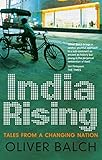
This is my review of India Rising: Tales from a Changing Nation by Oliver Balch.

Themed under the headings of Enterprise, Aspiration and Change, the ten chapters of interviews with a wide range of Indians can be picked and mixed in any order. With the stated “overarching goal..to gain a flavour of the place… the approach is unapologetically subjective” and anecdotal. In this, the author succeeds, but is it enough? I admire Balch’s enthusiasm and confidence, but found myself crying out for more context and analysis, as I searched for nuggets of information in the often banal padding and attempts to showcase Balch’s budding skills as a journalist.

Some of the least likely chapters are the best, as in “Actor Prepares” where the author tracks down Naval, the wannabee Bollywood director who has broken with tradition by giving up the course financed by his father, without telling him. In the process, Balch describes the urban tragedy of the hideous, jerry-built concrete housing blocks in unfinished suburbs where recent migrants to Mumbai are crammed without the money or knowhow to equip themselves adequately.

After visiting the artificial bubble of a western style shopping mall, which girls can only attend chaperoned or with friends, Bauch interviews the retail millionaire who feels that aspiration levels, even amongst the poor of India, are now too high to halt the growing tide of consumption: “material things are rewards for performance”. Can Gandhi’s opposing philosophy of the importance of inner peace and harmony survive against this? It is interesting to read how the ingenious poor of India are beginning to set about achieving their ends. There is the “microfinance” (controversial in view of the interest rates levied) which enables groups of women in the slums to borrow money for small-scale activities, guaranteeing repayments for each other as necessary. Similarly, in remote villages off the beaten track, it is again women who operate like “Avon ladies” selling small packets and jars of cleaning agents. When asked if she is happy with her purchases, an old lady gives the telling response, “Before, we washed our dishes with ash”.

On page 250, a rare piece of analysis asserts, “India is travelling at multiple speeds as in multiple directions. New India is a story of fits and starts, not linear progression.” And in the conclusion: “India is too diverse, too full of paradoxes, too confident ever to be homogenised” or swallowed up by global capitalism. But is this too simplistic? India is clearly in transition, with the poverty of the majority highlighted in the process: state-funded space research versus stagnant villages and mushrooming slums in filthy, lung-searing, gridlocked cities. Will the sheer scale of the economy create such pressures of pollution and instability that India plays a major part in the destruction of our global civilisation as we know it? “India Rising” never probes as deeply as this.

⭐⭐⭐ 3 Stars

The next liberal superpower?

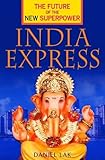
This is my review of India Express: The Future of the New Superpower by Daniel Lak.

Before a recent trip, the few books available apart from tour guides were disappointing. Published in 2008 so still reasonably up-to date, Daniel Lak's "India Express" came closest to fitting the bill (although I have just found a couple of promising alternatives to be reviewed).

Although not a native of India which he first visited in 1989, Lak has the journalist's ability to observe with an open mind, to present information in an interesting and accessible way, taking time to analyse what lies beneath the surface. As each chapter is self-contained and clearly themed, you can pick and mix them.

Not primarily interested in India's unexpected expertise for sorting out the "millennium bug" which I remembered to have been an illusion, and thinking I knew enough about Indian call centres, the country's demographic problems, the fight for independence and tragedy of partition, I made first for some of the later chapters.

"Hinduism and its discontents" clarified a subject too often made obscure and dull. "According to its constitution, India is a secular country, but religion is omnipresent." The description of the holy city of Varanasi (Benares) proved very accurate: teeming bazaars, near-naked holy men in trances, sacred cows munching at vegetables stalls but not too revered to be shooed away with a shove or obscenity. Lak found a priest who bathes daily in the sacred water of the Ganges, knowing it to be poisoned by pollution, to explain the twenty-five branches of Hinduism ranging from belief in billions of gods, through monotheism to atheism. Hindus see the "essence of divinity in humans themselves" with deities serving largely as metaphors for people to grasp. "What passes for modern Hinduism can be traced to British and European scholars" who "applied their own familiar models……in the process of interpreting ancient writing….intended..for a different purpose". That says it all.

Lak covers the contradictions of India: intense cheating in the education system alongside the incorruptible Indian Institutes of Technology producing graduates to hold key positions in major companies worldwide. Then, despite its flaws, there is the survival of a vibrant democracy against the odds, prompting Lak to describe India as "Asia's America", although possibly too large and complex for this.

The gulf between rich and poor is illustrated by the fleets of hired taxis and vans used to transport programmers to and from work at HP India, to avoid a repetition of the rape and murder of a female staff member by a bogus driver. Another example is the attitude of higher castes that "if we throw our garbage over the wall of our compound, it no longer exists" because the low caste sweeper can be relied upon to take it away.

Regarding the international shock of nuclear tests in 1998, Lak suggests the prime motivation may have been to earn the respect on the world stage that India craves, by insisting on the right to self-defence. "Were India and Pakistan to reach some sort of settlement on Kashmir….other points of contention would easily be dealt with" through negotiation.

If revised, the book might include a chapter on the media – TV adverts for developing lighter skins and purchasing cleaning products, a far cry from the bustling life of the filthy streets. Another topic could be the space race in which a minister recently announced India's intention to lead the world and reject foreign aid. So what about investment in the public services so lacking in the grid-locked Delhi which I witnessed?

Lak is hard to fault, apart from a possible overoptimism over India's future in such an overpopulated world of booming demands and limited resources.

⭐⭐⭐⭐⭐ 5 Stars

“If Dreyfus is innocent, the generals are scoundrels”

This is my review of The Dreyfus Affair: The Story of the Most Infamous Miscarriage of Justice in French History by Piers Paul Read.

When the passage of time might be expected to have washed away memories, this is only one of several recent books keeping alive "The Dreyfus Affair" in which a Jewish captain was found guilty of espionage in 1894 at an inept and corrupt court martial. Not only is truth stranger than fiction here, but it exposes the deep rift between on one hand the Catholics, bitter over past persecution by the French revolutionaries, yet still considered too influential in education and the army, and on the other hand the secular republicans, often seen as in league with a "syndicate" of wealthy Jews following their "liberation" by the French National Assembly in 1791.

So keen is the author to set the scene that we do not hear much about Dreyfus until Chapter 5. Although leavened with many fascinating details, such as the twisted sense of honour of the military men who arrested Dreyfus, leaving a gun loaded with a single bullet in reach as a hint for him to "do the right thing", this deeply researched study makes exhausting reading at times. This is due partly to the large number of characters with long complicated names, often in inverse length to their importance, also to the author's inability to resist distracting us with facts about them, even if marginal to the main theme.

1890s Paris is presented as a kind of Ruritania with leading figures swapping mistresses, indulging in duels, and accepting bribes to conceal embarrassing facts like the bankruptcy of the Panama Canal Company. Just as expenses scandals at Westminster are made to seem small beer, the excesses of our media pale into significance compared to the bilious anti-semitic outpourings from the pens of "respected" Catholic journalists. There are fascinating parallels with today: Dreyfus was convicted at one stage by a "dodgy dossier"; the need to protect national security was made a reason for not producing vital evidence which was shown, if at all, to the prosecution but not the defence; those who knew or came to believe that Dreyfus was innocent felt that establishing this was less important than maintaining the reputation of the army, whose senior staff had mistreated him. The recent controversy over the French striker Anelka's use of the "quenelle" or reverse nazi salute favoured by his friend the comedian Dieudonné show that the issues surrounding Dreyfus retain their substance, in a different form.

The books succeeds on both a broad historical and personal level. For the sake of his health and his family, did Dreyfus have any option but to accept a pardon even if it implied admission of guilt? Sadly, this capitulation divided his supporters, some to the extent of becoming estranged from him and each other. The final sad irony is the fate that met his loyal wife after his death: to spend her final years hiding from the Nazis in, of all things, a convent.

⭐⭐⭐⭐ 4 Stars

Glimpses of past glory

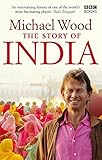
This is my review of The Story of India by Michael Wood.

With many colourful illustrations, this serves as an attractive souvenir of the BBC series, although the DVD is obviously better. The chapters themed by chronological time periods provide much intriguing information if you have the time and patience to tease it out of the somewhat rambling text: the followers of the Jain religion who gather annually to pour "great vats of milk, paste, saffron and vermilion over the giant statue" of their guru Babuballi; the ruler Ashoka, advised that he had to be "cruel to be great", who converted to Buddhism in later life, leaving his kingdom scattered with carved pillars instructing his subjects on how to live as he removed the death penalty, calling for the conservation of forests and respect for the beliefs and practices of others and so on.

I was looking for a book that would combine history with culture and politics, but to be fair this does not claim to be more than a history. With friends and contacts to ease his path, Wood presents a somewhat rose-tinted view of India: the squalor, dirt and pollution are cunningly omitted from all his pictures, and the ancient monuments and paintings gleam with colour, with little sign of the ravages of time. If you are reading this for a standard sightseeing tour, you may be a little disappointed by the often harsh and worn reality.

⭐⭐⭐⭐ 4 Stars

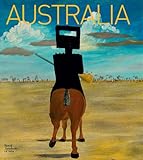
“Australia” by Wally Caruana,Franchesca Cubillo – Shedding light

This is my review of Australia by Wally Caruana,Franchesca Cubillo.

After spending more than two hours trying to absorb the twelve rooms of the Royal Academy’s impressive Autumn 2013 exhibition on Australia, I realised that there is a strong case for obtaining the official guide which covers the totality of exhibits, giving you time to digest at leisure the portrayal of Australian landscape and culture through paintings and photographs.

The official symbol of this striking exhibition is Sidney Nolan’s dramatic portrayal of the outlaw Ned Kelly, dehumanised by his helmet, rectangular and silhouetted in black, with only the sky visible through the visor. Yet, for me, the major discovery was the power and skill of Aboriginal art, initially applying to eucalyptus bark natural pigments of black, red, ochre and white in surprisingly sophisticated cross-hatchings to imitate sandhills, rivers, wildlife, dreams of rain and ancient legends. More recently, native artists have progressed to acrylic on canvas, whilst retaining their traditional themes, which have also been taken up and reinterpreted by the European artists who have settled in Australia.

I was also interested to see how movements such as impressionism and romanticism were developed in the late C19 to early C20 in a distinctive Australian style, influenced by the quality of the unrelenting and brilliant sunlight and the nature of the vegetation, the fronds giving rise to “fernomania” and the varieties of gum tree, relatively sparse-leaved but with branches forming strong patterns. European painters fell in love with the country, like Glover who painted a carefully tended and irrigated flower garden against the background of the natural bush.

Fascinating social history is revealed through the work of early convicts with an artistic bent, or McCubbin’s giant, moving tryptych of “The Pioneer”, arriving in a wagon, working with his wife to establish a holding, until she dies, leaving him to tend her grave. We see the colourful crowd on Manly Beach in 1913 after public bathing had been permitted, the confident “squatter’s daughter” in the 1920s. surveying in the brilliant sunshine the open woodland probably created by generations of aborigines following the practice of using fire to reduce the vegetation, and to bring it up to date, Howard Arkley’s luminously bright rendition of a prosperous suburban house, “Superb and Solid”.

Although there may be some justice in the charge that it would have been better to show more work by fewer artists, this begs the question of which one would choose. As it is, we are given a useful overview of the whole gamut of Australian art, leaving us to pick out and pursue what appeals to us as individuals.

⭐⭐⭐⭐⭐ 5 Stars