Hisham Matar has drawn much of the material for his novels from his Libyan heritage: a childhood experience of exile, with the need to conceal even his own identity, at times his very name, because of his father’s criticisms of Colonel Gaddafi’s dictatorship, or his father’s sudden arrest and abduction to Libya, never to be seen again.
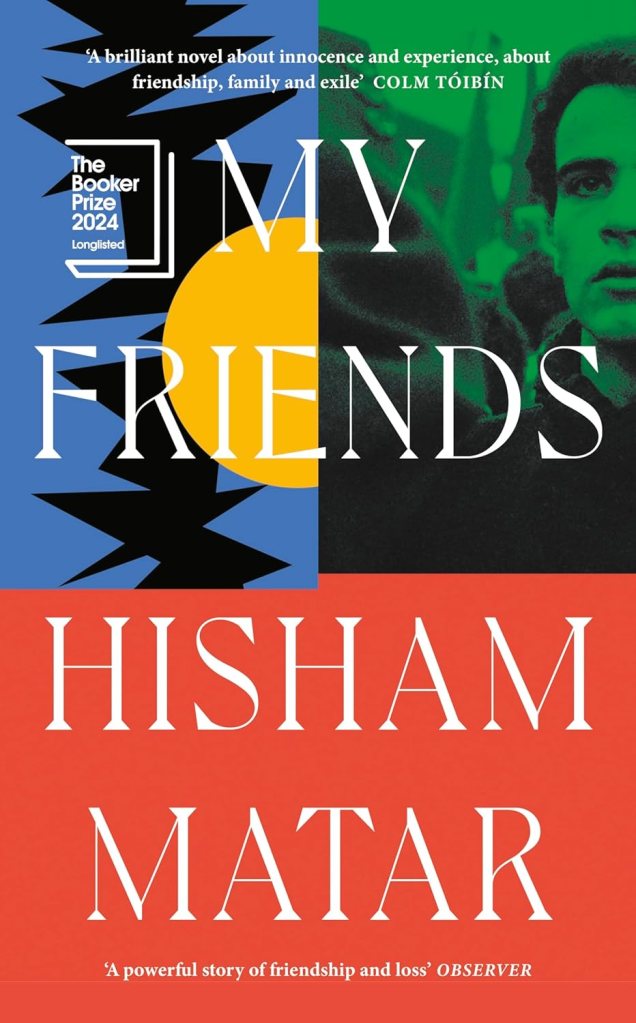
The story revolves round three rather different men, thrown together by chance and linked by the sense of being cast adrift as exiles. It begins at what proves to be the end, as the narrator Khaled has an emotional parting from his old friend Hosam Zowa, about to start yet another new life in California where his father had acquired a house. As Khaled wanders back from King’s Cross Station to the small flat he has rented for decades, the subsequent chapters form a series of flashbacks and reminiscences, set against the background of a people ground down by a repressive regime, energised by the Arab Spring to rise up in rebellion, only to become embroiled in a new round of “coups, counter-coups, chaos and confusion”.
Surprisingly few very dramatic events are recorded, notably the demonstration in London outside the Libyan Embassy in 1984, when policewoman Yvonne Fletcher was shot and died. Now studying in Edinburgh, Khaled is persuaded by his friend Mustafa to take part in the event, but the balaclavas they purchase to conceal their identities are no protection against the unexpected volley of bullets from an Embassy window. Although badly injured, both survive, but with lives irrevocably changed: doomed to be branded disloyal troublemakers. With the real risk of physical arrest and torture combined with the psychological games set up by the Gaddafi regime, the two young men are unsure whether their close relatives in Libya are aware of their plight but are afraid to contact them in case they suffer reprisals as a result. Khaled’s caution proves justified when he eventually risks phoning his parents: while his father goes away for a minute, the inevitable eavesdropper on the line coughs twice, just to make his presence known.

The novel conveys well the surreal aspect of crises, and the continual fear involved in exile. There is the constant need to be on guard, even against fellow students thought to be “spies” being paid to inform on Khaled and Mustafa. To protect himself from the long arm of Gaddafi’s regime, Khaled sacrifices much to keep a low profile. This involves becoming a habitual liar, even to his closest relatives back home. So incredibly, for years, he maintains the fiction that he is still studying at university and having a great time, when in fact he is living in poverty in London, doing dead-end jobs when he can.
Some of the most engaging passages are the dialogues involving conversations too detailed to be memories, as when Khaled, as a boy, hears his liberal-minded parents discussing the daring story read on the radio, written by Hosam, whom he has yet to meet. Or, years later there is a domestic scene set in Libya, which has to be relayed to Khaled in the form of a letter, in which Hosam describes his growing attraction to a much younger relative called Malak, who is goaded by Hosam’s brother into describing the kind of man she would choose to marry – it’s like being a fly on the wall observing another culture and adjusting one’s view of it in a positive way.
At other times, the author digresses into some topic which interests him and could easily be an essay in its own right: as in “a survey of London’s inherent instability” which involves Khaled and Hosam in visiting the houses where a range of famous writers lived in passing. Another example is a discussion of Arab words which have no English counterpart, like “heart” in the metaphysical sense: “How can the English language do without such a word?” Malak asks.

For the most part, the novel is slow-paced, and probably a hundred pages or more too long. Not much happens in Khaled’s life, restricted partly by his exiled status, partly the limits he imposes on himself, the implied inability to commit to a permanent relationship which may be the result of trauma. The author’s focus on small incidents and passing impressions, could become very tedious. Matar largely succeeds in avoiding this with the acute observations and insights which he weaves into Khaled’s stream of consciousness. Matar is interested in psychology, why people behave as they do, rather than in tight plotting and the power of a “less is more” style. He portrays Khaled as being in the middle of the trio : behaving like the impulsive Mustafa when he is with Hosam, or the cautious Hosam when with Mustafa.

Inevitably, the urge to return to Libya to fight for an end to tyranny proves irresistible for two of the trio, with Khaled apparently stuck in the safe inertia of his constrained haven in London – but this enables the dynamics of the relationship between the three to change again. On one level, the situation is often painfully poignant or sad, but on another it is simply a realistic portrayal of how life turns out.
The reliance on memories leads to fragmented, disjointed impressions, particularly in the final chapters which felt like a condensed bolt-on to reach a rather limp ending. Yet overall, the novel increased my awareness and understanding of Libya and the trauma of exile, although I felt that there was something in Khaled’s personality which made his life more constrained and limited than perhaps was necessary, and that humans being by their nature capable of adapting, he was in his own way oddly content.
 Antenna Reviews