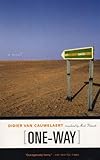
“One-way” by Didier van Cauwelaert – Fizzles out after a promising start

This is my review of One-way by Didier van Cauwelaert.

Aziz has never been accepted fully by a Marseille gypsy community, having been salvaged from a car in which his French parents perished in an accident. So when he presumes to get engaged to a beautiful gypsy girl, he is framed for the theft of the ring which ironically he has in fact purchased, admittedly from the proceeds of other petty robberies for which he has never been caught. His punishment is deportation to Morocco , his “official” birthplace. The young policeman friend who cannot help him out of this fix explains that, desperate to be seen to implement a new policy against illegal immigrants who break the law, the authorities have seized on Aziz as the first foreigner to hand who actually has identity papers, the irony being that there are in fact cheap forgeries. This is the author’s sardonic take on a controversial French policy of clamping down on immigrants, which apparently inspired him to write the book in partial protest.

Aziz accepts the situation with what may seem like a disappointing degree of passivity, although of course, if able to prove his Frenchness, he would be liable to end up in gaol. He forms an unlikely bond with Jean-Pierre Schneider, the gullible probation officer tasked with escorting him back to he fictitious birthplace which he devises on the spur of the moment. As Aziz, with his love of story-telling, compounds his potential problems by continually embellishing tales of life in a remote mountain community which does not exist, Schneider becomes ever more fascinated by it, perhaps as a kind of escape from his own personal problems of just having been left by his wife.

This short novel is certainly imaginative, and has been described as an allegory for the nature of identity, which can be imposed upon us, or fabricated by us as a mixture of reality and fantasy. Farcical and ironically humorous from the outset, with poignant moments, the tale becomes a tragi-comedy. Once in Morocco, it takes a surreal turn, with a complex plot, involving many unexpected incidents. The humour remains, as when we discover Schneider’s view of events, with his surprise over Aziz’s remarkably good French and spark of rebellion against his faith by eating with his left hand, but the storyline becomes too aimless to maintain my interest. Neither could I relate to or feel moved by the characters as the story progressed. The prolific author writes as the fancy takes him, thinking up bizarre or amusing situations, but not developing them fully, so that they fail to “add up” to anything or lead to any meaningful conclusion. The abrupt ending felt as if the author had found a convenient spot to dump his hero, before moving on to the next writing project.

The novel is good for practising one’s French if possible to read it in the original form, but otherwise somewhat unsatisfying.

⭐⭐⭐ 3 Stars

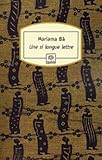
“Une si longue lettre” by Mariama Ba – A woman’s lot in Dakar

This is my review of Une si longue lettre by Mariama Ba.

Written during the prolonged period of mourning for her husband Modou, as required by Islam, Ramatoulaye’s lengthy letter to her lifelong friend Aïssatou is perhaps never intended to be sent. Containing so many descriptions of events with which Aïssatou is already only too familiar, the letter seems to be in fact a device for a series of reflections on the role of women in Senegal in the 1970s, when the book was first published.

Both originally marrying for love contrary to normal custom, the two Senegalese women have suffered in common the humiliation of their middle-aged husbands’ decisions to take a nubile young second wife, taking advantage of the Muslim encouragement of polygamy. Yet the two friends’ responses have been very different: walking out with her four sons, Aïssatou forges a new career and independent life; despite her education and confidence when talking to a distinguished old flame on equal terms, Ramatoulaye swallows her pride and hangs on, for reasons she gradually explains. After more than two decades of motherhood, her body and looks have been ruined by the birth of twelve children many of whom still depend on her maternal care, she likes her home, perhaps she is partly to blame for her husband’s roving eye, and besides, she still loves him.

Although it is clear why Mariama Bâ Is so highly regarded as an African female writer whose work is widely studied, as a Western C21 woman I find it hard to know how to read it. To what extent is Ramatoulaye meant to be a passive foil to her friend, reflecting the typical attitudes of women born around 1930, socially conditioned to accept a subservient, domesticated back seat role? Despite divorcing her own husband, to what extent was Mariama Bâ with her nine children herself a model for Ramatoulaye? The latter is portrayed as conventional in her attitudes. In a society strongly conditioned by “caste”, natural jealousy of her young “co-wife” Binetou is mixed with contempt for the girl’s low birth, and of her mother’s vulgar eagerness to gain status and material goods through the marriage. Following the custom of having a “griot” or “storyteller” attached to the family, Ramatoulaye tolerates the frequent company of a gossip-peddling fortune teller who interferes in her personal life.

As Ramatoulaye dribbles out the details of her marriage in a somewhat disjointed fashion, often leaving tantalising gaps as to how exactly she makes ends meet or juggles child care with some shadowy career, I became somewhat bored with a situation which seems to have been explained in essence with no sign of developing further. Appearing to have “lost its way”, the novel lapses into a series of cues for didactic reflections on marriage, motherhood and family which might fit better in an essay, or a Sunday colour supplement slot. The appeal of her flowing, almost poetical prose, apparently based on the Senegalese tradition of storytelling, tends to mask the fact that her reflections often seem like platitudes to a Western reader. Perhaps they would have appeared more radical when the book was first published.

I was disappointed by the tendency to stereotype: man are egotistical and often easily manipulated; mothers-in-law are scheming or materialistic, yet the married wives, often wronged, have the monopoly of integrity and endurance

Admittedly, the final pages are given a fillip with some tongue-in-cheek accounts of Ramatoulaye’s attempts to deal with her teenage children. She tends to take the line of least resistance, realising that it is often best to be pragmatic and accept, say, a daughter’s unplanned pregnancy by harnessing the good will of the student who has caused it. Yet when she tries to redress her previous failings as a mother by telling three of her other daughters the facts of life, she senses from their bored reaction that they know them already – or think that they do.

Mariam Bâ is strong on dialogue, which makes it all the more of a pity that so many events are “reported” to the reader. There are also some inconsistent shifts in point of view, as when Ramatoulaye enters the mind of the mother-in-law obsessed by the shame of Aïssatou’s low birth as a mere jeweller’s daughter, which she resolves to counter by grooming a niece as a genteel second wife for her spineless son.

On balance, I liked the sudden digression into a vivid description, the odd sharp insight, the almost soap opera bubbles of family anecdote. If Ramatoulaye appears essentially hidebound, she is capable of occasional flashes of independence as when she rejects an eligible suitor, an old flame who ironically wants to take her as a second wife.

⭐⭐⭐⭐ 4 Stars

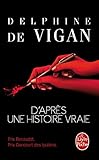
“D’apres une histoire vraie” by Delphine de Vigan – Interesting theme flogged to death?

This is my review of D’apres une histoire vraie by Delphine de Vigan.

Having written a fictionalised memoir of her bipolar mother’s life which ended in suicide, the award-winning author Delphine Le Vigan is well–placed to muse on the borders between reality, perceived truth and creative invention. In “D’Après une histoire vraie”, this theme is interwoven with the psychological drama of a vulnerable author finding her life being insidiously taken over by a charismatic but probably unstable individual who wants to go beyond being a ghost writer to control the life of a successful author. The inspiration for this comes at least in part from Stephen King’s novels, quotations from which, including “Misery”, at the beginning of each section give broad hints as to where matters are heading.

In giving the novel’s narrator her own name of Delphine, the author suggests a degree of autobiography, but although she herself may well have experienced a period of “writer’s block”, it is to be hoped that the bulk of the story is “made up”. Overwhelmed by the success of her novel revealing intimate family details, which has upset some relatives, bombarded at book signing sessions by fans whom she has given the confidence to unburden their own troubles, it is not surprising that the fictional Delphine is finding it impossible to write. With hindsight, she attributes her decline to the malign influence of her enigmatic friend “L” who at first seemed such a kindred spirit, so eager to help manage her life.

The tense, claustrophobic relationship rapidly established between Delphine and “L” is heightened by the absence of other characters. As regards Delphine’ family, this is conveniently explained by her childrens’ studies at distant colleges while her lover spends long periods on work projects in the States. While Delphine initially wants to write creative fiction, the ever more dominating “L” is determined that she should focus on real experiences, however painful, arguing that this is what people wish to read about and now expect from her. This seems a somewhat sterile argument over a false dichotomy, since apart from the facts that most fiction, however fanciful, is triggered by something “real”, and that people see reality very differently, it is inevitably altered through a writer’s descriptions and interpretations into a “form of fiction”. A book may claim to be “a true story”, but even when “inspired by real facts” may in practice be largely invented. The author makes this point several times, and to some extent shows it to be the case in the twists of the plot but this is not enough to carry the novel.

Although this book has been highly praised, neither the ideas about the nature of fiction, nor the psychological drama are handled with the the mind-bending subtlety for which I hoped. The decision to present a retrospective acount of events with indications of what was about to happen may feed a sense of “reality” but combined with excessive repetition makes for an often tedious read. Whenever the suspense does begin to ramp up, it tends to become rapidly over-melodramatic, collapsing all too predictably into disappointingly banal or even ludicrous explanations. Although the novel benefits from a twist towards the end, the author does not seem to know when to stop – the last two chapters in particular seem counterproductive.

This is a relatively easy read in French, with a clear style and many useful idioms and clichés for a student of French – also a good source of discussion for a book group.

I am tempted to see Polanski’s film on this, since I suspect that the director of “Rosemary’s Baby” will know how to create a real sense of menacing suspense, perhaps at the expense of the literary arguments.

⭐⭐⭐ 3 Stars

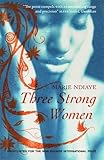
“Three Strong Women” by Marie NDiaye -Is originality enough?

This is my review of Three Strong Women by Marie NDiaye.

Set mainly in Senegal where the author’s father, absent from her infancy, was born, the novel’s three untitled sections of varied length are very tenuously linked – for instance Khady, who makes a brief appearance in the first part is cast as the main character of the final section, making the perilous attempted migration to a better life in Europe. Apart from Senegal and women who have been deserted or wronged by men, all the sections seem to have in common are originality in plot and style, with a frequent surreal, dreamlike quality.

In the first part Norah, qualified as a lawyer despite her upbringing in an impoverished single parent family, has responded to a mysterious summons to visit her father, who abandoned his family years before to make a fortune from running a Senegalese holiday village. He demands her help in representing Sony, the son he took with him when he left. Despite his intelligence and new-found wealth, Sony seems as damaged by past events as the mother and sisters from whom he was abruptly separated as a five-year-old.

At first, I was irritated by the long, complex, often repetitive sentences forming a stream of consciousness which requires intense concentration, plus the image of the father perched like a bird in the branches of the flamboyant tree growing by the porch is a little hard to take. My interest was caught when Norah begins to agonise over her relationship with the charming but irresponsible Jakob, berating herself for having allowed him to infiltrate her life. However, as with the drama involving Sony, none of this is ever fully developed. The denouement seems abrupt and ambiguous – perhaps it is the author’s intention to leave matters open to several interpretations.

In the middle section, it gradually emerges that the main protagonist, an incompetent kitchen salesman called Rudy, has been forced by a scandal to quit a teaching post in Dakar to return to France. His selfishness is apparent not only in his self-absorption, but also in misleading his Senegalese wife Fanta into thinking she will be able to teach in France. Her anger with him is symbolised by a menacing buzzard which continually haunts him: the author seems very keen on metaphorical birds.

Another obsession is with physical ailments: Norah is incontinent when embarrassed, Rudy suffers from piles and Khady is lamed by an injury too grave to heal without medical care.

The final part is the shortest, most conventional and best constructed of the three, but perhaps the bleakest in its theme of the exploitation of migrants, with the casually brutal treatment of women in particular.

Although there are some striking images in this book, the disconnected nature of the writing meant that I did not feel fully engaged with the characters. Nor was it clear to me in what ways Norah who seems to fall under her father’s spell, Fanta who makes so small an appearance, and Khady, buoyed up by the mantra-like sense of “being herself”, yet passively enduring the most appalling hardship, can be described first and foremost as “strong”.

The task of translating this unusual book seems particularly challenging, so it seems best read in the original French if possible.

⭐⭐⭐ 3 Stars

“Fire in the Blood” by Irène Némirovsky -Poignant, insightful writing that puts others in the shade

This is my review of Fire in the Blood by Irène Némirovsky.

After years of wandering in exotic places, dissipating his inheritance on unsuccessful schemes which leave him unable to repay debts to his kindly relatives Hélène and François, and forced to sell land to the miserly old Duclos who has married the young, penniless possible gold-digger Brigitte, Silvio has returned to his home village of Issy-L’Évêque in Burgundy, where the author herself once lived briefly in the 1930s.

Observing the world with a shrewd and cynical detachment, Silvio suspects that Colette, the vivacious young daughter of Helene and François may regret her marriage to Jean, the sensitive young miller. When Jean is found drowned after an inexplicable accident, a chain of events is set in motion, revealing the passions which lie beneath the surface of a closed, conservative community whose members maintain a rock-like solidarity to suppress any whiff of scandal: keeping up appearances, guarding one’s privacy and leading a quiet life are more powerful driving forces than admitting the truth and ensuring that justice is done.

This short novel hooked me from the first page. It is a psychological drama written with great clarity, which I believe has been retained in the English version. Irene Némirovsky is remarkable both for her insight into human nature and her acute sense of culture and place. Without having experienced life in a French village, one is convinced of the truth of her perceptions, as when Silvio describes how the bourgeoisie, from which he comes do not stand out from the ordinary people in their attitudes, working their land and not giving a fig about anyone else. Living behind their triple-locked doors, their drawing rooms may be stuffed with furniture, but they live in the kitchen to save on fuel. In another evocative scene, Silvio captures the beauty of nightfall – the subtle change and reduction in colours, “ne laissant qu’une nuance intermédiaire entre le gris de perle et le gris de fer”. But all the outlines are perfectly sharp: the cherry trees, the little low wall, the forest and the cat’s head as it plays between his feet and bites his shoe.

Laden with nostalgia, the story contrasts mature, companionable love with “the fire in the blood” of youthful passion, posing the question as to which of these states is more “real”, and necessary for us to have lived to the full. How often does love make us lie to each other, and delude ourselves? When reminded in old age of past passions, how can we deal with feelings of regret and jealousy.

It was neither the somewhat stereotyped characters nor some contrived incidents that disappointed me initially, but rather the abrupt and unexpected ending. However, since the novel was not discovered until 2007, decades after the author’s tragic death in Auschwitz which denied her the opportunity to edit and complete it, we should be thankful that it survived at all and be impressed that what is probably a “first draft” should be so well-written and tightly structured, and have the power to absorb and move us so strongly. Also, the ambiguity of the last sentence leaves us free to speculate on the final outcome, on what the author intended to write next and adds to the sense that we may never fully know and understand each other in our complex and fluid emotions.

⭐⭐⭐⭐ 4 Stars

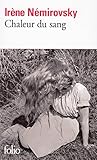
“Chaleur du sang” by Irene Nemirovsky -Writing full of poignant insight puts others in the shade

This is my review of Chaleur du sang (Collection Folio) by Irene Nemirovsky.

After years of wandering in exotic places, dissipating his inheritance on unsuccessful schemes which leave him unable to repay debts to his kindly relatives Hélène and François, and forced to sell land to the miserly old Duclos who has married the young, penniless possible gold-digger Brigitte, Silvio has returned to his home village of Issy-L’Évêque in Burgundy, where the author herself once lived briefly in the 1930s.

Observing the world with a shrewd and cynical detachment, Silvio suspects that Colette, the vivacious young daughter of Helene and François may regret her marriage to Jean, the sensitive young miller. When Jean is found drowned after an inexplicable accident, a chain of events is set in motion, revealing the passions which lie beneath the surface of a closed, conservative community whose members maintain a rock-like solidarity to suppress any whiff of scandal: keeping up appearances, guarding one’s privacy and leading a quiet life are more powerful driving forces than admitting the truth and ensuring that justice is done.

This short novel hooked me from the first page. It is a psychological drama written with great clarity, which I believe has been retained in the English version. Irene Némirovsky is remarkable both for her insight into human nature and her acute sense of culture and place. Without having experienced life in a French village, one is convinced of the truth of her perceptions, as when Silvio describes how the bourgeoisie, from which he comes do not stand out from the ordinary people in their attitudes, working their land and not giving a fig about anyone else. Living behind their triple-locked doors, their drawing rooms may be stuffed with furniture, but they live in the kitchen to save on fuel. In another evocative scene, Silvio captures the beauty of nightfall – the subtle change and reduction in colours, “ne laissant qu’une nuance intermédiaire entre le gris de perle et le gris de fer”. But all the outlines are perfectly sharp: the cherry trees, the little low wall, the forest and the cat’s head as it plays between his feet and bites his shoe.

Laden with nostalgia, the story contrasts mature, companionable love with “the fire in the blood” of youthful passion, posing the question as to which of these states is more “real”, and necessary for us to have lived to the full. How often does love make us lie to each other, and delude ourselves? When reminded in old age of past passions, how can we deal with feelings of regret and jealousy.

It was neither the somewhat stereotyped characters nor some contrived incidents that disappointed me initially, but rather the abrupt and unexpected ending. However, since the novel was not discovered until 2007, decades after the author’s tragic death in Auschwitz which denied her the opportunity to edit and complete it, we should be thankful that it survived at all and be impressed that what is probably a “first draft” should be so well-written and tightly structured, and have the power to absorb and move us so strongly. Also, the ambiguity of the last sentence leaves us free to speculate on the final outcome, on what the author intended to write next and adds to the sense that we may never fully know and understand each other in our complex and fluid emotions.

⭐⭐⭐⭐ 4 Stars

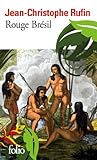
Rouge Brésil by Jean-Christophe Rufin – An intriguing tale stifled by verbiage – and at least two hundred pages too long

This is my review of Rouge Brésil by Jean-Christophe Rufin.

When Just and his younger sister Colombe are left by their soldier father in the care of an unscrupulous relative, she seizes the chance to send them off on an expedition to found a new French colony in Brazil, children being in demand as future interpreters because of their ability to pick languages up quickly. It is the mid-1500s, and France is keen to curtail Portuguese imperial ambitions in the New World, to gain access to resources, such as the red dye obtainable from Brazilian trees (hence the title) and to convert the savage Indians to Christianity. However, with the Reformation in full spate, what are they to be taught: the old Catholic faith, or which version of Protestantism including the extreme, apparently abstruse, doctrine of Calvin?

The crew on board ship are a motley bunch, including criminals and Protestants escaping persecution, including a crazed band of Anabaptists, so Colombe’s disguise as a boy probably provides much-needed protection. Once the pair’s aristocratic connections become known, they are taken under the wing of the charismatic but unstable commander Villegagnon, based on a real-life character. Having reached their destination in Guanabara Bay, the site of the present-day Rio de Janeiro, Just readily accepts the life of constructing a fortress and learning how to defend it against future attacks. More reflective, Colombe who has been sent to learn the local Tupi language, identifies strongly with the Indians, living in harmony with nature and free from sterile wrangling over Christian rituals and doctrine.

With his experience as a diplomat and human rights’ worker, including a decade spent living in Rio de Janeiro, Rufin has researched the historical period in depth. This novel is a variation on a theme which absorbs him: the dramatic effects of the meeting between very different cultures, and the sense which many of those involved feel of being in a state of limbo, not clearly belonging to either.

Although Rufin creates a convincing impression of life on board ship, I found the first half of this book intolerably tedious. He no doubt intentionally adopts the formal, literary style of a nineteenth century classical novel, peppered with the authentic terms for items of clothing or parts of a ship, culled from histories of the sixteenth century. However, there are too many over-detailed or unnecessary scenes which could have been pruned down or omitted altogether. Colombe is idealised, and seems too mature and articulate for her age. Most of the other characters are caricatures, dialogues wooden and often the action does not seem far removed from a “Boys’ Own” yarn.

However, when the Calvinists whom Villegagnon has requested to assist him prove to be religious bigots, while Colombe’s experience of life with the Indians highlights the hollowness of so-called European “civilisation”, I began to find my interest engaged. It is as if, having waded through to the point where he wants to be, analysing cultural relations, Rufin comes into his own and his writing takes off, presenting points of view from all angles, with the irony becoming sharper. Yet he can never quite avoid straying into the corny or sentimental at the expense of his serious intent.

The descriptions of the landscape, the great bay with the distinctive sugarloaf mountain and forest teeming with unfamiliar vegetation and wildlife are very vivid. There is some thought-provoking philosophy, as when Pay-Lo, the wise old European conveniently gone native, enabling him to explain Indian thought to Colombe, justifies cannibalism. He likens it to the European habit of killing one’s enemies: to eat one’s enemy is merely a logical part of a life lived close to nature in which everything is recycled and returned to the earth to regrow. Rufin has sanitised and glamorised the lives of the Indians somewhat, but they are clearly underestimated by the Huguenots who decide that trying to convert them is as futile as the attempt to bring an antelope to the knowledge of Christ.

Despite the unusual and potentially interesting subject-matter, the novel is too long and laboured. I would have preferred a well-written history of the period.

⭐⭐⭐ 3 Stars

Still beating heart of darkness

This is my review of Notre-dame Du Nil by Scholastique Mukasonga.

The statue of the Virgin at the source of the Nile gives its name to the Catholic boarding school for the daughters of the Rwandan élite, located in the remote highlands to isolate them from any temptation which might jeopardise their destined role as good wives and mothers. Having said this, the spineless Mother Superior and creepy sidekick Père Herménégildé take the easy course of turning a blind eye to a number of dubious activities.

At first, the novel seems like an African take on Enid Blyton’s “Mallory Towers”. As the girls return at the start of a new term, we see a dust-covered Immaculée cadging a lift in her friend Gorettis’s chauffeur-driven car, having thought it best not to ride pillion on her boyfriend’s motorbike right up to the school gate. Frida, daughter of a flashily-dressed ambassador causes a stir with her brutally straightened hair, and full-skirted red dress to match the colour of a long, two-seater convertible in which she lounges, as if in bed. A primitive tribal culture lies uneasily just below the surface trappings of western-style materialism.

The presiding force is Gloriosa, secretly nicknamed “the Mastodon”, the domineering daughter of an important Hutu government minister, brimming with resentment over the enforced quota of Tutsi girls which prevents “the real Rwandis, the majority people, the hoe-carriers” from obtaining their rightful secondary school places.

After losing some thirty-seven members of her family in the appalling Rwandan genocide of 1994, author Scholastique Mukasonga could be forgiven for either rejecting any attempt to write about it, or for creating a novel of unbearable cruelty and violence. Instead, she has chosen to make satirical humour an integral part of her book, telling an interviewer that irony is a fundamental characteristic of her Tutsi culture, even in adversity. Her aim is to act as a “memory bearer”, to help readers understand what happened, as a way of mourning and a “homage to the dispossessed”. In this respect, humour creates a certain distance from the raw horror without belittling the suffering.

Despite the tongue-in-cheek tone, there are hints of menace from the outset. The photographs of the famous inauguration of the Virgin’s statue have been hidden away, the features of most of the dignitaries struck out with red ink – because they were Tutsis. Tension builds towards a final grim climax, as Gloriosa hatches a ludicrous plan to replace the statue’s Tutsi nose with a Hutu one. This reflects the white colonialist’s ill-judged role in emphasising the beauty and past nobility of the Tutsi minority, to the irritation of the majority of more stockily-built agricultural Hutus.

Dialogues often seem unnatural and the storyline to meander in a series of unconnected incidents, some banal, such as the stir caused by a hippy white male teacher’s long flowing hair, others bizarre such as the eccentric coffee planter M. de Fontenaille’s obsession with making Veronique and her friend Virginia, the bright girl from a rural Tutsi background, into reincarnations of former Tutsi queens. There is also a touch of “magic realism” in say, Virginia’s dealings with the sorcerer from whom she seeks advice on how to propitiate the queen whose spirit she is disturbing by assuming her identity.

Although this book “speaks for itself” if one reads between the lines, I would have found a postscript to explain the political and social background useful. I would also have liked a glossary of the Kinyarwandan words used, since the meaning is not always sufficiently clear in context, and I struggled to find definitions on line. Yet despite reservations over the story’s style and structure, the author’s first-hand knowledge and understanding of her culture and the events which led to the crisis give the novel a kind of authenticity and sobering food for thought which cannot be gainsaid.

⭐⭐⭐⭐ 4 Stars

Katiba by Jean-Christophe Rufin – Between two worlds

This is my review of Katiba (LITTERATURE FRA) (French Edition) by Jean-Christophe Rufin.

Published in 2010, this political thriller is prescient as regards recent terrorist attacks in France and the radicalisation of young Muslims. Author Jean-Christophe Rufin’s experience as a globe-trotting doctor, aid worker, diplomat and historian have made him a novelist interested in serious political and ethical issues, with the first-hand knowledge to weave dramas around them. Having enjoyed his book of short stories based on far-flung parts of the world, “Sept histoires qui viennent de loin”, I had high hopes of this political thriller named “Katiba” after the training camps for Islamist fighters in the remote desert areas of North Africa.

It was therefore disappointing to find that, after a dramatic opening chapter, the novel becomes quite clunky and disjointed. This is partly because the author has chosen to switch continually between different characters in various locations as a way of juggling several parallel story threads. At first Jasmine seems to be the key character, an enigmatic young woman whose half-Arab origins have not prevented her gaining a post in protocol at the Quai d’Orsay, the French Ministry of Foreign Affairs. Is anyone quite what he or she (although there aren’t many females in this book) seems, be it the charismatic Kader, an effective trafficker in drugs, cigarettes and arms, or Archie, the suave Director of Providence, the US-based private intelligence agency contracted to sniff out suspected Islamic terrorist plots? The one person we know to be working “under cover” is Dimitri, the disarmingly naïve young medic deployed to a Mauritanian hospital to spy on a possible cell of radical fanatics among the doctors.

Rufin can be quite long-winded and pedestrian over the banal details of an event, although the description of how to assemble a suicide belt makes compulsively shocking reading. In an attempt to create a sense of tension, he leaves some key points unclear for long periods, which can be confusing. Yet, when he chooses to enlighten us, there is too much reliance on having one character explain the situation to others, a device which is obviously for the benefit of the reader, when it would be much better, although clearly more of a challenge for the author, to reveal what is really afoot through dramatic scenes.

Admittedly, the plot builds up to a final climax, there are striking descriptions of the barren Sahara, which proved very accurate when I googled photos of it, and some perceptive observations, not least the recurring reference to the Senegalese proverb that “a dog may have four paws, but cannot follow two paths at the same time”. Yet overall, I found too many of the large cast of characters either stereotypes, or undeveloped. The complex, contrasting motivations of the key players were not explored in much depth, a missed opportunity.

On the other hand, this is a worthwhile read for practising one’s French and is also likely to divide opinion, so is a good basis for discussion.

⭐⭐⭐ 3 Stars

If Belphégor could speak

This is my review of La femme au carnet rouge by Antoine Laurain.

When bookseller Laurent finds a mauve handbag, presumably discarded by a thief since it contains neither purse nor phone, the personal possessions it still contains, not least a red notebook of quirky reflections, arouses his interest in the woman who owns it. Through a mixture of persistence, advice from his shrewd teenage daughter and sheer luck, he manages to discover her name, locate her address, even insinuate himself into her life. But will the real woman, perhaps tritely named Laure, live up to the imagined one? Will she be able to forgive an intrusion which has troubled some readers as obsessive to the point of seeming a little creepy?

What is essentially a light, whimsical romance with a somewhat contrived ending has frequent touches of humour or poignancy, and is given depth by some striking passages as when Laurent muses on the relevance to his life of a book title, “La Nostalgie du possible” Can one feel nostalgia for events which have never taken place – regrets for situations in which we are almost sure of not having made the right decision, as in a relationship?

References to real life writers may seem a bit pretentious at times, but I was interested to read about the writer and installation artist Sophie Calle, who may well have inspired this novel’s plot by her habit of following complete strangers without their knowledge in order to produce striking photographs of them. This led to the famous “Suite vénitienne” where she pursed a man to Venice, in a bizarre artistic inversion of male stalking of women.

An enjoyable read in French because of the flowing, musical prose, I would probably enjoy it less in English.

⭐⭐⭐⭐ 4 Stars