“Les Innocents” by Georges Simenon: “to undestand, but not judge”

Numbers differ according to which source one reads, but “Les Innocents” was the last of the 117 “romans durs” which Georges Simenon wrote in addition to the 75 books and 28 short stories featuring Inspector Maigret. In these “hard novels”, Simenon wished to create stand-alone stories with psychological depth, entering the minds of his main characters, exploring what factors had shaped them, how they behaved in extreme situations, how they reflected on their lives in terms of success, failure, and the point of it all. Although his “romans durs” were admired by writers like Gide or Mauriac, other critics questioned the quality of novels produced at such speed and frequency.

In “Les Innocents”, based in Paris, Georges Célerin is a successful jeweller, a skilled goldsmith with a flair for design, who at times can hardly believe the intense happiness of twenty years of marriage to Annette. Dedicated to his work, he accepts her insistence on continuing her social work, caring for the aged poor, because she wishes to maintain her independence. Their two teenage children give no cause for concern, and the burden of domestic tasks is shouldered by their former live-in nanny, now housekeeper, Nathalie. This idyllic life is shattered when a policeman appears in his workshop, with news that Annette has been killed – running across the road, she slipped and was crushed by a lorry.

Grief-striken, Célerin is forced to reflect on his marriage. Gradually, he comes to realise that he did not know his wife, but it is clear that he loved her far more than vice versa, while in his obsessive focus on his wife, he did not pay his children sufficient attention. In short, this is an example of the lack of communication between a man and a woman, which was so often a theme of Simenon’s work. How will Célerin react when by chance he is driven to find out for himself what on earth she was doing in the locality where she met her death, and so confront the truth?

Simenon was a gifted storyteller, weaving insights and a strong sense of place into the often banal events of ordinary lives. He is good at building up tension, and if he sometimes disappoints one by diffusing it, this may prove plausible, as in real life. Perhaps assisted by his early employment as a journalist, including as a crime reporter, he made a conscious effort to write in a clear, concise style to engage the reader. This is most evident if read in French, by comparison with the flowery phrases often found in this language. My only criticism is that in dialogues it can be hard to be sure who is talking.

The most fascinating aspect in all this is Simenon’s own personal life, so much more complex and intriguing than, for instance, this plot. In reality, he had not only affairs, but a chain of much younger mistresses, living with him and his wife for long periods (not to mention bearing his children), or holidaying with him and each other at the same time. In his novels, he clearly took particular situations from his own life and developed them. His stated aim was to understand without judging, but it is hard either to understand or fail to judge the convoluted transgressions of his life.

Germinal by Zola: a marathon read worth running

When Zola died in 1902, crowds of workers hailed his funeral cortège with cries of « Germinal », the best-selling novel which is probably his most famous work. This was based on the meticulous research conducted in 1884 when, formally dressed in frock coat, high collar and top hat, pen and notebook in hand, he descended into a coalmine belonging to the Anzin company in the Pas-de-Calais region of France, in order to assess the working conditions which led to a prolonged and unsuccessful strike.

A journalist before achieving sufficient success to support himself as an author, Zola had known great poverty as a child, after his father’s premature death, and as an unemployed young man who had twice failed his baccalauréat. Perhaps the experience of inequality triggered his strong social conscience. This was combined with a firm conviction that people’s lives are determined by a mixture of heredity and their environment. We see this in the principal character in Germinal, Étienne, the idealistic but naive newcomer who is carried away by his inherited impulsive, addictive personality to become the leader of a doomed strike. While conveying vividly the hardship and injustice suffered by the mining families, Zola continually shows how they have been brutalised by this: casually promiscuous, quick to take advantage of each other and capable of cruel acts of vengeance.

The novel opens with a dramatic description of the mine at night as first seen by Étienne. Zola portrays it as a kind of monster, literally swallowing up the miners as they descend for their shift. The descriptions of the working conditions are truly appalling : long, dangerous trudges and climbs deep underground to the coal seams, drenched with water as they hew the coal, risk of fire damp explosions, unfair pay cuts when they fail to meet impossible targets to both install the pit props to protect themselves and bring enough truckloads of coal to the pithead. The food is so scanty and poor, the exhaustion so intense, the patronising support available so inadequate and unreliable, hardships and misfortunes for some pile up to such a weight that one wonders how the mining community can survive at all. The comparisons with the pampered lives of the families of the mines shareholders and senior staff are shocking.

There is a powerful metaphor in the huge percheron, the draught horse brought down as a foal to drag containers filled with coal along tunnels to the pithead, which becomes blind through lack of light, can only dream of the sunlight, and eventually dies underground, to be buried there.

Events often seem exaggerated or far-fetched, and many characters, particularly the wealthy, highly stereotyped. The frequent detailed descriptions filled with technical terms for the mining operations are hard to follow, especially in the original French if not one’s first language. So reading all five hundred and forty odd pages of it (or even more in some editions) requires a marathon effort. One can grow inured to so much intense suffering, and the touches of ironic humour cannot compensate for this.

Produced originally in instalments for a magazine over a period of about four months, now the novel seems too long, at times repetitive, and in need of a firm edit, reflecting the lack of alternative media at the time to distract people from reading it. Yet, it is the kind of classic novel which lingers in the mind, provoking thought. If possible, it is best to read the novel in its original langage to experience the full impact.

The novel ends on the optimistic note, that the miners, forced back to work but their spirits unbroken, will, like seeds, produce future generations who are able to rise up and claim their rights – a belief , yet to be realised, which has inspired the causes of socialism and reform. Hence the title, for Germinal was the seventh month of the French Revolution’s revised calendar, intended to evoke the idea of seeds of equality growing in fertile ground.

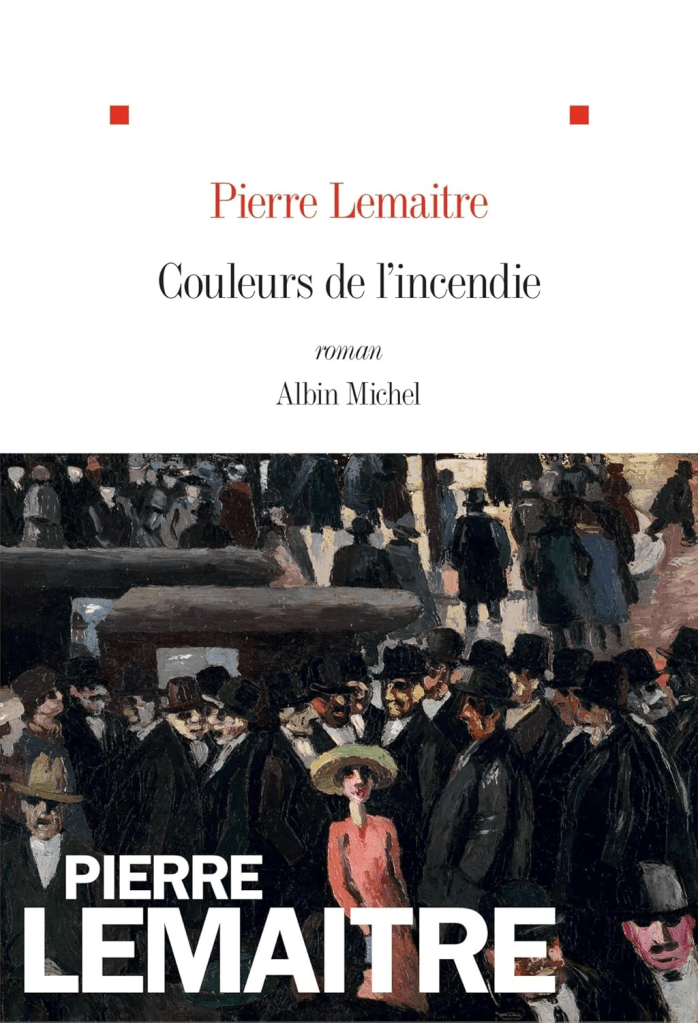
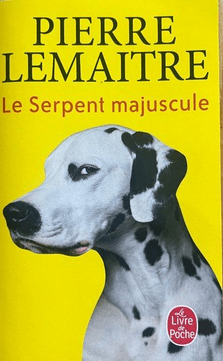
Le Serpent majuscule (The Grand Serpent) by Pierre Lemaître – Should fictional cruelty be kept within certain limits? Discuss!

Pierre Lemaître became an internationally bestselling author on the basis of his ingenious if far-fetched, macabre, “romans noirs” crime fiction. So his switch to historical novels via “Au revoir là-haut” (The Great Swindle) did not please all his fans. The decision to publish in 2021 Le Serpent majuscule (The Great Serpent), his first novel, written in the nineteen eighties, is apparently an attempt to make amends.

With only minimal editing, this “rings true” for its period. It’s a world without mobile phones, social networks, surveillance cameras, centralised computer records and advanced use of DNA: in short all the sophisticated technology now available to trap a serial killer.

The interest in psychology which runs through Lemaître’s work is already evident in this first novel, focused on the two main characters, Mathilde and Henri. These are psychopaths who applied their skills to a noble cause in the French Resistance, but whose ruthlessness in peacetime is channelled into contract killing for financial gain. For some, the suspense lies in whether and how Mathilde, with her alternating periods of mental astuteness and signs of dementia which make her an increasing liability for Henri to employ, will emerge triumphantly, escaping her just deserts.

Promoters of the book have no trouble in culling phrases from reviewers, like Le Figaro’s, “Délicieusement immoral”, but as his “Avant-propos” or foreword shows, Lemaître is keenly aware of many readers’ reservations over his casual erasure of characters to whom they have become attached, and he seems perhaps surprisingly anxious to defend himself. I take his point that misfortune and bad luck are “what happens in life”, so why fight shy of including them in a novel? He also argues that since it’s predictable that crime novels will contain bloodshed, perhaps sensitive readers should simply avoid them.

Overall, Le Serpent majuscule repelled me with the sheer degree of its clinically described gratuitous violence, wreaked not only on fellow-villains but also on the few decent and potentially interesting characters. The dispatch of individuals by shooting or bludgeoning, be it for unexplained reasons, in error, or as “collateral damage” in the course of pursuing another target, became tedious. Mathilde’s confused and contradictory thoughts became repetitive. Between the bursts of brutality, the narrative drive often seems plodding.

Apart from the obligations of a French book group deadline, what kept me going was the chance to learn some more of the idioms and ”argot” with which this novel is peppered in the French version.

I may persist with the historical trilogy, “Les enfants du désastre” which starts with “Au revoir là-haut” set in the First World War and its aftermath in France. This would seem a less unedifying use of one’s time, also displaying better Lemaître’s development as a writer.

Je l’aimais or Someone I loved by Anna Gavalda

A mother of two little girls, Chloé is devastated by her husband Adrien’s abrupt announcement that he is leaving her – taking a flight to be with a mistress of whose existence Chloé has been totally unaware.

Surprisingly, Chloé seeks the support of Adrien’s parents, despite the fact that her father-in-law Pierre seems unlikely to be sympathetic – an undemonstrative man whom Adrien and his sister Christine have always criticised for his harsh, uncaring treatment of them as children. It therefore appears odd that Peter should insist on driving Chloé to the family’s holiday home where she may feel calmer. I suspected that this would be the cue for an imprudent romance between the unlikely pair. Far from this, Pierre uses their seclusion as an opportunity to unburden himself to Chloé. He confesses to a passionate longstanding affair which he had to give up years earlier out of a sense of obligation to his wife, who refused to divorce him since it would have meant a loss of material benefits and status. His message to Chloé is that, in abandoning her, Adrien is not only displaying a courage which his father lacked, but also giving her the freedom to embark on a new life.

It seems that the author had experienced a recent divorce, so that perhaps the writing of the novel was cathartic. However, Pierre’s argument seems both overly simplistic and highly debatable.

This debut novel by Anna Gavalda which has proved the first in a string of bestsellers, is distinctive in being written in a play-like format, almost totally dialogue, with no real plot and little context. The downside of this is that, too often, one has to stop and check who is speaking. Otherwise, it’s a relatively easy read for someone learning French. However, the lack of context and action reduces one’s ability to engage with any of the characters.

Situations are gradually revealed or implied through the dialogue, until roughly halfway through, Pierre becomes the main character, indulging in a monologue of “telling” which becomes tedious in its repetition. Meanwhile, Chloé’s plight recedes into the background and is left unresolved.

Initially, Chloé’s emotions are portrayed realistically, together with her relations with her children. Pierre seems a less convincing character. Many of the situations described seem somewhat clichéd.

Made into a film in 2009, this tale may have found a more effective format, but the novel lacks depth and one does not feel much sympathy for any of the characters when it reaches its limp conclusion.

“Gros-Câlin (Big Hug) by Romain Gary as Émile Ajar: Crushing defeat

Not content to have been France’s most popular author in the past, Romain Gary resolved to restore his flagging reputation, regain critical acclaim and win for a second time the Prix Goncourt which is only supposed to be awarded once to the same person, by resorting to the ruse of writing under a pseudonym, as Émile Ajar. The publisher Gallimard was prepared to go along with this, and no one else seemed to notice that “Gary” sounds like “burn” and “Ajar” like “embers” in Russian.

Ajar’s first novel, published in 1974” was “Gros Câlin”, or “Big Hug”, the quirky tale of “M. Cousin”, a lonely, Parisian statistician, who purchases a pet python, which will give him the physical contact he craves, and bring him into contact with people drawn by curiosity. Feeding Gros Câlin soon becomes a problem, since his diet of living mice distresses Cousin, particularly as regards a pretty white mouse which he names “Blondine” and resorts to keeping in a box on a shelf out of the python’s reach. When he confides in a priest, he receives the cynical advice to buy a lot of mice to make them seem anonymous and easier to kill, rather like fighter pilots in the war, who found it less disturbing to bomb from a great height people they didn’t know.

This satirical humour may not prove enough of a distraction from the essential poignancy of Cousin’s chronic inability to relate to others, and to read social situations correctly. In the Metro, he chooses to sit right next to the only other occupant of the carriage, with no concept of behaving oddly and invading a stranger’s personal space. At work, he is convinced that Mlle Dreyfus, a work colleague, is in love with him simply because she greets him regularly in the lift, and imagines that they will soon get married.

This novel proved so successful that Gary had to persuade his cousin Paul Pavlowitch to impersonate him in interviews. However, perhaps because I read this in French, I could not fully appreciate all the literary allusions, puns and misuse of words which French readers apparently find so clever and entertaining.

Lacking much of a plot, the narrative soon began to feel repetitive and tedious, particularly as regards Cousin’s visits to prostitutes, which are described in sordid detail, suggesting Gary’s bias toward defending this way of life. The descriptions of Mlle Dreyfus, who comes from Guyana, struck me as being, if unintentionally, somewhat racist.

Towards the end, the novel becomes somewhat surreal, with Cousin appearing to have been driven mad, which like “But it was all a dream” may seem like a cop-out. There are a few interesting observations, like the fact that it might be useful if, like a python, a human being could simply shed his skin periodically to achieve a kind of “rebirth” – also a metaphor for Gary achieving renewed success by writing under an assumed name.

Describing Cousin’s sense of isolation may have been an outlet for Gary’s own state of mind, for only a few years later in 1980, the author shot himself – having left a note for his lawyer to reveal the true identity of Ajar.

Impact by Olivier Norek: jury out on un thriller écolo

A bestselling French author of crime fiction, Olivier Norek was also a scriptwriter for the addictive television series “Engrenages” or “Spiral” in English. In “Impact”, he has chosen to use a thriller as a vehicle for confronting us with the extreme consequences of climatic change, particularly in parts of the world little known to those most responsible for aggravating the problem. His serious purpose, perhaps fed by years spent as an aid worker, is indicated by the references supplied at the end to support every adverse effect described.

His opening chapter sets the tone with a graphic description of the Niger delta, where leaking oil pipes have polluted the land, forcing the evacuation of the local population to a coastal “bidonville” shanty town. The bodies of the many who have already died are burned, presumably to prevent a greater pollution at the price of a lesser one, not to mention the lack of humanity involved. Subsequent digressions transport us to a range of far-flung places under pressure, like northern Siberia, where hungry polar bears forced southwards by the melting of ice caps terrorise the residents.


Already shaken by his experiences in Nigeria, soldier Virgil Solal is devastated by the loss of his infant daughter, only a few moments after her birth. Doctors assure him that despite living in the attractive district of Bercy Village, the foetus must have been fatally damaged by the effects of air pollution from the nearby ring road and cement works. This is the trigger for Solal to assume the role of an ecowarrior, heading up a direct action group, “Greenwar”.


This novel may well stir the emotions, prick the conscience and alter the mindset of readers. It may also prompt discussions which the writer did not intend.

The wildfires raging through the Hollywood Hills as I write, leaving a landscape reminiscent of Gaza, may prove to some that the scale of potential global catastrophe cannot be exaggerated. However, such scenes as the Indian family taking refuge on their kitchen work tops not just from the rising water but the snapping jaws of the crocodile lurking in it appear too far-fetched. Likewise, the rapid rise of a global cult, supporting Solal with his assistants dressed in panda suits with distinctive mock red facial scars seem improbable. We are assured of the effort to minimise the impact on the environment of printing this novel, but what about that of the mass production of the panda suits?

Solal’s murder of a kidnapped oil executive whose company predictably refuses to pay a vast ransom with major concessions is justified by him and legal defence as being nothing compared with the deaths due to climate change caused by fossil fuels. The suggestion that Solal’s actions will be sufficient to arouse mass movements to force change is unconvincing. The issues are oversimplified by the failure to present and adequately demolish where possible the counterarguments. Do the ends justify the means? Are the ends actually achieved sufficient? What about the complicating effects of overpopulation, or the understandable wish of less developed countries to “catch up”?

Do the somewhat two-dimensional, stereotyped characters, neatly divided into “good” and “bad” detract from the novel, together with the excessive contrast between moments of gimmicky horror and sentimentality?

It was good practice to read this in the original French, and although by turns irritating, disjointed and a little tedious in its repetition of calamities, Impact is thought-provoking. However, I would prefer to have read a John Pilger-style set of articles exposing the untrammelled capitalism, short-term approach, greed and lack of vision and strategy, to name only a few of the complex factors driving climate change.

“Continuer” by Laurent Mauvignier: “Travel not to escape life, but for life not to escape us”

Confronted by her teenage son Samuel’s delinquency, Sibylle decides on a drastic solution which she may well have been considering for herself: to uproot him from Bordeaux to a different culture, closer to nature, where he can learn “true” values, by trekking on horseback through the mountains of Kirghizistan. Selling with apparent ease a conveniently inherited house, she is able to finance this scheme, and set off, despite her ex-husband Benoît’s strong objections, and Samuel’ sullen resentment.

The novel proceeds in a series of dramatic incidents, some quite improbable, covered in great detail, often in a “stream of consciousness” style which can become oppressive in its repetition and intensity. Events are punctuated with flashbacks including the rather hackneyed use of dreams, to reveal the past events of Sibylle’s life.

“Continuer” has been made into a film which apparently focuses on the relationship between mother and son, and the striking landscapes through which they travel, perhaps because these are the strongest aspects of the novel (despite the author reportedly not having set foot in Kirghizistan before writing it). But Mauvignier has sapped his theme with continual references to Sibylle’s underdeveloped backstory, some details of which have to be shoehorned into the somewhat rushed anti-climax of the ending.

“Continuer” seems to have been well-received in France, although I preferred Mauvignier’s earlier novel “Des Hommes” (“The Wound” in translation) which deals with the problems of coming to terms with the past faced by Frenchmen forced to fight in the Algerian war of independence. Both novels share what may be the hallmarks of his writing: distinctive style, unusual structure and inconclusive ending. Both novels convey a strong sense of place with minute descriptions of physical sensations, some of which can be absorbing, but in this case did not engage me fully.

“Tropique de la Violence” (Tropic of Violence) by Nathacha Appanah – hell in a corner of paradise.

This is a searing portrayal of Mayotte, the small island off the coast of Africa in the Indian Ocean, a far-flung remnant of the French colonies, sharing the status of “Department” in name alone with those in mainland France. This is a land of brutal contrasts: a little corner of paradise for tourists with its white sandy beaches and lush scents of flowering hibiscus and frangipani on one hand, on the other the hell of the shanty towns like Kaweni, nicknamed Gaza with tragic prescience. Here gangs of youths roam and steal, high on drugs, while the population is swollen  by the “clandestins”, immigrants “sans papiers” who  mistakenly see Mayotte as an easy backdoor route into France.

Moïse  symbolises the plight of an individual in limbo between two cultures.  He is the son of a young illegal immigrant who rejects him at birth for having two eyes of different colour, one black, one green. This dooms him to be branded a djinn, bringer of misfortune, symbol of the negative forces which bedevil the local community.  Yet his adoptive mother is an educated white woman whose untimely death leaves him ill-equipped to deal with harsh reality.  While he wishes to be accepted into a gang of disaffected black youths,  they only see him as a spoilt little rich boy, to be fleeced of his cash for them to spend on drugs and mocked for his natural politeness and, for them, ludicrous consideration for his pet dog.

The vivid descriptions of Mayotte and well-observed characters studies to some extent offset some scenes of extreme violence, which at times seems gratuitous. The author succeeds in arousing our sympathy even for the gang leader Bruce who has been brutalised by his own experience of rejection, and seems driven by jealousy of the privilege which Moïse enjoyed and took for granted in the past.

Highly praised, this book is worth reading,  particularly by those with little knowledge or understanding of the issues involved, although  it makes its key points early on, so that the agonising account of  Moïse’s predicament becomes somewhat repetitive,  even tedious.  My main criticism is that the different viewpoint adopted in each chapter includes characters who are clearly dead, but hover in spirit form, commenting on the scene in question. This may reflect the superstitions of the native culture, but felt like a surrealistic device too far.

I was intrigued by the possible ambiguity of the ending, left unsure whether it was a sad, but predictable because inevitable outcome, or if I was meant to read into it an ironic clever twist.

This has also been made into a film.

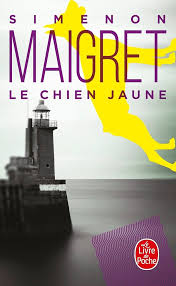
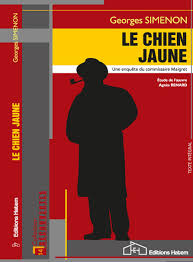
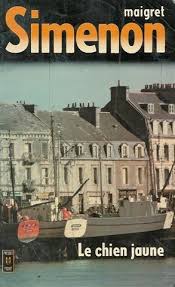
“Le Chien jaune” (The Yellow Dog) by Georges Simenon – promising but Simenon not at his best

Maigret needs no introduction, and the choice of “Le Chien jaune”, popular enough to be made into a film only a year after its publication in 1931, seemed a promising choice for a French book group.
It began well, with a customs officer observing the murder by an invisible assassin of a well-liked wine merchant shortly after he leaves a hotel bar. Summoned to investigate, as Maigret sits in the bar, he witnesses an attempt to poison the dead man’s colleagues. Meanwhile, a yellow dog, origin and owner unknown, has begun to lie by the till.

There was general agreement that Simenon shows once again his gift for capturing the ambience of a place, in this case the Brittany fishing port of Concarneau, which in the early 1930s may well have been the kind of provincial, inward-looking community where fear and prejudice could easily be aroused and manipulated. The impact of the journalists, descending en masse from national newspapers and bent on sensationalising events, is well portrayed.

However, there is something lacking. Most of the characters seem quite wooden, stereotypes or caricatures, while the plot plods through a disjointed series of events, with some of the most dramatic scenes described by third parties.

There is too much reliance on implausible scenes, as when Maigret and Leroy just happen to be sitting on the hotel roof when an intriguing meeting between two characters is visible through a nearby window. Maigret’s public admission of a criminal act for which he is never charged, and turns out to have made to protect a suspect for whom he feels sympathy, is also ludicrous.

Maybe this is unfair, in that Simenon, arguably the French (he was actually Belgian) equivalent of Agatha Christie, was a pioneer in making detective fiction highly popular. By creating Maigret as such a flawed character, needlessly brusque, uncommunicative and high-handed, perhaps he set the trend for dysfunctional but talented detectives. In this case, Maigret’s talent seems hard to justify: while informing his hapless sidekick Leroy that he is acting on intuition rather than following procedures, the fact that he could in no way have deduced so accurately and then explained the details of the complex crime so clearly in the usual “denouement” scene leaves the reader feeling a bit cheated.

If detective novels have become so much more sophisticated and dramatic in recent decades, do we still want to read about Maigret? Credited with having written more than 400 novels, Simenon’s many “romans durs” (hard novels) like “Le Train” or “Le Chat” seem to have more merit: psychological novels with tight structures and clear, spare prose, a wide range of themes and contexts and “real” characters.

Simenon’s extraordinary life is also more gripping than this encounter with Maigret.

“The Honorary Consul” by Graham Greene – reaching the heart of the matter?

Set in Paraguay, presumably in the early 1970s since there is a reference to President Nixon, the central character proves not to be the “Honorary Consul” Charlie Fortnum, an alcoholic whose life revolves round “the right measure”, just enough whisky to blur reality without becoming unable to function. It is rather the “young” Doctor Eduardo Plarr, who seems quite middle-aged in his cool, cynical assessment of the world, and avoidance of emotional involvement when seducing other men’s wives, between visits to the local brothel. This is while clearly being a dedicated doctor, caring for the poor in the town he has chosen to inhabit, on the border with Paraguay. This seems to be the key to his detachment, stemming from the childhood trauma of having to escape with his mother to safe exile in Argentina, with his last memory of a father refusing to accompany them, preferring to risk long-term imprisonment as a political dissident.

The slow-paced novel focuses initially on the often mundane details of Plarr’s daily life, leaving readers to deduce some of the most dramatic events, to the extent that we keep thinking some vital point must have been missed. So it turns out that, motivated by an apparent opportunity to get his father out of prison, Plarr has collaborated with a group of political activists he happens to know from his school days. He has provided vital information for a plot to kidnap a visiting American ambassador, a valuable bargaining counter in negotiating the release of political prisoners, hopefully including Plarr’s father. This is in contradiction to the fact that we have been given to understand at the outset that Plarr’s father is already buried somewhere in Paraguay.

It soon becomes clear that the scheme has been bungled, with the far less valuable Charlie Fortnum captured in error. Plarr is faced with the practical and moral dilemma of how far to go in trying to remedy the situation, his motives complicated by the fact that he is having an affair with Charlie’s wife Clara, a former prostitute whom the Consul has married, to the disapproval of his social circle.

“The Honorary Consul” has been described as one of Graham Greene’s finest novels, and was apparently a favourite of his amongst his own works. So I was disappointed to find it wanting in comparison with his “The Quiet American”, to which I turned recently with relief as an antidote to some over-hyped, overlong current bestsellers.

If you are familiar with “The Quiet American”, you will see parallels in the two stories: Plarr and the cynical journalist Fowler; well-meaning but flawed Fortnum and the naïve young American Pyle; the local women Clara and Phuong, dependent on men to give them security, and so on. However, whereas the former conveys a powerful sense of place, and the culture of 1950s Vietnam, together with a strong development of the main characters, and the narrative drive which reveals their mixed motives, “The Honorary Consul” is less absorbing. This may be because the places, like the town where the story is mainly set, which Greene left unnamed “so as not to be tied down” are portrayed less vividly. The characters seem less convincing, more two-dimensional or caricatured. Written in the third person, there is too much of a tendency to “tell” readers about events (in a disjointed fashion) rather than “show” what they might deduce for themselves.

The drama of a potentially tense climax leaks away: while the survival of everyone directly concerned hangs in the balance, Plarr and Father Leon, the lapsed priest leading the band of kidnappers, indulge in lengthy, incongruous philosophical discussions about having, or renouncing, the Catholic faith in which they were brought up. Perhaps this is meant to be more of a novel of reflection on conflicting ideas and reactions, rather than a tense psychological drama, but with the added element of cynical farce, the reader is pulled simultaneously in too many directions.

Another interesting aspect is the extent to which the male chauvinism, bordering on misogyny, may have been an aspect of Greene’s own personality. Charlie’s wife Clara is portrayed as a sweet young woman who seeks to please men in exchange for what they are prepared to give her. Yet at their last meeting, she seems to be expressing a genuine love for Plarr which he is too emotionally damaged to return. Is it possible that he really does not take in the crucial question she asks him, because he thinks that “The only questions of importance are those which a man asks himself”?

With eighteen years between the publication of these two novels, and Greene approaching seventy when “The Honorary Consul” appeared, did he lack the motivation to hone the latter to realise its full potential? Perhaps one needs to know and care about Catholicism to appreciate what seems like a digression from the other moral questions and human failings that this novel seeks to portray and explore – but somehow fails to get to “the heart of the matter”.