“The Salt of the Earth” DVD – The all-seeing eye

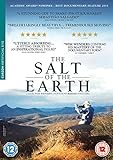
This is my review of The Salt of the Earth DVD.

Wim Wender’s documentary on the life and work of the Brazilian photographer Sebastião Salgado holds the audience speechless and spellbound by the artistry, beauty yet often bleak evidence of man’s inhumanity in his pictures. Starting with incredible shots, all the more striking for being black-and-white, of miners swarming like ants on ladders to scale the steep, irregular face of a goldmine, the film goes on to show the various stages of his career. The scale of the forested valley and hills round his family’s farm may have formed his love of landscapes, where he has sought out self-sufficient communities, from Amazonia to Siberia, and won their confidence, enabling him to show them living in close harmony with nature. Another of his collections of photojournalism produced with his wife, focuses on different aspects of employment round the world.

A sensitive man, made aware of injustice through the harshness of the authoritarian military regime which forced him and his wife into exile in their youth, he was inevitably drawn to cover the sufferings of those forced by brutal war to become refugees. Uncensored photos of African victims are particularly harrowing, so it easy to understand why he became depressed by man’s capacity for cruelty, and turned to the animal world, with amusing scenes of his dedication, as he and his son roll over stony ground to catch walruses unawares, rearing up to clash their tusks in the misty dawn. “Genesis”, a wide-ranging project “dedicated to showing the beauty of our planet, reversing the damage done to it, and preserving it for the future” includes some breath-taking aerial shots.

With an innate confidence, he has taught himself the craft of different types of photography, aided by his artist’s eye – he explains at one point to his son how a shot will not work owing to the lack of a suitable background or “frame”.

We see the personal cost of his work, with long periods away from his wife who was left with the care of a Downs Syndrome son, while he seemed like a stranger to his older boy in his early years. The restoration of Salgado’s family farm by the replanting of trees to replace the deforestation and erosion is also inspiring – presumably made possible at least partly by his book sales.

His portrayal of the dignity and pathos of displaced people arouses a deep sense of unease over the handling by the West of current migrations into Europe and by our materialism which aggravates the problem, to which there is admittedly no simple solution.

⭐⭐⭐⭐⭐ 5 Stars

The Gift – Cutting the Gordian knot

This is my review of The Gift [Blu-ray].

This well-acted psychological thriller, original in its unpredictable plot, manages to build a sense of menace through a threatening atmosphere rather than brutal violence. It is like a subtle version of a Hitchcock film.

In the opening scenes, Simon and Robyn appear to be a happily married, affluent couple in the process of moving into an up-market house in the Californian hills – attractive if you don’t mind the sense of exposure from surrounding trees pressing in on the expanses of floor-to-ceiling windows. A chance meeting with a former schoolmate Gordo, whom Simon does not at first recognise, is the dramatic trigger. As Gordon becomes increasingly intrusive with his uninvited appearances when Robyn is alone, and his over-generous yet unwanted gifts, Simon indulges in very realistic, jokey conversations with their new circle of friends over how to deal with “Weidro Gordo” whereas the more sensitive Robyn feels sympathy for him. Gradually, Simon is revealed as dominant and ruthlessly ambitious, Robyn appears vulnerable, possibly disturbed and dependent on her husband’s protection. How well does she know the man supposedly so close to her, and can she trust him? What is the truth? What makes some people winners and others losers? What exactly is “the gift” of the title?

Although as is often the case, aspects of the denouement are unclear or even implausible, the ending is very effective in leaving matters open to the viewer’s individual interpretation, and even in playing with one’s emotions to switch sympathy in inexpected directions.

A film to which I brought low expectations turned out to be gripping and thought-provoking. I was also interested to note that the excellent actor, Joel Edgerton, who plays Gordo was also writer, producer and projector for the project.

⭐⭐⭐⭐ 4 Stars

Turkish Mike Leigh

This is my review of Once Upon a Time in Anatolia [DVD].

Three carloads of Turkish policemen with accompanying prosecutor, doctor, diggers and two hand-cuffed prisoners arrested for murder search the bleak Anatolian countryside for the victim’s grave. It is dark, perhaps because the prime suspect has already been leading them on a wild goose chase for some time. Another possible reason is the pure incompetence of the police which often borders on comedy, together with the lack of resources to do their job effectively – this being the complaint of others encountered on the way.

In the course of a night and the following day, we are given an insight into Turkish life. We learn much about the characters’ attitudes through their banter and confidences, and their facial expressions in some fine pieces of naturalistic acting. I was reminded at times of Mike Leigh, in the authentic scenes which could well be based on improvisation. The dialogue is often quite like a stage play, with little action, for which the subtitles are sometimes barely adequate.

My main problem is the extremely slow pace, with the film taking two-and-a-half hours, which would have been transformed for me into a much more powerful work if reduced by at least sixty minutes. Also, vital information on the motive for the murder is delivered so quickly that I had to check the plot summary on Wikipedia to confirm what had happened.

So, although this is a plot with great potential, well-acted with striking photography I cannot give it more than 3 stars.

⭐⭐⭐ 3 Stars

Agonising vicious circle

This is my review of The Outcast [DVD].

I do not know how close this film is to the original novel, but it is a vivid and moving portrayal of how a tragedy can turn a lively and appealing ten-year-old into a violent delinquent. Nowadays, Lewis Aldridge would receive counselling and therapy, which might not necessarily work, of course. However, in the stuffy convention of England in the 1940s-50s, his traumatised inability to account for the tragic incident makes him an object of suspicion, even for his father Gilbert. It does not help that, recently returned from the war, Gilbert is a virtual stranger to his son, and that his uptight inability to abandon his stiff upper lip makes him unable to show the boy any natural emotions of love and sympathy.

It is agonising to see how Lewis’s life spirals inexorably out of control, and to doubt that the tale can ever reach a positive conclusion. Problems are compounded by his relations with the neighbouring family of Gilbert’s boss, who are in their respective ways even more dysfunctional than the Aldridges, hiding their problems behind masks of well-heeled respectability.

Although some scenes are a little clunky, and I could have done with subtitles to catch all the dialogue, the film is very powerful in arousing empathy for Lewis as he is repeatedly misunderstood and driven into a downward spiral. It could be that the unrelenting nastiness of some characters is a little exaggerated, and the inhabitants of Waterford somewhat stereotyped in their prejudices, but it is a compelling drama, evocative of a bland, stuffy 1950s which could drive bored housewives to drink.

⭐⭐⭐⭐ 4 Stars

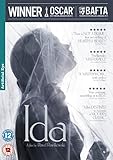
Ida – Avoiding the truth

This is my review of Ida [DVD].

Demure, unaware of her sexual appeal, eighteen-year old Ida is about to take her vows as a nun. Brought to the convent as an orphan, she knows nothing of life in the outside world. The Mother Superior insists that Ida visits her sole remaining relative, who turns out to be a chain-smoking, hard-drinking, promiscuous and clearly embittered Communist woman judge. Ida is introduced abruptly to a corrupt, secular world, lightened by the lure of soulful jazz, dancing and handsome band players. She also learns about how her parents died, with all this symbolises of the dark side of recent Polish history. Will she be destroyed by these new experiences? Can she return to life as a nun?

Visually slow-paced, in what may be an East European tradition, yet covering events in brief fragments, this provides what seems to be an authentic picture of Poland in the early `60s, the black-and-white photography adding to the impression of general poverty and contradictions of a strongly rural, Catholic society under an imposed atheist Communist regime. The film exposes some of the unresolved conflicts in a troubled, occupied post-war country.

This subtle film, which reveals its story gradually, deserves the praise it has attracted, even if the ending is initially disappointing.

⭐⭐⭐⭐ 4 Stars

Tamed by experience

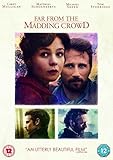
This is my review of Far From The Madding Crowd [DVD] [2015].

Visually beautiful, well-acted with some impressive recreations of harvesting by hand in golden cornfields or quenching a conflagration in a barn, this latest filming of Thomas Hardy's classic did not live up to my hopes. Perhaps my memories of the lovely Julie Christie in the role of the headstrong landowner Bathsheba Everdene and the fatally attractive Sergeant Troy in the shape of Terence Stamp make this disappointment inevitable. Yet I was prepared to give this film a chance.

Reviewers have criticised Belgian Mathew Schoenaert's English – which I thought was rather good. It bothered me more that none of the main characters had any trace of a Dorset accent. Perhaps because of the need to cram a complex story into two hours, the storyline proceeds in rapid, jerky steps with no time for development of situations and characters. Director Schlesinger's much longer 1967 film, made practicable by the convention of an interval, had the benefit of more scope to establish these aspects. I missed the originality of the earlier film, from which, for instance, I still recall the surreally tragic transport of the coffin of a young girl who has died in childbirth as seen through the eyes of the drunken carter. The wild coastal landscape also seemed to play more of a part in the first film from the memorable opening shots. It is worth making comparisons with the 1967 film of which a digitally enhanced version is scheduled for release in June 2015.

I accept that the new version may provide sharper insights into the issue of female equality and fulfilment in a society where convention demanded that men proposed marriage to women they barely knew, taking it for granted that they would play a subservient role in their husbands's lives. Yet it is more romantic and soft-centred, insufficiently moving, leaving little doubt from the outset which of the trio of stalwart shepherd Gabriel Oak, repressed beneath his suave exterior landowner Mr Boldwood and sword-flashing cad Sergeant Troy will ultimately prove to be the successful rival for Bathsheba's hand.

⭐⭐⭐ 3 Stars

Whose side do you take?

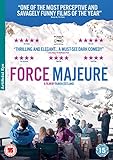
This is my review of Force Majeure DVD.

Tomas and Ebba, a Swedish couple whose marriage may already be under pressure, take their two young children on a ski trip to the Alps. When a controlled avalanche exercise goes awry and seems to pose a serious threat, Tomas thinks only of saving himself. Ebba is shocked by the incident, but even more so by her husband's inability to admit to his action. By turns humorous, moving or cringe-making, the ensuing chain of events dissects human relationships – marriage, family, gender roles and friendships. The film may also intend to explore Swedish inhibitions over expressing emotions, which were apparent to me forty odd years ago, although times may have changed, but this aspect may not be clear to a non-Swedish audience.

"Force majeure" is a common clause in contracts that essentially frees both parties from liability when an extraordinary event or circumstance beyond their control prevents one side or the other from fulfilling their obligations. The film's title is therefore ambiguous. Does it refer to Tomas's failure to act as expected of a husband and father? Or, does it relate to Ebba's extreme reaction to her husband's behaviour?

I enjoyed the brilliant beauty of the mountains under snow, the discussions which rang true, and the relevant, thought-provoking ideas raised. A few scenes did not quite work for me, such as the events of the last "Day 5" of the ski trip, but the ending is unpredictable, interesting and open to different interpretations.

⭐⭐⭐⭐ 4 Stars

A lot of formality

This is my review of A Little Chaos [DVD] [2014] [2015].

This period drama romance develops a fictitious episode in the life of André le Nôtre, famous landscape gardener employed by the capricious "Sun King", Louis X1V. Le Nôtre (played by Matthias Schoenaerts, at the time of writing a favourite choice for the role of handsome heartthrob) hires Sabine De Barra to add a little artistic chaos to his own formal style, which he senses is not quite enough to guarantee the king's approval for the designs of the gardens at Versailles. Since De Barra's rock garden with fountains ends up looking pretty formal to our eyes, the "chaos" seems to apply mostly to the characters' personal lives.

The course of events is predictable in this film which also seems too long in view of the essential thinness of the plot: 90 minutes might have been better than 117. Apart from the visual beauty of the scenes, the main interest lies in the portrayal of court life, an artificial bubble of luxurious excess, in which the courtiers at times literally dancing attendance on the king seem like pampered children in ludicrously ornate fancy dress, trapped in their privilege since they are free neither to leave the court, nor to express their true emotions, although overt flirtation seems permitted. The main point of suspense is over how De Barra became a widow and lost the young daughter, over whose memory she is obsessed.

I agree with the "professional" reviewers that although Kate Winslet plays De Barra with emotional honesty, the talents of a strong cast of actors are not shown to full effect by the script, pacing and plot. The Hollywood Reporter sums it up well for me by: "This decently acted film is agreeable entertainment, even if it works better on a scene by scene basis than in terms of overall flow."

⭐⭐⭐ 3 Stars

“If you do not love me I shall not be loved If I do not love you I shall not love.” Samuel Beckett

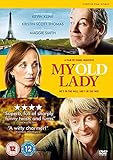
This is my review of My Old Lady [DVD] [2014].

Penniless American Mathias Gold, whose baggage is largely that of understandable neuroses, travels to the upmarket Parisian apartment left to him by his estranged father. He is shocked to find that the flat was purchased cheaply on a “viager” or life annuity basis, which means that he has inherited the obligation to pay the previous owner and long-term resident Mathilde a substantial monthly fee for the rest of her natural life. Although aged ninety-two, she seems robust enough to live for quite a few more years. Mathias’s attempts to find the money for the payments in the short run and solve the problem in the long-term, obstructed by Mathilde’s spiky daughter Chloé, form the theme of this bitter-sweet comedy, which turns quite dark at times as Mathias discovers more about his past.

Although this is not a great film, and I was left at the end confused over some aspects of the chronology of past events, it is well acted as one would expect from such luminaries as Maggie Smith, Kristen Scott-Thomas and Kevin Kline. There are some amusing scenes, poignant moments and picturesque shots conveying the ambience of the district of Le Marais au bord de la Seine. For me, this was sufficient to compensate for some of the corny aspects.

⭐⭐⭐⭐ 4 Stars

Resisting war and love

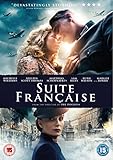
This is my review of Suite Francaise [DVD] [2015].

The lukewarm reviews lowered my expectations for a film which proved to be moving, over and above the poignancy of knowing the fate in a Nazi concentration camp that awaited the Jewish author Irène Némirovsky. She lived long enough to see the humiliation of the rapid French defeat in 1940, the brutal German bombardment of the helpless refugees toiling along the main roads out of Paris and the exposure of true character under pressure – some hoarding their wealth, others risking their lives to give what little they had to help others.

The film dramatises "Dolce", the second of the two parts to be completed out of the five intended for "Suite Française". Unlike Part 1, "Tempête en juin", which follows the fortunes of several very different sets of people fleeing the capital, "Dolce" has a tighter storyline. Lucille has led a quiet life, dominated by her mother-in-law, Madame Angellier (a spiky Kristen Scott-Thomas), as she waits for news from the Front of the husband she was pressured into marrying "for security". When the country town of Bussy is overwhelmed by the arrival of the victorious German occupiers, even Mme Angellier cannot refuse to billet an officer. Inevitably, Lucille is caught in the dilemma of being drawn to an "enemy" she has been instructed to cold shoulder, yet feeling obliged to help a neighbour whose stand against an abusive German has put his life in jeopardy.

Many characters may be stereotypes, but we see how the contrasting reactions of resistance, collaboration and passive acceptance are fed by social divisions: the arrogant local Viscountess, who hates the peasants enough to shop one of them to the Germans, with devastating results; the tenant's daughter driven to abject poverty by the rent-grabbing Madame Angellier, who sleeps with an enemy soldier for the material gain it may bring; the townspeople who seize the opportunity to spit at Lucille when they think she is doing the same thing.

The film-makers seem to have found the original climax of the book too subtle, and so spiced it up with a final chain of events which did do not quite "ring true" yet it is overall a thought-provoking, well-acted and atmospheric film which captures a strong sense of the times.

⭐⭐⭐⭐ 4 Stars