Mountain: In thrall to indifferent mountains

This is my review of Mountain directed by Jennifer Peedom.

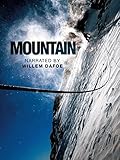
Stunning photography – was it made with the aid of drones or intrepid helicopter pilots? – reveals the stark beauty and vast scale and complexity of landscapes most of us will never be able to see close at hand. Time lapse photography to show clouds moving to obscure huge peaks, the plethora of stars in a night sky free from pollution, white valleys rising and falling as the snow builds up and melts, add dynamism to landscapes we may previously only have seen in static pictures. Suddenly one realises that two dots in a vast expanse of ice are in fact human- mountaineers planning an ascent. Then, with nail-biting tension, we see rock climbers high up on sheer faces, hands bare as they feel for invisible finger-holds, apparently unroped and alone. Footage of skiers weaving down near vertical slopes through trees, or surfing avalanches; mountain bikers hurtling along narrow winding ridges hundreds of feet above rocky valley floors; a tight-rope walker suspended between two pinnacles above a void, all capture the addiction to the adrenalin rush which must drive some to risk their lives for an experience which they cannot really share with the “normal world” from which they must feel disconnected on their return to it.

Accompanied by some freshly composed atmospheric music and beautiful classical pieces, Dafoe’s commentary – sometimes needlessly overblown – traces the short history of mountaineering, since for centuries local people treated high places as the land of gods and devils, to be avoided by ordinary mortals. We see clips of some of the intrepid C19 travellers who began to explore the mountains, totally under-equipped by our standards. The ascent of Everest triggered the growing stream of climbers, assisted by technical aids, often swinging from their belts like a kind of ceremonial metallic skirt, who now form a snail-pace queue up to the world’s highest peak.

This film is a totally absorbing work of art, with many memorable scenes and will appeal not only to mountaineers but people like me who are terrified of the idea of climbing but fascinated by the scenery and why people risk their lives in this pursuit. Yet I agree with the reviewer who would have liked more information on the location of the shots with a little cultural detail e.g. on prayer wheels and flags, explanation of some of the equipment used, the identity of some of the historical characters and events shown. As it is, the film assumes perhaps a little too much prior knowledge.

⭐⭐⭐⭐ 4 Stars

Happy End – Heartless in Calais

This is my review of Happy End [DVD].

One often hears of the minutes if not hours of film discarded on the cutting room floor to extract the essence of what the director aims to convey. In this case, it is as if Michael Haneke has perversely challenged us to make sense of a film largely constructed from the shots which would normally be edited out. We hear about a character taking an overdose, crashing a car, even dying, but rarely witness these dramatic incidents. Often we do not realise that we have seen a significant event until its effect becomes apparent later. The scenes of glacial slowness, require great concentration, not only because they are mostly in French with subtitles, but also because one is continually trying not to miss the vital piece of action which may in fact not occur in a situation where basically not much is happening.

Despite its bleak theme, which appears to be the director’s stock in trade, the ironically-titled “Happy Ending” is leavened by moments of dark humour and has the ingredients for a gripping and moving psychological study of how we may damage each other. It involves the Calais–based Laurent family, their wealth made from the construction industry and other businesses, who all follow the bourgeois conventions of polite society in public, but seem incapable of real warmth, natural affection and normal emotion in private. They live out their dysfunctional relationships against the background of the impoverished black migrants who haunt the port town.

We initially experience their formal bourgeois life from the viewpoint of the approaching teen-age Eve Laurent who receives a somewhat reluctant welcome when she comes to stay in the extended family home with her father Edward, after her mother, his ex-wife, takes a lethal overdose of antidepressants. Eve appears outwardly to be an innocent, sensitive young girl, but from the outset there are signs of a troubling darker side to her character, leading one to speculate to what extent she may have been damaged by her self-absorbed parents’ neglect, or possibly inherited some of the family’s less appealing personality traits.

There is a cast to raise expectations high, with Jean-Louis Trintignant in the role of patriarch sinking into senility, from which he seeks to escape through suicide – unless he can find someone prepared to put him out of his misery– and Isabelle Huppert as his ambitious daughter Anne who is romantically involved with her British lawyer, played by Toby Jones. Anne’s important business deals are undermined by a serious accident on a building site for which her son Pierre may be to blame. Rejecting his mother’s love and her plans for him to take over the business, are his drunken outbursts due more to his sense of inadequacy than to a genuine anger over his family’s lack of concern for the poor as anything other than a source of cheap domestic labour?

For me the film does not work partly because it is like a single-phrase tune. As indicated already, the work is so fragmented, with long shots and overlong, disjointed, initially incomprehensible scenes and sociopathic characters, that I rarely felt engaged, was often frankly bored, only continuing to watch in the forlorn hope of an effective denouement which I never expected to occur.

⭐⭐⭐ 3 Stars

The Florida Project (DVD) – The joy of childhood against the odds

This is my review of The Florida Project [DVD].

Lively, precocious Moonee runs wild with her small group of friends around the cheap motels where they all live encircled by fast roads, wasteland, the garish colours of grotesque orange- and witch-shaped cafes, not to mention a noisy helicopter pad, all on the fringes of the Florida Walt Disney fantasy land. It is an ugly, urbanised, artificial but sun-drenched world, with occasional flashes of natural beauty in a sunset, or a group of birds.

As the children’s freewheeling mischief leads to more risky escapades, one fears for their safety. Moonee’s immature young mother Halley, foul-mouthed, chain-smoking, often high on drugs, more than a little crazy as she swings between uninhibited self-expression and violent outbursts when thwarted, also arouses concerns for Moonee’s future. As Hailey resorts to petty crime to pay her rent, it is clear that the little girl’s carefree world cannot last much longer.

This film conveys a child’s sense of joy in living, curiosity over every new experience, the ability to be happy with very little. One can see that Moonee risks being ruined by a lack of boundaries, frequently insufferable, noisy, mouthy, defiant and destructive, yet also with a strong sense of justice, loyal and generous to friends, acutely aware of the world around her although often unable to make sense of it. The moments of bonding with the free-spirited Halley who is more like a big sister than a mother are quite moving. Although clearly “unfit” to be a parent, Halley loves her daughter – too immature and self-absorbed to see how she is neglecting Moonee, she does not appear to consider giving the child up as a solution to ease her penniless state, but rather, being a child at heart herself, she knows how to create on a shoestring (or by stolen means) the magical experiences Moonee will never forget like making wishes outdoors at midnight as fireworks explode over Disney World.

The acting is generally excellent, from the children, Halley’s long-suffering friend and some of the real-life police and social workers in the cast, to William Dafoe in the role of the harassed caretaker who develops a soft spot for the appealing child and feckless young mother. The performance in this role by Bria Vinaite, the much-tatooed free-spirited first-time actress,who certainly looks the part, is a little too frenetic and exaggerated at times, which began to grate on me. Although it is sometimes hard to grasp the American drawl, some amusing one-liners come through clearly and it is generally pretty clear what is going on, except I did not understand that the gaudy wristbands Hallee was trying to sell were valuable passes to Disney World. The pace drags somewhat with repetitive scenes in the middle, although this may be intentional to reflect the reality of a child’s life. Despite building up in the end to a dramatic climax with a director who knows when to stop – if a little fancifully -, the film would have benefitted from sharper editing.

Recommended overall for its mix of humour and pathos in a realistic portrayal of children’s resilience, ability to survive and live joyfully against the odds.

⭐⭐⭐⭐ 4 Stars

“Loving Vincent” [DVD] -Mesmerising

This is my review of Loving Vincent [DVD].

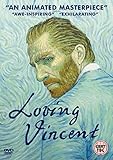
Unlike any film I have seen before, this hundred minute dramatisation of the differing explanation of Van Gogh’s death consists entirely of a remarkable animation of nearly sixty-seven thousand oil-paintings, skilful copies of ninety-four of his pictures, into which the characters have been painted in new poses as required.

The continual movement applied to Van Gogh’s broad strokes and swirls of colour are fascinating, as is the brilliant way actors who have been chosen for their likeness to real people whom he painted such as his physician Doctor Gachet, latter’s daughter Marguerite or the paint supplier and art dealer Père Tanguy, are given such life-like expressions and mannerisms recognisable as typical of the actors used. Although every effort has been made to use Van Gogh’s paintings, where it has been necessary to create new settings, these are shown in black-and-white, again painted, as in the scenes of his brother Theo, himself dying and mentally tortured soon after Vincent’s demise.

The theme may sound sombre, but is touched with moments of humour as the hard-drinking Armand Roulin, son of Vincent’s postman, always wearing his distinctive canary yellow jacket which apparently drove the film’s artists mad as they constantly cleared canvases to repaint it at another angle, fulfils his father’s instruction to deliver by hand to a suitable person Vincent’s last letter. Initially reluctant to do this, Armand becomes obsessed with the desire to obtain the truth and justice for the artist who may have been the victim of manslaughter rather than fallen prey to suicide in a psychotic moment.

Although there is something to be gained from coming to this film, as I did, with no prior knowledge of how it was made, there are some informative short videos about this on Youtube.

I also think it is helpful to be aware of the essential facts of Van Gogh’s life: he was a difficult man subject to great enthusiasms and mood swings, probably bi-polar. Taking up painting in his late twenties, he was supported entirely by his long-suffering brother Theo, never or barely selling a single picture in his lifetime. Captivated by the brilliant colours in the sunshine of Provence, he hoped to establish an artist’s colony there, only succeeding in falling out with Gauguin in a failed attempt to get this started. He was astonishingly prolific in his production of both paintings and letters decorated with drawings in the margins.

This film needs to be seen more than once, requiring intense concentration in the attempt to take in every clever or beautiful visual effect, as when the tossing of some object like an apple core prompts a flock of cawing crows to flap up out of a cornfield.

The “storyline” sometimes seems a little disjointed, the black-and-white scenes are the least satisfactory, often appearing blurred and weird, and the overall dreamlike quality may distance viewers from the characters. Yet the film still creates a sense of poignancy, and its technical achievement outweighs any minor criticism. ( A subjective view, but the choice of an inferior new recording in preference to Don Maclean’s original version of “Starry, starry night” in the final moments seems ill-judged.)

The visionary genius of conceiving this film in the first place, and the teamwork involved in producing it over a period of years seem to justify a string of awards.

⭐⭐⭐⭐⭐ 5 Stars

“Their Finest” [Blu-ray] [2017] – Morale under fire

This is my review of Their Finest [Blu-ray] [2017].

Although you may think that every possible angle on World War Two has been covered on screen, “Their Finest” builds an entertaining, humorous yet at times poignant drama round the to modern eyes corny but evocative propaganda films produced to raise morale.

Gemma Arterton plays “Mrs Cole”, the irrepressible young woman hired to churn out “slop”, or women’s parts in film scripts. She is soon involved in the major project of an “authentic and optimistic” film extolling the bravery of two Cornish sisters who use their father’s fishing boat to help evacuate soldiers from Dunkerque. There is a topical note in what proves to be the “fake news” which Catrin Cole artfully conceals, in an initial example of the steely determination beneath her demur demeanour. The job is made harder by continual government interference, such as the requirement for the film to include a major part for a real-life, highly decorated American serviceman, in a ploy to help lure the US into the war.

The film continually reminds us how much progress has been made in equality for women, as Catrin meets blatant chauvinism at every turn, not least the angry response of her husband, a struggling artist who feels humiliated at the thought of her paying the rent. In addition to the injustice of earning less because she is female, Catrin has to endure the dismissive contempt of Buckley, the arrogant young scriptwriter in residence, who grins maliciously as he watches her squeeze round furniture to reach her desk in a dark corner.

Bill Nighy steals the show as the impossibly vain, ageing actor, querulous over the lack of good parts after the past glory of his leading role in a popular detective series. Although it seems a little too slick at first, the dialogue sustains a witty pace. As Catrin wins the men over, this film could have descended into a bland, sentimental treatment of the last war, but some dark incidents, even if a little too coincidental, give the drama more depth.

⭐⭐⭐⭐ 4 Stars

“The Sense of An Ending” [DVD] [2017] -When capturing a book on screen may prove harder than it seems

This is my review of The Sense of An Ending [DVD] [2017].

Amicably divorced, running a small camera shop as a retirement hobby, Tony Webster is jolted out of his superficially pleasant existence by an unexpected bequest from Sarah, mother of Veronica, the girlfriend from his student days. Memories come flooding back of his elitist secondary school where, in a clique of pretentious, precocious yet immature boys, he looked up to and befriended Adrian, the new boy who dared to spar intellectually with the teachers. He also has vivid recollections of Veronica, provocative but always holding back, and the excruciating visit to her wealthy but decidedly odd, perhaps emotionally warped family, not least her flirtatious mother.

What has become of Veronica over the decades? Why, as executor, has she destroyed Adrian’s diary, which is what the bequest proves to be? Why did Adrian commit suicide in his youth, and how did Sarah come by the diary anyway? What part did Tony play in all this, and to what extent is he to blame for any tragedy? Has a sense of unfinished business and his own culpability, real or imagined, for past events stunted his own emotions over the years, undermining his marriage and turning him into what his ex-wife and daughter describe as an old “curmudgeon”?

To the horror of his barrister ex-wife, who may even be a little jealous, Tony virtually stalks Veronica in his attempt to discover the truth, Even when he thinks he has found it, there is a further poignant twist.

Although true to the original plot, the Director felt the need to flesh out the details of Tony’s family life far more than in the original book. So, the birth of his daughter’s first child becomes one of the most moving points in the story, whereas it does not occur at all in the book. Similarly, the spiky but affectionate relations with his ex-wife are an entertaining aspect of the film but not the book. This may be because, without these embellishments, the book has a kind of detached, emotionally cool quality which may not make for “good box office”. What the book does possess, of course, is the distinctive, highly articulate, insightful, at times philosophical style which is what won it the Man Booker. Although the film tries to retain some of this by using Tony as a voice-over narrator at times, it obviously cannot capture all Julian Barnes’s wry wisdom.

I remember that the book was a page turner as regards finding out what happened, creating the sense of the need to reread it to get the full meaning, although this did not happen in my case because I felt “let down” over the denouement, which seems somewhat contrived. So, it is perhaps unsurprising if the film has the same flaw.

This film is essentially about the need for closure, which may become more urgent towards the end of our lives. It is well-acted, with Jim Broadbent as a sound anchor, but the storyline seems too undeveloped and fragmented in places, with some scenes, such as the classroom teaching, or encounters with Veronica’s family cringe-making in their falsity – although perhaps that is part of the point.

⭐⭐⭐ 3 Stars

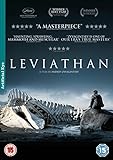
“Leviathan” [DVD] – A modern Job

This is my review of Leviathan [DVD].

One of the most striking scenes in this visually beautiful film is the skeleton of a huge whale cast up on the north Russian beach. “Leviathan”, whether defined as a sea monster or Hobbesian autocratic state, serves as a metaphor for a deeply corrupt Russia where bribes oil the wheels of exchange and “might is right”.

Kolya, a hard-drinking, chauvinistic rough diamond, but at heart a decent man, tries to buck the trend by using the law to foil the crooked local mayor Vadim’s designs on the property built by his family on the shore of the bleakly beautiful coastline. Kolya enlists the support of Dimitri, a suave former army friend turned Moscow lawyer, but unused to the ways of the wild north, where legal procedures can be all too easily subverted, and brute force is always the default position, Dimitri proves no match for Vadim, who when sober proves wily and ruthless.

In an unrelenting succession of trials and tribulations, Kolya is all too obviously a modern-day Job. At 141 minutes the film is far too long, but is worth watching on a number of counts. In addition to some humorous moments to leaven the anguish, the acting is strong and realistic, giving what feels like an authentic impression of life in off-the-beaten-track, rural small-town Russia where hardship takes many forms: coping with harsh weather, limited opportunities – the only source of employment for Kolya’s incongruously beautiful young second wife being the fish factory -, oppressive bureaucracy, the lack of democracy, since Communism has been replaced by an authoritarian capitalism, and the all-pervasive corruption, permeating even the law courts where justice is a mockery and the recently revived Orthodox Church. Ironically, Vadim is deeply devout when sober, fraternising with the cynical self-serving local bishop Grishko.

It is hardly surprising that everyone seems to resort to vodka on the smallest pretext, be it to relax with friends, or to drown one’s sorrows alone. Stoical acceptance or resignation are the usual reaction to setbacks, punctuated with occasional bursts of destructive anger.

Perhaps the most intriguing twist is that the film did not baulk at making a harsh attack on the Russian regime, despite receiving a hefty subsidy from the Ministry of Culture. If it is the case that the director Zvyagintsev was forced to make some changes, I cannot imagine how hard-hitting the initial version was. Yet, having noted its success at Cannes, the Russian powers that be went on to nominate if as their foreign-language Oscar submission

⭐⭐⭐⭐ 4 Stars

“Fences” [DVD + Digital Copy] [2017] – Fenced in

This is my review of Fences [DVD + Digital Copy] [2017].

Retaining the script and staged quality of the original theatre play, but capturing in its street scenes and domestic interiors the atmosphere of 1950s suburban Pittsburgh, this film revolves around Troy, the garbage collector with some understandable but mighty chips on his shoulder: only white men are allowed to drive the vans which he has to ride hanging on to the open back, and his glory days as a baseball player occurred when the teams were segregated. One may admire his rash persistence in claiming the right to work as a driver, but will he be satisfied if he obtains it? Is his harsh treatment of his younger son the result of a brutal upbringing which denied him a good role model of how to be a father, or has he fallen prey to jealousy of the boy’s easier path to becoming a successful footballer? He clearly loves his wife, willingly handing over his pay cheque each week, but can he resist the temptation to betray her, and will he acknowledge and take responsibility for his weakness? At times, he shows great compassion for the pathetic brother injured in battle, but has he taken financial advantage of him?

The garden fence which Troy never quite gets round to completing is the metaphor for the barriers he erects in his life. Troy is clearly a complex, flawed man, so is he fated to sink into self-destructive failure or achieve some ultimate positive resolution?

Although I understand why Denzel Washington hoped for an Oscar in his demanding part, dominating the screen in virtually every scene, I found it hard to catch all the meaning of his passionate rants. By contrast, most of the strong supporting actors were very clear, notably the elder son who had suffered his father’s neglect, and the long-suffering wife, played by the brilliant Viola Davis.

I agree with reviewers who feel that, although well-directed and acted with realism, the play itself, the intense, emotionally draining work of August Wilson, a kind of black Arthur Miller, leaves one feeling a little disappointed, I think because it makes its points early on, promises much in the build up, but tails off, losing its dramatic punch at the end.

⭐⭐⭐⭐ 4 Stars

History repeating itself

This is my review of Viceroy’s House [DVD] [2017].

In the false calm before the carnage, we see the hundreds of servants in their immaculate “native” uniforms performing the symbolic pageantry of a declining Empire bent on withdrawing from a colony with dignity. I have no idea how faithful this film is to history, but when the world is still riven by fighting between religious factions, this film is a timely reminder of historical bungling from seventy years ago. Yet unlike many humanitarian disasters, it is unclear what actions could have been taken to avoid it.

Hugh Bonneville is well-cast as Lord Mountbatten, the affable, unflappable negotiator brought in to pour oil on the tense meetings between the two adversaries Nehru and Jinnah, the one seeking liberty in the form of a united India, the other set on partition to permit the emergence of Pakistan as a Muslim state.

As British administrators indulge in heated debates as how best to stem the growing tide of unrest, they fail to notice the Indians in attendance hanging on on evey word, to pass on in whispers, only feeding the climate of prejudice and intolerance. The apparently illicit and futile love affair between a young Hindu and his longterm Muslim friend is a perhaps slightly sentimental metaphor for the problem of finding a solution.

In the film, the alleys of Delhi and the poor who throng them are impossibly clean and well-fed, and it must be hard to follow the arguments without prior knowledge of situation, as convincing lookalikes for the Oxbridge-educated Nehru, Jinnar and giggling, barefoot Gandhi make their appearances. Yet this is a visually impressive, well-acted, compelling film reminding us of a tragedy which time has eroded too quickly from memory: the massace of millions during the enforced displacement of 14 million Indians, and the terrible dilemma of having to choose quickly which country to join. There is also the twist at the end when we learn how Mountbatten himself may have been a mere pawn in a cynical exercise.

⭐⭐⭐⭐ 4 Stars

Interesting idea but missed the mark for me

This is my review of Toni Erdmann [DVD] [2017].

In this offbeat farce with a serious message, artistic prankster Winfried Conradi is appalled to see how his daughter Ines has become a high-flying workaholic, driven to succeed in a ruthless, corporate world. This is a far cry from his own idealism and lack of materialism, born in a time when Germany was redefining its values after WW2. Ines is by turns embarrassed and furious when he gatecrashes her working life in Bucharest, where she is trying to negotiate a delicate contract which will involve handling the redundancies which will inevitably result from the reorganisation of Romanian oil production on efficient modern lines.

Winfried has been likened in appearance to Dame Edna Everage’s counterpart Les Patterson, but I have to confess being irritated by his trademark fake goofy teeth and mop-like wig. He struck me as the kind of attention-seeking unfunny would-be comic I would avoid like the plague in real life, making it hard to be convinced that there is supposed to be a wise, perceptive, right-thinking character underneath.

The acting is good, particularly the role of the tense Ines, whose sense of the ridiculous, which is perhaps inevitable in the child of such a father, nevertheless breaks through, even at inopportune moments.

This film has been highly praised by the critics, and certainly had many people roaring continually with laughter when I watched the film with a live audience. Yet for me, the film does not really “work”.

It is at least 45 minutes too long with some scenes so protracted, possibly in an attempt to immerse the audience in realism, that their initial dramatic impact is allowed to evaporate. Since the director apparently produced about 100 hours of footage, I appreciate that cutting it down to barely 3 hours must have been a challenge, but the lack of editing seriously weakens the film.

I admit that there are some moving moments, and that the main aim may be to explore the relationship between father and daughter, a serious theme leavened by a comic framework, but I am not sure that the film added much insight over the three hours. Although perhaps too different from her father ever to give up her career and become genuinely laid back, Ines shows from the outset that, despite her uptight exterior, she cannot help laughing at, even joining in, some of her father’s pranks, and is remarkably tolerant towards his excesses.

⭐⭐⭐ 3 Stars