This Thing of Darkness by Harry Thompson – A Masterpiece Overlooked as was Fitzroy.

At 750 pages, this is a megatherium of a historical novel, to cite the name of the giant fossilised sloth which Darwin comes across during his five- year exploration of South America while employed as a naturalist aboard the survey ship, HMS Beagle. In the span of almost four decades from 1828, it is hard to keep track of the vast cast of characters, many of whom only appear briefly from time to time. Women play a minor role, and tend to be passive stereotypes, but that reflects life at the time.

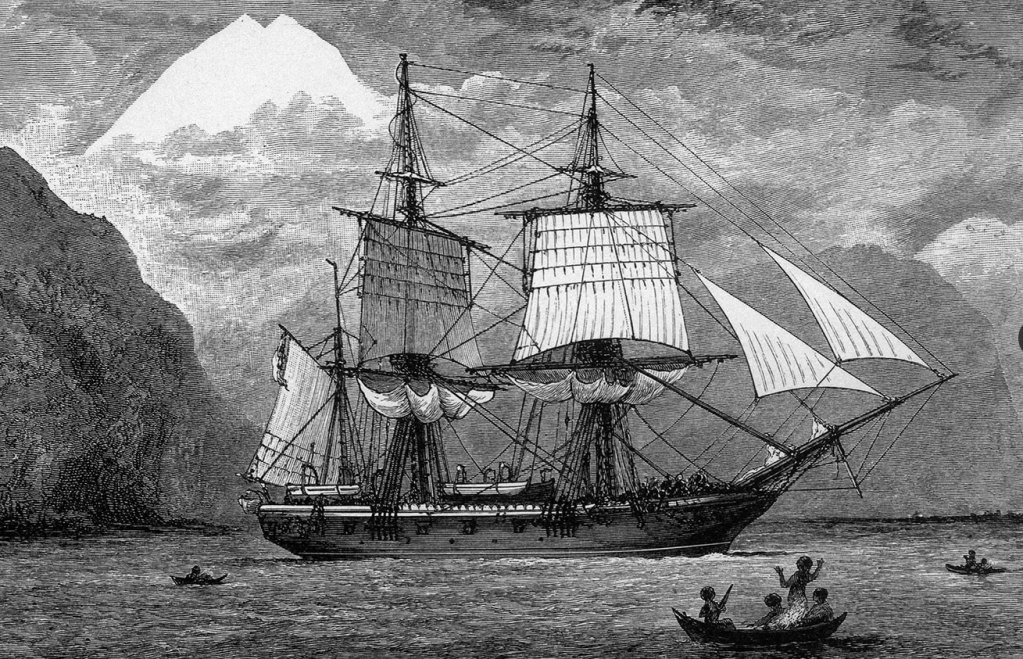
Although Darwin is the most famous, the focus is on Robert Fitzroy, appointed Captain of the Beagle at the age of twenty-three, not only for his aristocratic connections, but also his brilliant performance as a student at the Royal Naval College. His first task is to complete the survey of the complex coast of Patagonia, with the harsh climate which drove his predecessor mad. The novel brings home the enormity of the task of mapping a continent with the limited equipment available, the cultural gulf between the Europeans and the various tribes they encounter, and the human cost of the well-intentioned desire to achieve “progress” complicated by the innate human drives of competition, domination and greed.

A central theme is the relationship between Fitzroy and Darwin, forced into close companionship for months on end in the cramped confines of a sailing ship. A bone of contention between them is the explanation of the variations in the creatures observed on their travels, whether alive or preserved in layers of exposed rock. Initially destined to be a clergyman, and troubled by his conclusions, Darwin finds it increasingly hard to deny the existence of some kind of evolution, as we now call it. Fitzroy, despite his analytical mind, cannot give up his belief that surviving species remain as they were first created by God, with only limited changes through adaptation to different environments.

Frustrated by the government’s refusal to fund further voyages of the Beagle, he resolves to finance them himself, running up excessive debts in the process. Constantly dealing with dramatic changes in the weather, he begins to see patterns, and while employed in later life at the Board of Trade sets up a weather forecasting system to issue storm warnings which save lives. Pressure from the owners of fishing fleets, concerned by the loss of earnings when forecasts keep their boats in port, lead to abandonment of then daily weather reports. This proves the last straw for a man who has suffered throughout his adult life from periods of depression.

At times of stress, Fitzroy suffers brief but severe manic episodes, which put both him and his men at risk. At a time of such prejudice against madness, it is surprising that he is not demoted for that reason. The extreme loyalty he arouses in his crew may partly explain this. The practice of sending little boys, as young as ten (or twelve in his case) off to sea to learn the ropes may have aggravated his instability.

Darwin is more balanced, and ultimately more successful. Yet he is presented in an unflattering light. His fellow officers on The Beagle generously bring him examples of unusual creatures they have found, but when these are shipped off to England, it is Darwin who receives all the credit, never acknowledging their contribution.

This novel is based on such detailed research on sailing 19th century ships in often atrocious weather conditions, and on every aspect of the varied landscapes and society of South America at the time, as well as the contrasting vivid portrayal of London and the rural south of England, that I imagined the author must be some nerdish eccentric. In fact, Harry Thompson was a highly successful television producer and comedy writer, who produced, for example, “Have I Got News for You”. His sense of farce pervades this book with flashes of irony and dark humour which lighten the theme.

By the age of 45, he had also found time to write a string of books, including biographies and this debut novel, “This Thing of Darkness”, which arguably deserved to win the Booker Prize rather than merely be longlisted. Ironically, the winner was John Banville’s “The Sea”, so different that the two novels seem to defy comparison in the same contest.

What might Harry Thompson have gone on to achieve, had he not died prematurely of lung cancer, never having been a smoker? It is a pity that many people will lack the time to embark on this book, or be deterred by its length. Reading it proves an absorbing, immersive experience, creating a powerful sense of many different places, and enabling us to identify with characters despite the accepted attitudes, value and knowledge of their day. Admittedly , in some dramatic scenes of near-death experiences, the derring-do may seem overdone; otherwise, the tedium and hardship of long days at sea, or struggling over unfamiliar, harsh terrain feels oppressive, but authentic. The political corruption of the period is all too similar to that of today – plus ça change!

Thompson really succeeds in bringing a fascinating period of history alive. This novel is a remarkable achievement, moving and informative, that will linger in the mind.

Precipice by Robert Harris: A Study of Obsession

The First World War may seem an overused theme for a novel, but Robert Harris approaches it from a fresh angle by portraying the real life situation of a British Prime Minister under great political stress, as strongly resisted demands for Irish Home Rule were eclipsed by the imminent threat of strife in Europe in the summer of 1914. Herbert Asquith found relief in an unwise affair with an aristocratic socialite less than half his age. He was known to enjoy the company of pretty young women, described by his sharp-tongued wife Margot as his “harem”, but Venetia Stanley was different with her obvious intelligence and ability to act as a sounding board for his concerns.

At times it is hard to credit how Asquith was able to walk about without any apparent security guards, or find time for long afternoon drives with Venetia in the countryside, cocooned behind blinds in the back of his chauffeur-driven Mercedes. Most extraordinary, at a time when London households might receive up to 12 postal deliveries a day, as Asquith’s obsession with Venetia grew, he wrote several times a week, on at least one occasion four times in a single day. With an increasing lack of caution, he gave her unique access to classified information, including telegrams, details of military plans or sensitive issues which were being covered up.

Venetia kept more than 500 of these letters, which have survived to be selected for inclusion in a skilful blend of fact and fiction, for Asquith himself later destroyed Venetia’s replies. Robert Harris has also been obliged to invent Paul Deemer, the imaginary policeman who is transferred to a secret team to investigate the apparent security leaks from the Prime Minister’s office. In later chapters, Deemer feels ineasy as a voyeur, intercepting love letters laced with sensitive information which amount to the politician with the highest office in the land committing a serious offence. Why is Asquith doing this, and can Venetia be trusted? What damage will be caused if the situation comes to light? If it remains concealed, what are the unintended consequences?

Certain aspects of the plot, involving Deemer for instance, seem too contrived. Some reviewers have found the pace unduly slow, or felt unable to care enough about the main characters: a self-indulgent older man and pampered, aimless younger woman. There are moments of high tension, although inevitably sapped for readers wise after the event, such as the disastrous Dardanelles campaign which portrays Churchill in a poor light.

The plot may be thin, but the author is probably more concerned to capture a sense of time and place: a deferential society in which wealthy, privileged people were above the law, protected from the need to face up to their actions; a world where intelligent young women were discouraged from pursuing any ambition or self-fulfilment other than marriage to suitably rich man. Yet an unexpected tragic and pointless war gave them the scope to do “men’s jobs” and widen their horizons.

This is essentially a psychological study of obsession, in which, while seeing their flaws, we can feel some sympathy for Venetia, Asquith, and even his wife Margot, clearly wronged, but portrayed as irritating and unpleasant. We may feel relief over the shift in Venetia’s thinking as she begins to find Asquith’s neediness oppressive, but her decisions at the end seem highly questionable.

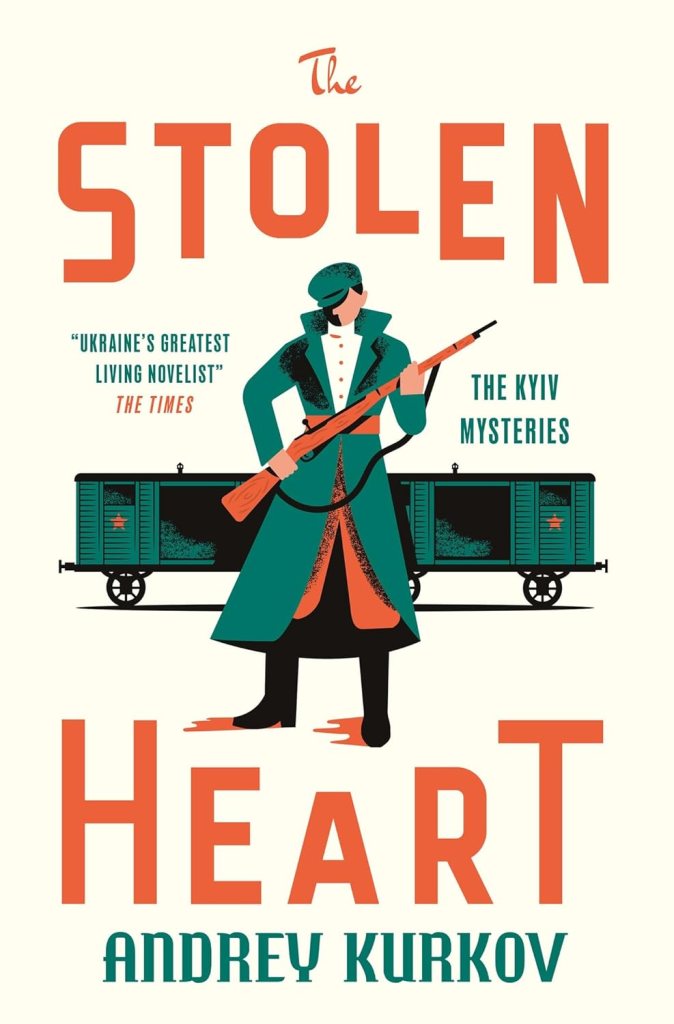
“The Silver Bone”, (The Kiev Mysteries 1) by Andrey Kurkov –

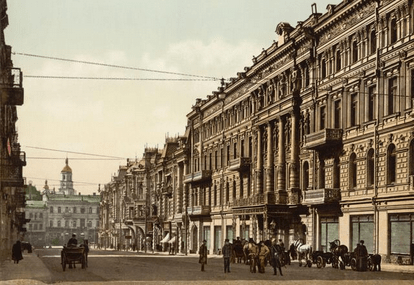
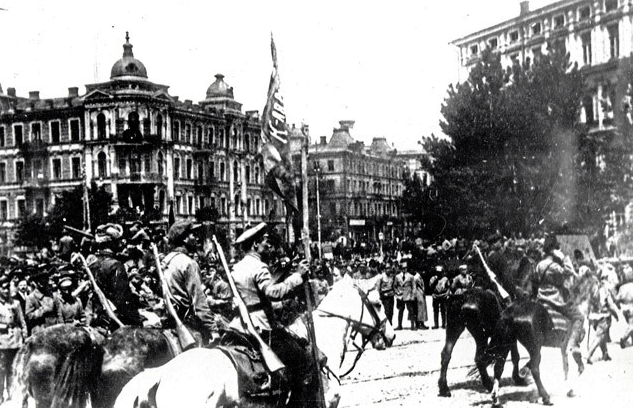
Set in the Kiev of 1919, this historical crime fiction provides a striking portrayal of life in the Ukrainian People’s Republic, newly formed in the wake of the Great War and the Russian Revolution, its independence undermined by a confusing succession of competing Bolsheviks, White Russians, and Hetman-led Cossacks. Perhaps this enables us to identify even more with the perpetual state of uncertainty and disarray which the citizens of Kiev have to endure now.

In the dramatic opening pages, former student Samson Kolechko’s right ear is severed by a passing Cossack’s sabre, which also leaves his father lying dead in the street.  On returning to the scene, Samson finds that his father’s shoes have been stolen, but his wallet remains, stuffed with banknotes, although some are useless, having been replaced recently by yet another new regime’s currency .

When his flat is requisitioned by a couple of corrupt Soviet soldiers, who use it to store stolen goods, Kolechno fears for this life. By a rare stroke of luck, his ability to write coherent reports gains him employment as a detective at the local police station. Intrigued by a curious silver bone among the stolen items, he embarks on a dangerous investigation.

The first in what promises to be a series of “The Kiev Mysteries”, this novel was longlisted for the International Booker Prize, and has been widely praised. Andrey Kurkov was already well-known for his writing, including “Death of a Penguin”, a satire on the political situation in the Ukraine of the 1990s.

Translated from the Russian, the style is sometimes stilted, but this may enhance the sense of a past age. Based on a good deal of research of the period, including a street map of the main locations, “The Silver Bone” relies on black humour and a touch of surrealism, which some may find unnecessary and irritating, to keep us engaged in a world of arbitrary decisions. People survive by keeping their heads down in a world of sudden violence and niggling deprivation. They’re are beaten if they resist attempts to commandeer all but their most basic items of furniture; they are ordered to remove snow drifts in the streets, without being given the necessary equipment. Power cuts are frequent, goods and services are best paid for using some item in short supply, even as basic as salt, if one can get hold of it.

Unfortunately, apart from a few dramatic moments, and an ironic twist at the end which paves the way for a sequel, the solving “mystery” proves a disappointment- convoluted and unconvincing, weighed down with some unduly long or tedious descriptions. Left with a sense that the denouement doesn’t quite “add up”, one cannot muster the energy to trawl back through the text to work out why.

Apart from Samson, the characters are mainly two-dimensional, with a few exceptions like Kholodny who has abandoned the priesthood to become a policeman. When asked by Samson what people will believe in when they forget god, he meditates, “In themselves, in the future, in the power of nature”, sadly a case of overoptimism.

There are parallels between this and the earlier “Death and the Penguin” but the latter is more subtle and original in its quirkiness, contriving to escape censorship in corrupt regime.

“Gros-Câlin (Big Hug) by Romain Gary as Émile Ajar: Crushing defeat

Not content to have been France’s most popular author in the past, Romain Gary resolved to restore his flagging reputation, regain critical acclaim and win for a second time the Prix Goncourt which is only supposed to be awarded once to the same person, by resorting to the ruse of writing under a pseudonym, as Émile Ajar. The publisher Gallimard was prepared to go along with this, and no one else seemed to notice that “Gary” sounds like “burn” and “Ajar” like “embers” in Russian.

Ajar’s first novel, published in 1974” was “Gros Câlin”, or “Big Hug”, the quirky tale of “M. Cousin”, a lonely, Parisian statistician, who purchases a pet python, which will give him the physical contact he craves, and bring him into contact with people drawn by curiosity. Feeding Gros Câlin soon becomes a problem, since his diet of living mice distresses Cousin, particularly as regards a pretty white mouse which he names “Blondine” and resorts to keeping in a box on a shelf out of the python’s reach. When he confides in a priest, he receives the cynical advice to buy a lot of mice to make them seem anonymous and easier to kill, rather like fighter pilots in the war, who found it less disturbing to bomb from a great height people they didn’t know.

This satirical humour may not prove enough of a distraction from the essential poignancy of Cousin’s chronic inability to relate to others, and to read social situations correctly. In the Metro, he chooses to sit right next to the only other occupant of the carriage, with no concept of behaving oddly and invading a stranger’s personal space. At work, he is convinced that Mlle Dreyfus, a work colleague, is in love with him simply because she greets him regularly in the lift, and imagines that they will soon get married.

This novel proved so successful that Gary had to persuade his cousin Paul Pavlowitch to impersonate him in interviews. However, perhaps because I read this in French, I could not fully appreciate all the literary allusions, puns and misuse of words which French readers apparently find so clever and entertaining.

Lacking much of a plot, the narrative soon began to feel repetitive and tedious, particularly as regards Cousin’s visits to prostitutes, which are described in sordid detail, suggesting Gary’s bias toward defending this way of life. The descriptions of Mlle Dreyfus, who comes from Guyana, struck me as being, if unintentionally, somewhat racist.

Towards the end, the novel becomes somewhat surreal, with Cousin appearing to have been driven mad, which like “But it was all a dream” may seem like a cop-out. There are a few interesting observations, like the fact that it might be useful if, like a python, a human being could simply shed his skin periodically to achieve a kind of “rebirth” – also a metaphor for Gary achieving renewed success by writing under an assumed name.

Describing Cousin’s sense of isolation may have been an outlet for Gary’s own state of mind, for only a few years later in 1980, the author shot himself – having left a note for his lawyer to reveal the true identity of Ajar.

“Nickel Boys” by Colston Whitehead: disturbing for good reason.

After his parents’ departure to make a better living in California, Elwood is left to grow up in the Florida of the 1960s in the segregated black neighbourhood of Frenchtown, Tallahassee. He is kept on the straight and narrow by his stern but loving grandmother. A bright, thoughtful boy, he is fatefully influenced by a record of Martin Luther King’s speeches, which he plays obsessively.  His potential is spotted by a teacher, who eases his path to a technical college, the route to a better life.

Through an unlucky chain of events, he is obliged to hitch a ride to his first day at college, and just happens to be picked up by the driver of a stolen car.  With a prejudiced court, the penalty is disproportionate This leads to his incarceration in the grim institution of the Nickel Academy, based  on a  former real reform school, Dozier School in Florida, which operated for more than a century.  It was exposed recently as the scene of much appalling violence against pupils, including unrecorded deaths and burials. Not only this, but the inequity between the treatment of the  black and white students, and the cynical exploitation on the part of local people, including influential members of the local “clan”, Ku Klux implied, in siphoning off food and equipment intended for the boys, added to the injustice which Colson Whitehead clearly felt impelled to make more widely known.

Thinking I had read enough fiction about boys being abused at school for one lifetime, I avoided reading this at first. However, having walked out of the highly praised film version of it, because I could not engage with the technique being used, I decide to read the book in order to grasp exactly what it was about. This would be an unbearably bleak read were it not for the vivid descriptions of a society which kept flagrant inequality alive with a casual, unthinking acceptance, and the author’s flashes of dry, ironic humour, against the odds.  The novel resembles his debut novel, “The Underground Railway” in tending to digress into the lives of various minor characters, but is different in the authentic ring of its sense of place, rather than any hint of magic realism.

He also lightens the plot by shifting forward in time for much of the final Part 3, to show us the life of an adult Elwood who has survived the Nickel Academy to make a living, but we see the permanent scars in apparent difficulties in sustaining emotional relationships, and no evidence that he has managed to fulfil his intellectual promise.  Sometimes, the narrative drive seems to lose momentum, but the plot comes into sharp focus with a dramatic and unexpected twist at the end.

I was interested to read Colston Whitehead’s description of the two central characters as the  “two different parts of my personality”, with Elwood Curtis being “the optimistic or hopeful part of me that believes we can make the world a better place if we keep working at it”, and his friend Jack Turner, “the cynical side that says no—this country is founded on genocide murder, and slavery and it will always be that way.”

“The Nickel Boys” is a book that all young white people would benefit from reading, to gain an understanding of the wrongs suffered by black Americans over time. Whitehead is a talented writer who merits being one of the few to win the Pullitzer Prize twice.

“Walk the Blue Fields” by Claire Keegan: on the path to something remarkable

Set mostly in rural or coastal Ireland, these stories probably resonate most strongly with those who have first-hand experience of its recent past: the folklore, superstition, dominance of the Catholic Church and close-knit, by turns supportive and judgemental communities, where every individual’s business is known, often in several versions, scarcely before an assumed event has taken place.

Varying a good deal in length, the eight short stories have many common features: a strong sense of place, even if one has never visited it; a quirky or unclear scenario; insensitive or controlling men; unfulfilled women who sometimes summon the strength to break free; the appearance of remarkably prescient healers and fortune-tellers, while priests break their vows and doubt their faith. A drip-feed of explanations lead to the climax, often followed by an inconclusive ending which leads the reader to ponder what might happen next.

Yet reviewers differ widely in how they rate these stories. Despite the hook of its title, “A Long and Painful Death”, I found the opening story quite unengaging with its detailed descriptions of the commonplace and a main character known only as “the woman”. So it took a reader who recognised the location “on the seaward side of a winding road high over the Atlantic ocean on the western edge of the island of Achill, itself perched on the western edge of the island of Ireland” to trigger an appreciation of the descriptions. Only at the end did I grasp that this tale is all about writer’s block. Having arrived at the house of a famous dead author, the woman spends the day doing anything but produce some words, yet her writer’s mind is continuously noting her surroundings as a possible source of material and inspiration. It is not until the last page that the vital idea for a dramatic plot comes to her from an unexpected quarter.

”The Parting Gift”, is a poignant portrayal of a teenage girl who has sold her horse to buy the plane ticket to New York so as to escape from such a restrictive life, with a darker undercurrent, on the family farm, that she is unfamiliar with the security baggage scanner at the airport. It seems like a forerunner of Claire Keegan’s much-admired novels, “Foster” and “Small Things Like These”, with its clear prose, tight structure, ear for dialogue and skill in implying the complex relationships between the family members.

“Dark Horses” is perhaps the least memorable story, perhaps because at barely eight pages, it is too short to do much more than demonstrate Claire Keegan’s ear for the banter of Irish men in a pub.

At the other extreme of thirty-five pages, “Night of the Quicken Trees” was a little too fey and contrived in weaving folklore into the tale of two lonely neighbours, where the exaggeration and humour of turf-cutter Stack frying eel while his pet goat Josephine has the run of his chaotic house, take the edge off the melancholy off a women driven half-mad with grief over the loss of her child. This mixture of comedy and sadness is also evident in what some regard as the finest story. Again at about forty pages, “The Forester’s Daughter “ is long enough to have mini-chapters, to chart the course of an unwise marriage, trapping an ill-matched pair, with the plot revolving round the anthropomorphic dog Judge, which husband Deegan gives his daughter as an unintended birthday present.

These stories are quite thought-provoking if not as moving as they could be, and I shall read the initial set, “Atlantic” which established Claire Keegan as a prize-winning writer. However, her work seems to have evolved over the years, from an over-reliance on folk tales and caricatures to her admired novellas: “Foster” and “Small Things Like These”. Their subtlety stems from some striking original prose employed to create the sense of place, the authentic ring of the dialogue and insight into her more convincing characters’ thoughts and interactions.

Impact by Olivier Norek: jury out on un thriller écolo

A bestselling French author of crime fiction, Olivier Norek was also a scriptwriter for the addictive television series “Engrenages” or “Spiral” in English. In “Impact”, he has chosen to use a thriller as a vehicle for confronting us with the extreme consequences of climatic change, particularly in parts of the world little known to those most responsible for aggravating the problem. His serious purpose, perhaps fed by years spent as an aid worker, is indicated by the references supplied at the end to support every adverse effect described.

His opening chapter sets the tone with a graphic description of the Niger delta, where leaking oil pipes have polluted the land, forcing the evacuation of the local population to a coastal “bidonville” shanty town. The bodies of the many who have already died are burned, presumably to prevent a greater pollution at the price of a lesser one, not to mention the lack of humanity involved. Subsequent digressions transport us to a range of far-flung places under pressure, like northern Siberia, where hungry polar bears forced southwards by the melting of ice caps terrorise the residents.


Already shaken by his experiences in Nigeria, soldier Virgil Solal is devastated by the loss of his infant daughter, only a few moments after her birth. Doctors assure him that despite living in the attractive district of Bercy Village, the foetus must have been fatally damaged by the effects of air pollution from the nearby ring road and cement works. This is the trigger for Solal to assume the role of an ecowarrior, heading up a direct action group, “Greenwar”.


This novel may well stir the emotions, prick the conscience and alter the mindset of readers. It may also prompt discussions which the writer did not intend.

The wildfires raging through the Hollywood Hills as I write, leaving a landscape reminiscent of Gaza, may prove to some that the scale of potential global catastrophe cannot be exaggerated. However, such scenes as the Indian family taking refuge on their kitchen work tops not just from the rising water but the snapping jaws of the crocodile lurking in it appear too far-fetched. Likewise, the rapid rise of a global cult, supporting Solal with his assistants dressed in panda suits with distinctive mock red facial scars seem improbable. We are assured of the effort to minimise the impact on the environment of printing this novel, but what about that of the mass production of the panda suits?

Solal’s murder of a kidnapped oil executive whose company predictably refuses to pay a vast ransom with major concessions is justified by him and legal defence as being nothing compared with the deaths due to climate change caused by fossil fuels. The suggestion that Solal’s actions will be sufficient to arouse mass movements to force change is unconvincing. The issues are oversimplified by the failure to present and adequately demolish where possible the counterarguments. Do the ends justify the means? Are the ends actually achieved sufficient? What about the complicating effects of overpopulation, or the understandable wish of less developed countries to “catch up”?

Do the somewhat two-dimensional, stereotyped characters, neatly divided into “good” and “bad” detract from the novel, together with the excessive contrast between moments of gimmicky horror and sentimentality?

It was good practice to read this in the original French, and although by turns irritating, disjointed and a little tedious in its repetition of calamities, Impact is thought-provoking. However, I would prefer to have read a John Pilger-style set of articles exposing the untrammelled capitalism, short-term approach, greed and lack of vision and strategy, to name only a few of the complex factors driving climate change.

“In a Summer Season” by Elizabeth Taylor: Caught on a cultural watershed

Although still in print, the novelist Elizabeth Taylor seems to be generally overlooked, and perhaps on the brink of being forgotten unless some director is inspired to make a film of one of her books, as was the late Dan Ireland for “Mrs Palfrey at the Claremont” in 2006, establishing this as perhaps her best-known work. Taylor was probably resigned to be eclipsed from the outset by the coincidence of sharing her name with the film star who shot to fame in “National Velvet” in 1944, shortly before the publication of the first of the author’s twelve novels, “At Mrs. Lippincote’s”.

Despite having been described as “her most sex-infused work”, Taylor’s eighth novel, “In a Summer Season”, published in 1961, reminds me of Jane Austen as she might have written if living in the 1930s-1950s. Although the tale switches between arguably too many points of view, Taylor’s heroine is wealthy forty-something Kate Heron, recently widowed after a happy marriage, who has set tongues wagging in the local community by marrying Dermot, handsome and charming, but ten years her junior, and unable to hold down a job.

The main characters are not quite as aristocratic as Austen’s, although some casually count the odd titled friend, and Kate’s former father-in-law, the crusty Sir Alfred, has been knighted for his rags-to-riches success as a factory owner. They tend to fall into two groups: well-heeled and living on unearned income on one hand, on the other, like retired teacher Aunt Ethel, or Kate’s new husband Dermot, ruefully or resentfully aware of being obliged to trade on the good will of richer relatives.

While Austen’s focus is on young women’s attempts to find suitable husbands in the confined world of country houses and the Bath Assembly Rooms, Kate occupies a spacious house with a telescope providing a view of Windsor Castle, a live-in cook, daughter at boarding school and son moodily learning the ropes in the factory he is expected to inherit. The main issue is whether everyone is correct in assuming that her marriage to Dermot is doomed to fail, the question being when and how. Combined with sub-plots, this may all sound too trivial and dated to be worth reading. Yet, as with Austen, what raises this novel above unendurable banality is Taylor’s skill in combining comedy, acerbic wit and poignancy, although her acute observations are expressed through the thoughts and dialogues of her characters rather than the explanations of an older-style, sometimes intrusive narrator.

Another difference is that Taylor is more experimental in deliberately playing down plot narration , preferring to focus on particular scenes. So it is that, for instance, the two major events in the plot are only referred to, or inferred – in fact never fully explained – after they occur. Instead, the detail lies in apparently minor scenes, like Kate’s visits to the hairdresser “Elbaire”, the uncharitable atmosphere at the sorting of clothes for the village church jumble sale, or the accepted ritual of “seeing off” the children at Waterloo Station for the autumn term return to boarding school, with the firmly repressed fleeting doubts as to the justification for sending one’s offspring away in this fashion.

From this approach, we learn a good deal about the characters’ thoughts, the degree of self-delusion, and their views on each other – generally, they are more clear-sighted about the latter than themselves. Taylor also conveys the behaviour and outlook of people living in the 1950s very vividly, although she confines herself to a narrow and privileged section of society. Of course, the world has changed so much since then, that it may be difficult for readers under say forty to feel engaged.

I am particularly intrigued by the fact that this book was published in 1961 at a time of sea change, when the author could have gone either way between a “genteel” novel which formed a natural progression on from Jane Austen, and the “kitchen sink realism” of working class drama, with the abandonment of conventions. Elizabeth Taylor chose to “play safe” and stay “in line” with writers like Barbara Pym, rather than join the ranks of the “ground-breaking” works like John Osborne’s “Look Back in Anger” (1956), Shelagh Delaney’s “A Taste of Honey”, or Lynne Reid Banks’ “The L-shaped Room” (1960). Admittedly, the acute sexual desire which is what attracts Kate to Dermot is described, but she remains essentially conformist, expecting to live as an appendage to a husband, accommodating his wants, rather than seeking independent self-fulfilment. The only somewhat caricatured “modern” touch is provided by Araminta, a neighbour’s uninhibited daughter who is training to be a model in London.

Although she lived into the 1970s, perhaps “The Swinging Sixties”, the pill and certainly the Sexual Discrimination Act, to name a few changes, came a little too late for Taylor to make the adjustment to an edgier style. However, it seems that in fact she was quietly radical in her thinking. It comes as a surprise to learn that, as a young woman, she belonged to the Communist Party, and she remained an atheist and a Labour voter in later life. So, it must have been a conscious choice to omit any evidence of this from the novel, apart from Kate’s atheism which did not prevent her from making wedding “vows before the God she does not believe in, without the slightest hesitation”, to quote Aunt Ethel.

It is a fair observation that a psychological study of privileged people can be as moving and insightful as one about those struggling in poverty, and Taylor does not shy away from displaying a capacity for ruthlessness when it comes to achieving her chosen (if somewhat abrupt and contrived) ending.

What is certain is that, if alive today, Elizabeth Taylor could have written some gripping soap operas.

“Continuer” by Laurent Mauvignier: “Travel not to escape life, but for life not to escape us”

Confronted by her teenage son Samuel’s delinquency, Sibylle decides on a drastic solution which she may well have been considering for herself: to uproot him from Bordeaux to a different culture, closer to nature, where he can learn “true” values, by trekking on horseback through the mountains of Kirghizistan. Selling with apparent ease a conveniently inherited house, she is able to finance this scheme, and set off, despite her ex-husband Benoît’s strong objections, and Samuel’ sullen resentment.

The novel proceeds in a series of dramatic incidents, some quite improbable, covered in great detail, often in a “stream of consciousness” style which can become oppressive in its repetition and intensity. Events are punctuated with flashbacks including the rather hackneyed use of dreams, to reveal the past events of Sibylle’s life.

“Continuer” has been made into a film which apparently focuses on the relationship between mother and son, and the striking landscapes through which they travel, perhaps because these are the strongest aspects of the novel (despite the author reportedly not having set foot in Kirghizistan before writing it). But Mauvignier has sapped his theme with continual references to Sibylle’s underdeveloped backstory, some details of which have to be shoehorned into the somewhat rushed anti-climax of the ending.

“Continuer” seems to have been well-received in France, although I preferred Mauvignier’s earlier novel “Des Hommes” (“The Wound” in translation) which deals with the problems of coming to terms with the past faced by Frenchmen forced to fight in the Algerian war of independence. Both novels share what may be the hallmarks of his writing: distinctive style, unusual structure and inconclusive ending. Both novels convey a strong sense of place with minute descriptions of physical sensations, some of which can be absorbing, but in this case did not engage me fully.

Remembering Babylon by David Malouf: Living in a world where a sense of the presence of those who have gone before is lacking

Written by the internationally admired novelist and poet David Malouf, this is an unusual take on the interactions between the European colonists and the native Aborigines in C19 Queensland.

The central character, Gemmy Fairley, is based on the life of James Morrill, a sailor who was shipwrecked and washed up on the Queensland coast where he lived for sixteen years with the Aborigines, before returning to the settlers’ “civilisation”. Both men announce themselves with the same words, “Don’t shoot! I am a British object!”, but the Gemmy of Malouf’s imagination seems to be a more poignant and touching character who seems to have adapted quite easily to Aborigine life, after an even harder childhood as an orphan exploited by a London rat-catcher.

At first, Gemmy is a source of curiosity and amusement, but in an isolated, insecure white immigrant community, he soon arouses suspicion mingled with a repulsion which is heightened by the nature of his difference – physically damaged by adversity, he is between two cultures, a white man who looks and behaves like a native. In a community which lives in a constant sense of fear of the unknown, uneasily aware of the presence of elusive, possibly menacing strangers, they dare not trust him, particularly when he is reported to have received a visit from a couple of Aborigines.

In this subtle psychological drama, Malouf tends to portray the Aborigines in a more sympathetic light, as more sensitive and empathic than the white settlers, although they remain more two-dimensional than the latter. The Aborigine couple “were concerned that in coming here, among these ghostly white creatures, he might have slipped back into the thinner world of wraiths and demons he had escaped, though never completely in his days with them. They had come to reclaim him; but lightly, bringing what would feed his spirit”. As tensions rise in the colonial village, those who have supported Gemmy feel rejected by the community, but disillusioned with their former friends in return.

The Minister, Mr Frazer, makes use of Gemmy’s local knowledge and labour to dig up the unfamiliar local plants he wishes to study. This gives him the idea of developing a market for local fruit and vegetables, but the plan is bound to wither in the face of a Governor who thinks only of imposing his own British culture.

By turns disturbing and beautiful, carefully crafted, Malouf’s prose needs to be read slowly, like a poem, to appreciate more fully the vivid pictures created of Queensland, to note the small details which may prove relevant later and to understand fully the thoughts he wishes to convey.

From the outset, I felt that the novel which focuses on small insights was building up slowly to a powerful climax but this drifted away in the last three chapters which seem disjointed, rushed and too disconnected from what has gone before, featuring insufficiently developed relationships, or characters who have not even appeared previously. Perhaps the author is simply most interested in showing how , for instance, a single incident may have particular significance in one’s memory; a person may have a lasting influence which may be hard to grasp, perhaps only when it is too late.

This novel is worth reading for the quality of the writing and observation, and the issues it addresses, although I would rate “The Conversations at Curlew Creek” more highly from the viewpoint of structure. ”Remembering Babylon” could be a good choice for a book group, since it could spark discussion over the experience of being a colonial settler, the relationships with indigenous groups, and the psychology of individuals in groups under pressure, or living in a world where they need, but do not have, “a sense of the presence of those who have gone before”.